


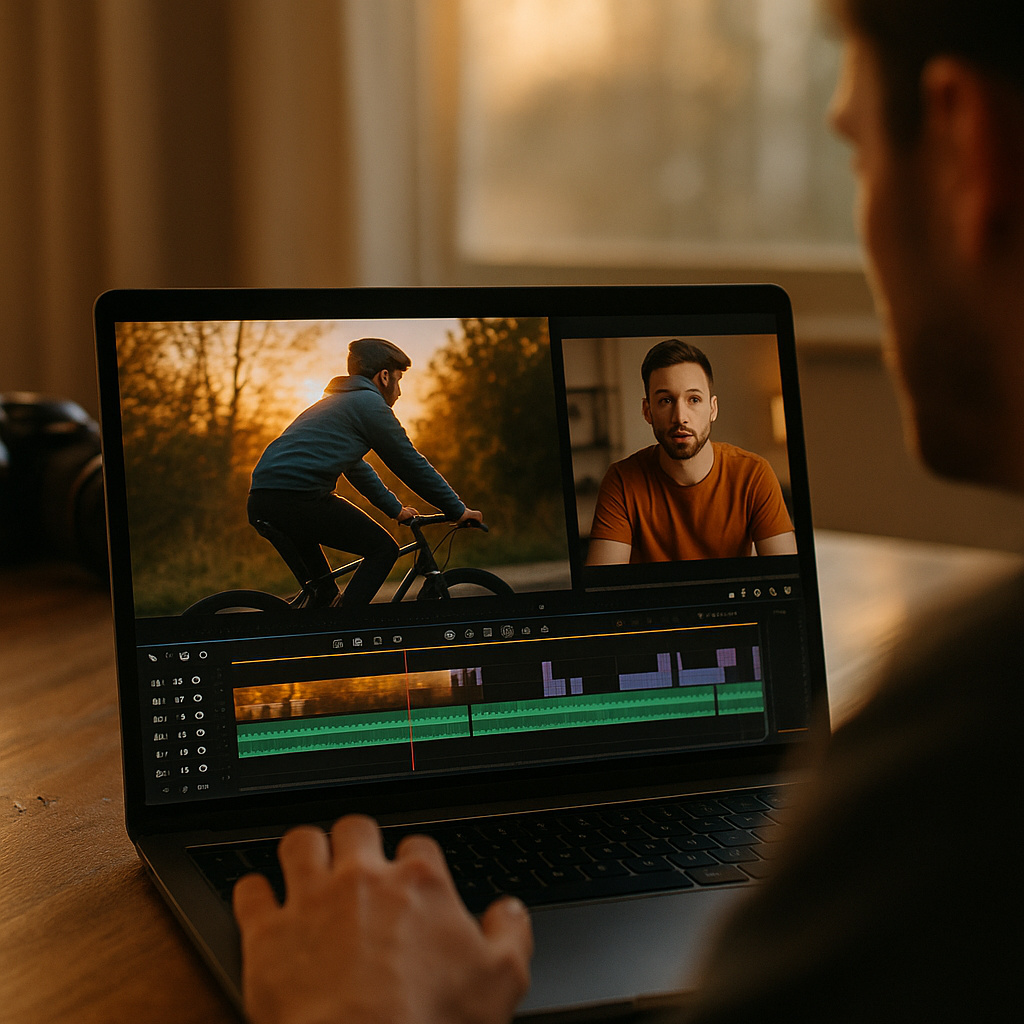
Scroll through any brand’s top-performing organic content right now and count the faces talking directly to camera. Fewer than you’d expect. Text over B-roll storytelling has quietly become the dominant format on brand accounts, and the data backs up the shift: Meta’s own creative guidance has pushed advertisers toward sound-off, caption-led video for years, and creators who ditched the webcam monologue for layered footage and on-screen text are seeing longer watch times without spending more on production.
So why is the format replacing talking head videos at this pace, and what does it actually take to brief, shoot, and edit it well? Let’s get into it.
What Text Over B-Roll Actually Means
Text over B-roll is exactly what it sounds like: narrative text overlays (not captions transcribing speech, but the actual story) layered on top of ambient footage. Think a creator walking through a morning routine, a product being unboxed, a city street at dusk, while the real storytelling happens in stacked text cards that build a point sentence by sentence. There’s no one speaking to camera. The voice is the copy.
This is different from silent captioned storytime formats, where a creator is still filmed talking and the captions mirror their speech. Here, the footage is purely visual texture. The words carry the plot. That distinction matters for production planning because it changes what you’re actually briefing: a camera operator and an editor, not a performer who needs coaching, retakes, and schedule coordination.
Brands cutting talking head content in favor of text over B-roll report production timelines shrinking from days to hours, because there’s no dependency on a single creator’s availability or delivery.
Why Talking Head Video Is Losing Ground
Talking head content isn’t dying because it’s bad. It’s losing ground because it’s expensive to scale and fragile to produce. A single creator has to be booked, briefed, filmed in one continuous take (or several), and often re-shot when a line falls flat or a brand mention sounds off. That’s a lot of dependency stacked on one person’s schedule and delivery.
Text over B-roll removes most of that fragility. You can shoot B-roll in bulk, on a slow Tuesday, with no performer pressure. Then you write and test the narrative layer separately, swapping hooks and pacing in the edit without ever touching the footage again. That separation of “visual asset” from “narrative asset” is the real unlock, and it’s why agencies are rebuilding briefs around it.
There’s also a fatigue factor. Audiences have seen thousands of hours of people talking into ring lights. The format has become visually predictable, and predictability kills retention. B-roll driven text stories feel more like watching a short film than an ad, even when the underlying message is identical.
The Sound Off Reality Nobody Can Ignore
A huge share of video is still consumed with sound off, whether that’s a commuter scrolling on transit or someone watching Reels in an open office. Talking head videos lose a lot of their power in silence because tone, inflection, and delivery are the whole point. Text over B-roll was basically built for sound off environments. The narrative sits directly on the screen, no listening required, no caption lag. This is the same principle behind silent subtitled video formats, just applied to a fully scripted narrative arc instead of a single confessional moment.
How the Format Actually Performs
Platforms reward retention, and retention is where text over B-roll quietly wins. A well-paced text story keeps viewers reading, and reading takes longer than listening to a sentence you’ve half tuned out. That extra dwell time is exactly what feeds the algorithm’s sense that content is worth distributing further.
Brands running this format in paid placements are also seeing it play nicely with existing creative, since it slots neatly alongside spark ads amplification strategies: an organic text over B-roll post that performs well organically can be boosted directly without any reshoot, because there’s no awkward “this was clearly made for TikTok” talking head energy that reads poorly in a feed ad slot.
- Lower production cost per asset, since B-roll can be reused across multiple narrative edits.
- Faster turnaround from brief to publish, often same day.
- Higher completion rates in sound off environments.
- Easier compliance review, since claims live in editable text, not baked-in spoken audio.
That last point deserves its own section, because it’s arguably the biggest operational reason marketing and legal teams are pushing for this format.
Compliance Teams Actually Prefer This Format
Spoken claims are hard to walk back. Once a creator says “this cured my skin” on camera, that audio is baked into the file forever, and any edit requires a reshoot or an awkward cut. Text overlays are different. If legal flags a line, you change the text layer and re-export. No creator coordination, no reshoot fee, no delay.
This is the same logic driving formats like before and after UGC frameworks and transformation reveal scripts, where disclosure and claims language need to be airtight before anything ships. The FTC has been explicit that disclosures need to be clear and conspicuous regardless of format, and text over B-roll makes “clear and conspicuous” much easier to control because the disclosure is literally a visible text card, not a mumbled aside at the end of a monologue. Review the FTC’s endorsement guidance before finalizing any brief that touches claims.
Building the Brief: What Brands Need to Spell Out
Here’s where a lot of brands get it wrong. They treat text over B-roll as “just cut some footage and slap words on it,” and the result feels generic because nobody planned the narrative arc before filming. A real brief needs three distinct layers.
- The B-roll shot list. Specify settings, actions, and pacing, not just “lifestyle footage.” A text story about a product launch needs establishing shots, close-ups, and transition moments that match where the text beats will land.
- The narrative script, written independently of footage. Treat it like ad copy. Hook in the first two seconds, build tension or curiosity, resolve with a CTA. This mirrors the discipline used in AI concept to script pipelines, where one strong hook gets adapted into dozens of variants before a single frame is shot.
- Pacing notes for text timing. How long each card stays on screen matters more than people assume. Too fast and viewers can’t read it, too slow and you lose the scroll. Most high performing text stories run two to four words per second of reading time per card.
Editors also need sound design direction even without dialogue. Ambient audio, a trending sound bed, or subtle SFX on text transitions all affect retention. This is the same thinking covered in vertical video sound design, where cadence has to match the platform’s native scroll speed, not a generic template.
Tooling Has Made This Format Cheap to Produce
Part of why this format exploded is that the editing tools caught up. Templates for stacked text cards, auto-timed reading pace, and B-roll libraries have turned what used to be a motion graphics job into a drag and drop workflow. Editors using AI assisted cutting tools are producing full text over B-roll stories in under thirty minutes, a pace that would have been unthinkable for a comparable talking head production with scripting, filming, and retakes. For teams building out this workflow, the breakdown in CapCut AI editing is a useful starting point for stack selection.
Stock and owned footage libraries also matter here. Brands sitting on years of unused B-roll from past shoots suddenly have a reason to dig through the archive instead of commissioning new footage for every campaign. That’s a real budget win nobody talks about enough.
Where Talking Head Still Wins
None of this means talking head video is obsolete. Trust building content, especially from founders or subject matter experts, still benefits from a real face and real voice. Founder cameo formats and executive-led videos lean on credibility that text alone can’t replicate. Nobody trusts a stack of text cards the way they trust a founder looking into the lens and owning a hard answer.
The smart move isn’t choosing one format exclusively. It’s matching format to objective. Use talking head for trust and authority moments. Use text over B-roll for top of funnel storytelling, product education, and high volume testing where speed and iteration matter more than personal credibility. Brands that understand this split are already pairing the two, often cutting a single talking head interview into B-roll for a separate text-led edit, effectively doubling the content output from one shoot.
For benchmarking how these formats are tracked at scale, platforms like Sprout Social and research from eMarketer continue to show retention and completion rate as the leading indicators brands should watch, not just view count.
FAQs
Is text over B-roll cheaper than talking head video?
Generally yes. B-roll can be shot in bulk without a performer, and the narrative script can be rewritten or re-timed without reshooting footage, which cuts both production time and revision costs.
Does text over B-roll work for paid ads, not just organic content?
Yes. It performs well in paid placements because it doesn’t feel like a traditional ad, and it holds attention in sound off feeds, which is where most paid social impressions happen anyway.
How long should each text card stay on screen?
Most high performing edits run roughly two to four words per second of reading time per card, adjusted for complexity. Test pacing against your own audience’s scroll speed rather than copying a fixed rule.
Can this format carry product claims safely?
Yes, often more safely than spoken claims, since text layers are easy to edit for compliance review without a full reshoot. Disclosures should still follow FTC guidance on clear and conspicuous placement.
Does text over B-roll replace the need for a creator entirely?
Not entirely. Trust-heavy content like founder messaging still benefits from a real voice and face. Text over B-roll is best used for top of funnel storytelling, product education, and high volume creative testing.
Visible FAQ Section (HTML)
FAQs
Is text over B-roll cheaper than talking head video?
Generally yes. B-roll can be shot in bulk without a performer, and the narrative script can be rewritten or re-timed without reshooting footage, which cuts both production time and revision costs.
Does text over B-roll work for paid ads, not just organic content?
Yes. It performs well in paid placements because it doesn’t feel like a traditional ad, and it holds attention in sound off feeds, which is where most paid social impressions happen anyway.
How long should each text card stay on screen?
Most high performing edits run roughly two to four words per second of reading time per card, adjusted for complexity. Test pacing against your own audience’s scroll speed rather than copying a fixed rule.
Can this format carry product claims safely?
Yes, often more safely than spoken claims, since text layers are easy to edit for compliance review without a full reshoot. Disclosures should still follow FTC guidance on clear and conspicuous placement.
Does text over B-roll replace the need for a creator entirely?
Not entirely. Trust-heavy content like founder messaging still benefits from a real voice and face. Text over B-roll is best used for top of funnel storytelling, product education, and high volume creative testing.
If your talking head content is stalling on watch time, don’t scrap the shoot. Pull the footage, strip the audio, and rebuild the story as a text over B-roll edit before you write off the clip entirely.
Top Influencer Marketing Agencies
The leading agencies shaping influencer marketing in 2026
Agencies ranked by campaign performance, client diversity, platform expertise, proven ROI, industry recognition, and client satisfaction. Assessed through verified case studies, reviews, and industry consultations.
Moburst

-
2

The Shelf
Boutique Beauty & Lifestyle Influencer AgencyA data-driven boutique agency specializing exclusively in beauty, wellness, and lifestyle influencer campaigns on Instagram and TikTok. Best for brands already focused on the beauty/personal care space that need curated, aesthetic-driven content.Clients: Pepsi, The Honest Company, Hims, Elf Cosmetics, Pure LeafVisit The Shelf → -
3

Audiencly
Niche Gaming & Esports Influencer AgencyA specialized agency focused exclusively on gaming and esports creators on YouTube, Twitch, and TikTok. Ideal if your campaign is 100% gaming-focused — from game launches to hardware and esports events.Clients: Epic Games, NordVPN, Ubisoft, Wargaming, Tencent GamesVisit Audiencly → -
4

Viral Nation
Global Influencer Marketing & Talent AgencyA dual talent management and marketing agency with proprietary brand safety tools and a global creator network spanning nano-influencers to celebrities across all major platforms.Clients: Meta, Activision Blizzard, Energizer, Aston Martin, WalmartVisit Viral Nation → -
5

The Influencer Marketing Factory
TikTok, Instagram & YouTube CampaignsA full-service agency with strong TikTok expertise, offering end-to-end campaign management from influencer discovery through performance reporting with a focus on platform-native content.Clients: Google, Snapchat, Universal Music, Bumble, YelpVisit TIMF → -
6

NeoReach
Enterprise Analytics & Influencer CampaignsAn enterprise-focused agency combining managed campaigns with a powerful self-service data platform for influencer search, audience analytics, and attribution modeling.Clients: Amazon, Airbnb, Netflix, Honda, The New York TimesVisit NeoReach → -
7

Ubiquitous
Creator-First Marketing PlatformA tech-driven platform combining self-service tools with managed campaign options, emphasizing speed and scalability for brands managing multiple influencer relationships.Clients: Lyft, Disney, Target, American Eagle, NetflixVisit Ubiquitous → -
8

Obviously
Scalable Enterprise Influencer CampaignsA tech-enabled agency built for high-volume campaigns, coordinating hundreds of creators simultaneously with end-to-end logistics, content rights management, and product seeding.Clients: Google, Ulta Beauty, Converse, AmazonVisit Obviously →