


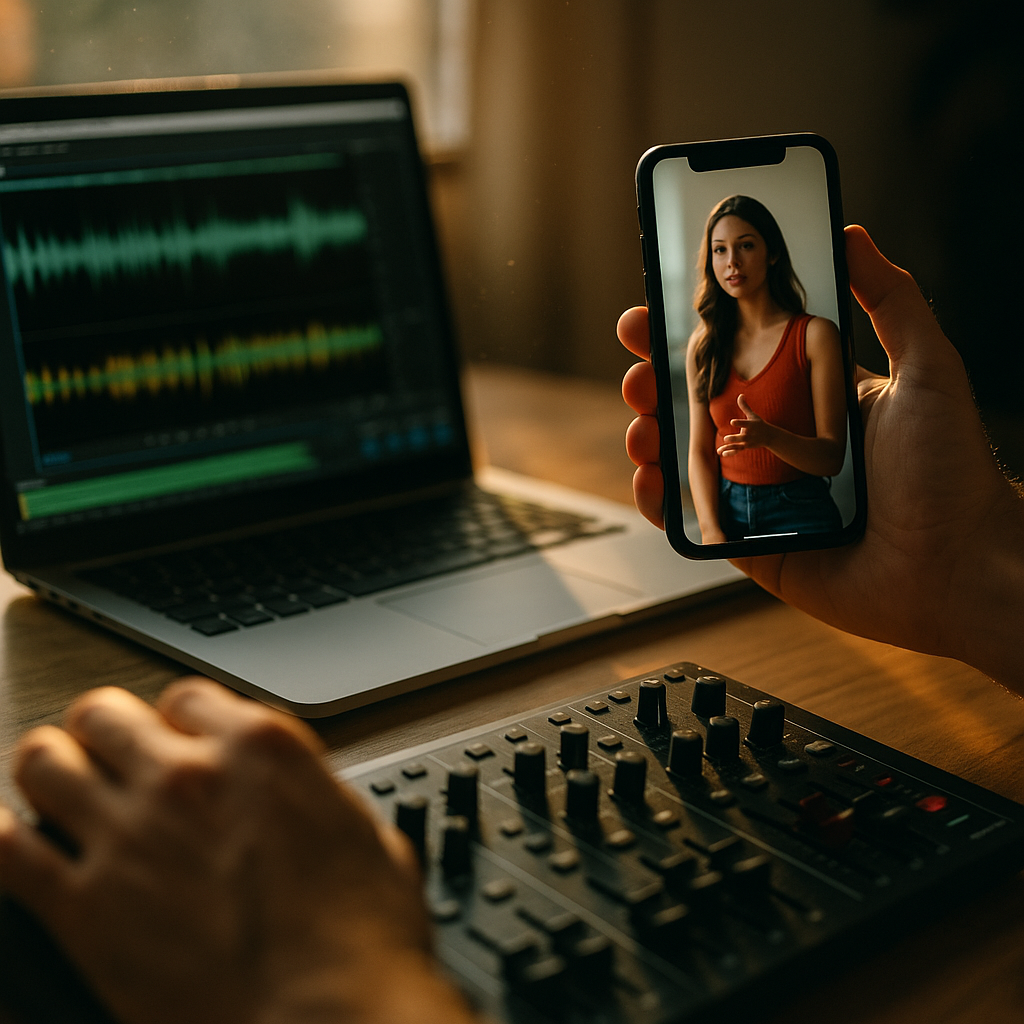
73% of TikTok users say sound is essential to the experience, while Instagram built Reels around a feature that lets people scroll with the volume off entirely. That single divergence explains why the same fifteen-second ad can crush it on one platform and flatline on the other. Sound design for vertical video isn’t a finishing touch anymore. It’s a targeting decision, and most brands are still treating it like an afterthought.
The Platforms Were Never Built on the Same Audio Logic
TikTok grew up as a music and meme app. Its entire discovery engine, the sound library, the “use this audio” button, the way trending tracks surface in the For You feed, assumes the viewer is listening. Reels came out of Instagram, a platform that spent a decade training users to scroll silently through a visual feed with captions baked in. Meta added sound later, almost as a retrofit. That origin story still shapes behavior today.
On TikTok, audio often arrives first and the visual gets built around it. Creators pick a trending sound, then cut footage to match its beat drops and pauses. On Reels, the visual usually carries the weight, and audio layers in as reinforcement, background music, a voiceover, or nothing at all if the creator assumes sound off viewing.
This isn’t a minor stylistic quirk. It means the cadence, the rhythm of cuts, pauses, and emphasis points, needs to diverge by platform if you want either version to actually land.
Why Cadence, Not Just Volume, Is the Real Divide
Cadence is the timing relationship between what you hear and what you see. On TikTok, viewers expect audio cues to predict the next cut. A beat drop signals a transition. A vocal stutter signals a punchline. When your edit syncs to that rhythm, the video feels native. When it doesn’t, it feels like an ad that wandered in from television.
Reels cadence works differently because so much of the audience consumes it muted. Meta’s own creator guidance has repeatedly pushed captions and on-screen text as primary communication tools, not supplements. That means the visual pacing has to carry narrative weight on its own, with audio as an optional amplifier rather than the spine of the edit.
If you build a TikTok cut sound-first and simply reupload it to Reels, you’re asking a silent-first audience to do the work your audio was supposed to do.
This is the mistake brand teams make constantly: one master edit, two platform placements, zero adjustment to how sound and visual are sequenced. The content performs on one platform and quietly underperforms on the other, and nobody can figure out why the “same video” has wildly different completion rates.
What This Means for Your Brief
If you’re briefing creators or editors, platform-specific cadence needs to be a line item, not an assumption. A few operational shifts that actually move the needle:
- For TikTok: Build the cut around the audio track first. Mark beat drops, lyric emphasis, and trending sound cues before you touch the visual timeline. Let the sound dictate pacing.
- For Reels: Design for mute from the first frame. Captions need to carry full meaning without audio, and visual transitions should signal narrative beats independently of any music cue.
- For both: Keep hook timing under two seconds regardless of sound treatment. The platforms diverge on cadence, but neither forgives a slow open.
This is the same operational discipline we’ve covered in silent captioned storytime briefs, where the entire format assumes zero audio and still has to carry emotional weight through pacing and text alone. The lesson transfers directly to Reels strategy even outside that specific format.
ASMR and Voiceover: Two Formats That Expose the Gap
Nothing illustrates the platform split better than ASMR product demos. These formats live and die on sound, tapping product crinkles, texture snaps, and liquid pours as the entire value proposition. They are a TikTok-native format almost by definition, as we’ve broken down in our look at ASMR product demos driving TikTok Shop. Strip the audio out for a muted Reels placement and you’ve got nothing. The format simply doesn’t translate without a visual-first rebuild.
Voiceover-driven trend audio sits in a similar bind. Riding a viral sound on TikTok carries real upside, but it also carries licensing and brand-safety exposure that brands need to manage carefully, something we cover in detail in our guide to trend audio and legal risk. Reels doesn’t have the same viral-audio culture, so the legal calculus and the creative payoff both shift when you move the same concept cross-platform.
The practical takeaway: don’t force a sound-dependent format into a sound-agnostic feed. Pick the platform where the audio logic actually fits the content, or rebuild the concept from scratch for the other one.
Measuring the Difference Without Guessing
Completion rate and average watch time are the two metrics that expose cadence mismatches fastest. If your TikTok cut shows a drop-off right at a beat transition, your sound sync is off. If your Reels version shows a drop-off in a section that depends on an audio cue your captions didn’t cover, you’ve got a mute-first failure.
Sprout Social’s platform benchmarking tools and native analytics in both apps will show you retention curves at the second-by-second level. Pull them before you scale spend behind a creative. A video that “performs fine” in aggregate can still be leaking viewers at a specific cadence failure point that a quick re-edit would fix.
This is also where editing stacks matter. Tools built for rapid platform-specific variants, like the workflows covered in our CapCut AI editing breakdown, let teams generate a sound-synced TikTok cut and a caption-led Reels cut from the same source footage without doubling production time. That’s the operational fix for a creative problem: build two cadences, not one master file forced into two placements.
Silence as a Format, Not a Failure State
There’s a growing category of content built to work in total silence by design, not as a fallback. Formats like text overlay confessionals and silent subtitled video treat the absence of audio as a creative constraint that sharpens pacing rather than a limitation to apologize for. These formats tend to travel well on Reels precisely because they were never dependent on sound cadence in the first place.
That’s worth internalizing for brand teams planning content calendars. Not every concept needs a TikTok-first, sound-synced treatment. Some of your best-performing Reels content should be designed mute-first from the concept stage, with audio added only as a final, optional layer. Flip that order and you’re retrofitting silence onto something that was never built for it, which almost always shows.
Industry data backs the shift toward caption-led consumption broadly. eMarketer’s research on short-form video habits has repeatedly flagged mobile sound-off viewing as a majority behavior in public and commute contexts, which covers a huge share of daily scroll time across both platforms, not just Reels.
Budget and Workflow Implications
None of this is free. Building genuinely divergent cadences for TikTok and Reels means either shooting platform-specific footage or editing the same raw footage twice with different rhythm logic. For lean teams, that’s a real resourcing question.
The practical answer most mid-sized brands land on: shoot once, edit twice, and budget editing time as its own line item rather than folding it into general post-production. A ten-minute re-cut for cadence is cheaper than a reshoot, and far cheaper than running paid spend behind a creative that’s quietly underperforming because the sound logic doesn’t match the platform. TikTok’s ad platform documentation itself recommends native-feeling audio treatment for any boosted organic content, which tells you the platform expects this divergence too.
Next step: audit your last ten posts per platform for completion rate drop-off points, flag where cadence or mute-readiness is the likely culprit, and rebuild your next brief with platform-specific audio logic instead of a single master cut.
FAQs
Why does the same video perform differently on TikTok versus Reels?
The platforms train users toward different listening habits. TikTok audiences expect sound-synced cuts, while Reels audiences frequently scroll muted, so a video edited for one cadence often loses impact on the other.
Should brands create separate edits for TikTok and Reels?
Yes, at least for the pacing and caption treatment. A single master edit can work for raw footage, but the final cut’s cadence should be adjusted per platform to match sound-on versus sound-off viewing patterns.
What metrics show a sound cadence mismatch?
Watch retention curves and completion rate are the clearest signals. A sudden drop-off at a beat transition or an uncaptioned audio cue usually points to a cadence problem rather than a content quality problem.
Do ASMR and sound-dependent formats work on Reels?
Generally not without a full visual rebuild, since a large share of Reels viewers watch muted. Formats that depend entirely on audio texture are better suited to TikTok’s sound-first environment.
Is captioning enough to fix a Reels audio problem?
Captions solve the comprehension gap but not the pacing gap. The visual edit itself still needs to carry narrative rhythm independently of any audio cue for mute-first viewers to stay engaged.
Top Influencer Marketing Agencies
The leading agencies shaping influencer marketing in 2026
Agencies ranked by campaign performance, client diversity, platform expertise, proven ROI, industry recognition, and client satisfaction. Assessed through verified case studies, reviews, and industry consultations.
Moburst

-
2

The Shelf
Boutique Beauty & Lifestyle Influencer AgencyA data-driven boutique agency specializing exclusively in beauty, wellness, and lifestyle influencer campaigns on Instagram and TikTok. Best for brands already focused on the beauty/personal care space that need curated, aesthetic-driven content.Clients: Pepsi, The Honest Company, Hims, Elf Cosmetics, Pure LeafVisit The Shelf → -
3

Audiencly
Niche Gaming & Esports Influencer AgencyA specialized agency focused exclusively on gaming and esports creators on YouTube, Twitch, and TikTok. Ideal if your campaign is 100% gaming-focused — from game launches to hardware and esports events.Clients: Epic Games, NordVPN, Ubisoft, Wargaming, Tencent GamesVisit Audiencly → -
4

Viral Nation
Global Influencer Marketing & Talent AgencyA dual talent management and marketing agency with proprietary brand safety tools and a global creator network spanning nano-influencers to celebrities across all major platforms.Clients: Meta, Activision Blizzard, Energizer, Aston Martin, WalmartVisit Viral Nation → -
5

The Influencer Marketing Factory
TikTok, Instagram & YouTube CampaignsA full-service agency with strong TikTok expertise, offering end-to-end campaign management from influencer discovery through performance reporting with a focus on platform-native content.Clients: Google, Snapchat, Universal Music, Bumble, YelpVisit TIMF → -
6

NeoReach
Enterprise Analytics & Influencer CampaignsAn enterprise-focused agency combining managed campaigns with a powerful self-service data platform for influencer search, audience analytics, and attribution modeling.Clients: Amazon, Airbnb, Netflix, Honda, The New York TimesVisit NeoReach → -
7

Ubiquitous
Creator-First Marketing PlatformA tech-driven platform combining self-service tools with managed campaign options, emphasizing speed and scalability for brands managing multiple influencer relationships.Clients: Lyft, Disney, Target, American Eagle, NetflixVisit Ubiquitous → -
8

Obviously
Scalable Enterprise Influencer CampaignsA tech-enabled agency built for high-volume campaigns, coordinating hundreds of creators simultaneously with end-to-end logistics, content rights management, and product seeding.Clients: Google, Ulta Beauty, Converse, AmazonVisit Obviously →