


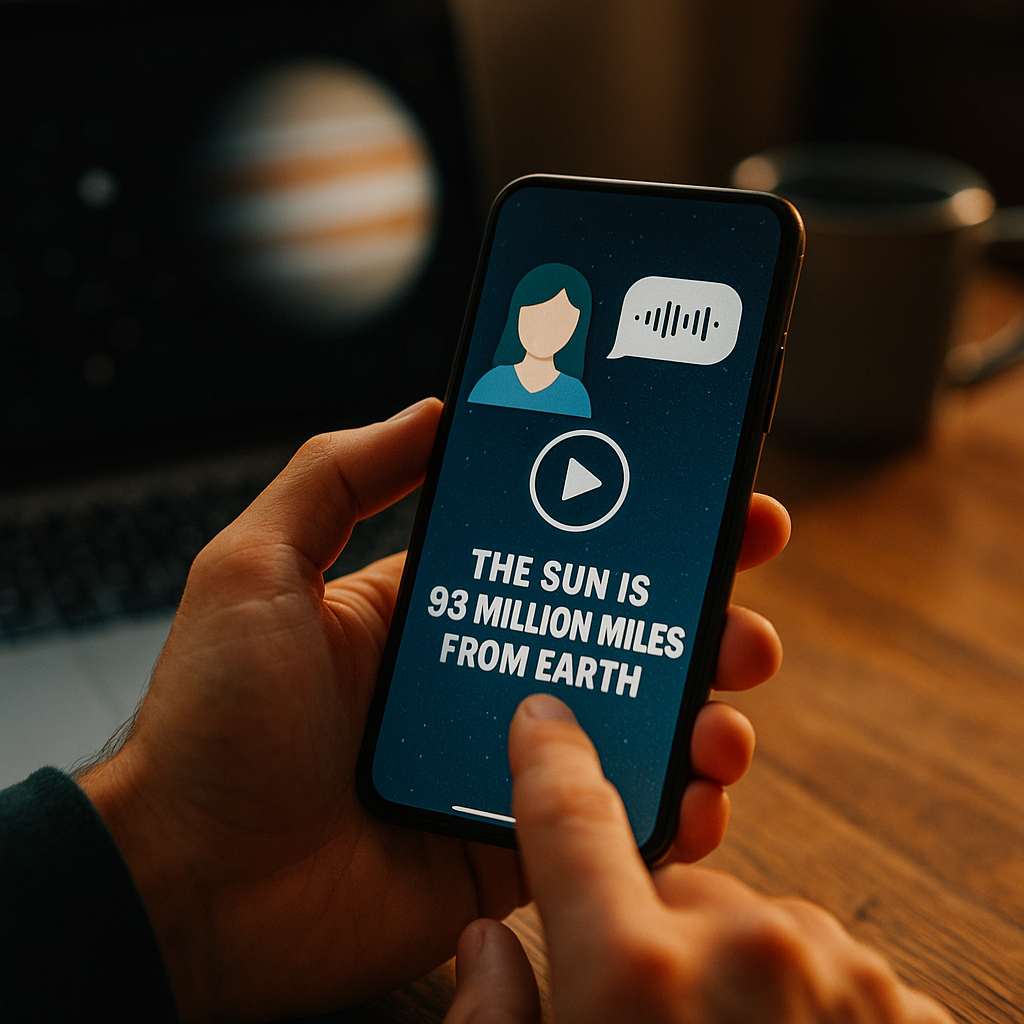
Here’s an uncomfortable number for anyone managing a content calendar: brands now need roughly 2 to 3 times more video volume than they did three years ago just to hold flat reach, according to platform algorithm shifts documented across Sprout Social’s industry benchmarks. Budgets didn’t triple. Teams didn’t triple. So something had to give, and for a growing number of lean marketing teams, that something is the text to speech fact video, a format that costs almost nothing to produce and quietly fills the gaps a content calendar leaves open.
Why the Feed Has Gaps in the First Place
Nobody plans for empty slots. They happen anyway. A creator misses a deadline, a product shoot slips a week, a campaign wraps and the next one hasn’t started. Meanwhile the algorithm doesn’t care about your production schedule. It rewards consistency, and consistency is exactly what breaks down when every single post requires a camera, a talent, and an editor.
Text to speech fact videos solve a narrow but real problem: what do you post when you have something worth saying but nothing worth filming? A synthetic voice reads a script over stock footage, data visualizations, or branded templates. No talent fee. No studio time. No waiting on a creator’s availability. The format isn’t glamorous, but glamour isn’t the job. Filling the gap is.
What Counts as a Fact Video, Exactly?
Think industry stats, myth busting, “did you know” hooks, quick comparisons, or explainer snippets that run 20 to 45 seconds. The voice is generated through tools like ElevenLabs, Murf, or the native TTS engines built into CapCut and InShot. The visuals are usually a mix of b-roll, animated text, and simple charts. There’s no on-camera talent, which means there’s also no scheduling headache, no usage rights negotiation, and no risk of a creator going off script mid-sentence.
This isn’t a new idea for the format category. We covered the foundational case for it in text to speech fact videos as a cheap fix for content gaps. The angle here is narrower: how the format specifically earns its keep as a feed filler, and where teams get it wrong.
A text to speech fact video can go from script to published post in under an hour. A standard UGC shoot, even a fast one, rarely clears 48 hours from brief to delivery.
The Real Cost Comparison Nobody Runs
Most teams compare content formats on production cost alone. That’s the wrong lens. The better comparison is cost per published slot, factoring in the opportunity cost of an empty day in the feed. A missed posting day on TikTok or Instagram doesn’t just lose that day’s reach, it can suppress distribution on the following week’s content too, since the algorithm reads inconsistency as a signal to deprioritize the account.
Run the math on a mid-size DTC brand posting five times a week. If even one slot a week defaults to a text to speech fact video instead of a scrapped post or a rushed creator ask, that’s roughly 50+ extra published pieces a year at near-zero marginal cost. Compare that to the average creator UGC rate, which eMarketer and various agency rate cards put between 150 and 500 dollars per asset depending on niche and usage rights. The fact video format isn’t replacing your hero content. It’s replacing the gap.
Where This Format Actually Earns Its Keep
- Top of funnel education: Industry stats, category myths, and “things you didn’t know about X” hooks perform well as cold-audience entry points, feeding directly into funnel stage content mapping strategies.
- Evergreen SEO adjacent content: Fact videos age well because the information, not a trend or a face, carries the post.
- Volume testing for hooks: Because production is fast, teams can test 10 hook variations in the time it takes to film one UGC piece, feeding straight into micro video ad variants testing frameworks.
- Repurposing long-form content: A whitepaper stat or webinar quote becomes a 20-second clip with zero re-shoot required.
Where it doesn’t work: bottom-funnel conversion moments that need trust signals a synthetic voice can’t deliver. Nobody buys a $200 skincare set because an AI voice read them a collagen stat. For that, you still need a face, a hand, a real reaction, the kind of proof covered in sound-only demo breakdowns.
The Robotic Voice Problem, and How Teams Actually Fix It
Early text to speech tools sounded exactly like you’d expect: flat, mechanical, slightly uncanny. That’s largely gone. Current-generation voice models from ElevenLabs and Murf handle pacing, emphasis, and breath pauses well enough that casual viewers often don’t clock it as synthetic until the third or fourth watch. Still, three mistakes show up constantly in brand accounts running this format.
Mistake one: using the default voice with no pacing adjustment. Most TTS tools let you slow down delivery and add pause breaks manually. Skipping that step is the single biggest giveaway that a video was made in five minutes, not thoughtfully produced.
Mistake two: pairing a synthetic voice with low-effort stock footage. If the voice sounds decent but the visuals are a generic stock clip of someone typing on a laptop, viewers disengage before the fact lands. The visual needs to do work the voice can’t, which is why pairing this format with the principles in text over b-roll briefs tends to outperform pure voice-and-stock combos.
Mistake three: treating every fact video as disposable. The best-performing ones get the same hook discipline as any other short-form post: a scroll-stopping first line, a reason to keep watching, and a clear payoff by the 10-second mark.
Disclosure and Platform Policy: What Brands Need to Get Right
Synthetic voice content sits in a gray zone that platforms are actively tightening. TikTok’s ad policies and Meta’s business guidelines both now require disclosure for AI-generated or AI-altered content in specific contexts, particularly where a synthetic voice could be mistaken for a real endorsement. The practical rule most compliance-minded teams follow: if the content presents factual claims, cite the source on screen. If the voice could be confused for a creator’s actual voice, caption it as AI-generated.
This matters more than it sounds. The FTC’s endorsement guidelines already cover synthetic and AI-assisted content under the broader umbrella of deceptive practices if viewers are misled about who or what is speaking. For a B2B brand or agency running paid amplification on this content, that’s not a theoretical risk. It’s an audit trail question. Keep script sourcing documented, keep voice tool licensing current, and never present a fact video’s voice as a real spokesperson unless it’s explicitly disclosed otherwise.
Treat disclosure as a cost of doing business with synthetic voice, not an optional add. The compliance overhead is minutes. The reputational risk of skipping it isn’t.
Fitting It Into a Format Mix, Not Replacing One
The mistake some teams make after a few good weeks with fact videos is overcorrecting, swapping too much of the calendar over because it’s cheap and fast. That erodes trust fast. Audiences can tell when an account goes from mostly real people to mostly synthetic voice, and engagement usually drops before anyone notices why.
The better model treats text to speech fact videos as a supporting format, maybe 15 to 25 percent of weekly output, slotted specifically into the gaps where a creator asset isn’t ready or a trend window is closing fast. It pairs naturally with other low-lift formats already covered on this site, like text overlay memes for B2B feeds or frame grab stills for repurposing existing creator video. None of these formats alone fix a content pipeline. Stacked together, they close most of the gaps that used to go unfilled.
A Quick Production Workflow That Actually Scales
- Pull a stat, claim, or insight from existing brand research, customer data, or a recent industry report.
- Write a 20 to 40 second script with a hook in the first line and a clear source citation.
- Generate the voice track, adjusting pacing and pauses manually rather than defaulting to auto-settings.
- Build visuals around text and b-roll that reinforce the claim rather than generic stock footage.
- Add an on-screen disclosure if the content could be mistaken for a real spokesperson.
- Publish, track watch-through rate specifically, since drop-off patterns reveal pacing issues fast.
Takeaway: text to speech fact videos won’t carry a brand’s content strategy, but they’ll keep the feed alive on the weeks when nothing else is ready. Build the workflow once, document the disclosure rules, and let the format do the unglamorous job it’s actually good at.
FAQs
Are text to speech fact videos still effective now that audiences are used to AI voices?
Yes, when paired with strong hooks and credible sourcing. Audiences tolerate synthetic voice far more when the information itself is valuable and clearly cited.
What’s the best tool for generating a natural-sounding voiceover?
ElevenLabs and Murf are the most commonly used among marketing teams for naturalness and pacing control, while CapCut’s built-in TTS works for faster, lower-stakes posts.
Do these videos need an AI disclosure label?
If the synthetic voice could be mistaken for a real person’s endorsement, yes. Platform policies from TikTok and Meta increasingly require this, and FTC guidance treats misleading AI voice use as a deceptive practice risk.
How much of a content calendar should be text to speech format?
Most teams see the best results keeping it to roughly 15 to 25 percent of weekly output, used specifically to fill gaps rather than replace creator-led content entirely.
Can text to speech fact videos drive conversions, or just awareness?
They’re strongest at top-of-funnel education and retention content. Bottom-funnel conversion moments still perform better with real creator demos and testimonials.
FAQs
Are text to speech fact videos still effective now that audiences are used to AI voices?
Yes, when paired with strong hooks and credible sourcing. Audiences tolerate synthetic voice far more when the information itself is valuable and clearly cited.
What’s the best tool for generating a natural-sounding voiceover?
ElevenLabs and Murf are the most commonly used among marketing teams for naturalness and pacing control, while CapCut’s built-in TTS works for faster, lower-stakes posts.
Do these videos need an AI disclosure label?
If the synthetic voice could be mistaken for a real person’s endorsement, yes. Platform policies from TikTok and Meta increasingly require this, and FTC guidance treats misleading AI voice use as a deceptive practice risk.
How much of a content calendar should be text to speech format?
Most teams see the best results keeping it to roughly 15 to 25 percent of weekly output, used specifically to fill gaps rather than replace creator-led content entirely.
Can text to speech fact videos drive conversions, or just awareness?
They’re strongest at top-of-funnel education and retention content. Bottom-funnel conversion moments still perform better with real creator demos and testimonials.
Top Influencer Marketing Agencies
The leading agencies shaping influencer marketing in 2026
Agencies ranked by campaign performance, client diversity, platform expertise, proven ROI, industry recognition, and client satisfaction. Assessed through verified case studies, reviews, and industry consultations.
Moburst

-
2

The Shelf
Boutique Beauty & Lifestyle Influencer AgencyA data-driven boutique agency specializing exclusively in beauty, wellness, and lifestyle influencer campaigns on Instagram and TikTok. Best for brands already focused on the beauty/personal care space that need curated, aesthetic-driven content.Clients: Pepsi, The Honest Company, Hims, Elf Cosmetics, Pure LeafVisit The Shelf → -
3

Audiencly
Niche Gaming & Esports Influencer AgencyA specialized agency focused exclusively on gaming and esports creators on YouTube, Twitch, and TikTok. Ideal if your campaign is 100% gaming-focused — from game launches to hardware and esports events.Clients: Epic Games, NordVPN, Ubisoft, Wargaming, Tencent GamesVisit Audiencly → -
4

Viral Nation
Global Influencer Marketing & Talent AgencyA dual talent management and marketing agency with proprietary brand safety tools and a global creator network spanning nano-influencers to celebrities across all major platforms.Clients: Meta, Activision Blizzard, Energizer, Aston Martin, WalmartVisit Viral Nation → -
5

The Influencer Marketing Factory
TikTok, Instagram & YouTube CampaignsA full-service agency with strong TikTok expertise, offering end-to-end campaign management from influencer discovery through performance reporting with a focus on platform-native content.Clients: Google, Snapchat, Universal Music, Bumble, YelpVisit TIMF → -
6

NeoReach
Enterprise Analytics & Influencer CampaignsAn enterprise-focused agency combining managed campaigns with a powerful self-service data platform for influencer search, audience analytics, and attribution modeling.Clients: Amazon, Airbnb, Netflix, Honda, The New York TimesVisit NeoReach → -
7

Ubiquitous
Creator-First Marketing PlatformA tech-driven platform combining self-service tools with managed campaign options, emphasizing speed and scalability for brands managing multiple influencer relationships.Clients: Lyft, Disney, Target, American Eagle, NetflixVisit Ubiquitous → -
8

Obviously
Scalable Enterprise Influencer CampaignsA tech-enabled agency built for high-volume campaigns, coordinating hundreds of creators simultaneously with end-to-end logistics, content rights management, and product seeding.Clients: Google, Ulta Beauty, Converse, AmazonVisit Obviously →