


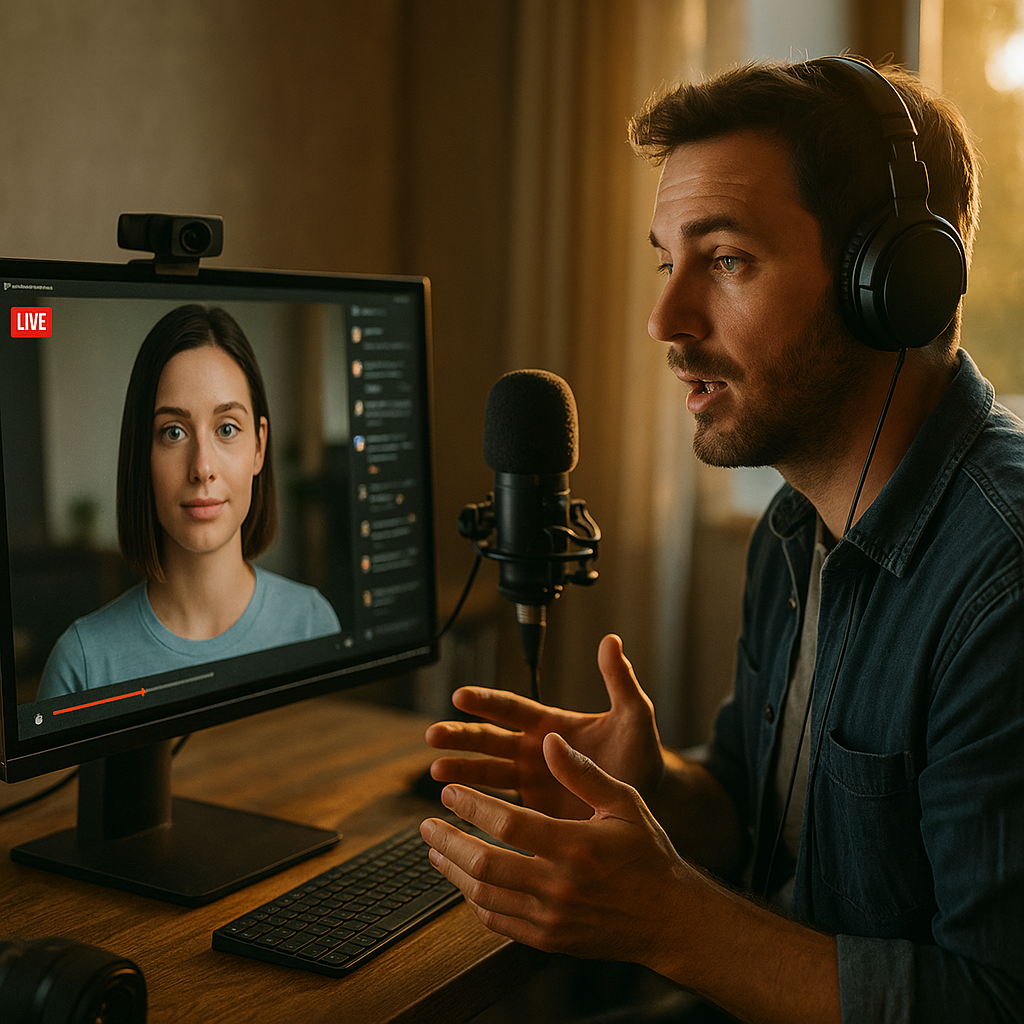
Seventy one percent of shoppers now say they have made a purchase after watching a livestream, according to eMarketer estimates on social commerce behavior. So why are brands still paying hosts to sit on camera for six hours a day? A new wave of AI livestream co host tools wants to answer that question, and the shopping show tech stack is about to look very different.
The pitch is simple. An AI avatar reads your product catalog, responds to live comments, answers pricing questions, and runs a shopping show around the clock without a single human blinking on camera. Vendors like Google’s own streaming infrastructure partners, TikTok Shop’s LIVE ecosystem, and a growing list of startups building on top of large language models are racing to productize this. But “simple” and “ready for enterprise deployment” are not the same thing. Let’s look at what’s actually in the stack, what works, and where the risk still lives.
What Is an AI Livestream Co Host, Really?
Strip away the marketing language and an AI co host is three components stitched together: a generative voice and avatar engine, a retrieval layer pulling from your product catalog and FAQ library, and a real time comment moderation and response system. Some platforms, like Taobao’s AI anchor tools in China, have been running this for years on top of Alibaba’s commerce infrastructure. Western platforms are catching up fast, with TikTok Shop and YouTube Shopping both testing AI-assisted live formats in select markets.
The use case brands care about is coverage. A human host can run maybe four to six hours of live shopping a day before fatigue sets in and the energy drops. An AI co host doesn’t get tired. It can run a 24 hour flash sale stream, answer the same sizing question for the six hundredth time without sounding bored, and hand off seamlessly to a human host for peak hours.
The real ROI case for AI livestream co hosts isn’t replacing your best talent, it’s filling the dead hours your best talent can’t cover.
The Current Tech Stack, Piece by Piece
Here’s what a reasonably sophisticated AI shopping show setup looks like in 2026:
- Avatar and voice layer: Photorealistic or stylized avatars trained on brand ambassador likeness or fully synthetic personas, paired with low latency text to speech.
- Product knowledge base: A retrieval augmented generation layer connected to your PIM or Shopify catalog so the AI doesn’t invent pricing or inventory counts.
- Comment ingestion and prioritization: Natural language processing that ranks incoming comments by purchase intent, flags abusive content, and queues the highest value questions.
- Checkout and attribution hooks: Integration with shoppable link infrastructure so every sale during the AI segment gets tagged correctly.
- Compliance and disclosure layer: Automated on screen labeling that the host is AI generated, increasingly required under evolving platform policy and advertising regulation.
That last piece matters more than most brands realize. The FTC has been explicit that synthetic endorsers and AI generated spokespeople fall under the same disclosure expectations as human influencers. If your AI co host implies a personal endorsement or review of a product it hasn’t “used,” that’s a liability conversation your legal team needs before launch, not after a complaint.
Does the Attribution Actually Hold Up?
This is where a lot of brands get burned. An AI co host running at 3am might generate a thousand comments and two hundred clicks, but if your attribution stack can’t separate AI-segment sales from human host sales, you’re flying blind on which format is actually driving revenue. The same logic that governs verifying creator sales before payout applies here: you need clean, segment level attribution or the whole ROI case collapses into guesswork.
Brands running mixed human and AI livestream schedules should be demanding hour by hour attribution breakdowns from their platform, not aggregate daily totals. If your vendor can’t give you that, ask why.
Real time reporting infrastructure is the unsexy backbone of this whole trend. Tools built around closing the creator reporting lag are increasingly being adapted to ingest livestream session data, which means marketing ops teams finally have a shot at comparing AI host performance against human host performance on an apples to apples basis.
Where AI Co Hosts Genuinely Outperform
Let’s give credit where it’s due. AI co hosts are excellent at a narrow set of jobs:
- Overnight and international time zone coverage without staffing a graveyard shift
- Repetitive FAQ handling during flash sales, freeing human hosts to focus on storytelling
- Multilingual streaming, since a well trained model can switch languages mid-stream far faster than hiring bilingual talent
- Consistent, on brand messaging with zero risk of off script commentary
That last point cuts both ways, which we’ll get to.
Where It Still Falls Short
Here’s the uncomfortable truth vendors won’t lead with in their sales decks. AI co hosts struggle with genuine spontaneity, the thing that actually drives the parasocial connection behind livestream shopping’s success in the first place. Viewers tune into live shopping because it feels unscripted. An avatar reading from a retrieval layer, however smooth, still reads as a performance of spontaneity rather than the real thing, and sharp eyed audiences notice.
There’s also a trust gap. Sprout Social research has consistently shown that audience trust correlates with perceived authenticity, and early data on AI hosted shopping streams suggests conversion rates dip when viewers realize mid-stream that the host isn’t human and wasn’t disclosed as such upfront. Disclosure isn’t just a compliance checkbox, it’s a conversion variable.
Undisclosed AI hosting isn’t just a regulatory risk, it’s a trust tax that shows up directly in your conversion rate.
Then there’s the moderation ceiling. Comment sections during live shopping events get chaotic fast, with bot traffic, bad faith trolling, and genuine customer service escalations all arriving at once. Current generation AI co hosts handle routine questions well but still hand off complex complaints, refund disputes, or anything emotionally charged to a human moderator behind the scenes. That human layer is not optional. Any vendor telling you otherwise hasn’t run a stream during a product recall.
Vendor Selection: What to Actually Ask
If you’re evaluating this category for the first time, treat it the same way you’d evaluate any creator vetting process. The parallels to AI creator matching at TikTok Shop scale are closer than they seem, since both categories are selling automation with a thin human safety net underneath. Ask vendors directly:
- Can the AI host pull live inventory data, or does it work off a static catalog snapshot that goes stale mid-stream?
- What is the latency between a viewer comment and an AI response, and does that latency spike under high comment volume?
- Is AI disclosure built into the stream overlay by default, or does the brand have to configure it manually?
- What happens when the AI encounters a question it cannot answer confidently? Does it guess, deflect, or escalate?
- Can attribution be segmented by host type (AI versus human) within the same stream session?
Platforms that can’t answer the escalation question clearly should be a hard pass. An AI that guesses on pricing or shipping timelines in front of a live audience of several thousand buyers is a refund dispute waiting to happen, and human sign off remains the safety net no brand should skip regardless of how polished the automation looks.
Budget and ROI: How to Model This Honestly
Most vendors price AI co host tools as a subscription plus a per-stream-hour fee, which makes the ROI math deceptively simple on paper. Run the numbers on cost per incremental sale, not cost per stream hour. A twelve hour overnight AI stream that generates fifty sales at a low average order value might look cheap per hour but expensive per conversion once you factor in platform fees and the attribution tooling needed to verify those sales weren’t inflated by bot comment traffic.
Compare that against what a unique link payout platform would cost you for an equivalent volume of nano creator generated sales, and you start to see where AI hosting genuinely wins on unit economics (overnight and off-peak coverage) versus where it doesn’t (peak hour conversion, where human hosts still outperform on engagement depth).
A Quick Reality Check on Timeline
Brands asking “can we launch this next month” should recalibrate. Building a clean product knowledge base, training an avatar on brand voice guidelines, and running a compliance review typically takes six to ten weeks for a mid-sized catalog. Rushing this stage is exactly how brands end up with an AI host confidently quoting the wrong return policy to five thousand live viewers.
The brands getting real results from AI livestream co hosts right now are the ones treating this as infrastructure, not a gimmick. They’re pairing AI coverage with human hosted peak hours, building attribution that separates the two, and keeping disclosure front and center rather than burying it. That’s a very different posture than “let’s try an AI avatar and see what happens,” and it’s the difference between a tech stack that scales and one that generates a compliance headache by next quarter.
Frequently Asked Questions
What exactly is an AI livestream co host?
It’s a generative AI system, typically combining an avatar or synthetic voice with a retrieval layer connected to product data, that can run or co-run a live shopping stream, answer viewer questions, and respond to comments without a human on camera.
Are AI hosted shopping streams legally required to disclose the host is AI?
Regulatory guidance from bodies like the FTC increasingly treats synthetic endorsers similarly to human influencers when it comes to disclosure expectations. Brands should assume disclosure is required and build it into the stream by default rather than treating it as optional.
Do AI co hosts actually convert as well as human hosts?
Current data suggests AI co hosts perform well during off-peak hours and for routine FAQ handling, but conversion rates during peak engagement windows still favor skilled human hosts, particularly when audiences sense the host is not human and it wasn’t disclosed upfront.
How long does it take to implement an AI co host tool?
For a mid-sized product catalog, expect six to ten weeks to properly build the knowledge base, train the avatar on brand voice, test comment handling under load, and complete a compliance review before a full launch.
Can AI co hosts handle customer complaints or refund disputes live?
Not reliably. Most current platforms escalate complex or emotionally charged questions to a human moderator behind the scenes, which means human oversight remains a required part of the stack, not an optional add-on.
How should brands measure ROI on AI livestream co hosts?
Measure cost per incremental verified sale, segmented by AI versus human hosted hours, rather than cost per stream hour. This requires attribution tooling capable of separating AI segment performance from human segment performance within the same stream.
Next step: before signing with any AI co host vendor, demand a segmented attribution demo and a documented escalation workflow. If either is missing, you’re not buying a tech stack, you’re buying a liability with good lighting.
Frequently Asked Questions
What exactly is an AI livestream co host?
It’s a generative AI system, typically combining an avatar or synthetic voice with a retrieval layer connected to product data, that can run or co-run a live shopping stream, answer viewer questions, and respond to comments without a human on camera.
Are AI hosted shopping streams legally required to disclose the host is AI?
Regulatory guidance from bodies like the FTC increasingly treats synthetic endorsers similarly to human influencers when it comes to disclosure expectations. Brands should assume disclosure is required and build it into the stream by default rather than treating it as optional.
Do AI co hosts actually convert as well as human hosts?
Current data suggests AI co hosts perform well during off-peak hours and for routine FAQ handling, but conversion rates during peak engagement windows still favor skilled human hosts, particularly when audiences sense the host is not human and it wasn’t disclosed upfront.
How long does it take to implement an AI co host tool?
For a mid-sized product catalog, expect six to ten weeks to properly build the knowledge base, train the avatar on brand voice, test comment handling under load, and complete a compliance review before a full launch.
Can AI co hosts handle customer complaints or refund disputes live?
Not reliably. Most current platforms escalate complex or emotionally charged questions to a human moderator behind the scenes, which means human oversight remains a required part of the stack, not an optional add-on.
How should brands measure ROI on AI livestream co hosts?
Measure cost per incremental verified sale, segmented by AI versus human hosted hours, rather than cost per stream hour. This requires attribution tooling capable of separating AI segment performance from human segment performance within the same stream.
Top Influencer Marketing Agencies
The leading agencies shaping influencer marketing in 2026
Agencies ranked by campaign performance, client diversity, platform expertise, proven ROI, industry recognition, and client satisfaction. Assessed through verified case studies, reviews, and industry consultations.
Moburst

-
2

The Shelf
Boutique Beauty & Lifestyle Influencer AgencyA data-driven boutique agency specializing exclusively in beauty, wellness, and lifestyle influencer campaigns on Instagram and TikTok. Best for brands already focused on the beauty/personal care space that need curated, aesthetic-driven content.Clients: Pepsi, The Honest Company, Hims, Elf Cosmetics, Pure LeafVisit The Shelf → -
3

Audiencly
Niche Gaming & Esports Influencer AgencyA specialized agency focused exclusively on gaming and esports creators on YouTube, Twitch, and TikTok. Ideal if your campaign is 100% gaming-focused — from game launches to hardware and esports events.Clients: Epic Games, NordVPN, Ubisoft, Wargaming, Tencent GamesVisit Audiencly → -
4

Viral Nation
Global Influencer Marketing & Talent AgencyA dual talent management and marketing agency with proprietary brand safety tools and a global creator network spanning nano-influencers to celebrities across all major platforms.Clients: Meta, Activision Blizzard, Energizer, Aston Martin, WalmartVisit Viral Nation → -
5

The Influencer Marketing Factory
TikTok, Instagram & YouTube CampaignsA full-service agency with strong TikTok expertise, offering end-to-end campaign management from influencer discovery through performance reporting with a focus on platform-native content.Clients: Google, Snapchat, Universal Music, Bumble, YelpVisit TIMF → -
6

NeoReach
Enterprise Analytics & Influencer CampaignsAn enterprise-focused agency combining managed campaigns with a powerful self-service data platform for influencer search, audience analytics, and attribution modeling.Clients: Amazon, Airbnb, Netflix, Honda, The New York TimesVisit NeoReach → -
7

Ubiquitous
Creator-First Marketing PlatformA tech-driven platform combining self-service tools with managed campaign options, emphasizing speed and scalability for brands managing multiple influencer relationships.Clients: Lyft, Disney, Target, American Eagle, NetflixVisit Ubiquitous → -
8

Obviously
Scalable Enterprise Influencer CampaignsA tech-enabled agency built for high-volume campaigns, coordinating hundreds of creators simultaneously with end-to-end logistics, content rights management, and product seeding.Clients: Google, Ulta Beauty, Converse, AmazonVisit Obviously →