


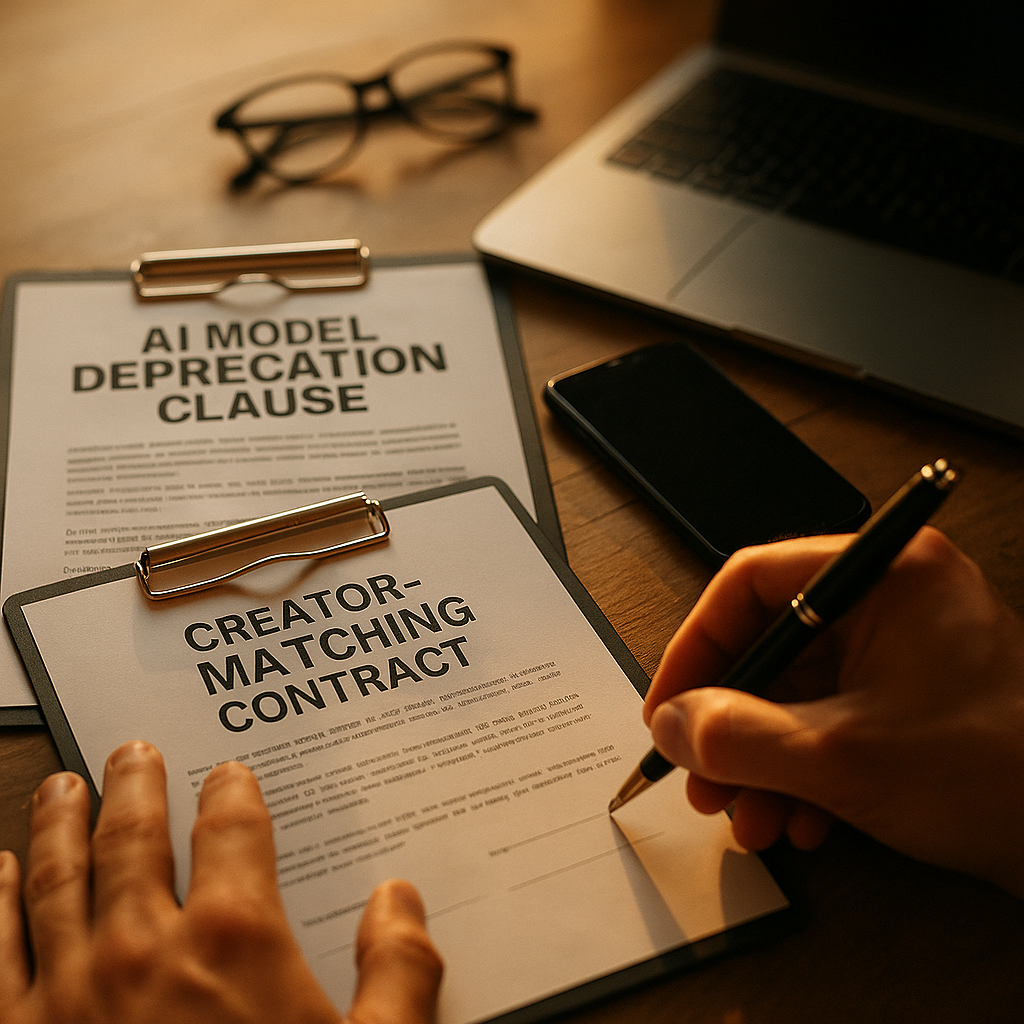
Somewhere in 2026, a mid-size DTC brand watched its creator-matching platform go dark for eleven days. Not an outage. A model retirement. The vendor swapped its underlying LLM, matching scores shifted overnight, and nobody had a contract clause to fall back on. If your vendor agreement doesn’t address AI model deprecation, you’re one silent model swap away from the same problem.
This isn’t a hypothetical risk anymore. It’s an operational certainty. LLM providers retrain, deprecate, and sunset models on their own timelines, often with 30 to 90 days’ notice to developers, sometimes less. Your creator-matching vendor sits downstream of that decision, and if their contract with you doesn’t pass along protections, you absorb the disruption.
Why This Clause Didn’t Exist a Year Ago
Creator-matching platforms, the tools that recommend which influencers fit your brand, predict audience overlap, or score authenticity signals, have quietly become AI-dependent in ways most procurement teams never scoped. Two years ago, these were rules-based recommendation engines. Now they’re wrappers around GPT-class models, fine-tuned embeddings, or proprietary LLMs trained on creator content libraries.
That shift happened fast. Legal teams are still catching up. Most existing vendor contracts were drafted before anyone thought to ask, “what happens to our matching accuracy when you retrain the model?”
The result: brands routinely sign renewals with zero language about model versioning, retraining cadence, or deprecation notice. It’s the same blind spot we’ve flagged in AI vendor due-diligence checklists — everyone audits data privacy and security, almost nobody audits model lifecycle risk.
If your creator-matching contract doesn’t name the model, define deprecation, and guarantee notice, you have no legal standing when performance quietly degrades — only a vendor telling you “we upgraded the system.”
What “Model Deprecation” Actually Means for Your Program
Let’s be precise, because vendors love vague language here. Model deprecation covers several distinct events, and your contract needs to address each one separately:
- Full retirement — the vendor stops using a model entirely (say, migrating from GPT-4-class to a newer generation) and swaps in a replacement.
- Retraining or fine-tuning — the same base model gets updated weights, new training data, or adjusted parameters, changing outputs without a “new model” announcement.
- Silent version bump — the vendor’s upstream API provider (OpenAI, Anthropic, Google) deprecates a specific model version, forcing the vendor to migrate whether they planned to or not.
- Provider-level shutdown — the underlying foundation model company discontinues the model entirely, sometimes with as little as 60 days’ notice.
Each scenario produces the same downstream symptom: your creator-matching scores shift. A creator who scored 94% brand-fit last quarter scores 71% this quarter, not because the creator changed, but because the model did. Without a clause, you have no mechanism to demand explanation, rollback, or compensation.
The Five Clauses Your Contract Is Probably Missing
1. Model identification and version pinning. Your contract should name the specific model or model family powering the matching engine, not just “proprietary AI” or “machine learning technology.” Vague identification lets vendors swap freely without triggering any contractual obligation. Require the vendor to disclose model name, version, and provider (even if it’s a fine-tuned open-source model) in an exhibit that gets updated with each material change.
2. Advance notice requirements. This is the single most important protection. Demand a minimum notice window, 60 to 90 days is standard for enterprise SaaS, before any model swap, retraining event, or version migration that could materially affect matching output. Anthropic and OpenAI both publish deprecation timelines for their own APIs; your vendor contract should mirror that transparency and require similar advance disclosure from your vendor to you.
3. Performance benchmarking before and after. Require the vendor to run parallel testing, old model versus new model, on a representative sample of your creator roster before cutover. If matching accuracy drops more than an agreed threshold (say, 10-15%), you should have the right to delay migration or request remediation. This is the same logic we’ve covered in who pays when AI picks the wrong ad format — accountability requires measurable baselines, not vendor assurances.
4. Rollback and continuity guarantees. Can the vendor revert to the prior model version if the new one underperforms? Many can’t, once a model’s deprecated upstream, it’s gone. But your contract should still require the vendor to maintain a manual or rules-based fallback matching process during transition periods, so your program doesn’t go dark while they sort out the new model.
5. Service credit or termination rights tied to disruption. If a model swap causes measurable service degradation, campaign delays, mismatched creator recommendations, reporting gaps, you want defined remedies. Service credits are the minimum. For serious disruption (extended downtime, repeated failures), you want a termination-for-cause right that doesn’t require you to prove breach through months of arbitration.
Borrow the Indemnification Logic From Adjacent Contracts
Brands negotiating AI vendor contracts elsewhere have already built useful precedent. The indemnification frameworks used for AI bidding agent errors apply almost directly to creator-matching disruption: if the vendor’s AI made a decision that cost you money or damaged a campaign, who’s liable? The same question applies when a model swap tanks your matching quality mid-campaign.
Similarly, platform algorithm change indemnification language offers a template. Platforms like TikTok and Instagram change their algorithms constantly, and savvy brands have learned to negotiate protection against unannounced changes that tank organic reach. Model deprecation is the AI-era equivalent. Same risk category, different technical trigger.
Don’t reinvent the wheel here. Pull your legal team’s existing algorithm-change language, adapt the notice periods and benchmarking requirements for LLM-specific realities, and you’ve got a starting draft in an afternoon rather than a quarter.
What Happens If You Skip This (A Realistic Scenario)
Picture a mid-funnel influencer campaign, 40 creators, six weeks of scheduled content, matched by an AI tool your team trusts. Three weeks in, the vendor’s underlying model gets deprecated by its upstream provider with 45 days’ notice, standard practice for major LLM providers. The vendor migrates fast to avoid an API cutoff. New model, new embeddings, new scoring logic.
Your dashboard suddenly recommends different creators for remaining phases. Your account manager says “we upgraded the system, it’s more accurate now.” Maybe it is. But you have no benchmark data proving it, no notice you could’ve planned around, and no contractual basis to demand rollback testing.
Multiply that across a $2 million annual creator-matching contract and the exposure is real: wasted spend on misaligned creators, campaign timeline slippage, and a vendor relationship built on trust rather than terms.
Roughly 73% of marketers report using AI tools in campaign planning, according to eMarketer’s ongoing research on marketing technology adoption, yet contract language for AI-specific risk lags years behind adoption speed. Deprecation clauses sit squarely in that gap.
Building This Into Your Renewal Cycle
The best time to negotiate deprecation protection is renewal, not mid-contract. Vendors are far more willing to add notice requirements and benchmarking clauses when you’re the one holding a signature they need. Treat it the way you’d treat any contract audit ahead of renewal: build a checklist, flag gaps, and negotiate before you’re locked in for another 12 months.
A few practical steps:
- Ask your vendor directly: “What foundation model or models power your matching engine, and what’s your deprecation notice policy?” If they can’t answer clearly, that’s diagnostic information on its own.
- Request a model-change log for the past 12 months. If they’ve already swapped models without telling you, you’ll see it in unexplained performance shifts.
- Loop in procurement and legal early. This isn’t purely a legal question, it affects budget forecasting, campaign planning, and creator relationship continuity.
- Reference the due-diligence framework used for AI format recommenders as a parallel structure, since matching engines and format recommenders share nearly identical model-risk profiles.
None of this requires exotic legal maneuvering. It requires treating your AI vendor’s model roadmap as material contract information, the same way you’d treat a data breach notification clause or an SLA uptime guarantee.
Next Step
Before your next renewal cycle, pull your current creator-matching vendor contract and search it for the words “model,” “retrain,” and “deprecat.” If none appear, you have a gap, and now you have the clause language to close it.
Frequently Asked Questions
What is an AI model deprecation clause?
It’s a contract provision requiring an AI vendor to disclose, provide advance notice of, and manage the transition around retiring, retraining, or replacing the underlying AI model that powers their service, in this case, a creator-matching platform.
How much notice should brands require before a model change?
Most enterprise-grade contracts should require 60 to 90 days’ advance notice for any material model swap or retraining event, giving your team time to benchmark performance and adjust campaign planning if needed.
Can a vendor refuse to disclose which AI model they use?
They can try, but it’s a red flag. Reasonable vendors will name the model family or provider, especially when asked during contract negotiation or renewal. Refusal to disclose should factor into your risk assessment.
What happens if a model swap degrades matching accuracy mid-campaign?
Without a contract clause addressing this, you have limited recourse beyond a difficult conversation with your account manager. With a properly drafted clause, you can demand benchmarking data, request rollback or remediation, and potentially claim service credits or termination rights.
Is this different from a standard SLA uptime clause?
Yes. Uptime SLAs address whether the service is technically available. Model deprecation clauses address whether the service’s underlying intelligence is performing consistently, a distinct and often overlooked risk category.
Should smaller brands worry about this, or is it only relevant for enterprise contracts?
Any brand relying on AI-powered creator-matching tools faces this risk, regardless of contract size. Smaller brands often have less negotiating leverage, which makes flagging the issue at renewal even more important.
Top Influencer Marketing Agencies
The leading agencies shaping influencer marketing in 2026
Agencies ranked by campaign performance, client diversity, platform expertise, proven ROI, industry recognition, and client satisfaction. Assessed through verified case studies, reviews, and industry consultations.
Moburst

-
2

The Shelf
Boutique Beauty & Lifestyle Influencer AgencyA data-driven boutique agency specializing exclusively in beauty, wellness, and lifestyle influencer campaigns on Instagram and TikTok. Best for brands already focused on the beauty/personal care space that need curated, aesthetic-driven content.Clients: Pepsi, The Honest Company, Hims, Elf Cosmetics, Pure LeafVisit The Shelf → -
3

Audiencly
Niche Gaming & Esports Influencer AgencyA specialized agency focused exclusively on gaming and esports creators on YouTube, Twitch, and TikTok. Ideal if your campaign is 100% gaming-focused — from game launches to hardware and esports events.Clients: Epic Games, NordVPN, Ubisoft, Wargaming, Tencent GamesVisit Audiencly → -
4

Viral Nation
Global Influencer Marketing & Talent AgencyA dual talent management and marketing agency with proprietary brand safety tools and a global creator network spanning nano-influencers to celebrities across all major platforms.Clients: Meta, Activision Blizzard, Energizer, Aston Martin, WalmartVisit Viral Nation → -
5

The Influencer Marketing Factory
TikTok, Instagram & YouTube CampaignsA full-service agency with strong TikTok expertise, offering end-to-end campaign management from influencer discovery through performance reporting with a focus on platform-native content.Clients: Google, Snapchat, Universal Music, Bumble, YelpVisit TIMF → -
6

NeoReach
Enterprise Analytics & Influencer CampaignsAn enterprise-focused agency combining managed campaigns with a powerful self-service data platform for influencer search, audience analytics, and attribution modeling.Clients: Amazon, Airbnb, Netflix, Honda, The New York TimesVisit NeoReach → -
7

Ubiquitous
Creator-First Marketing PlatformA tech-driven platform combining self-service tools with managed campaign options, emphasizing speed and scalability for brands managing multiple influencer relationships.Clients: Lyft, Disney, Target, American Eagle, NetflixVisit Ubiquitous → -
8

Obviously
Scalable Enterprise Influencer CampaignsA tech-enabled agency built for high-volume campaigns, coordinating hundreds of creators simultaneously with end-to-end logistics, content rights management, and product seeding.Clients: Google, Ulta Beauty, Converse, AmazonVisit Obviously →