


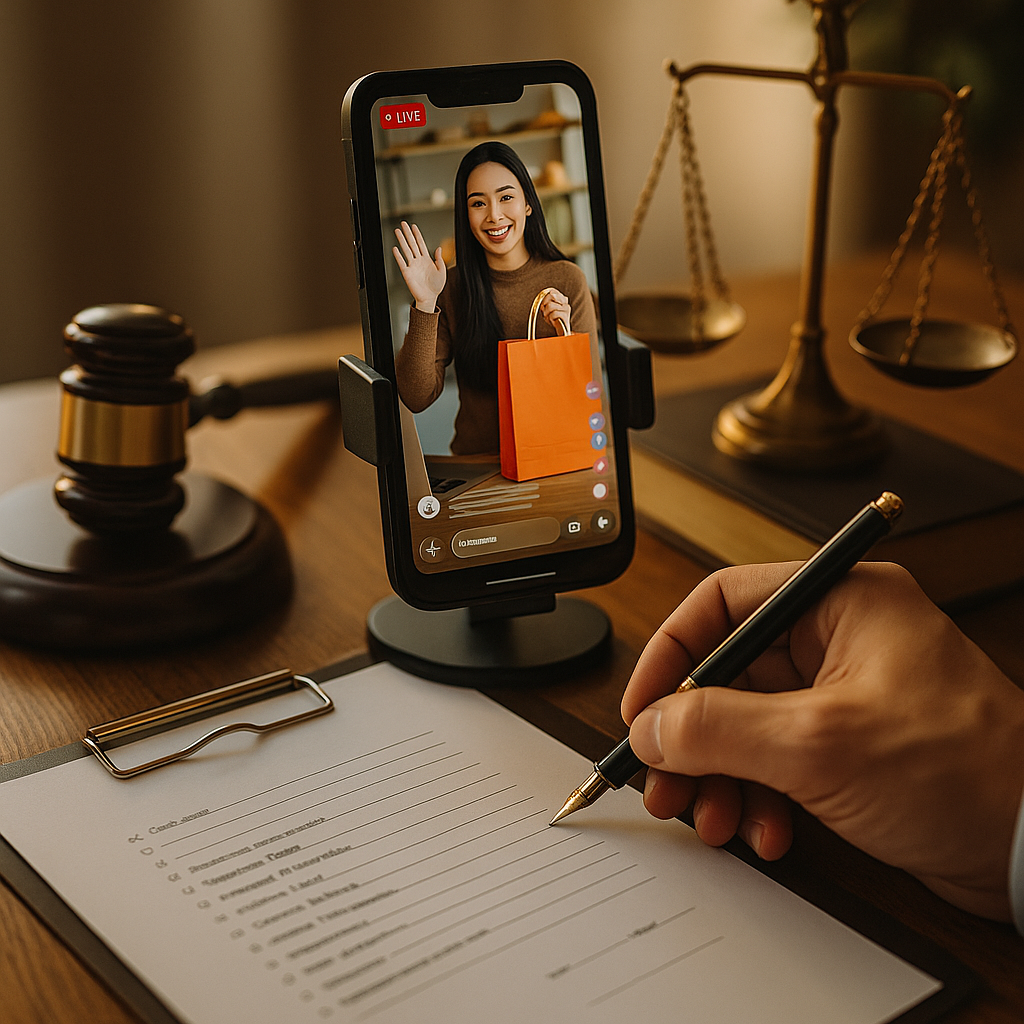
Livestream shopping errors can’t be edited out. There’s no “delete tweet” for a host who promises a product “cures inflammation” to 40,000 live viewers with a countdown clock ticking underneath. A solid pre-campaign legal sign-off checklist is the only real defense brands have against the three-headed risk of livestream commerce: unscripted claims, manufactured urgency, and affiliate links that outlive their disclosures.
Livestream shopping is projected to top $1 trillion globally by some estimates, with U.S. adoption still catching up to China’s mature market. That growth curve means more brands are running events with less legal infrastructure than the format demands. Most influencer contracts were built for static posts, not ninety minutes of live, improvised selling.
Why Livestream Commerce Breaks Standard Legal Review
Traditional creative approval works because there’s a fixed asset. A script, a video file, a caption. Someone reviews it, signs off, it ships. Livestream commerce has no fixed asset until it’s already been broadcast. By the time legal sees the “creative,” it’s a VOD replay and the FTC complaint window is already open.
This is the core operational problem: you cannot pre-approve something that doesn’t exist yet. So the checklist has to shift from reviewing content to governing behavior — locking down claims libraries, urgency mechanics, and link hygiene before the host ever goes live.
If your legal sign-off process assumes a finished asset to review, it was not built for livestream. Livestream compliance is procedural, not content-based — you’re approving guardrails, not scripts.
The Three Risk Vectors, Named Clearly
Strip away the format’s novelty and livestream commerce events carry three distinct legal exposures that rarely get separated in planning docs.
- Real-time claims: Hosts improvising product benefits, health claims, performance comparisons, or “as seen on” references with no compliance filter between mouth and microphone.
- Countdown urgency: Scarcity messaging (“only 12 left,” “price goes up in 3 minutes”) that may not reflect actual inventory or pricing reality, triggering FTC deceptive-practice concerns.
- Affiliate links: Commission-based links dropped into chat or overlays without adequate, persistent disclosure, especially once the stream becomes an on-demand replay.
Each of these has its own regulatory exposure and each needs its own checklist line. Bundling them into one vague “compliance review” step is how gaps happen.
Real-Time Claims: The Pre-Approved Language Bank
You cannot script a two-hour livestream word for word. Hosts need room to riff, that’s the appeal of the format. But “room to riff” doesn’t mean “no boundaries.” The fix is a pre-approved claims library: a document, reviewed by legal, listing exactly what can and cannot be said about the product, with specific banned phrases flagged.
Health, efficacy, and comparative superiority claims are the highest-risk category. If a supplement brand’s host says a product “boosts immunity” without substantiation, that’s not a hypothetical FTC issue, it’s a documented enforcement pattern. The same discipline that applies to creative briefs triggering FTC liability applies here, just compressed into real time.
Practical sign-off items for this vector:
- Legal-approved claims bank distributed to hosts 48+ hours before the event, not the morning of.
- A designated “compliance monitor” watching the live feed with authority to intervene or cut audio if a banned claim is made.
- Pre-scripted correction language the host can use on-air if a claim needs walking back mid-stream.
- Substantiation files on hand (studies, test data) for any claim that could be challenged, even loosely.
Countdown Urgency: Where Marketing Tactics Meet Deceptive Pricing Law
Countdown timers work. That’s precisely the problem. The FTC has been increasingly vocal about “dark pattern” urgency tactics, and a livestream countdown that resets, or a “limited stock” claim not tied to real inventory data, is exactly the kind of thing that draws scrutiny under FTC guidance on deceptive practices.
The sign-off checklist needs a hard rule: every urgency claim must be tied to a verifiable, real-time data source. If the host says “only 8 left,” there need to be, in fact, 8 left, confirmed by inventory systems feeding the stream in real time. If it’s a manufactured scarcity tactic dressed as fact, that’s a liability sitting in plain sight on video.
Checklist items here:
- Inventory/pricing data feed verified as accurate and synced to the platform before broadcast starts.
- No countdown timers that reset without a documented, pre-approved business reason (e.g., new batch released).
- Legal sign-off on all urgency copy templates: “selling fast,” “flash price,” “today only,” etc.
- Screenshot/recording archive of on-screen urgency claims for post-event audit trail.
Affiliate Links Don’t Get a Pass Because the Format Is New
Here’s where a lot of brands get sloppy. They treat livestream affiliate links like an extension of standard influencer affiliate programs and assume the same disclosure rules just carry over automatically. They do carry over — the FTC doesn’t grade on format novelty — but the mechanics of disclosure are different in a live, fast-moving chat environment.
A disclosure buried in a stream’s static description doesn’t count if the affiliate link itself appears repeatedly in chat, in overlays, and in post-stream replay clips without repeated disclosure. This is the same “disclosure decay” problem covered in guidance on reposted ads needing fresh disclosure — except livestream compresses that decay into minutes instead of months.
Brands running travel, beauty, or lifestyle livestream commerce should also reference the affiliate-specific frameworks already built out for creator commission programs, since the underlying disclosure logic is the same even if the live format adds urgency: see the affiliate disclosure standard for FTC and EU markets and the breakdown of FTC rules versus platform terms for commission-based content.
A disclosure that appears once in a stream description and never again during a 90-minute broadcast is not a disclosure. It’s a formality that won’t survive an FTC review.
Checklist items for affiliate link governance:
- Verbal disclosure requirement at set intervals (every 5-10 minutes is a reasonable working standard for long-form live content).
- On-screen persistent disclosure badge/overlay, not a one-time pop-up.
- Confirmation that replay/VOD versions retain the same disclosure treatment as the live broadcast — this gets missed constantly.
- Link tracking audit to confirm affiliate URLs route correctly and commission data logs match what’s disclosed to viewers about pricing.
Building the Actual Checklist Document
A checklist that lives in someone’s head isn’t a checklist, it’s a hope. The document needs four sections mapped to a sign-off chain, and each section needs a named owner, not a department.
- Pre-production (T-minus 2 weeks): Claims bank finalized, inventory data feed tested, disclosure templates approved, host briefing scheduled.
- Pre-broadcast (T-minus 48 hours): Host sign-off on claims bank received in writing, compliance monitor assigned, urgency copy locked, affiliate link tracking verified live.
- Live monitoring (during broadcast): Real-time compliance monitor with cut-off authority, disclosure interval tracking, screenshot archive running.
- Post-event (within 24 hours): VOD disclosure audit, claims made vs. claims bank reconciliation, archived record stored for the FTC’s typical look-back window.
Notice that legal’s heaviest lift happens before broadcast, not during it. That’s intentional. You want compliance baked into the infrastructure, not relying on a lawyer watching a live feed and hoping to catch every stray word. Real-time monitoring is a backstop, not the primary control.
This mirrors the shift already happening in AI-driven ad creative review, where brands are building sign-off gates before launch rather than reviewing after the fact. Livestream commerce just compresses the timeline further and removes the ability to pull an asset once it’s live.
Who Actually Owns This Checklist?
Ambiguity kills compliance programs. If “legal” owns the checklist but marketing owns the host relationship and platform ops owns the inventory feed, nobody actually owns the risk until something goes wrong. Assign a single accountable owner, typically a brand compliance lead or senior marketing counsel, with named contributors from legal, e-commerce ops, and the influencer/creator management team.
That owner should also be the person who has authority to pull the plug on a broadcast if a claim goes sideways. Without that authority explicitly assigned in advance, you get frozen decision-making during the exact moment speed matters most.
Contractually, this means host agreements need explicit livestream clauses, not generic sponsored-content boilerplate. Compensation, kill-switch authority, and claims-bank adherence should all be spelled out, similar to how sales-lift reporting addendums tightened reporting obligations for performance-based creator deals. Livestream commerce needs its own addendum, and it should be a standard rider by now, not a bespoke negotiation every time.
What Regulators and Platforms Are Already Signaling
The direction of travel is clear even without a livestream-specific statute yet. The FTC’s endorsement guidance already covers material connections regardless of format, and enforcement actions increasingly reference livestream and short-form video specifically. Platforms are also tightening their own rules: TikTok Shop, for instance, has expanded its live commerce policies around disclosure and pricing accuracy, per TikTok’s advertising guidelines.
For brands running EU or UK audiences, the disclosure bar is arguably higher already. Ofcom and the ASA have both signaled interest in live commercial content, and the DSA’s transparency requirements add another compliance layer that pure US-focused checklists tend to miss, a gap covered in more depth in DSA enforcement risk for scroll-based ad strategy.
Industry data from eMarketer continues to show livestream commerce as one of the fastest-growing retail media formats, which means the volume of legal exposure is scaling right alongside the marketing opportunity. More streams, more hosts, more improvisation, more chances for a claim to go unchecked.
The Takeaway
Build the checklist around behavior, not content: lock the claims bank, verify urgency data in real time, and treat disclosure as a recurring obligation, not a one-time badge. Assign one named owner with kill-switch authority before your next event goes live, not after something breaks.
FAQs
What makes livestream commerce legally riskier than standard sponsored content?
The absence of a fixed, pre-reviewable asset. Claims, pricing, and urgency messaging happen live and unscripted, meaning legal review has to shift from approving finished content to governing real-time behavior and infrastructure.
How often should affiliate link disclosures repeat during a livestream?
A reasonable working standard is every 5 to 10 minutes for verbal disclosure, plus a persistent on-screen badge, since viewers join and leave a stream continuously and a single disclosure at the start won’t reach everyone.
Who should have authority to stop a livestream if a host makes a risky claim?
A single, named compliance owner assigned before broadcast, typically brand compliance or senior marketing counsel, with pre-agreed authority to intervene or cut the feed without needing real-time approval from multiple stakeholders.
Does the FTC treat livestream countdown timers differently from standard urgency marketing?
Not differently in principle, but livestream urgency claims are harder to substantiate after the fact since they’re spoken live. The FTC’s deceptive-practice standards still apply; the checklist requirement is tying every urgency claim to verifiable, real-time inventory or pricing data.
Do VOD replays of a livestream need the same disclosures as the live broadcast?
Yes. Disclosure treatment must carry over to replay and clipped versions of the stream. This is a commonly missed step, since teams often focus compliance effort on the live moment and forget the archived version needs equal disclosure treatment.
Top Influencer Marketing Agencies
The leading agencies shaping influencer marketing in 2026
Agencies ranked by campaign performance, client diversity, platform expertise, proven ROI, industry recognition, and client satisfaction. Assessed through verified case studies, reviews, and industry consultations.
Moburst

-
2

The Shelf
Boutique Beauty & Lifestyle Influencer AgencyA data-driven boutique agency specializing exclusively in beauty, wellness, and lifestyle influencer campaigns on Instagram and TikTok. Best for brands already focused on the beauty/personal care space that need curated, aesthetic-driven content.Clients: Pepsi, The Honest Company, Hims, Elf Cosmetics, Pure LeafVisit The Shelf → -
3

Audiencly
Niche Gaming & Esports Influencer AgencyA specialized agency focused exclusively on gaming and esports creators on YouTube, Twitch, and TikTok. Ideal if your campaign is 100% gaming-focused — from game launches to hardware and esports events.Clients: Epic Games, NordVPN, Ubisoft, Wargaming, Tencent GamesVisit Audiencly → -
4

Viral Nation
Global Influencer Marketing & Talent AgencyA dual talent management and marketing agency with proprietary brand safety tools and a global creator network spanning nano-influencers to celebrities across all major platforms.Clients: Meta, Activision Blizzard, Energizer, Aston Martin, WalmartVisit Viral Nation → -
5

The Influencer Marketing Factory
TikTok, Instagram & YouTube CampaignsA full-service agency with strong TikTok expertise, offering end-to-end campaign management from influencer discovery through performance reporting with a focus on platform-native content.Clients: Google, Snapchat, Universal Music, Bumble, YelpVisit TIMF → -
6

NeoReach
Enterprise Analytics & Influencer CampaignsAn enterprise-focused agency combining managed campaigns with a powerful self-service data platform for influencer search, audience analytics, and attribution modeling.Clients: Amazon, Airbnb, Netflix, Honda, The New York TimesVisit NeoReach → -
7

Ubiquitous
Creator-First Marketing PlatformA tech-driven platform combining self-service tools with managed campaign options, emphasizing speed and scalability for brands managing multiple influencer relationships.Clients: Lyft, Disney, Target, American Eagle, NetflixVisit Ubiquitous → -
8

Obviously
Scalable Enterprise Influencer CampaignsA tech-enabled agency built for high-volume campaigns, coordinating hundreds of creators simultaneously with end-to-end logistics, content rights management, and product seeding.Clients: Google, Ulta Beauty, Converse, AmazonVisit Obviously →