


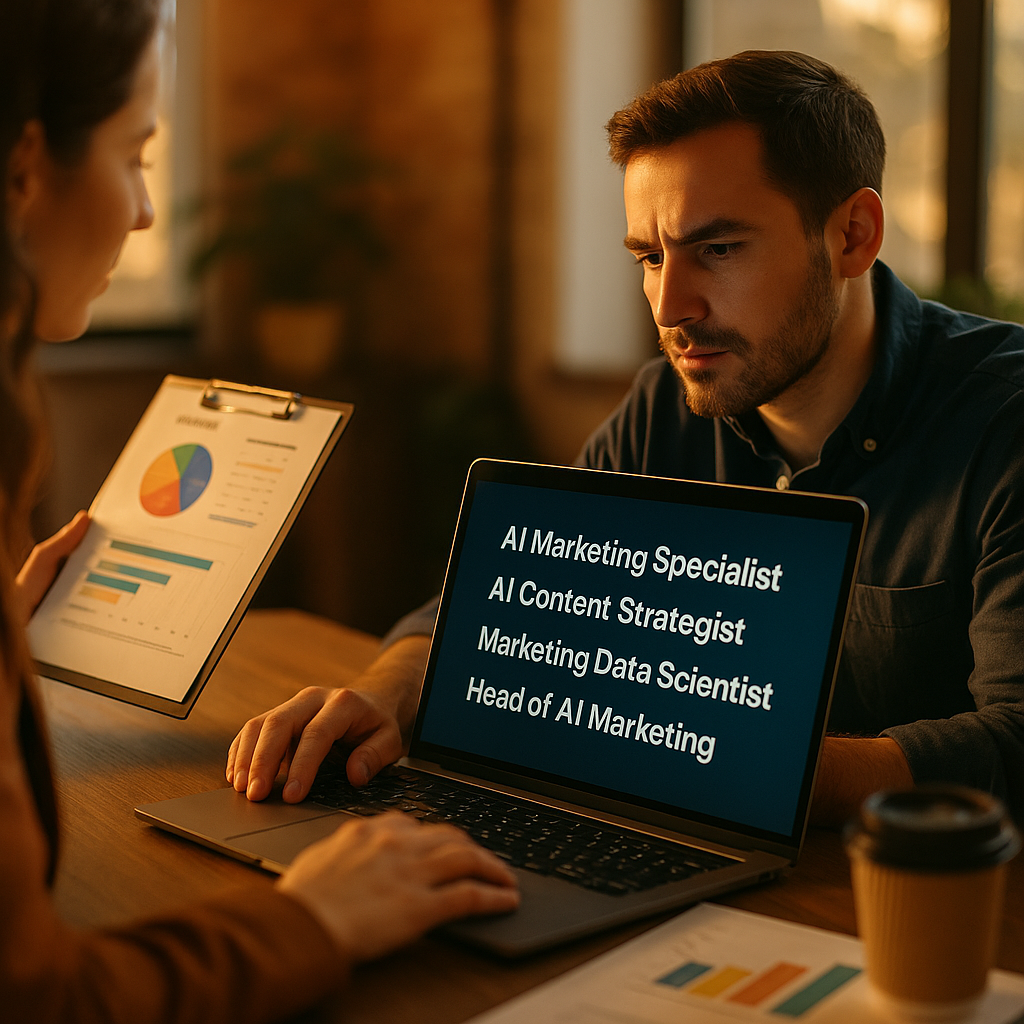
Fourteen. That’s how many Fortune 500 companies created a net-new “Head of AI Marketing” or equivalent role in a single month. Not a rebrand of an existing VP seat — a new line item on the org chart. If you’re still hiring for the same marketing skill set you had two years ago, the AI-native marketing job titles filling LinkedIn feeds this summer should worry you.
This isn’t a trend piece about buzzwords. It’s a signal read. Executive moves are lagging indicators of where budget and belief have already shifted — and July’s hiring activity tells a specific story about what skills brands are willing to pay for right now.
The Titles Nobody Had Two Years Ago
Scroll LinkedIn’s executive moves feed and you’ll notice a pattern: Chief AI Marketing Officer, Head of Agentic Commerce, VP of AI-Native Content Operations, Director of Synthetic Media Governance. None of these existed as standard titles before. Now they’re showing up at consumer packaged goods companies, retail banks, and mid-size DTC brands alike.
What’s notable isn’t the novelty. It’s the seniority. Companies aren’t burying AI expertise in a coordinator role three levels down. They’re putting it at the VP and C-suite level, reporting directly to the CMO or CEO. That’s a capital allocation decision as much as a hiring one — it tells the market this function controls budget, not just workflow.
When a company creates a C-suite title around a capability, it’s telling investors and competitors that the capability is now core infrastructure, not an experiment.
Compare this to the last major title wave — “Head of Social Media” circa 2010, or “VP of Growth” a decade later. Both started as novelty titles that skeptics dismissed as fads. Both became permanent fixtures once the underlying discipline proved it could move revenue. AI-native marketing roles are following the same arc, just compressed into months instead of years.
What “AI-Native” Actually Means in a Job Description
Strip the jargon and these roles cluster around four capabilities:
- Agentic workflow design — building and supervising AI agents that execute campaign tasks (briefing, bidding, creative variation testing) with human oversight at checkpoints, not at every step.
- Synthetic content governance — setting policy for AI-generated creative, from disclosure standards to brand-voice guardrails to detecting when AI output drifts into low-quality AI slop that damages trust instead of building it.
- AI search and discovery optimization — making sure brand content surfaces correctly in ChatGPT, Gemini, and Rufus-style shopping assistants, a discipline barely two years old that already has its own budget line at large retailers.
- Cross-platform attribution modeling — stitching together performance data across creator content, paid amplification, and AI-assisted discovery so finance actually trusts the numbers.
None of these are “prompt engineering,” notably. That title’s fifteen minutes of fame came and went. What replaced it is more durable: governance, orchestration, and measurement. In other words, the same core marketing disciplines that have always mattered, just applied to a new substrate.
Why Governance Roles Are Growing Faster Than Production Roles
Here’s the part that should reshape your hiring plan. Job postings for AI content governance and compliance roles are growing faster than postings for AI content creation roles. Brands learned the hard way that generating AI content is the easy part. Controlling it — legally, reputationally, creatively — is where the real risk sits.
The FTC has made clear that endorsement and disclosure rules apply regardless of whether a human or an algorithm produced the content. The UK’s Information Commissioner’s Office has signaled similar scrutiny around data use in AI-driven personalization. Brands hiring governance leads aren’t being cautious for caution’s sake. They’re pricing in regulatory risk before it becomes a headline.
This mirrors what we’ve already seen play out with certified creator compliance standards in the UK — the market rewards brands that can prove they got ahead of the rulebook, not just followed it after a fine.
The In-House Shift Is Accelerating This
It’s not a coincidence that AI-native titles are multiplying at the same time large advertisers are pulling capability in-house. Intuit’s very public agency restructuring earlier this year — where the company moved core AI marketing functions internal rather than routing them through its agency of record — signaled a broader shift that plenty of CMOs have quietly followed since.
Why does this matter for job titles specifically? Because in-house teams need someone accountable for AI output who sits inside the building, not at an agency three steps removed from legal and brand safety. You can outsource execution. You can’t outsource accountability once regulators or customers start asking questions. That accountability gap is exactly what these new C-suite and VP titles are built to close.
It also explains why the agency-of-record model is under renewed pressure. If the highest-value skill is real-time AI governance and orchestration, that’s hard to hand off to an external partner working on a quarterly retainer cycle. Speed matters, and speed favors in-house.
What This Means for Your Org Chart, Not Just Theirs
You don’t need to hire a Chief AI Marketing Officer next quarter. Most mid-market brands don’t have the budget or the AI maturity to justify that title yet. But the skill gaps these hires are filling at the Fortune 500 level will hit your team eventually, usually faster than planned.
Three practical moves worth making now:
- Audit who owns AI risk today. If the honest answer is “nobody, really,” that’s your first gap. It doesn’t need to be a new hire immediately — it could be a redefined scope for an existing director-level marketer.
- Separate governance from production in your job architecture. The person approving AI-generated creator briefs shouldn’t be the same person under pressure to hit content volume targets. Conflicting incentives create the exact failures regulators are watching for.
- Build attribution literacy before you build AI production capacity. Plenty of brands rushed to scale AI content and only later realized they couldn’t measure whether it worked. Fix measurement first, or you’re just producing more content you can’t defend in a budget review.
The brands creating AI-native titles aren’t chasing a trend — they’re pricing risk and attribution gaps that already existed. Naming the role just makes the accountability visible.
Skills That Are Quietly Becoming Non-Negotiable
Recruiters filling these roles report a consistent shortlist of skills that separate qualified candidates from the rest: fluency in at least one major AI platform’s ad or discovery ecosystem (Google’s Gemini shopping tools, Amazon’s Rufus, or equivalents), working knowledge of consent and data provenance rules, and — somewhat old-fashioned — strong editorial judgment. AI can generate a hundred creative variations in minutes. Someone still has to know which one is actually good, on-brand, and won’t embarrass the company in a screenshot.
This is the same judgment gap driving demand for authenticity measurement expertise across creator content generally. AI-native titles are really just an extension of that same skill, applied to synthetic and hybrid content rather than purely human-generated UGC.
There’s also a growing expectation that these hires understand AI shopping discovery mechanics well enough to brief creative and creator teams accordingly. If your product isn’t structured to be legible to an AI shopping assistant, no amount of clever creative fixes that at the point of sale.
A Word of Caution on Title Inflation
Not every “Head of AI” hire this July represents real capability. Some are cosmetic — a rebrand meant to signal innovation to the board or the press without a corresponding change in budget or headcount. Treat any AI-native title with a healthy dose of scrutiny: does this person have actual authority over spend and tooling decisions, or is this a title stapled onto an existing role for the LinkedIn optics?
The distinguishing signal, per multiple LinkedIn talent and HubSpot research reports on marketing hiring trends, is reporting line. Real AI-native roles report to the CMO or CEO with budget authority attached. Cosmetic ones report sideways into an existing marketing ops function with no new resources.
Where This Goes Next
Expect the next wave of titles to move from “AI marketing” broadly toward specialization: expect to see Head of Agentic Media Buying, Director of AI Creator Vetting, and VP of Synthetic Voice Licensing appear within the next two hiring cycles. The generalist AI marketing title is a transitional phase. Specialization always follows once a discipline proves durable — the same thing happened with social media roles, and it’s already happening with creator economy job functions tracked by eMarketer and Statista.
The brands paying attention to these executive moves aren’t copying titles. They’re reading them as a map of where competitive advantage is heading — and building the skills before the job posting forces the issue.
Next step: Before your next budget cycle, map who on your team currently owns AI governance, AI discovery optimization, and cross-channel attribution — if any of those boxes are empty, that’s your hiring priority, title or no title.
Frequently Asked Questions
What is an AI-native marketing job title?
It’s a role created specifically around AI-driven marketing functions — such as agentic workflow management, synthetic content governance, or AI search optimization — rather than a traditional marketing title with AI tools bolted on. These roles typically sit at VP or C-suite level with dedicated budget authority.
Why are companies creating new C-suite titles for AI marketing instead of adding it to existing roles?
Seniority signals accountability. Placing AI marketing authority at the executive level tells regulators, investors, and internal stakeholders that AI-driven decisions have real oversight, not just tactical execution buried in a lower-level role.
Do mid-market brands need a Chief AI Marketing Officer?
Not necessarily. Most mid-market brands can close the same skill gap by redefining an existing director or VP role to explicitly own AI governance, attribution, and discovery optimization, rather than creating a brand-new C-suite seat.
What skills are most in demand for AI marketing roles right now?
Platform fluency in AI shopping and discovery tools, data provenance and consent literacy, cross-channel attribution modeling, and strong editorial judgment for evaluating AI-generated creative at scale.
How can brands tell if an AI marketing title is substantive or just a rebrand?
Check the reporting line and budget authority. Substantive roles report to the CMO or CEO and control spend or tooling decisions. Cosmetic titles are usually folded into existing marketing ops functions with no new resources attached.
FAQs
What is an AI-native marketing job title?
It’s a role created specifically around AI-driven marketing functions — such as agentic workflow management, synthetic content governance, or AI search optimization — rather than a traditional marketing title with AI tools bolted on. These roles typically sit at VP or C-suite level with dedicated budget authority.
Top Influencer Marketing Agencies
The leading agencies shaping influencer marketing in 2026
Agencies ranked by campaign performance, client diversity, platform expertise, proven ROI, industry recognition, and client satisfaction. Assessed through verified case studies, reviews, and industry consultations.
Moburst

-
2

The Shelf
Boutique Beauty & Lifestyle Influencer AgencyA data-driven boutique agency specializing exclusively in beauty, wellness, and lifestyle influencer campaigns on Instagram and TikTok. Best for brands already focused on the beauty/personal care space that need curated, aesthetic-driven content.Clients: Pepsi, The Honest Company, Hims, Elf Cosmetics, Pure LeafVisit The Shelf → -
3

Audiencly
Niche Gaming & Esports Influencer AgencyA specialized agency focused exclusively on gaming and esports creators on YouTube, Twitch, and TikTok. Ideal if your campaign is 100% gaming-focused — from game launches to hardware and esports events.Clients: Epic Games, NordVPN, Ubisoft, Wargaming, Tencent GamesVisit Audiencly → -
4

Viral Nation
Global Influencer Marketing & Talent AgencyA dual talent management and marketing agency with proprietary brand safety tools and a global creator network spanning nano-influencers to celebrities across all major platforms.Clients: Meta, Activision Blizzard, Energizer, Aston Martin, WalmartVisit Viral Nation → -
5

The Influencer Marketing Factory
TikTok, Instagram & YouTube CampaignsA full-service agency with strong TikTok expertise, offering end-to-end campaign management from influencer discovery through performance reporting with a focus on platform-native content.Clients: Google, Snapchat, Universal Music, Bumble, YelpVisit TIMF → -
6

NeoReach
Enterprise Analytics & Influencer CampaignsAn enterprise-focused agency combining managed campaigns with a powerful self-service data platform for influencer search, audience analytics, and attribution modeling.Clients: Amazon, Airbnb, Netflix, Honda, The New York TimesVisit NeoReach → -
7

Ubiquitous
Creator-First Marketing PlatformA tech-driven platform combining self-service tools with managed campaign options, emphasizing speed and scalability for brands managing multiple influencer relationships.Clients: Lyft, Disney, Target, American Eagle, NetflixVisit Ubiquitous → -
8

Obviously
Scalable Enterprise Influencer CampaignsA tech-enabled agency built for high-volume campaigns, coordinating hundreds of creators simultaneously with end-to-end logistics, content rights management, and product seeding.Clients: Google, Ulta Beauty, Converse, AmazonVisit Obviously →