


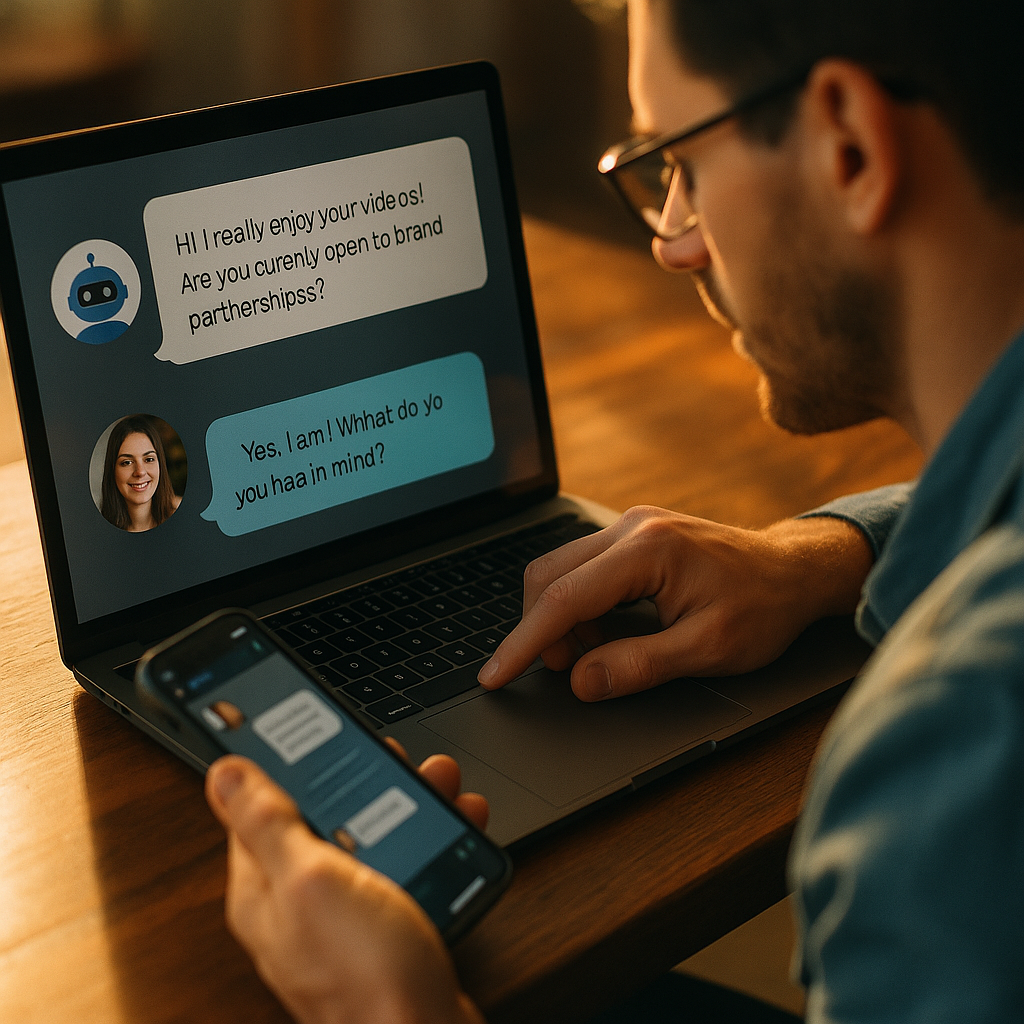
Sixty percent of influencer marketers say sourcing and messaging creators eats more time than any other part of a campaign, according to research cited by Sprout Social. So why are brands still hand typing the same “loved your last post” opener five hundred times a week? AI outreach agents now draft first contact creator messages in seconds, but the campaigns that actually convert still have a human reading every single one before it ships.
The Pitch: Speed Without Sounding Like a Robot
Outreach agents built into platforms like CreatorIQ, Grin, and a wave of newer AI-native tools scrape a creator’s last twenty posts, pull engagement patterns, and generate a personalized opening line in under ten seconds. That used to take a coordinator fifteen minutes per creator. Multiply that across a campaign targeting three hundred micro creators, and you’re looking at seventy five hours of manual drafting compressed into an afternoon.
The pitch is obvious: scale. A mid sized DTC brand running a seeding campaign across TikTok and Instagram can now message a thousand creators in the time it once took to message fifty. That matters when brief windows are shrinking and competitors are already in a creator’s DMs.
Where the Drafts Actually Come From
Most agents pull from three data sources: public profile metadata, recent caption text, and brand fit scores generated by matchmaking layers similar to what’s described in creator matchmaking tools. The result is a message that references a real post, name checks a niche, and slots in a rate range pulled from historical benchmarks. It reads personalized. Often it is anything but.
An outreach message that name checks the wrong campaign, misgenders a creator’s audience, or references a sponsored post as organic content doesn’t just fail to convert. It signals the brand didn’t bother to check, and that perception spreads fast in creator circles.
Why Response Rates Still Depend on a Human Edit
Here’s the uncomfortable data point agencies don’t love sharing: raw AI drafted outreach, sent without review, converts at roughly half the rate of the same message lightly edited by a human before send. That’s not a knock on the models. It’s a reflection of what creators can smell from a mile away. Generic enthusiasm. Slightly off tone. A brand voice that doesn’t match the product being pitched.
Creators get dozens of pitches a week. Many have started publicly calling out obviously templated ones, sometimes screenshotting them for followers. That’s a brand safety problem hiding inside an efficiency win. The tools that promise full automation, the ones covered in agentic creator tools coverage, keep landing in the same place: autonomy on paper, manual review in practice.
The Judgment Calls Machines Still Miss
- Tone matching: An agent can identify that a creator uses humor, but it can’t reliably tell dry sarcasm from genuine enthusiasm in a caption, and getting that wrong in an opener kills credibility instantly.
- Timing sensitivity: A creator who just posted about a personal loss or controversy needs a pause, not a scheduled send. Agents rarely catch context outside the immediate content feed.
- Rate framing: Algorithms suggest rate ranges based on comparable creators, but they don’t know a specific creator just turned down a competitor at double that number.
- Cultural nuance: Regional slang, community in-jokes, and platform-specific etiquette (a Discord-native creator expects different phrasing than a LinkedIn creator) still trip up generative drafts.
What Good Human-in-the-Loop Outreach Looks Like
The brands getting this right aren’t rejecting automation. They’re restructuring the workflow so AI handles volume and humans handle judgment. A typical setup: the agent drafts a first pass pulling in creator specific detail and campaign parameters, a coordinator reviews and edits within a two minute window per message, and only then does it send. That two minute review isn’t busywork. It’s where brand voice, legal caution, and relationship context get layered back in.
This mirrors what’s happening in adjacent AI marketing functions. AI negotiators haggling rates face the same ceiling: they can propose numbers, but autonomy risk climbs the moment real money and real relationships are on the line. Outreach is the same story one step earlier in the funnel.
Some agencies have built entire playbooks around this hybrid model. Moburst, a global growth agency that has worked with over 900 clients and won 45+ international awards, treats influencer marketing specialists as the layer that reviews creator recruitment and outreach before it goes out, pairing AI-assisted vetting with human judgment on tone and fit rather than letting either run the process alone.
Compliance Is the Quiet Risk Nobody Drafts For
First contact messages increasingly double as the first documented step in a paid partnership disclosure trail. If an outreach agent promises payment terms, exclusivity clauses, or usage rights that legal never approved, that draft becomes a liability the moment a creator accepts and screenshots it. The FTC’s endorsement guidance doesn’t care whether a bot or a human wrote the initial pitch. It cares whether disclosure and terms were accurate.
This is the same governance gap flagged in AI fit score vetting coverage: speed without a compliance checkpoint just moves risk earlier in the funnel instead of removing it. Smart teams route any AI drafted outreach mentioning rates, deliverables, or usage rights through a fast legal glance before it leaves the building, even if that adds a few hours to the timeline.
The ROI Math Brands Actually Care About
Strip away the hype and the calculation is simple. AI outreach agents cut drafting time by roughly 80 to 90 percent on the first pass. Human review adds back a fraction of that time but recovers the conversion rate gap. Net result: campaigns still move faster than fully manual outreach, and response quality holds. HubSpot’s research on personalized outreach has long shown that even minor personalization touches lift reply rates meaningfully, and creator outreach is no exception, arguably more sensitive to it given how saturated creator inboxes have become.
Budget owners should track two numbers here, not one. Messages sent per hour tells you about efficiency. Response rate per message tells you whether that efficiency is actually producing pipeline. Optimizing only for the first metric is how brands end up with impressive-looking dashboards and a roster of creators who never wrote back.
What Comes Next for Outreach Automation
Expect outreach agents to get better at flagging their own uncertainty, essentially routing low confidence drafts to humans automatically while auto sending high confidence, low risk ones. That kind of tiered review already exists in adjacent workflows like contract risk flagging, where AI surfaces concerns and a human still makes the final call. Outreach will likely follow the same arc: not full autonomy, but confidence-scored automation with a human backstop that never fully disappears.
Frequently Asked Questions
FAQs
Do AI outreach agents replace influencer marketing coordinators?
No. They replace the repetitive drafting work, not the judgment calls around tone, timing, and compliance that determine whether a message actually converts.
How much faster is AI-assisted creator outreach compared to manual outreach?
Drafting time typically drops by 80 to 90 percent, though brands that skip human review before sending often see response rates fall by roughly half.
What’s the biggest risk with fully automated outreach messages?
Compliance exposure. If an AI draft states payment terms or usage rights that legal hasn’t approved, that message can become a binding reference point once a creator accepts it.
Can AI accurately match a creator’s tone in outreach messages?
It can approximate tone based on caption patterns, but it frequently misses sarcasm, cultural nuance, and recent context that a human reviewer would catch in seconds.
Should small brands with limited budgets use AI outreach tools?
Yes, with a lightweight review step. Even a two minute human edit per message preserves most of the speed gains while protecting response rates and brand voice.
Next step: audit your current outreach workflow this week. If AI drafted messages are going out without a human touchpoint for tone, rates, or usage rights, that’s the fix to make before scaling volume any further.
FAQs
Do AI outreach agents replace influencer marketing coordinators?
No. They replace the repetitive drafting work, not the judgment calls around tone, timing, and compliance that determine whether a message actually converts.
How much faster is AI-assisted creator outreach compared to manual outreach?
Drafting time typically drops by 80 to 90 percent, though brands that skip human review before sending often see response rates fall by roughly half.
What’s the biggest risk with fully automated outreach messages?
Compliance exposure. If an AI draft states payment terms or usage rights that legal hasn’t approved, that message can become a binding reference point once a creator accepts it.
Can AI accurately match a creator’s tone in outreach messages?
It can approximate tone based on caption patterns, but it frequently misses sarcasm, cultural nuance, and recent context that a human reviewer would catch in seconds.
Should small brands with limited budgets use AI outreach tools?
Yes, with a lightweight review step. Even a two minute human edit per message preserves most of the speed gains while protecting response rates and brand voice.
Top Influencer Marketing Agencies
The leading agencies shaping influencer marketing in 2026
Agencies ranked by campaign performance, client diversity, platform expertise, proven ROI, industry recognition, and client satisfaction. Assessed through verified case studies, reviews, and industry consultations.
Moburst

-
2

The Shelf
Boutique Beauty & Lifestyle Influencer AgencyA data-driven boutique agency specializing exclusively in beauty, wellness, and lifestyle influencer campaigns on Instagram and TikTok. Best for brands already focused on the beauty/personal care space that need curated, aesthetic-driven content.Clients: Pepsi, The Honest Company, Hims, Elf Cosmetics, Pure LeafVisit The Shelf → -
3

Audiencly
Niche Gaming & Esports Influencer AgencyA specialized agency focused exclusively on gaming and esports creators on YouTube, Twitch, and TikTok. Ideal if your campaign is 100% gaming-focused — from game launches to hardware and esports events.Clients: Epic Games, NordVPN, Ubisoft, Wargaming, Tencent GamesVisit Audiencly → -
4

Viral Nation
Global Influencer Marketing & Talent AgencyA dual talent management and marketing agency with proprietary brand safety tools and a global creator network spanning nano-influencers to celebrities across all major platforms.Clients: Meta, Activision Blizzard, Energizer, Aston Martin, WalmartVisit Viral Nation → -
5

The Influencer Marketing Factory
TikTok, Instagram & YouTube CampaignsA full-service agency with strong TikTok expertise, offering end-to-end campaign management from influencer discovery through performance reporting with a focus on platform-native content.Clients: Google, Snapchat, Universal Music, Bumble, YelpVisit TIMF → -
6

NeoReach
Enterprise Analytics & Influencer CampaignsAn enterprise-focused agency combining managed campaigns with a powerful self-service data platform for influencer search, audience analytics, and attribution modeling.Clients: Amazon, Airbnb, Netflix, Honda, The New York TimesVisit NeoReach → -
7

Ubiquitous
Creator-First Marketing PlatformA tech-driven platform combining self-service tools with managed campaign options, emphasizing speed and scalability for brands managing multiple influencer relationships.Clients: Lyft, Disney, Target, American Eagle, NetflixVisit Ubiquitous → -
8

Obviously
Scalable Enterprise Influencer CampaignsA tech-enabled agency built for high-volume campaigns, coordinating hundreds of creators simultaneously with end-to-end logistics, content rights management, and product seeding.Clients: Google, Ulta Beauty, Converse, AmazonVisit Obviously →