


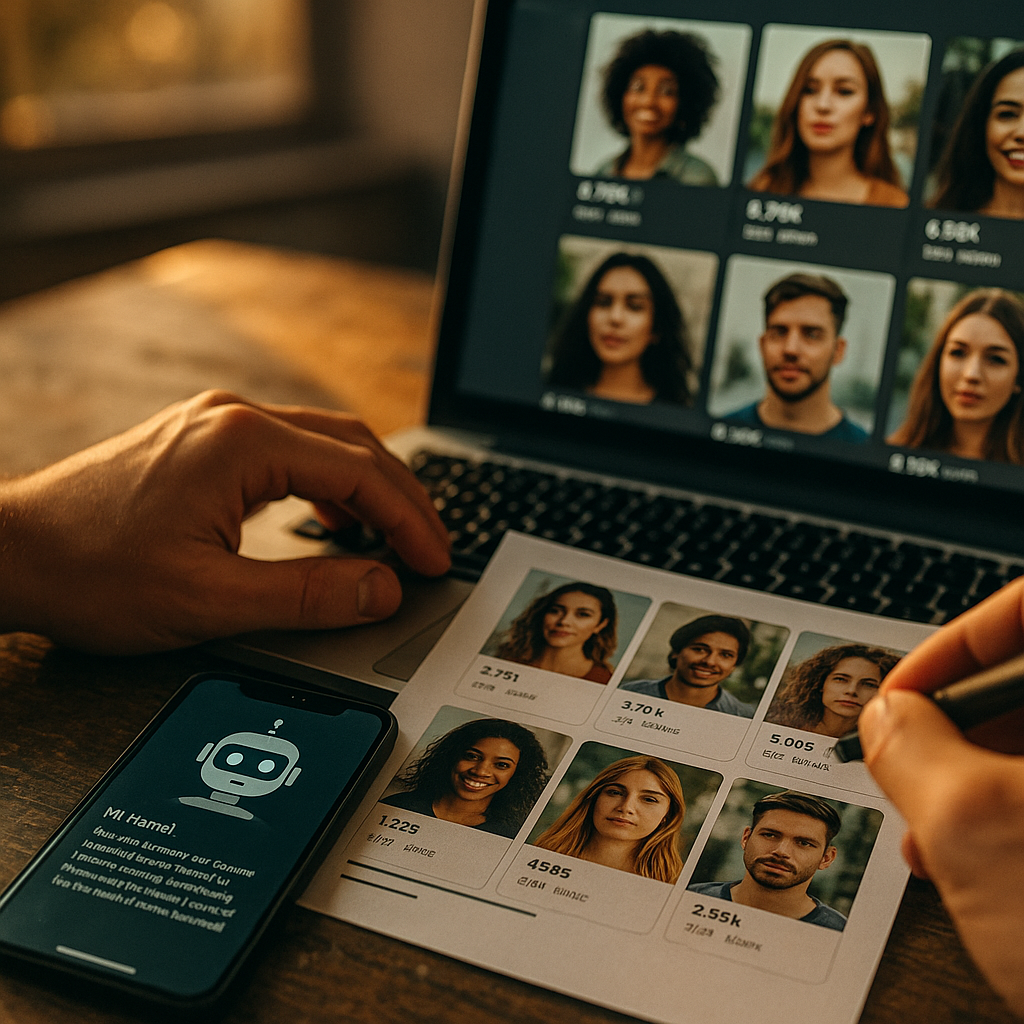
Brands running AI powered outreach personalization tools report sending five times more creator pitches per week than teams doing manual sourcing, yet reply rates often tell a different story. Some AI tools boost response rates. Others tank them because creators can smell a templated DM from three scroll-stops away. So which approach actually drives signed deals and campaign ROI in 2026? We tested both, and the answer isn’t as clean as either camp wants it to be.
The Setup: What We Actually Tested
We ran a 90-day side-by-side comparison across two in-house teams at a mid-sized DTC apparel brand. One team used an AI outreach personalization stack (combining a creator discovery database with generative email and DM drafting) to contact 400 micro and mid-tier creators. The other team manually sourced, vetted, and personalized outreach to 150 creators using spreadsheets, manual profile review, and hand-typed messages.
Same budget pool. Same campaign brief. Same product category (sustainable activewear). The only variable was the sourcing and outreach method.
The AI team moved faster, no surprise there. They sent their first 200 messages in under six hours. The manual team took nine working days to hit 150 personalized touches. But speed was never the question. ROI, deal quality, and long-term creator fit were.
Response Rates: Where AI Stumbled First
The AI outreach tool pulled public bio data, recent captions, and follower demographics to auto-generate “personalized” opening lines. Response rate landed at 11%. The manual team, pulling from deeper research (watching actual videos, checking engagement authenticity, noting tone and niche fit), hit 29%.
Creators aren’t rejecting automation outright. They’re rejecting the feeling of being a line item in someone else’s spreadsheet, which is exactly what sloppy AI personalization signals.
Why the gap? The AI tool’s “personalization” leaned on surface signals: follower count, last post topic, hashtag usage. It didn’t understand sarcasm, inside jokes, or whether a creator’s audience actually buys the product category. Several creators flagged the outreach as “obviously templated” even when names and recent posts were correctly referenced. This mirrors findings from Sprout Social’s research on creator trust, which shows authenticity perception drops sharply when outreach feels mass-produced.
Where AI Pulled Ahead
Here’s the part the manual-sourcing purists don’t want to hear: AI crushed the discovery phase. The tool surfaced 40 creators the manual team never found, including several niche fitness micro-influencers whose engagement rates outperformed bigger names on the manual list by nearly double.
AI discovery tools scan engagement patterns, audience overlap, and content themes at a scale no human researcher can match in the same timeframe. This aligns with what we’ve covered in AI generated shortlists, where algorithmic matching increasingly determines which creators even make it onto a brand’s radar before a human reviews anything.
- AI found more total candidates in less time, widening the funnel significantly.
- AI flagged engagement anomalies (bought followers, comment pods) faster than manual spot-checks.
- AI’s audience overlap analysis reduced duplicate reach waste across the creator roster by an estimated 18%.
So the honest takeaway isn’t “AI bad, manual good.” It’s that AI wins at discovery and filtering, while manual effort wins at the relationship-building moment that actually converts a cold lead into a signed creator partner.
Deal Quality: The Number That Actually Matters
Response rate is vanity if the deals that follow are weak. We tracked three downstream metrics: negotiated rate fairness, content revision cycles, and campaign engagement lift.
Manually sourced creators required 30% fewer content revisions. Why? Because the brand team had already confirmed tone and content style fit before the first message went out. Fewer surprises, fewer “this isn’t what we asked for” moments.
AI-sourced creators, on average, delivered slightly higher raw reach (bigger audiences surfaced by the algorithm), but engagement lift on sponsored content was 14% lower than the manually sourced cohort. The mismatch between audience and brand message, something manual vetting tends to catch, showed up in the comments section as lukewarm engagement rather than outright negative feedback.
This tracks with broader industry concern around algorithmic matching bias, a topic explored in AI casting algorithm bias audits, where over-indexing on quantifiable metrics (follower count, post frequency) can crowd out qualitative fit signals that actually predict campaign success.
Cost Per Signed Creator: The Real Scoreboard
Here’s where it gets interesting for anyone holding the budget. Despite the manual team contacting fewer creators, their cost per signed deal (factoring in labor hours at a blended hourly rate) came out lower than the AI team’s, once you account for the AI platform’s licensing fee and the additional outreach volume needed to hit the same number of closed deals.
Rough numbers from our test: manual sourcing averaged $340 per signed creator partnership. AI-assisted outreach averaged $410, driven largely by the lower conversion rate requiring more volume to hit the same output. That gap narrows considerably at scale, though. If you’re trying to sign 10 creators, manual wins on cost. If you’re trying to sign 200 creators for a large-scale UGC push, AI’s speed advantage starts paying for itself.
This scale-dependent math shows up elsewhere too. The budget leakage patterns we documented in rule based automation budget leakage research suggest automation tools need volume to justify their cost, and brands running smaller, boutique programs often overpay for capability they don’t fully use.
The Hybrid Model That Actually Wins
After the 90 days, we didn’t crown a winner. We built a hybrid workflow instead, and it’s the one we’d recommend to any brand sourcing creators at meaningful scale.
- Use AI for top-of-funnel discovery. Let the algorithm surface candidates based on audience overlap, engagement authenticity signals, and content theme matching. This is where AI’s scale advantage is undeniable.
- Manually review the shortlist. Before any outreach goes out, a human watches actual content, checks brand safety signals, and confirms tone fit. This step alone eliminated roughly 25% of AI-surfaced candidates in our test.
- Personalize outreach by hand, or heavily edit AI drafts. Use AI-generated first drafts as a starting point, but have a real person add specific, non-obvious details. Reference a specific video, mention a shared connection, note something only someone who actually watched the content would know.
- Automate the logistics, not the relationship. Contract generation, payment scheduling, and content tracking are perfect for automation. The actual pitch and negotiation benefit from a human touch, particularly for mid-tier and above creators who get pitched dozens of times a week.
This mirrors a pattern we’ve seen across the broader AI-in-marketing conversation: tools that blend human judgment with machine scale consistently outperform either extreme. The Marketo AI agents versus HubSpot Breeze comparison found a similar pattern in CRM-driven creator ROI tracking: full automation underperforms a well-supervised hybrid.
What About Negotiation and Trust?
One wrinkle worth flagging separately: AI is increasingly creeping into the negotiation phase, not just outreach. We’re seeing early adoption of AI negotiation agents that haggle rates on a brand’s behalf. Our data suggests this works fine for templated, low-stakes micro-influencer deals, but it erodes trust fast with established creators who expect to negotiate with an actual human decision-maker.
For a deeper look at where that trust breaks down, the analysis in AI negotiation agents and brand trust is worth reading before you let a bot handle your rate conversations. Creators talk to each other. A bad automated negotiation experience spreads through group chats faster than most brands realize.
Compliance is another layer brands can’t skip. Automated outreach tools that scrape public data still need to respect platform terms of service and, depending on jurisdiction, data privacy rules. The FTC’s guidance on endorsements and disclosures also applies regardless of whether a human or an AI tool initiated the relationship, so don’t assume automation shields you from compliance obligations.
So Which Tool Should You Actually Buy?
If your team is sourcing fewer than 20 creators a month for a highly curated, brand-safety-sensitive campaign, manual sourcing still wins on ROI and deal quality. The labor cost is justified by the precision.
If you’re running always-on UGC programs or affiliate-style creator networks at 100+ partners, AI discovery tools pay for themselves through volume, provided you keep a human in the loop for final vetting and outreach personalization. Platforms built for creator database search and audience analysis, paired with a manual review gate, consistently outperformed either pure-AI or pure-manual approaches in our test.
One more thing worth considering: data from eMarketer’s influencer marketing spend forecasts shows brand investment in creator partnerships continuing to climb, which means the sourcing bottleneck is only going to get more competitive. Whoever builds the most efficient hybrid workflow now has a structural advantage heading into next year’s budget cycles.
Frequently Asked Questions
Do AI outreach personalization tools actually increase response rates from creators?
Not automatically. In our test, generic AI-generated personalization produced an 11% response rate compared to 29% for manually researched outreach. AI tools help most when used for discovery and drafting, with a human editing the final message for specific, non-obvious personal details.
Is manual creator sourcing still worth the time investment?
Yes, particularly for smaller campaigns or brand-safety-sensitive partnerships. Manual sourcing produced lower revision cycles and higher engagement lift in our test, and cost less per signed deal at lower volumes.
What’s the biggest risk of relying fully on AI for creator outreach?
Creators can detect templated or shallow personalization, which damages brand perception and lowers response rates. There’s also a compliance risk if outreach tools scrape data in ways that violate platform terms of service or privacy regulations.
Can AI and manual sourcing work together effectively?
Yes, and the hybrid approach performed best in our testing. Use AI for discovery and first-draft outreach, then have a human review content fit and personalize the final message before sending.
How do I measure ROI when comparing AI versus manual creator sourcing?
Track cost per signed creator (including labor and tool licensing costs), content revision cycles, and post-campaign engagement lift, not just response rate or outreach volume. Response rate alone can be misleading if it doesn’t translate into quality partnerships.
The winning move isn’t choosing AI or manual sourcing. It’s building a workflow where AI handles the haystack and your team finds the needle, then personalizes the pitch like they mean it.
Top Influencer Marketing Agencies
The leading agencies shaping influencer marketing in 2026
Agencies ranked by campaign performance, client diversity, platform expertise, proven ROI, industry recognition, and client satisfaction. Assessed through verified case studies, reviews, and industry consultations.
Moburst

-
2

The Shelf
Boutique Beauty & Lifestyle Influencer AgencyA data-driven boutique agency specializing exclusively in beauty, wellness, and lifestyle influencer campaigns on Instagram and TikTok. Best for brands already focused on the beauty/personal care space that need curated, aesthetic-driven content.Clients: Pepsi, The Honest Company, Hims, Elf Cosmetics, Pure LeafVisit The Shelf → -
3

Audiencly
Niche Gaming & Esports Influencer AgencyA specialized agency focused exclusively on gaming and esports creators on YouTube, Twitch, and TikTok. Ideal if your campaign is 100% gaming-focused — from game launches to hardware and esports events.Clients: Epic Games, NordVPN, Ubisoft, Wargaming, Tencent GamesVisit Audiencly → -
4

Viral Nation
Global Influencer Marketing & Talent AgencyA dual talent management and marketing agency with proprietary brand safety tools and a global creator network spanning nano-influencers to celebrities across all major platforms.Clients: Meta, Activision Blizzard, Energizer, Aston Martin, WalmartVisit Viral Nation → -
5

The Influencer Marketing Factory
TikTok, Instagram & YouTube CampaignsA full-service agency with strong TikTok expertise, offering end-to-end campaign management from influencer discovery through performance reporting with a focus on platform-native content.Clients: Google, Snapchat, Universal Music, Bumble, YelpVisit TIMF → -
6

NeoReach
Enterprise Analytics & Influencer CampaignsAn enterprise-focused agency combining managed campaigns with a powerful self-service data platform for influencer search, audience analytics, and attribution modeling.Clients: Amazon, Airbnb, Netflix, Honda, The New York TimesVisit NeoReach → -
7

Ubiquitous
Creator-First Marketing PlatformA tech-driven platform combining self-service tools with managed campaign options, emphasizing speed and scalability for brands managing multiple influencer relationships.Clients: Lyft, Disney, Target, American Eagle, NetflixVisit Ubiquitous → -
8

Obviously
Scalable Enterprise Influencer CampaignsA tech-enabled agency built for high-volume campaigns, coordinating hundreds of creators simultaneously with end-to-end logistics, content rights management, and product seeding.Clients: Google, Ulta Beauty, Converse, AmazonVisit Obviously →