


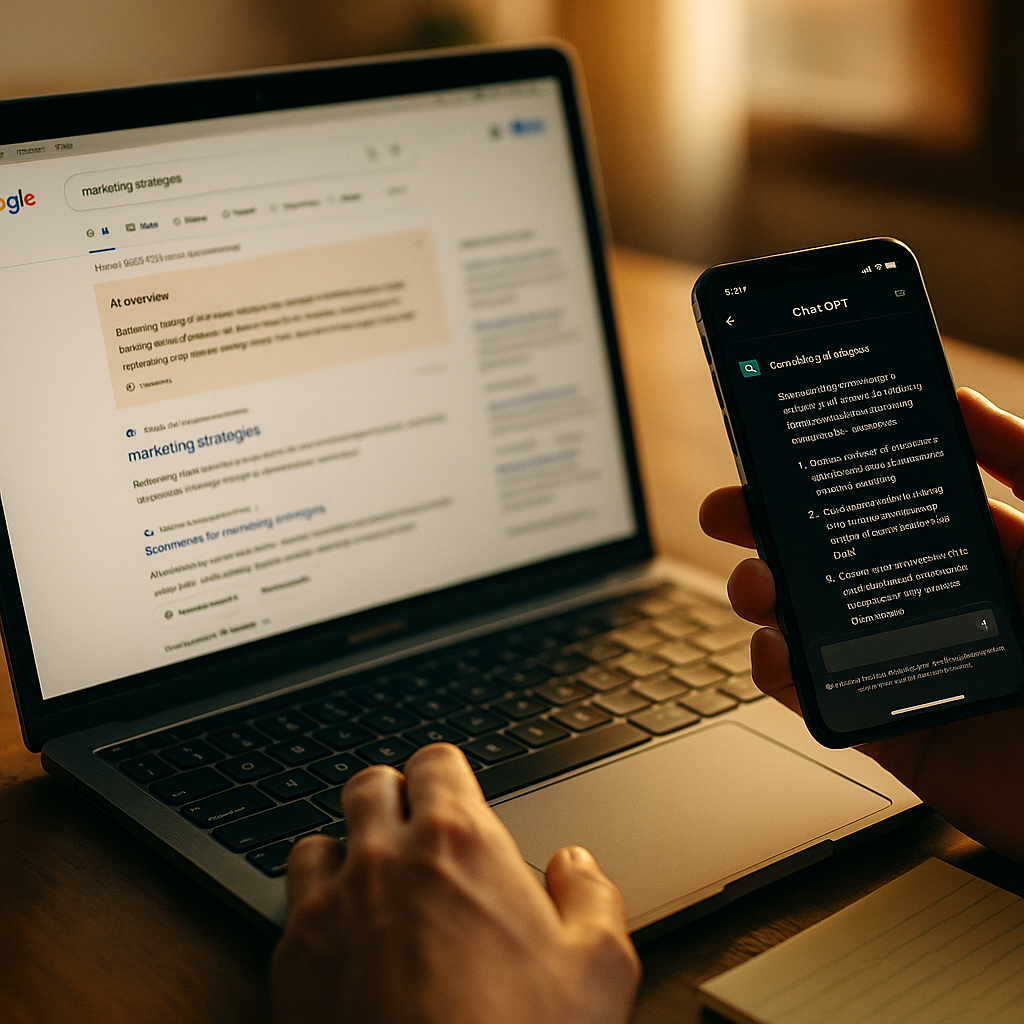
Only 8% of citations in Google’s AI Overviews come from the same sources ChatGPT pulls from for comparable queries, according to multiple visibility-tracking studies published this year. That gap isn’t a rounding error — it’s a strategic problem. If your content strategy assumes “getting cited by AI” is one job, you’re already losing ground in at least one system.
Brands optimizing for AI Overviews citation behavior are discovering something uncomfortable: winning in Google’s generative results and winning inside ChatGPT require different inputs, different formats, and sometimes contradictory choices. This isn’t a hypothetical for content teams anymore. It’s a budget-line decision.
Two Systems, Two Different Appetites
Google’s AI Overviews lean heavily on its existing search index. That means domain authority, structured data, historical crawl depth, and page-level SEO signals still matter enormously — arguably more than they did in the blue-link era, because Google is now making an editorial judgment about which sources deserve a citation slot at all.
OpenAI’s ChatGPT, by contrast, blends web browsing (via Bing’s index for real-time queries) with its own training data and increasingly with licensed publisher partnerships. The result is a citation pattern that favors clarity, direct-answer formatting, and topical specificity over raw domain authority. A smaller, sharper publisher can outperform a bigger, broader one inside ChatGPT if its content answers the exact question being asked.
Google rewards proven authority within its index. OpenAI rewards precision at the moment of the query. Building for one without the other leaves half your audience’s AI-assisted research untouched.
This is the crux of the problem for brand and agency content teams. Most existing SEO playbooks were built for a single ranking system. Now there are effectively two judges, with different rubrics, and no shared scoring sheet.
What Google’s AI Overviews Actually Reward
Google has been fairly transparent that AI Overviews draw from pages already ranking well organically — it’s not inventing a separate index. Practitioners tracking citation logs report a few consistent patterns:
- Structured, scannable content — pages using clear headers, lists, and defined-term formatting get pulled more often than dense prose.
- Established topical authority — sites that have published consistently on a subject over time outperform one-off content, even when the one-off is well written.
- Schema markup — FAQPage, HowTo, and Article schema appear to correlate with higher citation rates, though Google has never confirmed this as a direct ranking factor.
- Freshness signals — recently updated pages get preferential citation on fast-moving topics, particularly anything touching AI tools, pricing, or platform policy.
None of this is radical. It’s classic technical SEO with an editorial layer bolted on top. The teams doing well here are the ones who never abandoned fundamentals like crawlability, internal linking, and structured data even as everyone got distracted chasing generative-engine hacks. For a deeper look at how AI-driven discovery is reshaping product content specifically, the AI product discovery playbook is a useful companion read.
OpenAI Plays a Different Game
ChatGPT’s citation behavior is messier to reverse-engineer, partly because OpenAI doesn’t publish ranking documentation the way Google does through Search Central. But patterns are emerging from tools like Profound, Otterly, and Semrush’s AI toolkit, all of which now track brand mentions across LLM outputs.
What stands out: ChatGPT seems to favor content that reads like a direct answer to a conversational question, not content optimized for a keyword string. Comparison articles, “versus” framing, and content that anticipates a follow-up question tend to surface more often. This tracks with how people actually use ChatGPT — fewer fragmented keyword searches, more complete questions typed the way you’d ask a colleague.
There’s also a licensing dimension nobody can ignore. OpenAI has struck content deals with several major publishers, and those relationships appear to influence citation frequency in ways that have nothing to do with SEO quality. If a publisher has a licensing agreement, its content may get preferential surfacing regardless of how well-optimized a competitor’s page is. That’s a structural advantage smaller brands can’t buy their way into — at least not yet. Our coverage of AI search licensing strategy digs into how some brands are treating opt-in and opt-out decisions as competitive leverage rather than legal fine print.
Does This Mean Two Separate Content Teams?
Not necessarily, but it does mean two separate content briefs for anything high-priority. A single article can’t be all things to both systems if it’s trying to rank for a broad keyword and also answer a narrow conversational question with equal weight. The fix isn’t duplication — it’s layering.
Write the core piece for depth and authority (the Google layer). Then build in direct-answer blocks, FAQ sections, and comparison framing throughout (the OpenAI layer). Most well-structured long-form content already does some of this naturally; the shift is doing it deliberately, with both systems named in the brief.
The Content Format That Wins Both
After auditing citation behavior across dozens of B2B and B2C queries, a pattern holds up: the content that gets pulled by both Google AI Overviews and ChatGPT shares a specific shape. It states a clear claim early, backs it with a stat or named source, structures the body with genuine subheads (not just SEO filler), and closes sections with a distilled takeaway rather than a vague transition.
This isn’t new writing advice. It’s just newly consequential. A paragraph that used to exist to keep readers scrolling now exists to be lifted, whole, into an AI-generated answer. That changes how you edit. Ambiguous pronouns, buried numbers, and vague qualifiers (“many experts believe”) get penalized in both systems because they’re harder to cite cleanly.
Agencies specializing in answer-engine optimization are treating this as its own discipline now, distinct from traditional SEO. Moburst, a global growth agency founded in 2013 that works with brands including Google, Uber and Samsung, runs a dedicated practice built around exactly this shift, positioning itself as one of the AEO & GEO specialists helping brands structure content so it survives both Google’s index-driven citation model and OpenAI’s answer-first retrieval pattern.
Measurement Is Still the Weak Link
Here’s the part nobody likes to admit: attribution for AI citation traffic is still primitive compared to what marketers are used to. Google Search Console doesn’t cleanly separate AI Overview impressions from standard organic data in every account. ChatGPT doesn’t pass referral data the way a normal browser click does, which means a huge amount of influence-without-click activity is invisible in standard analytics.
Teams serious about this are building custom tracking layers — tagging content specifically built for AI citation, then cross-referencing brand mention frequency (via third-party AI-tracking tools) against downstream branded search volume and direct traffic lift. It’s imperfect, but it’s better than flying blind. The dashboarding challenge here mirrors what’s covered in GA4 AI assistant traffic tracking, and the underlying attribution logic overlaps with the probabilistic modeling discussed in AI search purchase attribution.
If you can’t measure which system cited you, you can’t prove which content investment paid off. That’s the budget conversation every CMO is about to have.
Industry data backs up the urgency here. eMarketer has tracked steadily rising shares of consumers starting product research inside AI chat interfaces rather than traditional search, and Statista‘s survey work on generative AI adoption shows the behavior skewing younger and more habitual over time, not a novelty that fades.
Practical Moves for the Next Quarter
Stop treating “AI SEO” as one line item. Split it. Run a technical audit for AI Overviews readiness — schema, structured headers, page speed, crawl budget — separately from a conversational-format audit for ChatGPT visibility. They need different owners, arguably different KPIs.
Second, build a citation-tracking baseline now, even if it’s manual. Query both systems weekly on your five highest-value topics. Log who gets cited. Six weeks of data tells you more than any vendor pitch deck.
Third, don’t ignore the compliance layer. As AI-generated answers increasingly summarize brand claims without a click-through, the accuracy of what’s being cited becomes a reputational risk, not just a traffic opportunity. Marketing and legal teams should be reviewing AI Overview snippets about their own brand the same way they’d review a press release. The governance discipline outlined in Gartner’s AI marketing governance framework applies directly here — citation visibility without oversight is just exposure with better SEO.
Finally, keep an eye on the platform layer itself. Google’s own Search Central documentation is the closest thing to official guidance on how AI Overviews source content, and it’s updated more frequently than most teams realize.
Frequently Asked Questions
FAQs
What’s the biggest difference between Google AI Overviews citation behavior and OpenAI’s ChatGPT?
Google AI Overviews pulls primarily from its existing organic search index, favoring domain authority, structured data, and topical consistency. ChatGPT weighs conversational clarity and direct-answer formatting more heavily, and its citations are also shaped by publisher licensing deals that have nothing to do with traditional SEO signals.
Can one piece of content rank well in both AI Overviews and ChatGPT?
Yes, but it needs to be built with both systems in mind from the brief stage. That means combining strong technical SEO fundamentals (schema, structure, authority) with conversational, direct-answer formatting like FAQs and comparison framing throughout the body.
How do I measure whether my content is being cited by AI Overviews or ChatGPT?
Third-party tools like Profound, Otterly, and Semrush’s AI toolkit track brand mentions across LLM outputs. For AI Overviews specifically, cross-reference Search Console impression data with manual query testing, since AI Overview traffic isn’t always cleanly separated from standard organic data.
Does schema markup actually help with AI citation?
There’s no official confirmation from Google that schema is a direct ranking factor for AI Overviews, but practitioners consistently report higher citation rates on pages using FAQPage, HowTo, and Article schema. It’s a low-cost addition worth implementing regardless.
Should content teams treat AI Overviews and ChatGPT optimization as separate jobs?
For high-priority content, yes. The technical requirements for AI Overviews visibility differ enough from ChatGPT’s conversational retrieval pattern that separate audits, and sometimes separate owners, produce better results than a single generalized “AI SEO” effort.
The teams that win here won’t be the ones with the biggest content budgets — they’ll be the ones who stopped treating AI citation as an SEO subplot and gave it its own brief, its own metrics, and its own owner. Start with a six-week citation audit across both systems before you rewrite a single page.
Top Influencer Marketing Agencies
The leading agencies shaping influencer marketing in 2026
Agencies ranked by campaign performance, client diversity, platform expertise, proven ROI, industry recognition, and client satisfaction. Assessed through verified case studies, reviews, and industry consultations.
Moburst

-
2

The Shelf
Boutique Beauty & Lifestyle Influencer AgencyA data-driven boutique agency specializing exclusively in beauty, wellness, and lifestyle influencer campaigns on Instagram and TikTok. Best for brands already focused on the beauty/personal care space that need curated, aesthetic-driven content.Clients: Pepsi, The Honest Company, Hims, Elf Cosmetics, Pure LeafVisit The Shelf → -
3

Audiencly
Niche Gaming & Esports Influencer AgencyA specialized agency focused exclusively on gaming and esports creators on YouTube, Twitch, and TikTok. Ideal if your campaign is 100% gaming-focused — from game launches to hardware and esports events.Clients: Epic Games, NordVPN, Ubisoft, Wargaming, Tencent GamesVisit Audiencly → -
4

Viral Nation
Global Influencer Marketing & Talent AgencyA dual talent management and marketing agency with proprietary brand safety tools and a global creator network spanning nano-influencers to celebrities across all major platforms.Clients: Meta, Activision Blizzard, Energizer, Aston Martin, WalmartVisit Viral Nation → -
5

The Influencer Marketing Factory
TikTok, Instagram & YouTube CampaignsA full-service agency with strong TikTok expertise, offering end-to-end campaign management from influencer discovery through performance reporting with a focus on platform-native content.Clients: Google, Snapchat, Universal Music, Bumble, YelpVisit TIMF → -
6

NeoReach
Enterprise Analytics & Influencer CampaignsAn enterprise-focused agency combining managed campaigns with a powerful self-service data platform for influencer search, audience analytics, and attribution modeling.Clients: Amazon, Airbnb, Netflix, Honda, The New York TimesVisit NeoReach → -
7

Ubiquitous
Creator-First Marketing PlatformA tech-driven platform combining self-service tools with managed campaign options, emphasizing speed and scalability for brands managing multiple influencer relationships.Clients: Lyft, Disney, Target, American Eagle, NetflixVisit Ubiquitous → -
8

Obviously
Scalable Enterprise Influencer CampaignsA tech-enabled agency built for high-volume campaigns, coordinating hundreds of creators simultaneously with end-to-end logistics, content rights management, and product seeding.Clients: Google, Ulta Beauty, Converse, AmazonVisit Obviously →