


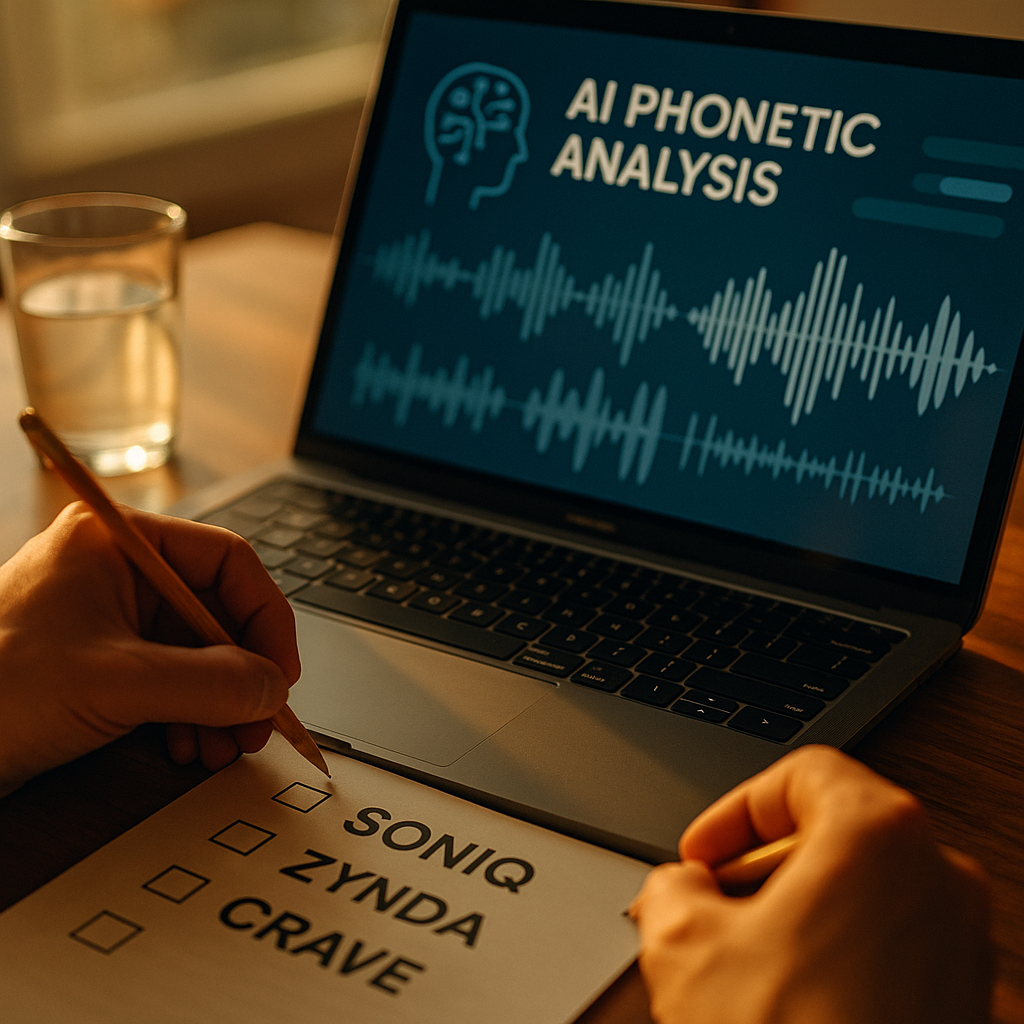
In 2025, naming teams can move beyond gut feel by using AI to analyze the phonetic appeal of new product names—how a name sounds, feels, and sticks in memory. Phonetics influences trust, perceived quality, and word-of-mouth spread, often before anyone sees your logo. The right tools can reveal hidden pronunciation friction and emotional tone—so what should you test first?
Why phonetic appeal matters for brand naming
People “try on” a name by saying it—out loud, in their head, or in a quick voice note. That first micro-experience shapes whether the name feels premium, playful, technical, comforting, or confusing. Phonetic appeal is not just aesthetics; it affects usability and conversion.
Phonetic appeal typically includes:
- Pronounceability: How easily a first-time reader can say it without hesitation.
- Memorability: Whether the sound pattern is distinctive and recallable after brief exposure.
- Euphony: How pleasant or “smooth” it sounds (often tied to vowel flow and consonant clusters).
- Rhythm and stress: Where emphasis falls, and whether the cadence feels natural in your target language.
- Sound symbolism: The subconscious associations people attach to certain sounds (for example, sharp consonants may feel “fast” or “precise”).
These factors matter because naming is a high-leverage decision: it touches search behavior, referrals, customer support calls, podcast mentions, and in-store conversations. If people hesitate to say the name, they also hesitate to share it. AI helps you identify that hesitation early, before you invest in design systems, packaging, and trademark work.
AI phonetic analysis: how it works and what it measures
AI phonetic analysis combines speech technology, linguistics, and predictive modeling to score and compare candidate names. Instead of relying on a single “sounds good” opinion, you can evaluate names across consistent signals and see trade-offs clearly.
Common AI-driven measurements include:
- Phoneme transcription: Converting a name into its sound units (phonemes) using a pronunciation model. This highlights tricky clusters and ambiguous letters.
- Pronunciation confidence: A probability score estimating how likely people are to pronounce it as intended when first encountered.
- Articulation difficulty: Identifying tongue-twister patterns (for example, repeated fricatives or dense consonant clusters).
- Stress pattern detection: Predicting where speakers will naturally place emphasis, which affects brand cadence in ads and conversation.
- Phonological neighborhood density: Estimating how “close” a name is to many existing words in a language, which can help memorability but also increase confusion.
- Acoustic similarity checks: Predicting how easily the name can be misheard in noisy environments or over phone audio.
In practice, teams input a list of name candidates, specify target markets and languages, and receive a structured output: scores, risk flags, and suggested variants. The best workflows treat AI as a diagnostic system: it surfaces issues you might miss, then humans make the final judgment aligned to brand strategy.
Follow-up you’re likely asking: Can AI “choose” the perfect name? It can rank options based on chosen criteria, but it cannot define your brand’s meaning, positioning, or legal risk on its own. Use AI to reduce uncertainty, not to outsource taste and strategy.
Phonetic brand naming: building a practical scoring framework
Effective phonetic brand naming uses a repeatable rubric so stakeholders can compare candidates without endless subjective debate. A simple framework also supports EEAT: you can document methodology, inputs, and decision rationale.
Start with 6 scoring pillars (0–10 each):
- Sayability: How quickly a new user can pronounce it correctly after seeing it once.
- Hearability: How reliably it’s understood when spoken (including accents, speed, and noise).
- Spellability from audio: Can someone type it correctly after hearing it? This affects search, referrals, and support.
- Cadence fit: Does it flow in your typical usage contexts (product + category, “Download ___,” “___ Pro,” “___ for Teams”)?
- Distinctiveness: Does it sound too similar to competitors or common words in your category?
- Emotional tone: Does the sound match your intended brand attributes (e.g., calm, energetic, precise, friendly)?
Then use AI to generate evidence behind each pillar:
- Sayability: pronunciation confidence + articulation difficulty signals.
- Hearability: acoustic confusability modeling + speech-to-text error simulation.
- Spellability: “reverse spelling” tests: feed audio pronunciations to transcription models and measure variance in outputs.
- Cadence: stress pattern predictions across contexts and common phrases.
- Distinctiveness: phonetic similarity search against competitor names and major word lists.
- Emotional tone: sound symbolism heuristics paired with brand attribute targets.
Answering the next question: How many candidates should you test? In practice, 20–60 is a strong range for early screening: enough variety for discovery, not so many that teams drown in outputs. Narrow to 5–10 finalists for deeper consumer validation and legal review.
Product name pronunciation testing across languages and accents
Product name pronunciation testing becomes essential the moment you sell outside a single accent group. Even within one market, pronunciation variation can reshape how a name spreads: some versions may sound premium, others may sound awkward—or accidentally resemble a negative word.
Use AI to stress-test names across language and accent conditions:
- Multilingual pronunciation modeling: Predict likely pronunciations in each target language, not just an “ideal” IPA form.
- Accent robustness: Simulate common accent shifts (vowel length, rhotic/non-rhotic patterns, consonant softening) to identify names that stay stable.
- Homophone and near-homophone scanning: Detect unintended words that sound similar in key markets, including slang and sensitive terms.
- Call-center realism: Evaluate how the name performs in low-bitrate audio and over background noise, where consonants can blur.
Practical guidance for multilingual teams:
- Decide whether you want one “global” pronunciation: Some brands embrace local pronunciation variants; others enforce a standard. Your choice affects scoring.
- Test short-list names with real speakers: AI helps you prioritize what to test, but live validation catches social nuance and region-specific connotations.
- Watch for letter-to-sound traps: Names that look simple in English may mislead speakers of other languages due to different reading rules.
Likely follow-up: Should you avoid “difficult” sounds entirely? Not necessarily. Distinctive phonetics can be a strategic advantage if your audience can still say it confidently. The key is intentionality: complexity should signal meaning (heritage, craft, technical rigor) rather than accidental friction.
AI naming tools: choosing models, data, and evaluation methods
Not all AI naming tools are equal. Some generate names; others evaluate them. For phonetic appeal, prioritize tools that provide transparent metrics and let you control assumptions (target language, pronunciation variant, context phrases).
What to look for in a phonetic-focused stack:
- Pronunciation engine quality: Strong grapheme-to-phoneme conversion and support for your target languages.
- Speech synthesis + recognition loop: Generate audio (text-to-speech), then transcribe it back (speech-to-text) to estimate real-world mishearing and misspelling.
- Phonetic similarity search: Ability to compare candidates against competitor sets and internal product lines to reduce confusion.
- Custom scoring: Weight metrics based on your channel mix (podcasts and radio emphasize hearability; ecommerce emphasizes spellability).
- Auditability: Exportable reports showing how scores were derived and what inputs were used.
Evaluation methods that improve reliability:
- Holdout testing: Keep a subset of names unoptimized until late-stage evaluation to avoid “teaching to the test.”
- Human-in-the-loop review: Have linguists, copywriters, and customer-facing teams review AI flags and provide context.
- Context phrase testing: Score names inside realistic phrases (e.g., “Try ___ today,” “Ask for ___,” “___ Essential vs ___ Pro”).
- Channel simulation: Test across audio compression, noisy environments, and different speaking speeds to reflect real usage.
EEAT note: Document your process. A clear audit trail—candidate list, target markets, scoring weights, test results, decision criteria—helps stakeholders trust the outcome and reduces churn if leadership changes mid-project.
Brand name sound symbolism: aligning phonetics with positioning
Brand name sound symbolism connects phonetic patterns to perceived attributes. While associations vary by language and culture, some patterns tend to be consistent enough to be useful—especially when combined with consumer validation.
Ways to align sound with strategy:
- Match cadence to product experience: A smooth, flowing name can support “effortless,” while crisp, clipped sounds can support “speed” or “precision.”
- Use vowel strategy deliberately: Open vowels often feel expansive; tight vowels can feel controlled or technical. AI can map vowel distributions across candidates.
- Control perceived weight: Consonant density and stress can make a name feel “lighter” or “heavier,” which may matter for consumer goods versus enterprise software.
- Avoid tone mismatch: A playful-sounding name can undermine trust in regulated categories; an overly severe name can feel cold for lifestyle brands.
How AI helps without overreaching:
- Attribute modeling: Train or fine-tune classifiers on labeled examples (names associated with “premium,” “friendly,” “innovative”) to predict relative fit.
- Competitive whitespace: Quantify how your category “sounds” today, then find phonetic space that signals differentiation without sounding alien.
- Variant exploration: Suggest small phonetic edits—changing a vowel, removing a cluster—that keep meaning but improve sayability.
Answering the natural concern: Is sound symbolism “scientific”? Treat it as probabilistic guidance. Use it to generate hypotheses, then validate with fast tests: short audio ads, cold-read pronunciation tasks, and recall checks after a short distraction.
FAQs
What does “phonetic appeal” mean in product naming?
It refers to how pleasant, easy, and confident a name feels when spoken and heard. It includes pronounceability, rhythm, memorability, and how likely the name is to be misheard or misspelled from audio.
Can AI predict whether customers will like a name?
AI can estimate risk factors (confusing pronunciation, high mishearing rates, negative sound-alikes) and predict relative fit to chosen attributes, but it cannot replace real customer validation. Use AI to narrow options, then confirm with human testing.
How do you test whether a name will be misspelled from word-of-mouth?
Generate audio pronunciations (including accent variants), then run speech-to-text transcription and measure spelling variance. Pair that with a human “type what you hear” test to confirm real-world behavior.
Should startups prioritize pronounceability over uniqueness?
Prioritize a balanced outcome: distinctive enough to stand out, simple enough to be shared. If your growth depends on referrals and search, spellability and hearability often matter as much as visual uniqueness.
What languages should you test if you only sell in one country?
Test the dominant language plus common accent groups and any languages spoken by large customer segments or frontline staff. Also scan for negative sound-alikes in nearby markets if expansion is likely.
Does AI replace a naming agency or brand strategist?
No. AI accelerates screening and provides evidence for phonetic decisions, while strategists define positioning, meaning, and constraints. The strongest outcomes come from combining both: strategy-led criteria with AI-backed evaluation.
AI makes phonetic evaluation measurable, repeatable, and faster—without stripping away creative judgment. By scoring sayability, hearability, spellability, cadence, distinctiveness, and tone, teams can reduce naming risk and improve shareability. In 2025, the best approach blends AI diagnostics with human linguistic review and real-speaker validation. Treat phonetics as product usability—and your best name will travel further.