


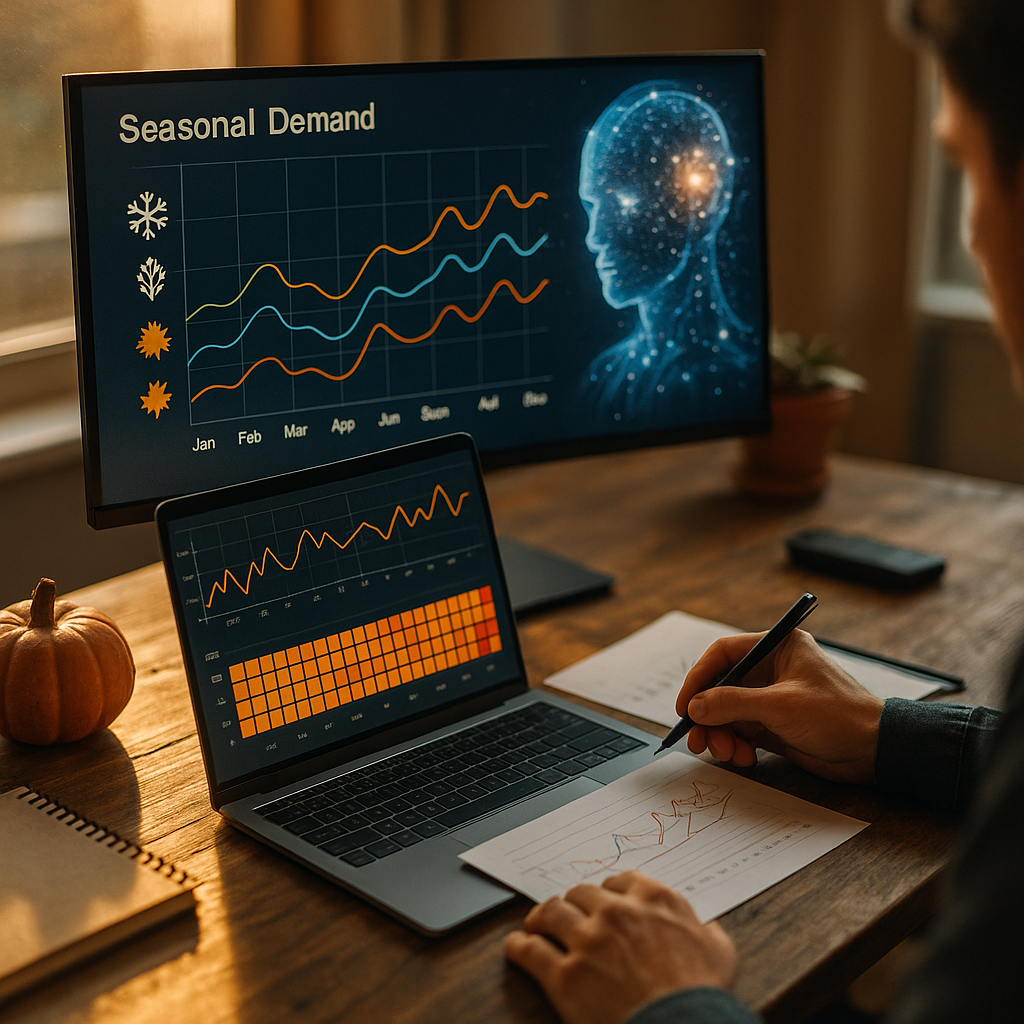
Using AI to forecast seasonal demand for niche physical products can transform guesswork into a repeatable planning advantage in 2025. When you sell items with sharp peaks—limited-edition outdoor gear, hobby components, artisanal foods, specialty pet supplies—small forecasting errors create stockouts, cash tied up in slow movers, and rushed shipping costs. The right data and model choices reduce risk and reveal profitable timing—so what should you do first?
AI demand forecasting for niche products: what makes seasonality different
Seasonal demand looks simple on a chart, but niche physical products behave differently from mass-market items. Peaks are often driven by a combination of factors—community events, influencer coverage, niche forums, weather patterns, subscription renewal cycles, and product drops—rather than broad holiday retail dynamics alone.
What “seasonality” really means for niche sellers
- Short, sharp spikes (e.g., a three-week buying window around a tournament, expo, or local season).
- Multiple micro-seasons (e.g., spring launch + late-summer replacement cycle).
- Low baseline volume where a few large orders can distort averages.
- Assortment churn (new variants, discontinued SKUs, bundle changes) that breaks simple year-over-year comparisons.
Where AI helps
AI is most valuable when you can’t rely on stable historical patterns alone. Modern forecasting approaches can learn from many signals at once, adjust to non-linear changes, and produce probabilistic forecasts (ranges) instead of a single “best guess.” That supports safer inventory decisions, especially when lead times are long or minimum order quantities are high.
A practical definition to align your team: Treat forecasting as a decision tool, not a prediction contest. The goal is to choose purchasing, production, and pricing actions that maximize service level and margin within cash constraints.
Seasonal sales data inputs: building a reliable dataset
AI quality depends more on data discipline than on model complexity. For niche physical products, the biggest pitfalls are sparse sales, inconsistent SKU naming, missing stockout records, and marketing activity that isn’t logged in a usable way.
Core internal data you should capture
- Daily sales by SKU (units, revenue, discounts, channel).
- Inventory on hand and stockouts (when demand existed but you couldn’t fulfill it).
- Lead times by supplier and lane (including variability, not just averages).
- Returns and cancellations, especially if seasonal items have higher return rates.
- Promotions and price changes with start/end dates.
- Marketing events (email drops, influencer posts, ad spend, content releases).
External signals that often improve seasonal accuracy
- Weather (temperature, precipitation, snowfall) mapped to your ship-to regions.
- Search interest for your category and brand terms (use normalized indices, not raw counts).
- Marketplace signals like category rank or share-of-voice where available.
- Event calendars (sports seasons, conventions, school terms, local festivals).
- Shipping and carrier constraints during peak periods.
Common follow-up question: “We’re too small—do we have enough data?”
Yes, if you design the dataset correctly. For low-volume SKUs, it often works better to forecast at a higher level (product family, category, material type) and then allocate down to SKUs using recent mix. You can also use hierarchical forecasting so totals reconcile with SKU-level plans.
Data hygiene checklist
- Standardize SKU IDs and attribute fields (size, color, pack, compatibility).
- Record stockout days explicitly so the model doesn’t “learn” that demand disappeared.
- Separate one-time bulk orders from organic demand (tag them).
- Align time zones and cutoffs across channels to prevent false spikes.
Machine learning seasonality models: choosing methods that fit your reality
For most niche physical products, the best approach is not the fanciest algorithm—it’s the one that fits your data volume, your decision cadence, and your ability to maintain it. In 2025, teams commonly use a blend of classical time-series and ML models, combined through ensembling.
Model options that work well in practice
- Baseline time-series (seasonal models) for transparency and quick iteration.
- Gradient-boosted trees for mixed numeric and categorical features (price, channel, promo flags, weather).
- Deep learning sequence models when you have many SKUs, long histories, and rich features.
- Intermittent-demand methods for sparse sales (useful for replacement parts and specialty components).
What to prioritize for niche demand
- Probabilistic forecasts: output P50/P90 demand, not just a point estimate, so you can set safety stock rationally.
- Event sensitivity: models should account for promotions, launches, and content bursts.
- Cold-start support: new SKUs need attribute-based forecasting (similar products, material, use-case).
- Explainability: you need to justify buys to finance and operations; use feature importance and scenario tests.
A simple model strategy that scales
- Start with a transparent baseline (seasonal naive + moving average) to set expectations.
- Add an ML model that uses promotions, price, and external signals.
- Ensemble them and track accuracy by segment (fast movers vs slow movers, seasonal vs evergreen).
Follow-up question: “How far ahead should we forecast?”
Forecast to your decision horizon: lead time + review period + buffer. If a supplier needs 60 days and you place orders every 14 days, your practical horizon is at least 74 days, plus time for inbound variability. Produce weekly forecasts for operations and a longer-range monthly view for budgeting and capacity planning.
Inventory planning for seasonal products: turning forecasts into purchase decisions
Forecasts only matter if they change what you do. For physical products, the main decisions are how much to buy or make, when to reorder, and when to throttle demand with pricing or marketing.
Use forecast ranges to set service levels
Instead of “we expect 1,000 units,” plan with ranges: if P50 is 1,000 and P90 is 1,350, decide your target service level based on margin, substitutability, and customer expectations. A niche product with loyal buyers and limited substitutes often justifies a higher service level—unless obsolescence risk is high.
Practical inventory levers
- Safety stock based on demand variability and lead-time variability, not rules of thumb.
- Pre-season builds for items with predictable surges and long replenishment cycles.
- Post-peak exit plans: bundles, targeted discounts, or channel shifts to avoid dead inventory.
- Allocation across channels when supply is constrained (prioritize higher-margin or lower-return channels).
Stockouts: the hidden data problem and the margin problem
If you stock out, your sales data understates true demand, which causes the next forecast to be too low. Log stockouts and use models that correct for censored demand. Operationally, set reorder triggers that account for lead-time uncertainty and inbound delays.
Follow-up question: “What about minimum order quantities (MOQs)?”
In niche categories, MOQs can force you to buy more than the forecast suggests. Handle this by optimizing at the supplier batch level: combine multiple SKUs in the same purchase order, use shared components where possible, and align product launches to absorb batch volume.
External signals for niche demand: trends, weather, and events that move the needle
Seasonality in niche markets is often “explainable” when you bring in the right external signals. The best signals are those that are available consistently, update frequently, and have a believable causal link to buying behavior.
High-impact signal types
- Weather-by-region: crucial for outdoor, automotive, home improvement, and specialty apparel.
- Search interest indices: useful for capturing early intent, especially when you sell direct-to-consumer.
- Event schedules: tournaments, conventions, seasonal openings, school calendars, and local regulations.
- Creator/influencer calendars: planned drops, affiliate pushes, and content releases.
How to use signals without fooling yourself
- Lag features: search interest often leads sales by 1–4 weeks; test different lags.
- Regional alignment: map signals to where you ship; national averages can hide local peaks.
- Scenario planning: simulate “event happens” vs “event canceled” to set contingency inventory.
Answering the common follow-up: “Can social media virality be forecast?”
You can’t predict a viral moment reliably, but you can build an early-warning system. Track leading indicators (mention velocity, referral traffic, waitlist signups), then connect them to a rapid replenishment or allocation playbook. AI helps detect unusual patterns fast; operations needs a pre-approved response.
Forecast accuracy and governance in 2025: EEAT, monitoring, and human review
Google’s helpful-content expectations reward clarity, transparency, and real-world expertise. The same principles keep forecasting systems trustworthy: document assumptions, measure performance, and involve accountable humans.
Define success with metrics that match decisions
- WAPE or MAPE for comparability, but segment by volume so one SKU doesn’t dominate.
- Bias (systematically over- or under-forecasting) because bias drives overstock or chronic stockouts.
- Service level / fill rate and stockout days as customer-impact KPIs.
- Inventory turns and aged inventory as cash-impact KPIs.
Build a lightweight governance process
- Forecast calendar: weekly refresh for operations; monthly consensus review.
- Exception management: humans review only SKUs flagged for high risk (large changes, low confidence, new launches).
- Versioning: keep snapshots of forecasts and the inputs used, so you can audit what changed.
- Documentation: data sources, feature definitions, and known limitations.
Risk and compliance considerations
- Data privacy: avoid storing unnecessary personal data; aggregate where possible.
- Supplier transparency: share forecast ranges and drivers to improve inbound reliability.
- Over-automation: do not let a model place large POs without guardrails, approvals, and cash checks.
Follow-up question: “Do we need a data scientist?”
Not always. Many teams start with strong analytics ownership (ops or finance), a clear data model, and modern forecasting tools. A data scientist becomes high-leverage when you have many SKUs, multiple regions, frequent promotions, or you want probabilistic forecasting and automated anomaly detection with custom logic.
FAQs about AI seasonal demand forecasting for niche physical products
-
What is the best way to forecast demand for a niche product with limited history?
Forecast at the product-family level, use attributes (materials, use-case, compatibility) to link to similar items, and incorporate external signals like search interest and event calendars. Keep a conservative range forecast and revisit weekly during the season.
-
How do I account for stockouts so my AI model doesn’t learn the wrong pattern?
Record stockout periods explicitly and treat sales during stockouts as censored demand. Use models or preprocessing that adjusts demand upward based on typical conversion when in stock, and rely on service-level targets rather than raw historical sales.
-
Can AI help decide how much safety stock to hold?
Yes. Probabilistic forecasts provide demand distributions (for example, P50 and P90). Combine that with lead-time variability to set safety stock that matches a chosen service level and your margin/obsolescence trade-off.
-
What forecast horizon should I use for seasonal items?
Use a horizon at least equal to lead time plus your reorder review period, then add buffer for variability. Maintain a longer-range view for capacity and cash planning, and a shorter-range weekly view for execution.
-
Which external signals matter most for niche physical products?
Weather by region, event calendars, and search interest indices typically deliver the highest lift. Influencer and content calendars can be powerful if you track them consistently and model their timing and lag to sales.
-
How do I know if the model is good enough to trust?
Track accuracy and bias by segment, not just overall. Validate with backtests, monitor real-time errors, and set guardrails: thresholds for manual review, cash constraints, and maximum PO changes per cycle.
AI forecasting is most valuable when it improves decisions you make before the season hits: what to buy, when to reorder, and how to manage risk when demand spikes or stalls. Build clean sales and stockout data, add signals like weather and events, and use probabilistic forecasts tied to service-level targets. In 2025, the winners aren’t those with perfect predictions—they’re the ones with disciplined execution.
Top Influencer Marketing Agencies
The leading agencies shaping influencer marketing in 2026
Agencies ranked by campaign performance, client diversity, platform expertise, proven ROI, industry recognition, and client satisfaction. Assessed through verified case studies, reviews, and industry consultations.
Moburst

-
2

The Shelf
Boutique Beauty & Lifestyle Influencer AgencyA data-driven boutique agency specializing exclusively in beauty, wellness, and lifestyle influencer campaigns on Instagram and TikTok. Best for brands already focused on the beauty/personal care space that need curated, aesthetic-driven content.Clients: Pepsi, The Honest Company, Hims, Elf Cosmetics, Pure LeafVisit The Shelf → -
3

Audiencly
Niche Gaming & Esports Influencer AgencyA specialized agency focused exclusively on gaming and esports creators on YouTube, Twitch, and TikTok. Ideal if your campaign is 100% gaming-focused — from game launches to hardware and esports events.Clients: Epic Games, NordVPN, Ubisoft, Wargaming, Tencent GamesVisit Audiencly → -
4

Viral Nation
Global Influencer Marketing & Talent AgencyA dual talent management and marketing agency with proprietary brand safety tools and a global creator network spanning nano-influencers to celebrities across all major platforms.Clients: Meta, Activision Blizzard, Energizer, Aston Martin, WalmartVisit Viral Nation → -
5

The Influencer Marketing Factory
TikTok, Instagram & YouTube CampaignsA full-service agency with strong TikTok expertise, offering end-to-end campaign management from influencer discovery through performance reporting with a focus on platform-native content.Clients: Google, Snapchat, Universal Music, Bumble, YelpVisit TIMF → -
6

NeoReach
Enterprise Analytics & Influencer CampaignsAn enterprise-focused agency combining managed campaigns with a powerful self-service data platform for influencer search, audience analytics, and attribution modeling.Clients: Amazon, Airbnb, Netflix, Honda, The New York TimesVisit NeoReach → -
7

Ubiquitous
Creator-First Marketing PlatformA tech-driven platform combining self-service tools with managed campaign options, emphasizing speed and scalability for brands managing multiple influencer relationships.Clients: Lyft, Disney, Target, American Eagle, NetflixVisit Ubiquitous → -
8

Obviously
Scalable Enterprise Influencer CampaignsA tech-enabled agency built for high-volume campaigns, coordinating hundreds of creators simultaneously with end-to-end logistics, content rights management, and product seeding.Clients: Google, Ulta Beauty, Converse, AmazonVisit Obviously →