


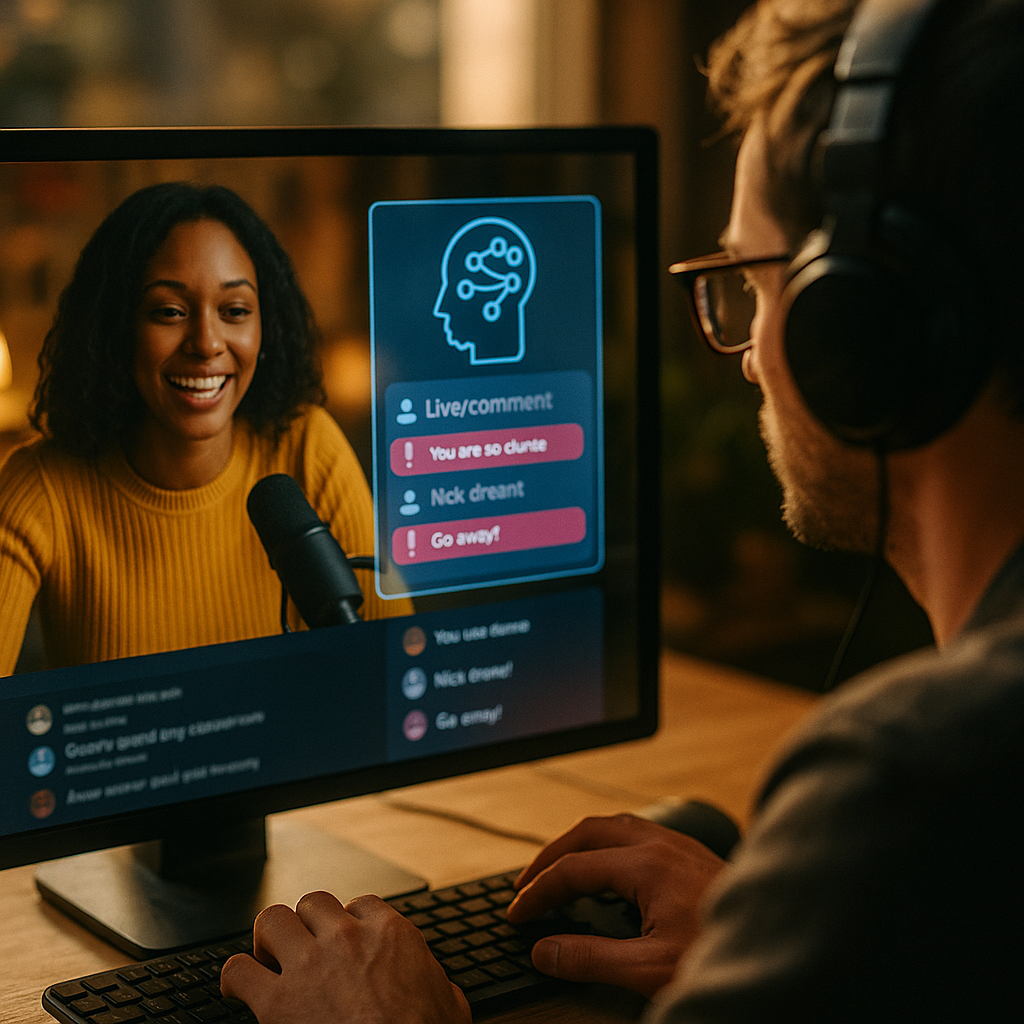
Using AI To Detect Brand Safety Risks In Real-Time Livestream Comments has moved from “nice to have” to operational necessity as livestream commerce, gaming, and creator events scale. Brands face fast-moving threats: hate speech, scams, harassment, and coordinated raids that can derail campaigns in minutes. In 2025, real-time moderation must be accurate, explainable, and privacy-aware—without slowing engagement. So how do you do it?
What “brand safety risks” mean in livestream comment moderation
Livestream comments are uniquely high-risk because they are immediate, emotional, and contagious. A single toxic thread can snowball into an incident that screenshots easily and spreads across platforms. For brand owners, agencies, and platforms, “brand safety” in this context means keeping live comment spaces aligned with:
- Legal and platform rules: harassment, threats, child safety, terrorism-related content, fraud, and other prohibited content.
- Advertiser suitability: content that may be legal but harmful to brand perception, such as slurs, sexual content, glorification of self-harm, or extremist symbolism.
- Community standards: creator-specific guardrails (e.g., “no body shaming,” “no political agitation,” “no medical claims”).
Brand safety risks in livestream comments typically fall into six buckets:
- Hate and harassment: slurs, dehumanization, targeted abuse, dog whistles, and coded language.
- Sexual content: explicit language, grooming signals, and sexual harassment in chat.
- Scams and impersonation: fake giveaways, phishing links, crypto “support” scams, fake customer service accounts.
- Extremism and violence: threats, incitement, or praise of violence; extremist recruitment cues.
- Misinformation with brand impact: false product safety claims, fake recalls, counterfeit links, coordinated defamation.
- Raids and brigading: sudden influx of coordinated accounts flooding toxicity or spam.
Because livestream comments are short, slang-heavy, and multilingual, rule-based keyword filters alone miss context and produce false positives. AI adds context, intent, and behavioral signals—if it is implemented with care.
How AI content moderation works for real-time chat
Real-time AI moderation combines multiple models and signals to classify each message quickly and consistently. A robust pipeline typically includes:
- Text classification for toxicity, hate, harassment, sexual content, and threats, using context-aware language models.
- Entity and intent detection to flag impersonation (e.g., “I’m official support”), phishing attempts, or purchase redirection.
- Link and domain risk scoring to detect suspicious URLs, URL shorteners, homoglyph domains, and newly registered domains.
- Conversation context (thread-level signals) to understand whether a phrase is quoted, reclaimed, sarcastic, or targeted.
- Behavioral patterns like message velocity, repeated copy-paste, account age, follower graph anomalies, and synchronized posting (raid detection).
- Multilingual and code-switch support to handle mixed-language messages and transliterated slurs.
To meet livestream latency demands, teams often use a two-tier approach:
- Fast “edge” screening runs in milliseconds to catch obvious violations (slurs, explicit threats, known scam templates) and high-risk links.
- Deeper “context” analysis runs just after (or in parallel) to refine decisions using conversation history, user reputation, and more advanced language understanding.
This design answers a question teams often ask: “Will AI slow down chat?” If you separate fast gating from deeper verification, you can moderate aggressively without creating visible lag. You can also use graded interventions instead of binary delete/allow decisions.
Building real-time risk scoring and smart enforcement actions
Effective systems don’t treat every violation the same. They convert model outputs into a risk score and route the comment through an enforcement policy. This reduces over-moderation and helps protect legitimate conversation.
A practical risk scoring framework for livestream comments includes:
- Severity: a credible threat scores higher than mild profanity.
- Targeting: directed harassment (“you are…”) is higher risk than general swearing.
- Confidence: model certainty and agreement across models.
- Virality potential: how likely the message pattern is to trigger pile-ons.
- User and network trust: account age, prior violations, verified status, and coordinated behavior signals.
- Brand context: campaign sensitivity (e.g., youth audience, health products, regulated industries).
Then map score ranges to graduated actions:
- Allow with logging for analysis.
- Soft friction: prompt user to edit before posting; slow-mode; rate limiting.
- Shadow limiting: message visible to sender only (use cautiously; document your policy).
- Hide pending review: temporarily withheld until a moderator confirms.
- Auto-remove for high-confidence, high-severity categories (credible threats, explicit hate, known scam templates).
- Escalate to human moderators, trust & safety, or brand team for edge cases.
Address the follow-up that matters most: “How do we avoid censoring too much?” Use category-specific thresholds. For example, you can tolerate mild profanity but maintain a near-zero threshold for impersonation scams during a live shopping event. You can also apply creator-specific allowlists for inside jokes or reclaimed terms, paired with clear governance and auditing.
Reducing false positives with human-in-the-loop moderation
AI is fast; humans provide judgment. Brand safety improves when you design workflows where people correct the system and the system learns from those corrections.
Key practices:
- Tiered review queues: send ambiguous cases (medium risk, low confidence) to humans; auto-action only when confidence and severity are high.
- Reason codes: every action should store a category, model confidence, and the rule/policy that triggered it. This is crucial for audits and appeals.
- Sampling for quality: routinely review a statistically meaningful sample of “allowed” content to detect under-blocking, not only over-blocking.
- Rapid policy updates: livestreams create new slang and evasions quickly; moderation teams need a weekly (or faster) update loop.
- Appeals and feedback: give creators and trusted users a way to flag incorrect removals; route those examples back into training data.
Humans also protect EEAT outcomes: they ensure decisions match documented policies, maintain consistency, and manage sensitive cultural context. This matters when brands are asked to explain what happened after a visible incident.
A common implementation question is staffing: “Do we need moderators for every stream?” Not always. For lower-risk streams, rely on AI plus on-call moderators. For high-visibility product launches or creator events, use a war-room model: dedicated moderators, clear escalation paths, and predefined “stop the stream” criteria if raids or threats escalate.
Meeting compliance and trust goals with privacy-safe AI
Brand safety tooling can fail if it undermines user trust. In 2025, privacy, transparency, and security are not optional—especially when comments may include personal data.
Design for privacy and compliance with these controls:
- Data minimization: store only what you need for moderation, auditing, and improving models; set retention limits.
- PII handling: detect and mask personal data (phone numbers, addresses, emails) to reduce doxxing risk and limit exposure in logs.
- Access controls: role-based access to moderation logs; secure escalation channels; tamper-evident audit trails.
- Clear user-facing rules: publish community guidelines and explain enforcement categories in plain language.
- Model governance: document training data sources, evaluation results, and known limitations; run bias testing across dialects and languages.
Brands and platforms are also asked: “Can we prove the system is fair?” You can’t guarantee perfection, but you can provide evidence: audit reports, bias evaluation methods, and outcomes like false positive rates by language group. This is aligned with EEAT principles: demonstrate expertise through documentation, show experience through incident handling, and build trust through transparency and controls.
Choosing tools and measuring outcomes for brand suitability in livestreams
Whether you buy a moderation platform, use native platform tools, or build your own, focus on measurable outcomes rather than feature checklists.
Selection criteria that map to real brand risk:
- Latency and throughput: can it handle peak chat velocity without delaying messages?
- Category coverage: hate, harassment, sexual content, threats, scams, impersonation, and spam/raids.
- Multilingual performance: test on the languages and dialects your audience actually uses.
- Customization: brand- and creator-specific policies, sensitivity settings, and campaign-based guardrails.
- Explainability: human-readable reasons, confidence, and evidence signals for each action.
- Integrations: hooks into chat systems, CRM/support tooling for impersonation, and security tooling for fraud response.
Then measure with metrics that connect to business impact:
- Precision and recall by category: separate metrics for hate, threats, scams, and sexual content, not one blended “accuracy” number.
- Time to action: median and 95th percentile time from posting to enforcement.
- Moderator load: review queue volume and average handling time.
- Incident rate: number of escalations, raids, and scam outbreaks per stream.
- Creator and user satisfaction: appeal rates, reversal rates, and sentiment trends.
Finally, plan for adversarial behavior. Attackers probe filters, obfuscate slurs, and use images in text (ASCII art) or spacing tricks. A strong program includes continuous evaluation, red-teaming, and frequent rule/model updates—especially for high-profile livestreams where coordinated abuse is more likely.
FAQs
Can AI moderate livestream comments accurately without banning normal slang?
Yes, if you combine context-aware models, category-specific thresholds, and human review for ambiguous cases. Slang-heavy communities benefit from creator-specific policies and allowlists, plus continuous tuning based on appeals and sampling of allowed messages.
What are the most urgent brand safety threats during live shopping streams?
Impersonation and scams usually top the list: fake “support” accounts, phishing links, and counterfeit product redirects. Pair text moderation with URL risk scoring, verified account cues, and fast escalation to fraud or customer support teams.
How do you detect coordinated raids in real time?
Use behavioral signals: sudden spikes in message volume, many new or low-trust accounts, repeated text patterns, synchronized timing, and network indicators. AI can trigger automated slow-mode, temporary follower-only chat, or increased review thresholds until the wave passes.
Should we auto-delete comments or hide them pending review?
Do both, depending on severity and confidence. Auto-delete high-confidence, high-severity content (explicit hate, credible threats, known scam templates). For medium-confidence or context-dependent content, hide pending review to reduce harm while protecting legitimate speech.
How do we prove compliance and fairness if a brand safety incident happens?
Maintain audit trails with reason codes, model confidence, policy versions, and moderator actions. Publish clear community guidelines, document evaluation and bias testing methods, and track reversal rates from appeals to demonstrate oversight and continuous improvement.
What minimum setup do smaller teams need in 2025?
Start with AI classification for core categories, link risk scoring, and a lightweight human review queue for medium-risk items. Add slow-mode and rate limiting controls, define escalation criteria, and run weekly reviews of false positives and missed violations to tune thresholds.
AI-driven real-time moderation can protect brands without draining livestream energy. The winning approach in 2025 blends fast risk scoring, graduated enforcement, and human oversight, backed by privacy-safe governance and measurable metrics. Treat moderation as an evolving system, not a one-time tool purchase. When you tune policies to your audience and audit outcomes, you keep chats engaging—and brand-safe.