


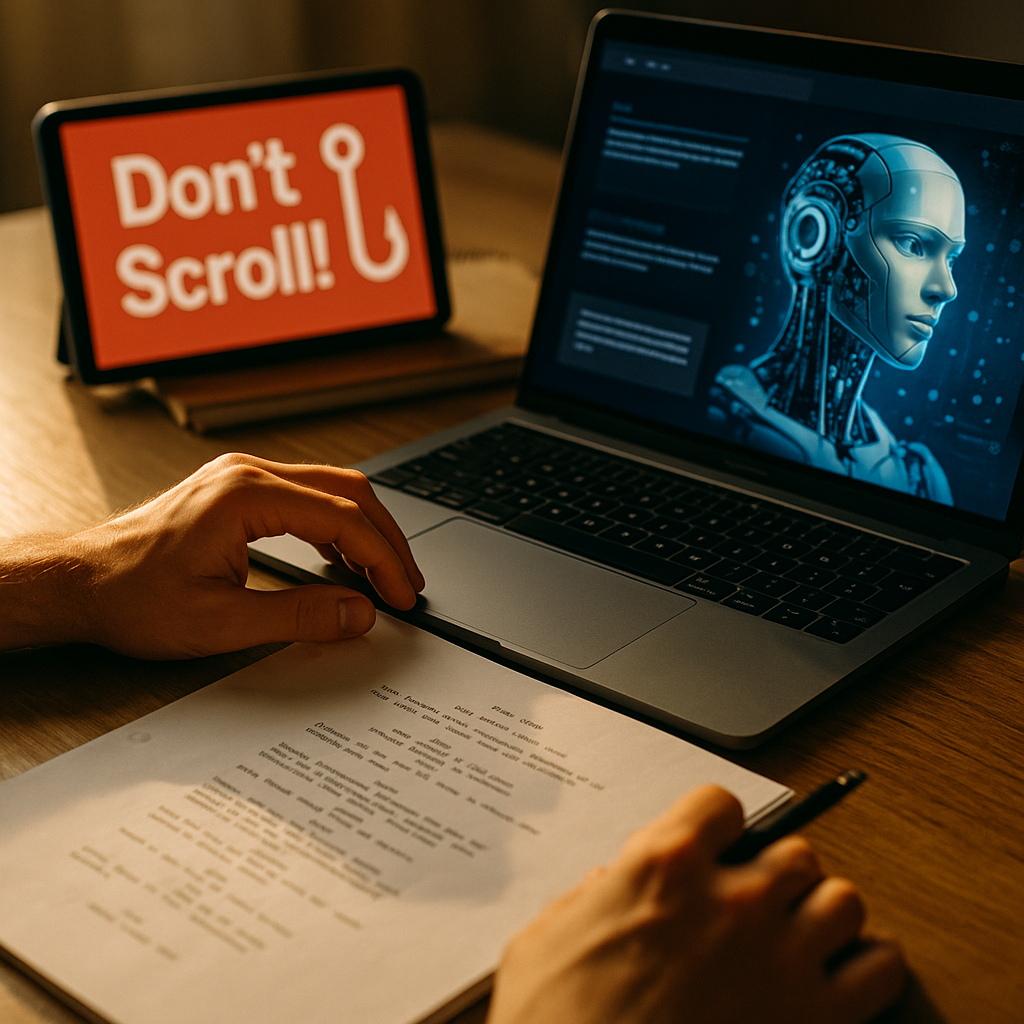
In 2025, creators and brands face an attention economy where the first seconds decide everything. AI for automated scriptwriting based on top-performing viral hooks helps you identify what reliably stops the scroll, then turns those patterns into repeatable scripts you can publish at scale. Used well, it accelerates research, improves consistency, and sharpens messaging. Used poorly, it creates noise. Which side will you choose?
Viral hooks analysis tools for attention-grabbing openings
A “viral hook” is the opening moment that earns attention and sets a promise: what the viewer will get if they keep watching. The best hooks are not magic lines; they’re structured value propositions matched to a platform’s behavior. AI systems that analyze top-performing hooks generally do three things well:
- Pattern detection: They group successful openings by format (contrasts, challenges, contrarian claims, quick demos, “before/after,” myth-busting) and by creator niche.
- Contextual scoring: They estimate which hook styles align with your topic, target audience, and channel norms, instead of treating all virality as universal.
- Language compression: They help you say more with fewer words, which is often the difference between a skip and a watch.
To keep this practical, treat hook analysis like a research workflow rather than a shortcut. Start by collecting a dataset of real, recent top performers in your niche: 30–100 videos or posts that match your platform, audience, and content type. Then extract the first 1–3 seconds (or first 1–2 lines for text posts), plus the outcome: views, watch time signals, saves, shares, and comments quality. AI can summarize these openings, cluster them into hook families, and surface recurring promise types.
Two follow-up questions usually matter most. First: “Are these hooks ethical?” They can be, if you avoid deception. A hook is a promise; your script must deliver on it. Second: “Will copying top hooks make me sound generic?” Not if you copy the structure and rewrite the substance in your voice, using your proof, examples, and point of view.
Automated scriptwriting AI workflows that turn hooks into full scripts
Once you have hook families, automated scriptwriting becomes a controlled process: choose a hook pattern, set a goal, and have AI draft a script that fulfills the promise. A strong workflow uses AI for speed while keeping humans in charge of clarity, truthfulness, and brand fit.
Use this repeatable pipeline:
- Define the outcome: What should the viewer do next (subscribe, click, buy, comment, save)? Scripts without a clear outcome drift.
- Pick the hook family: “Contrarian,” “instant demo,” “mistake audit,” “3-step fix,” “myth-bust,” or “story with a twist.”
- Draft the bridge: The bridge connects the hook to the content (“Here’s what’s actually happening…”). AI often rushes this; insist on a clean transition.
- Build the body in beats: Outline 3–7 beats (problem, insight, example, proof, counterpoint, steps, recap) rather than a single blob of text.
- End with payoff + CTA: Summarize the value, then ask for one action aligned with the outcome.
For short-form video, your script should be modular: hook (0–2s), premise (2–5s), proof or demo (5–20s), steps (20–45s), recap (45–55s), CTA (last 3–5s). For long-form video or podcasts, scale this into chapters and include “re-hooks” every few minutes: a fresh curiosity gap, a quick preview, or a mini-result.
Answering the typical follow-up: “How much should I let AI write?” Let AI draft 60–80%, then you finalize the claims, examples, and tone. You should personally verify anything that sounds like a statistic, a platform rule, a medical claim, or a legal claim. The goal is not automation for its own sake; it’s predictable quality at higher volume.
Hook templates for short-form video scripts that drive retention
AI performs best when you constrain it with proven templates. Below are hook structures that frequently correlate with higher retention because they set a clear promise and an immediate reason to continue. Treat these as frameworks, not copy-and-paste lines.
- “Stop doing X” correction: “Stop doing [common action]. Do this instead if you want [result].” Works when you can quickly justify the correction.
- Fast demo promise: “Watch this for 10 seconds and you’ll see [result].” Requires a visible, credible demonstration.
- Hidden cause reveal: “The reason [problem] keeps happening isn’t [popular belief]—it’s [real cause].”
- Time-bound shortcut (with integrity): “Here’s the 3-step way to [task] in under [time].” Only if it’s realistic for your audience.
- Before/after with method: “From [before] to [after] using this one change.”
- “Most people miss this” audit: “If you’re doing [activity], check this one thing first.”
To make AI-generated hooks sound human and trustworthy, add three elements the model cannot invent responsibly without your input:
- Specific context: Who is this for? “New managers,” “solo founders,” “busy parents,” “B2B marketers,” etc.
- Concrete proof: A quick screenshot, a real micro-case, a mini-demo, or your own measured outcome.
- Boundaries: When it won’t work, or what assumptions must be true. This boosts credibility and reduces negative comments.
A common follow-up is, “Can I use the same hook across platforms?” Use the same underlying promise, but adapt the packaging. Short-form platforms reward immediate clarity and quick cuts; professional networks often reward credibility signals earlier (what you tested, what you learned, what changed).
Content strategy with AI to scale viral hook testing
The biggest advantage of AI is not that it writes one good script. It’s that it supports systematic testing: many variations, measured outcomes, and faster learning. In 2025, “go viral” is less controllable than “improve your odds through experimentation.”
Build a simple testing plan:
- Choose one topic per batch: Testing multiple topics at once hides what actually improved performance.
- Generate 10–20 hook variants: Keep the body mostly the same, so the hook is the primary variable.
- Tag every asset: Label hook family, promise type, length, tone, and CTA so you can learn from results.
- Define success metrics: For short-form, prioritize hold rate and rewatches; for long-form, prioritize watch time and click-through; for ads, prioritize cost per desired action.
- Iterate weekly: AI makes iteration cheap; your discipline makes it valuable.
AI can also help you avoid audience fatigue by rotating hook families and angles. If your last five videos start with a “Stop doing X” pattern, your returning audience may tune out. Create a rotation plan: one contrarian, one demo, one story, one audit, one Q&A, one list. Keep the promise fresh while staying inside your niche.
Another expected follow-up: “What about trend chasing?” Trend chasing can work, but it’s unstable. A stronger approach is to anchor your content to evergreen problems, then use trend formats as packaging. AI can quickly reframe an evergreen lesson into a trending structure without changing the core message.
EEAT content quality for AI-generated scripts and brand trust
If you want consistent performance and low risk, you must treat AI output as a draft that needs editorial standards. Google’s EEAT principles (Experience, Expertise, Authoritativeness, Trust) map well to video and social scripts too: audiences reward creators who demonstrate competence and honesty.
Apply EEAT to scriptwriting with a practical checklist:
- Experience: Add what you actually did, tested, observed, or shipped. Replace vague lines with real steps, tools, and constraints.
- Expertise: Explain the “why,” not just the “what.” A one-sentence mechanism increases perceived competence.
- Authoritativeness: Reference credible sources when needed, but avoid citation dumping. If you mention research, state what it suggests and how it applies.
- Trust: Avoid exaggerated guarantees. Use transparent language: “often,” “in many cases,” “here’s what worked for me,” and include exceptions.
Reduce risk with a “claims policy.” Decide in advance which claims require verification: health, finance, legal, platform policy, and any statistic. If the AI drafts a number, treat it as unverified until you confirm it. If you can’t verify quickly, rewrite without the number.
Also protect brand voice. Create a short style guide for your AI prompts: sentence length, humor level, taboo phrases, reading grade, and preferred CTA style. Then store your highest-performing scripts as “gold standard” examples. AI improves dramatically when it can imitate your proven structure and tone.
AI scriptwriting prompts and tools to operationalize viral hooks
You do not need a complex tech stack to get results, but you do need consistent inputs. The most effective teams in 2025 treat prompts like production assets: versioned, tested, and improved.
Use prompts that force structure and verification:
- Hook mining prompt: “Cluster these 50 openings into 6 hook families, name each family, list the common promise, and propose 5 new hooks per family for [audience] about [topic]. Avoid exaggerations; keep each hook under 12 words.”
- Script from hook prompt: “Write a 45-second script from this hook: [hook]. Include: (1) bridge in 1 sentence, (2) 3 steps, (3) one concrete example, (4) a 1-sentence recap, (5) one CTA. Use my voice: [style notes]. Flag any claims that require verification.”
- Variation prompt: “Create 12 hook variations in 4 different families. Keep the promise identical, change only framing. Output with tags: family, tone, length.”
- Quality control prompt: “Audit this script for: unclear promise, missing proof, overclaims, jargon, and weak CTA. Rewrite only the lines that fail.”
Operationally, assign roles even if you’re a team of one:
- Researcher: collects top-performing examples and notes patterns.
- Producer: generates hook and script variants, schedules tests.
- Editor: enforces EEAT, verifies claims, ensures delivery on the hook.
The follow-up question here is usually, “How do I avoid sounding like everyone else using AI?” Provide the model with proprietary inputs: your customer objections, your support tickets, your sales call notes, your product usage data, and your personal opinions. Viral structure can be shared; the substance should be yours.
FAQs
What is a “top-performing viral hook” in practice?
A top-performing viral hook is an opening that consistently improves early retention or engagement for a specific niche and platform. “Top-performing” should be defined by your goal (hold rate, watch time, shares, saves, click-through), not just views.
Can AI reliably predict which hooks will go viral?
AI can improve your odds by identifying patterns and generating strong variations, but it cannot guarantee virality. Treat AI as a testing accelerator: it helps you produce more high-quality experiments and learn faster from results.
How many hook variations should I test per topic?
For short-form content, 10–20 hook variations per topic is a practical starting point. Keep the body similar so you can attribute performance changes to the hook rather than the entire script.
How do I keep AI-written scripts accurate and trustworthy?
Create a verification rule: any statistic, health/finance/legal advice, or platform policy statement must be checked. If you can’t verify quickly, rewrite the line to remove the claim or frame it as a personal observation with clear boundaries.
Will using AI hurt my brand voice?
Only if you let it. Provide a style guide, reuse your best-performing scripts as examples, and enforce an editorial pass that checks tone, pacing, and honesty. AI should draft; you should decide.
What’s the fastest way to improve retention with AI scriptwriting?
Start with a clear promise in the first seconds, add a tight bridge, and deliver proof early (a demo, example, or result). AI helps you generate and refine these components quickly, but you must ensure the script delivers exactly what the hook promises.
AI-driven scripting works best when you treat hooks as testable hypotheses and scripts as proof delivery systems. Use AI to analyze what’s already winning, generate structured variations, and accelerate iteration, then apply EEAT standards to protect trust. The takeaway is simple: automate the drafting, not the integrity. When your hooks promise clearly and your scripts deliver cleanly, growth becomes repeatable.
Top Influencer Marketing Agencies
The leading agencies shaping influencer marketing in 2026
Agencies ranked by campaign performance, client diversity, platform expertise, proven ROI, industry recognition, and client satisfaction. Assessed through verified case studies, reviews, and industry consultations.
Moburst

-
2

The Shelf
Boutique Beauty & Lifestyle Influencer AgencyA data-driven boutique agency specializing exclusively in beauty, wellness, and lifestyle influencer campaigns on Instagram and TikTok. Best for brands already focused on the beauty/personal care space that need curated, aesthetic-driven content.Clients: Pepsi, The Honest Company, Hims, Elf Cosmetics, Pure LeafVisit The Shelf → -
3

Audiencly
Niche Gaming & Esports Influencer AgencyA specialized agency focused exclusively on gaming and esports creators on YouTube, Twitch, and TikTok. Ideal if your campaign is 100% gaming-focused — from game launches to hardware and esports events.Clients: Epic Games, NordVPN, Ubisoft, Wargaming, Tencent GamesVisit Audiencly → -
4

Viral Nation
Global Influencer Marketing & Talent AgencyA dual talent management and marketing agency with proprietary brand safety tools and a global creator network spanning nano-influencers to celebrities across all major platforms.Clients: Meta, Activision Blizzard, Energizer, Aston Martin, WalmartVisit Viral Nation → -
5

The Influencer Marketing Factory
TikTok, Instagram & YouTube CampaignsA full-service agency with strong TikTok expertise, offering end-to-end campaign management from influencer discovery through performance reporting with a focus on platform-native content.Clients: Google, Snapchat, Universal Music, Bumble, YelpVisit TIMF → -
6

NeoReach
Enterprise Analytics & Influencer CampaignsAn enterprise-focused agency combining managed campaigns with a powerful self-service data platform for influencer search, audience analytics, and attribution modeling.Clients: Amazon, Airbnb, Netflix, Honda, The New York TimesVisit NeoReach → -
7

Ubiquitous
Creator-First Marketing PlatformA tech-driven platform combining self-service tools with managed campaign options, emphasizing speed and scalability for brands managing multiple influencer relationships.Clients: Lyft, Disney, Target, American Eagle, NetflixVisit Ubiquitous → -
8

Obviously
Scalable Enterprise Influencer CampaignsA tech-enabled agency built for high-volume campaigns, coordinating hundreds of creators simultaneously with end-to-end logistics, content rights management, and product seeding.Clients: Google, Ulta Beauty, Converse, AmazonVisit Obviously →