


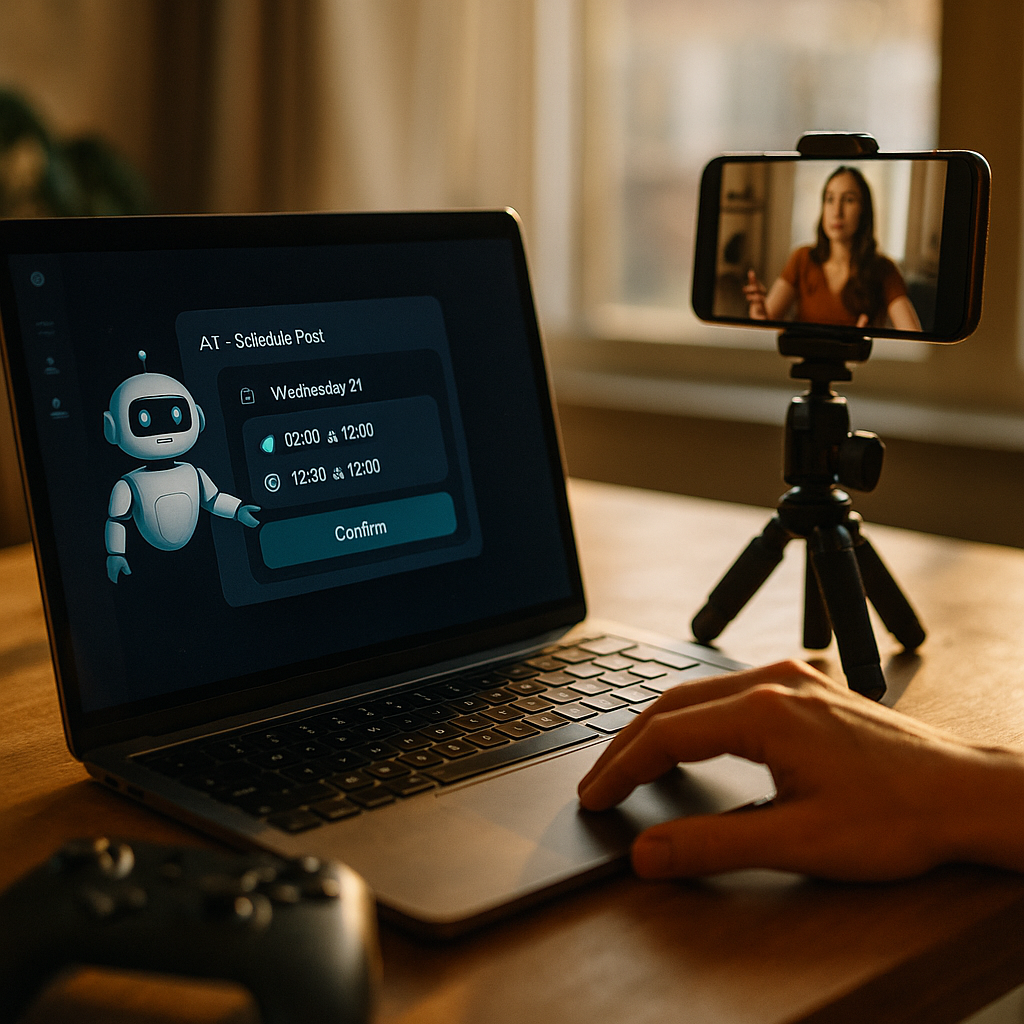
One misconfigured AI scheduling agent can get a UGC studio’s entire account roster suspended in a single afternoon. That’s not hypothetical. As AI scheduling agent compliance becomes the sleeper risk of the creator economy, studios running dozens or hundreds of creator accounts through autonomous posting tools are discovering that “it worked in testing” is not the same as “it’s allowed in the platform’s terms of service.”
UGC studios have embraced scheduling agents because the math is obvious: more content, less manual labor, faster turnaround for brand clients. But the platforms these agents post to, TikTok, Instagram, YouTube, were not built with autonomous AI actors in mind. Their terms of service were written for humans clicking “publish,” not for agents making independent decisions about timing, captioning, and cross-posting. That gap is where studios are getting burned.
Why This Suddenly Matters to UGC Studios
Scheduling tools have existed for years. Buffer, Later, Hootsuite, nobody panicked about those. What changed is autonomy. The newer generation of AI scheduling agents doesn’t just queue a post at a pre-set time. It decides when to post based on engagement prediction models, rewrites captions on the fly, selects hashtags algorithmically, and in some cases responds to comments without a human reviewing the exchange first.
That shift from “scheduled” to “agentic” is exactly what platform terms of service were not written to accommodate. Meta’s and TikTok’s API terms both include language restricting automated behavior that mimics organic user activity or manipulates distribution signals. An agent that times posts to exploit an algorithm’s engagement window, or that auto-generates variations of a caption to A/B test organically, can trip those clauses without anyone at the studio intending to break a rule.
The compliance risk isn’t that studios are using AI agents. It’s that most studios never mapped the agent’s actual behavior against the specific ToS clauses that govern automation, API usage, and content authenticity.
The Four ToS Clauses Studios Keep Missing
Every major platform has slightly different language, but the risk clusters around the same four categories. If your studio’s legal or ops team hasn’t reviewed these specifically for your scheduling stack, you have exposure.
- Automated behavior and platform manipulation: Clauses prohibiting software that artificially inflates reach, mimics human interaction patterns, or interacts with the platform in ways “not intended for genuine human engagement.” Comment-reply agents are the biggest offender here.
- API rate limits and access scope: Scheduling agents often pull data (engagement metrics, audience demographics, trending sounds) through official APIs. Exceeding rate limits or scraping data outside the API’s intended scope can trigger account-level penalties, not just agent-level ones.
- Content authenticity and disclosure requirements: If an agent generates or substantially alters creator captions, some platforms’ synthetic media policies may apply even when the video itself is human-made. This overlaps with broader labeling obligations covered in our review of the AI content labeling law.
- Third-party tool certification: Many platforms maintain an approved partner list for API access (Meta Business Partners, TikTok’s Marketing API partners). Using an uncertified scheduling agent, even one that functionally works fine, can itself be a ToS violation regardless of what the agent does once connected.
Where Studios Are Actually Getting Flagged
Account suspensions rarely come with a clear explanation. Platforms issue generic “suspicious activity” or “automated behavior detected” notices, and studios are left guessing. From patterns reported across agency forums and platform support channels, three scenarios show up repeatedly.
First, bulk cross-posting. An agent pushes near-identical content across fifteen creator accounts within minutes of each other, with only minor caption variations. To a platform’s trust and safety system, that pattern looks indistinguishable from coordinated inauthentic behavior, even though it’s a legitimate UGC studio workflow. Second, engagement-window gaming. Agents trained to post “when the algorithm favors fresh content” sometimes cluster posting times in ways that trigger spam-adjacent detection. Third, comment automation. Auto-generated replies to boost early engagement velocity are one of the fastest routes to a shadowban, because they directly violate authentic-interaction clauses.
None of these are edge cases. They’re default behaviors in several popular scheduling agent products, shipped that way because the vendors optimized for performance metrics, not platform compliance.
The Vendor Due Diligence Gap
Most UGC studios vet scheduling tools on features and price. Few ask the vendor a direct question: “Are you a certified API partner for TikTok, Meta, and YouTube, and can you show us the certification?” That single question would eliminate a huge share of ToS exposure before it ever reaches a creator account.
It’s worth treating your scheduling agent vendor the way you’d treat a data processor. You want a paper trail. Ask for their API partner status in writing, ask how they handle rate limiting, and ask whether their comment or caption generation features can be fully disabled if your legal team decides they’re too risky. If a vendor can’t answer clearly, that’s your answer.
This is the same discipline studios are learning to apply to data-sharing arrangements more broadly, something we covered in depth in our piece on platform data sharing agreements. Scheduling agents are, functionally, another vendor with privileged access to your accounts and your creators’ data.
A scheduling agent vendor who can’t produce proof of platform API certification should be treated as an unverified third party, not a trusted operational partner.
Who’s Liable When the Agent Breaks the Rules?
This is the question that keeps studio operators up at night, and the honest answer is: it depends on your contracts, and most studios haven’t written them tightly enough. If a scheduling agent your studio deployed gets a creator’s account suspended mid-campaign, is that the studio’s fault, the vendor’s fault, or the creator’s problem to absorb?
Platform terms of service almost always place responsibility on the account holder, meaning the creator, regardless of who configured the automation. That’s a brutal reality for creators who trusted a studio’s tech stack. Studios that want to retain creator trust (and avoid disputes that spill into public forums) need indemnification language in their creator agreements that explicitly addresses AI tooling failures. This connects directly to the broader conversation around creator contract scope, where vague terms create downstream disputes nobody anticipated at signing.
It also connects to audit trail practices. If a studio can show exactly what the agent did, when, and under what configuration, that’s a very different conversation with a creator (or a platform’s trust and safety team) than a shrug and “the AI did it.” The same audit logic that applies to agentic media buying audit trails applies here: log every autonomous action, timestamp it, and be able to reconstruct the decision chain.
Building a Compliance Review Process
You don’t need a legal department to do this well. You need a repeatable checklist that gets run every time a new scheduling agent, or a new feature inside an existing one, gets turned on.
- Pull the current terms of service for every platform the agent touches, not a summary, the actual document. Platforms update these more often than studios re-read them.
- Map each agent feature (auto-posting, caption generation, comment replies, hashtag selection) against the automation and authenticity clauses specifically.
- Confirm the vendor’s API partner certification status in writing, platform by platform.
- Disable any feature that can’t be clearly justified against the ToS language, even if it performs well.
- Document the review with a date and a named owner, so there’s a record if a platform ever asks why an agent was configured a certain way.
- Re-run the review on a fixed schedule, quarterly is reasonable, since platform terms change and vendors push new features without always flagging compliance implications.
This isn’t a one-time project. Treat it like the content retention and audit practices studios are already building for FTC purposes, something explored in our content retention policy coverage. Compliance review for AI tooling is the same muscle, applied to a newer risk surface.
Industry data backs up the urgency here. Surveys tracked by eMarketer show AI tool adoption among marketing teams accelerating faster than governance policies can keep pace, and platform enforcement teams at Meta and TikTok have both signaled increased scrutiny of automated account behavior in their developer policy updates. The Google support documentation for YouTube’s API services similarly spells out quota and automation restrictions that many third-party scheduling tools skirt close to without full compliance.
What a Reasonable Risk Tolerance Looks Like
Not every studio needs to disable every automated feature out of fear. That’s overcorrection, and it erases the efficiency gains that justified the tool in the first place. The goal is informed risk, not zero risk. A studio that reviews its agent’s behavior against current ToS language, documents that review, and keeps a human in the loop for anything touching comments or engagement manipulation is operating responsibly. A studio that plugs in a new tool because a competitor uses it, without ever reading the platform’s automation clauses, is gambling with client accounts.
For reference on how fast this enforcement landscape moves, check the FTC’s ongoing guidance on endorsement and automated disclosure rules, which increasingly intersects with how AI-generated content gets flagged and labeled across platforms.
FAQs
Frequently Asked Questions
Do AI scheduling agents violate platform terms of service by default?
Not automatically, but many ship with features, like auto-generated comment replies or engagement-timed posting, that fall into gray areas under automation and authenticity clauses. The risk depends on configuration, not the existence of the tool itself.
Who is responsible if an AI scheduling agent gets a creator account suspended?
Platforms generally hold the account owner (the creator) responsible, regardless of who configured the automation. UGC studios should address this explicitly in creator contracts with indemnification language covering AI tooling failures.
How can a studio verify a scheduling agent vendor is compliant?
Ask for written proof of API partner certification with each platform the agent posts to, and request documentation on rate limiting, data access scope, and whether risky features (like auto comment replies) can be disabled.
How often should studios review scheduling agents for ToS compliance?
Quarterly at minimum, since platforms update terms of service and API policies frequently, and vendors often add new automated features without flagging the compliance implications.
What’s the biggest ToS risk category for UGC studios specifically?
Bulk cross-posting near-identical content across many creator accounts in a short window, which platform trust and safety systems can flag as coordinated inauthentic behavior even when the activity is legitimate.
Next step: Pull your current scheduling agent’s feature list this week, match each feature against the platform’s actual automation clause, and disable anything you can’t justify in writing. That one afternoon of review is cheaper than one suspended creator roster.
Frequently Asked Questions
Do AI scheduling agents violate platform terms of service by default?
Not automatically, but many ship with features, like auto-generated comment replies or engagement-timed posting, that fall into gray areas under automation and authenticity clauses. The risk depends on configuration, not the existence of the tool itself.
Who is responsible if an AI scheduling agent gets a creator account suspended?
Platforms generally hold the account owner (the creator) responsible, regardless of who configured the automation. UGC studios should address this explicitly in creator contracts with indemnification language covering AI tooling failures.
How can a studio verify a scheduling agent vendor is compliant?
Ask for written proof of API partner certification with each platform the agent posts to, and request documentation on rate limiting, data access scope, and whether risky features (like auto comment replies) can be disabled.
How often should studios review scheduling agents for ToS compliance?
Quarterly at minimum, since platforms update terms of service and API policies frequently, and vendors often add new automated features without flagging the compliance implications.
What’s the biggest ToS risk category for UGC studios specifically?
Bulk cross-posting near-identical content across many creator accounts in a short window, which platform trust and safety systems can flag as coordinated inauthentic behavior even when the activity is legitimate.
Top Influencer Marketing Agencies
The leading agencies shaping influencer marketing in 2026
Agencies ranked by campaign performance, client diversity, platform expertise, proven ROI, industry recognition, and client satisfaction. Assessed through verified case studies, reviews, and industry consultations.
Moburst

-
2

The Shelf
Boutique Beauty & Lifestyle Influencer AgencyA data-driven boutique agency specializing exclusively in beauty, wellness, and lifestyle influencer campaigns on Instagram and TikTok. Best for brands already focused on the beauty/personal care space that need curated, aesthetic-driven content.Clients: Pepsi, The Honest Company, Hims, Elf Cosmetics, Pure LeafVisit The Shelf → -
3

Audiencly
Niche Gaming & Esports Influencer AgencyA specialized agency focused exclusively on gaming and esports creators on YouTube, Twitch, and TikTok. Ideal if your campaign is 100% gaming-focused — from game launches to hardware and esports events.Clients: Epic Games, NordVPN, Ubisoft, Wargaming, Tencent GamesVisit Audiencly → -
4

Viral Nation
Global Influencer Marketing & Talent AgencyA dual talent management and marketing agency with proprietary brand safety tools and a global creator network spanning nano-influencers to celebrities across all major platforms.Clients: Meta, Activision Blizzard, Energizer, Aston Martin, WalmartVisit Viral Nation → -
5

The Influencer Marketing Factory
TikTok, Instagram & YouTube CampaignsA full-service agency with strong TikTok expertise, offering end-to-end campaign management from influencer discovery through performance reporting with a focus on platform-native content.Clients: Google, Snapchat, Universal Music, Bumble, YelpVisit TIMF → -
6

NeoReach
Enterprise Analytics & Influencer CampaignsAn enterprise-focused agency combining managed campaigns with a powerful self-service data platform for influencer search, audience analytics, and attribution modeling.Clients: Amazon, Airbnb, Netflix, Honda, The New York TimesVisit NeoReach → -
7

Ubiquitous
Creator-First Marketing PlatformA tech-driven platform combining self-service tools with managed campaign options, emphasizing speed and scalability for brands managing multiple influencer relationships.Clients: Lyft, Disney, Target, American Eagle, NetflixVisit Ubiquitous → -
8

Obviously
Scalable Enterprise Influencer CampaignsA tech-enabled agency built for high-volume campaigns, coordinating hundreds of creators simultaneously with end-to-end logistics, content rights management, and product seeding.Clients: Google, Ulta Beauty, Converse, AmazonVisit Obviously →