


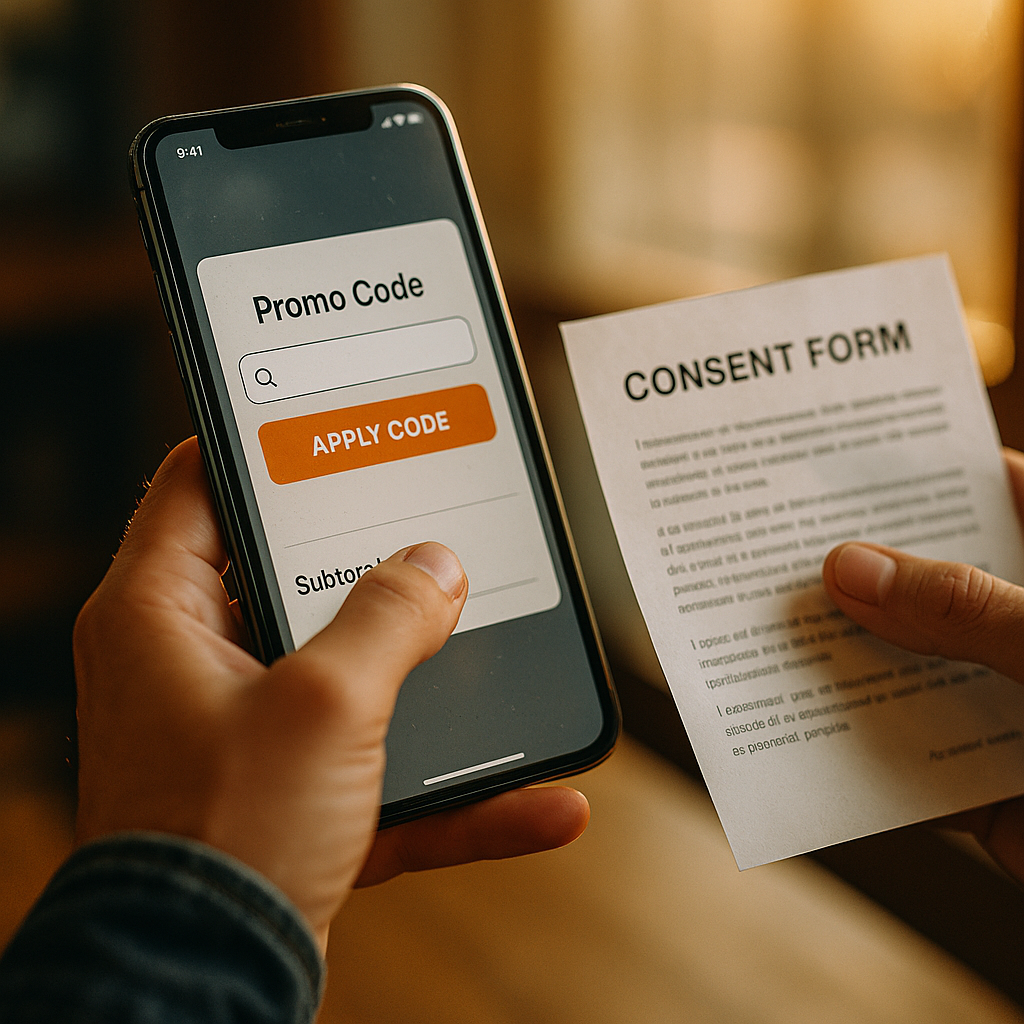
Nearly 40% of consumers say they have abandoned a purchase after seeing a tracking prompt they didn’t trust, according to Statista survey data on privacy sentiment. Yet most influencer programs still treat promo code attribution as a workaround that sidesteps consent requirements entirely. It doesn’t. Promo code attribution generates personal data the moment a code gets scanned, redeemed, or matched to a customer record, and that triggers the same consent obligations as any pixel or cookie.
Marketing teams love promo codes because they feel clean. No cookies, no third-party trackers, just a string of letters a creator’s audience types at checkout. That simplicity is an illusion. Once you tie a code to a purchase, a loyalty account, or an email address, you’ve built a profile. And profiles fall squarely under GDPR, CCPA, and every state privacy law modeled after them.
Why Promo Codes Feel Like a Privacy Loophole (and Why They Aren’t)
The logic brands use goes something like this: a promo code isn’t a cookie, it isn’t a device identifier, and the customer typed it in voluntarily, so consent doesn’t apply. That reasoning worked in 2015. It doesn’t hold up under current interpretations of “personal data” from regulators in Brussels, Sacramento, or Brasília.
Here’s the problem. A code like “JESSICA20” is trivially linkable to a specific creator and, once redeemed, to a specific buyer. Combine that redemption with an email address at checkout, a loyalty ID, or a shipping address, and you have a dataset that identifies a real person and reveals something about their behavior (they follow Jessica, they trust her recommendations, they buy a certain category of product). That’s exactly the kind of inference-rich profile that consent-based privacy frameworks were built to govern.
A promo code is not a tracking pixel, but the moment it gets matched to a purchase record, it becomes personal data under the same legal definition that governs cookies and device IDs.
Our sister piece on promo code tracking pixels covers the mechanics of this gap in more detail, but the short version is simple: the attribution method doesn’t determine your legal exposure. The data outcome does.
Where Consent Actually Breaks Down in Code-Based Attribution
Most brands collect consent at the point of sale through a cookie banner or a privacy notice buried in checkout flow. That notice almost never mentions promo codes specifically. So when legal teams audit the program, they find a disconnect: consent language covers “analytics cookies” and “advertising partners,” but says nothing about creator attribution or redemption tracking.
This matters because consent has to be specific and informed under GDPR’s Article 7 and under the disclosure requirements baked into CCPA and its state-law cousins. Vague, bundled consent (“we use data to improve your experience”) doesn’t satisfy regulators anymore. If a customer’s redemption data gets shared with a creator, an affiliate network, or a measurement platform, that purpose needs to be spelled out, and the customer needs a real choice to opt out.
- Redemption data shared with creators. Many programs send creators dashboards showing who redeemed their code, sometimes including order value or product category. That’s a data-sharing arrangement that needs its own consent basis.
- Cross-platform matching. When a code redemption gets matched against a CRM record or ad platform audience, you’ve created a new processing purpose that the original consent likely never covered.
- Retention without expiration. Codes tied to a creator often stay active for the life of a partnership, meaning redemption data piles up with no clear deletion trigger.
Each of these is a quiet compliance gap. None of them show up on a campaign dashboard. All of them show up in a regulator’s data request.
The Attribution Teams Want vs. the Consent Teams Need
Performance marketers want granular attribution: which creator drove which sale, at what margin, with what repeat-purchase rate. Privacy and legal teams want minimal data collection, clear purpose limitation, and an audit trail proving consent was obtained before processing began. These two goals aren’t opposites, but they do pull in different directions when nobody’s coordinating.
The fix isn’t choosing one team’s priorities over the other. It’s building attribution architecture that only activates granular tracking after consent is confirmed, and that degrades gracefully when it isn’t. Think of it as attribution with a consent gate, not attribution with a consent afterthought.
Brands running loyalty programs alongside creator codes should look closely at how their unified customer profiles handle this exact tension. If a customer’s loyalty record and their promo code redemption live in the same database without separated consent flags, you’ve merged two data streams that may have been collected under different legal bases. That’s a documentation nightmare waiting for an audit.
Identity resolution tools make this worse if they’re not purpose-limited. A CDP identity resolution setup that links a promo code redemption to a broader advertising profile, without the customer knowing that’s happening, is the kind of silent scope creep that triggers regulatory complaints. The UK’s Information Commissioner’s Office has flagged exactly this pattern in enforcement guidance on data minimization.
Building a Compliant Attribution Model: What Actually Works
You don’t need to abandon promo code attribution. You need to redesign it with consent as a structural input, not a legal footnote. A few practical moves:
- Separate the code from the person until consent is confirmed. Track aggregate redemption counts by default. Only link a specific redemption to an identifiable customer record once that customer has opted into attribution-related processing.
- Disclose creator data sharing explicitly. If a creator sees any individual-level redemption data, say so in your privacy notice, by name, not buried under “marketing partners.”
- Set retention limits per code, not per campaign. A code tied to a single creator deal shouldn’t hold redemption data indefinitely just because the partnership renewed. Tie deletion schedules to the code’s active life plus a defined buffer.
- Build a consent log that maps to each attribution touchpoint. Regulators don’t want a general privacy policy. They want proof that a specific customer consented to a specific use of their data at a specific time.
- Audit your affiliate and tracking infrastructure annually. Platforms change their default data-sharing settings more often than brands review them.
This isn’t theoretical. Brands that got this wrong have ended up documenting their failures in retention policies after the fact, the same reactive pattern covered in our piece on creator content retention policy gaps. Reactive compliance costs more than proactive design, every time.
What Regulators Are Actually Looking For
The FTC hasn’t issued promo-code-specific guidance, but its broader enforcement posture on dark patterns and deceptive data practices applies directly. If a customer reasonably believes their promo code use is private, and your program quietly builds a behavioral profile from it, that’s the kind of gap the agency has pursued in other contexts. Review the FTC’s general guidance on consumer privacy enforcement before assuming your program is too small to attract attention.
State-level laws add another layer. The emerging patchwork of U.S. state privacy statutes, detailed in our coverage of the state privacy patchwork gap, means a code redemption that’s compliant in Texas might not be compliant in Colorado or Connecticut. National creator campaigns can’t rely on a single consent template anymore.
A compliance strategy built for one state’s privacy law is a liability plan for every other state that doesn’t share its definitions.
For brands running influencer programs across multiple markets, the smartest move is designing for the strictest applicable standard (usually GDPR’s consent specificity combined with California’s opt-out rights) and letting that baseline cover everything else. It’s more conservative than most marketing teams want, but it’s far cheaper than a state-by-state remediation project after an audit flags the gap.
Where This Intersects With Broader Data Governance
Promo code attribution rarely lives in isolation. It usually connects to a creator data processing agreement, a CRM integration, and sometimes a creator identity graph used for matching across platforms. Each connection point needs its own consent documentation. Skipping this step is how a simple “use code CREATOR10” campaign turns into a multi-vendor data liability chain that nobody fully mapped.
If your legal team hasn’t reviewed how promo code data flows into your broader creator data processing agreements, that’s the next audit item. It’s a thirty-minute conversation that can save months of remediation later.
Marketing ops teams should also check how attribution data interacts with any creator identity graphs used for cross-platform matching. If a promo code redemption feeds into an identity graph that merges it with social profile data, you’ve expanded the scope of processing well beyond what most consent notices disclose.
Tools like HubSpot and Sprout Social offer consent management features that can help, but they’re only as good as the configuration behind them. Review platform defaults regularly: HubSpot’s data privacy resources and Sprout Social’s compliance tools both get updated with new consent controls that go unused if nobody assigns ownership.
Next step: pull your current promo code redemption flow, map every point where it touches a customer identifier, and check that flow against your actual consent language, not your assumed one. If there’s daylight between what you collect and what you disclosed, fix the disclosure before your next campaign launch, not after a complaint does it for you.
Frequently Asked Questions
Does a promo code count as personal data under privacy law?
Yes, once it’s linked to an identifiable purchase, email address, or customer record. The code itself is just a string of characters, but the moment it’s matched to a specific person’s transaction, it becomes personal data subject to consent requirements under GDPR, CCPA, and similar state laws.
Do I need separate consent for sharing redemption data with creators?
In most cases, yes. If a creator receives individual-level redemption data rather than aggregate performance numbers, that’s a data-sharing arrangement that typically needs explicit disclosure and, depending on jurisdiction, affirmative consent.
Can I use aggregate promo code data without triggering consent rules?
Aggregate, non-identifiable redemption counts generally fall outside consent requirements because they don’t identify an individual. The risk appears when that aggregate data gets cross-referenced with CRM records, loyalty accounts, or ad platform audiences, which can re-identify individuals.
How long can I retain promo code redemption data?
There’s no universal number, but best practice ties retention to the active life of the code plus a defined buffer for reconciliation and reporting, rather than keeping data indefinitely because a creator partnership renewed.
Is a single consent notice enough for a multi-state or multi-country campaign?
Rarely. Different jurisdictions define personal data and consent differently. Programs operating across U.S. states and international markets generally need to design for the strictest applicable standard rather than relying on one generic notice.
Top Influencer Marketing Agencies
The leading agencies shaping influencer marketing in 2026
Agencies ranked by campaign performance, client diversity, platform expertise, proven ROI, industry recognition, and client satisfaction. Assessed through verified case studies, reviews, and industry consultations.
Moburst

-
2

The Shelf
Boutique Beauty & Lifestyle Influencer AgencyA data-driven boutique agency specializing exclusively in beauty, wellness, and lifestyle influencer campaigns on Instagram and TikTok. Best for brands already focused on the beauty/personal care space that need curated, aesthetic-driven content.Clients: Pepsi, The Honest Company, Hims, Elf Cosmetics, Pure LeafVisit The Shelf → -
3

Audiencly
Niche Gaming & Esports Influencer AgencyA specialized agency focused exclusively on gaming and esports creators on YouTube, Twitch, and TikTok. Ideal if your campaign is 100% gaming-focused — from game launches to hardware and esports events.Clients: Epic Games, NordVPN, Ubisoft, Wargaming, Tencent GamesVisit Audiencly → -
4

Viral Nation
Global Influencer Marketing & Talent AgencyA dual talent management and marketing agency with proprietary brand safety tools and a global creator network spanning nano-influencers to celebrities across all major platforms.Clients: Meta, Activision Blizzard, Energizer, Aston Martin, WalmartVisit Viral Nation → -
5

The Influencer Marketing Factory
TikTok, Instagram & YouTube CampaignsA full-service agency with strong TikTok expertise, offering end-to-end campaign management from influencer discovery through performance reporting with a focus on platform-native content.Clients: Google, Snapchat, Universal Music, Bumble, YelpVisit TIMF → -
6

NeoReach
Enterprise Analytics & Influencer CampaignsAn enterprise-focused agency combining managed campaigns with a powerful self-service data platform for influencer search, audience analytics, and attribution modeling.Clients: Amazon, Airbnb, Netflix, Honda, The New York TimesVisit NeoReach → -
7

Ubiquitous
Creator-First Marketing PlatformA tech-driven platform combining self-service tools with managed campaign options, emphasizing speed and scalability for brands managing multiple influencer relationships.Clients: Lyft, Disney, Target, American Eagle, NetflixVisit Ubiquitous → -
8

Obviously
Scalable Enterprise Influencer CampaignsA tech-enabled agency built for high-volume campaigns, coordinating hundreds of creators simultaneously with end-to-end logistics, content rights management, and product seeding.Clients: Google, Ulta Beauty, Converse, AmazonVisit Obviously →