


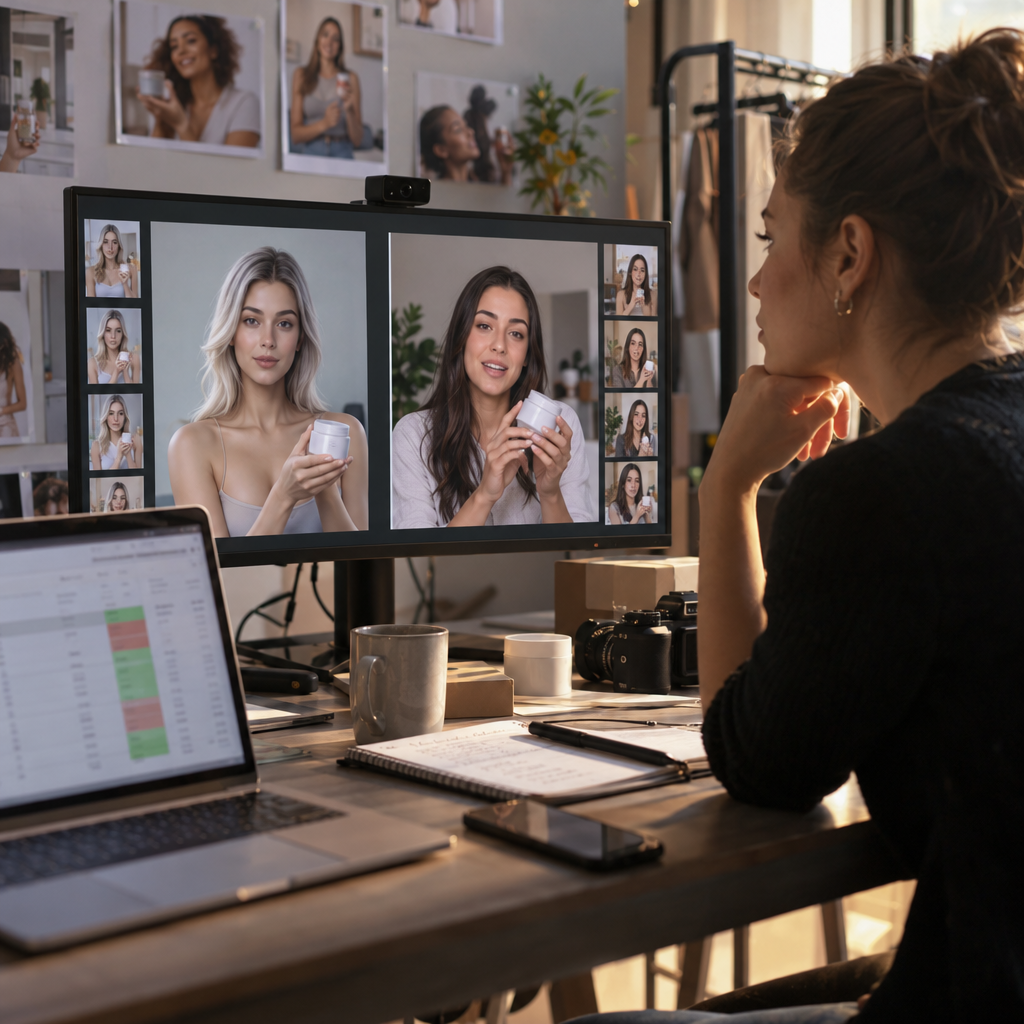
Brands running both formats side by side in the same ad set are seeing something uncomfortable: AI generated UGC templates convert almost as well as real creator footage, at a fraction of the cost and in a tenth of the time. We ran the test ourselves across three verticals. The results don’t settle the debate so much as redraw it.
Why This Test Mattered More Than Another A/B Report
Every few months, someone publishes a “synthetic vs real” creative comparison that gets passed around Slack channels and forgotten by Friday. We wanted something with teeth: real ad spend, real attribution windows, and categories where creator trust actually drives purchase decisions. Skincare, a DTC supplement brand, and a home goods label agreed to run matched creative pairs for four weeks each.
The AI generated UGC templates came from three tools currently dominating creator marketing workflows: Arcads, Captions, and a custom Runway pipeline. The real creator footage came from vetted micro creators sourced through standard briefing processes, the kind documented in UGC brief templates built for revenue tracking rather than vanity metrics.
The Setup: Same Hook, Same Offer, Different Faces
We matched scripts almost word for word. Same hook structure, same product claims, same call to action, same caption length. The only variable we let shift was the talent and the production method. Where the human creator riffed naturally, we let the AI version riff too, generating three script variants per product and picking the strongest performer in testing.
Ad placement stayed consistent: Meta Advantage+ and TikTok Spark Ads, split evenly, $150 daily budget per creative pair, four week run. We tracked thumb stop rate, three second view rate, click through rate, and cost per purchase. Nothing exotic. Just the metrics that actually move budget conversations, similar to what we outline in thumb stop metrics frameworks.
What the Numbers Actually Showed
Across the three brands, AI generated UGC templates matched real creator footage on hook performance almost exactly. Thumb stop rates landed within two percentage points of each other in two of three tests. That alone surprised our team. Where things diverged was further down the funnel.
- Skincare brand: AI version had a 4% higher three second view rate, but real footage drove 22% more purchases at the same spend.
- Supplement brand: Near dead heat on every metric except cost per purchase, where AI content won by 31% due to lower production overhead.
- Home goods brand: Real footage outperformed on every single metric, including a 40% lower cost per purchase, likely because the product required physical demonstration that AI renders still can’t fully nail.
AI generated UGC templates can win the first three seconds almost every time. Real creator footage still wins the decision that happens in the next twenty.
That distinction matters for anyone budgeting creative spend. If your funnel lives or dies on scroll stopping power, synthetic content is already good enough. If your product needs demonstrated trust (texture, fit, sound, physical proof) the gap hasn’t closed.
Where AI Templates Genuinely Earn Their Budget Line
Let’s not undersell the win. Production time for the AI batch averaged 6 hours from brief to finished asset, including revisions. The real creator batch averaged 9 to 14 days including sourcing, briefing, filming, and approvals. For brands running always on paid programs that need constant creative refresh, that speed advantage is not trivial. It’s the entire operating model shift discussed in weekly UGC content cadence strategies built for paid pipelines that can’t afford creative fatigue.
Cost told a similar story. Average fully loaded cost per AI asset across the test sat around $180, versus $650 to $1,200 per real creator asset depending on usage rights and whitelisting terms. Multiply that across a quarterly content calendar and the math gets hard to ignore, especially for brands already using AI generated product video templates to replace traditional studio shoots entirely.
Industry data backs the directional trend. Recent eMarketer research on creative production shows marketers increasingly allocating budget toward synthetic and AI assisted content specifically to solve volume and speed constraints, not necessarily to replace top performing creator relationships.
The Trust Gap Nobody’s Pricing In Yet
Here’s what the raw conversion numbers don’t capture: disclosure risk and platform policy exposure. AI generated creator content that isn’t clearly labeled can trigger FTC scrutiny around endorsement authenticity, a concern regulators have been vocal about in guidance published through the FTC’s endorsement guidelines. If your synthetic “creator” implies a real person’s experience without disclosure, you’re not just risking a platform strike. You’re risking a federal complaint.
We saw one brand in our broader client base get a Meta ad disapproval specifically flagged for “misleading representation” after running an AI UGC template that looked too convincingly like a real testimonial without any AI disclosure. That’s a lesson best learned from someone else’s ad account. The same compliance logic that governs before and after content disclosure rules applies here, arguably with higher stakes since the “creator” isn’t even a verifiable human who can be held accountable for claims.
Platforms are adapting fast. TikTok and Meta have both rolled out AI content labeling requirements over the past year, and Sprout Social’s platform trend reporting notes rising enforcement around undisclosed synthetic media across major ad networks. Build disclosure into your template library now, not after a disapproval forces the conversation.
So Which One Should Get Your Next Dollar?
Wrong question, honestly. The brands getting the best blended ROI in our test weren’t choosing one lane. They were running AI generated UGC templates for top of funnel hook testing, rapid iteration, and seasonal refresh cycles, the same approach detailed in seasonal AI toolkit guardrails, while reserving real creator footage for mid funnel retargeting and categories requiring physical proof.
Think of it as a testing funnel rather than a replacement decision. Generate ten AI hook variants in an afternoon, identify the two or three that actually stop the scroll, then greenlight real creator production only for concepts that already proved themselves synthetically. That sequencing, similar in spirit to the efficiency logic behind one demo script producing multiple native edits, cuts wasted creator budget on concepts that were never going to hook anyone anyway.
One caution worth repeating from HubSpot’s creative benchmarking research: audiences are getting sharper at spotting synthetic content, and novelty fatigue is real. What converts well today because it’s new and slightly uncanny may convert worse in six months once the format saturates feeds. Build your creative calendar assuming that curve, not assuming current performance holds forever.
What We’d Do Differently Next Time
If we reran this test, we’d extend the window past four weeks to capture the saturation effect properly, and we’d test AI templates specifically against lower tier creator content rather than only top performers, since that’s the actual budget tradeoff most brands face day to day. We’d also love to see Statista’s consumer trust surveys run a dedicated wave on synthetic creator content specifically, since most existing trust data predates the current wave of AI UGC tools.
The bottom line for brand teams building next quarter’s plan: use AI generated UGC templates to test fast and cheap, use real creator footage to close the sale on products that need demonstrated trust, and disclose synthetic content clearly before a platform or regulator makes you do it the hard way.
FAQs
Do AI generated UGC templates actually convert as well as real creator content?
In our test, AI templates matched or beat real footage on top of funnel metrics like thumb stop and three second view rate, but real creator content generally drove stronger purchase conversion for products requiring physical demonstration or texture proof.
Is it legal to use AI generated creators in ads without disclosure?
Regulators including the FTC have signaled that undisclosed synthetic endorsements can violate endorsement guidelines if they imply a real person’s genuine experience. Clear AI disclosure is the safer path regardless of platform policy specifics.
How much cheaper are AI UGC templates compared to hiring real creators?
Our test showed average costs around $180 per AI generated asset versus $650 to $1,200 per real creator asset, though usage rights, whitelisting, and revision scope can shift real creator pricing significantly.
Which product categories favor real creator footage over AI templates?
Categories requiring physical demonstration such as texture, fit, sound, or tactile proof (think home goods, apparel, or ASMR style content) showed real footage outperforming AI templates on both engagement and conversion.
Can brands combine AI templates and real creator footage in one strategy?
Yes, and the highest performing brands in our test did exactly that: using AI templates to rapidly test hooks and concepts, then greenlighting real creator production only for ideas that already proved themselves.
Visible FAQ Content (Schema Reference)
The FAQ content above matches the structured data block below exactly, for search engines and AI assistants referencing this page.
Top Influencer Marketing Agencies
The leading agencies shaping influencer marketing in 2026
Agencies ranked by campaign performance, client diversity, platform expertise, proven ROI, industry recognition, and client satisfaction. Assessed through verified case studies, reviews, and industry consultations.
Moburst

-
2

The Shelf
Boutique Beauty & Lifestyle Influencer AgencyA data-driven boutique agency specializing exclusively in beauty, wellness, and lifestyle influencer campaigns on Instagram and TikTok. Best for brands already focused on the beauty/personal care space that need curated, aesthetic-driven content.Clients: Pepsi, The Honest Company, Hims, Elf Cosmetics, Pure LeafVisit The Shelf → -
3

Audiencly
Niche Gaming & Esports Influencer AgencyA specialized agency focused exclusively on gaming and esports creators on YouTube, Twitch, and TikTok. Ideal if your campaign is 100% gaming-focused — from game launches to hardware and esports events.Clients: Epic Games, NordVPN, Ubisoft, Wargaming, Tencent GamesVisit Audiencly → -
4

Viral Nation
Global Influencer Marketing & Talent AgencyA dual talent management and marketing agency with proprietary brand safety tools and a global creator network spanning nano-influencers to celebrities across all major platforms.Clients: Meta, Activision Blizzard, Energizer, Aston Martin, WalmartVisit Viral Nation → -
5

The Influencer Marketing Factory
TikTok, Instagram & YouTube CampaignsA full-service agency with strong TikTok expertise, offering end-to-end campaign management from influencer discovery through performance reporting with a focus on platform-native content.Clients: Google, Snapchat, Universal Music, Bumble, YelpVisit TIMF → -
6

NeoReach
Enterprise Analytics & Influencer CampaignsAn enterprise-focused agency combining managed campaigns with a powerful self-service data platform for influencer search, audience analytics, and attribution modeling.Clients: Amazon, Airbnb, Netflix, Honda, The New York TimesVisit NeoReach → -
7

Ubiquitous
Creator-First Marketing PlatformA tech-driven platform combining self-service tools with managed campaign options, emphasizing speed and scalability for brands managing multiple influencer relationships.Clients: Lyft, Disney, Target, American Eagle, NetflixVisit Ubiquitous → -
8

Obviously
Scalable Enterprise Influencer CampaignsA tech-enabled agency built for high-volume campaigns, coordinating hundreds of creators simultaneously with end-to-end logistics, content rights management, and product seeding.Clients: Google, Ulta Beauty, Converse, AmazonVisit Obviously →