


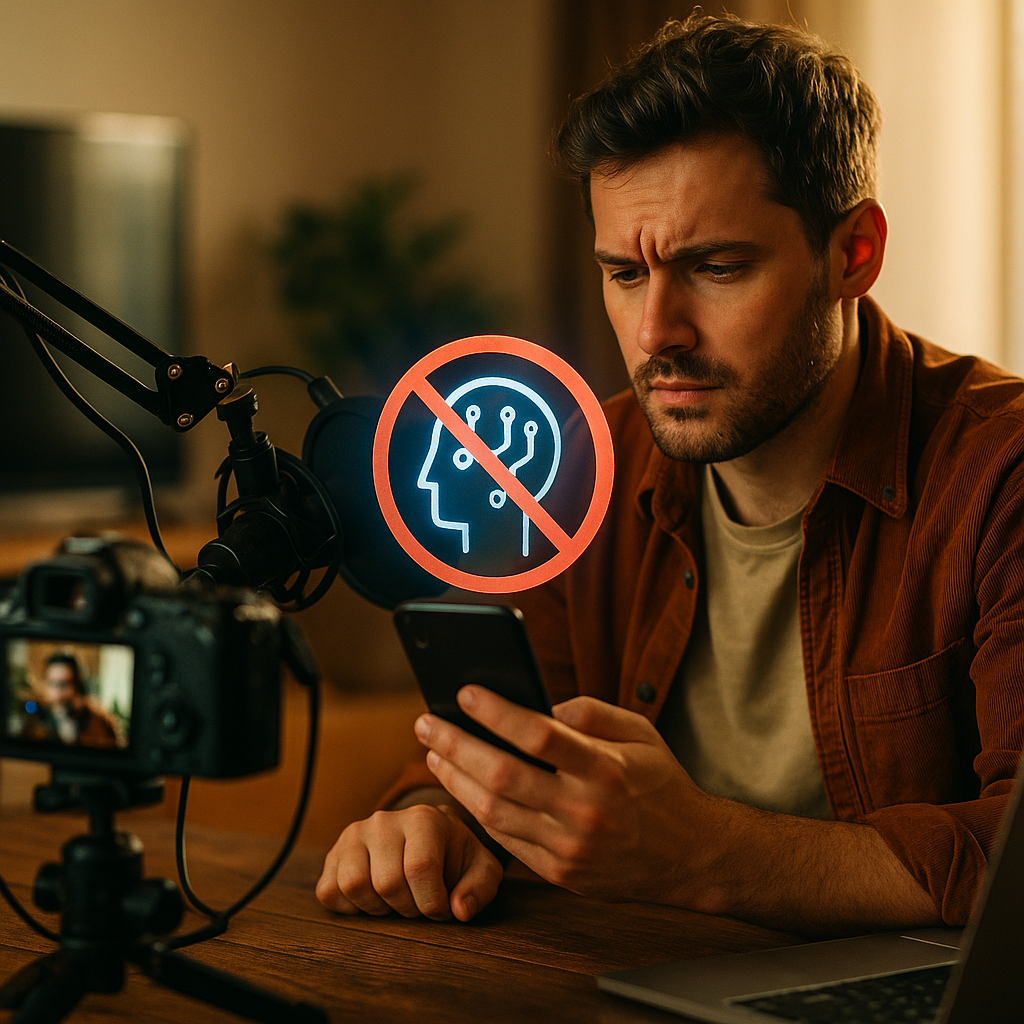
Platforms are actively suppressing faceless AI video content, and brands that ignore this signal are paying for distribution that never arrives. Authentic creator authorship is no longer a brand-safety nicety. It is a performance variable with direct implications for reach, engagement, and ROI.
The Suppression Is Real, and It Is Already Priced Into Performance
YouTube, TikTok, and Instagram have each introduced mechanisms to identify, label, or deprioritize synthetic and AI-generated content lacking a genuine human voice. YouTube’s AI-generated content disclosure requirements, rolled out through its Creator Studio policies, now require creators to flag material that realistically depicts events or people using AI. TikTok has expanded its content labeling infrastructure through the TikTok Ads platform to automatically detect AI-generated media. Meta’s policies via Meta Business similarly require disclosure on AI-generated content in paid campaigns.
The downstream effect on organic performance is significant. Creators running faceless AI channels, where no human appears on camera and the voiceover and visuals are entirely machine-generated, are reporting steep declines in suggested feed placement and algorithmic amplification. For brands that built affiliate or performance programs on top of these channels, the distribution model has quietly collapsed.
When a platform’s recommendation engine starts treating AI-generated video as a credibility risk rather than a neutral content type, every brand whose product appears in that content inherits the same credibility discount.
Why “Faceless AI Video” Became a Platform Problem
The economics made it inevitable. Faceless AI video channels promised zero talent cost, infinite scalability, and semi-automated content pipelines. At peak, tools like Pictory, Synthesia, and HeyGen made it possible to produce hundreds of product-adjacent videos per month with minimal human input. Some affiliate marketers were running thousands of SKU-level videos across YouTube and TikTok simultaneously, all generated without a human creator ever appearing or genuinely testing the product.
Platforms measure trust signals differently from brands. Watch time, comment quality, profile engagement patterns, and audience retention curves all behave differently on AI-generated content than on genuine creator content. Platforms noticed. The suppression signal followed.
For brands, the critical question is not whether AI tools have a role in production. They do, and the AI-authenticity balance in creator marketing is already a strategic conversation happening at the CMO level. The question is whether the human creator is genuinely the author of the content, or simply a figurehead on an AI assembly line.
What “Human-Authored” Actually Means in a Briefing Context
This is where the operational gap sits for most brand teams. Most creator briefs are written to control output, not to verify authorship. They specify talking points, hashtags, disclosure language, and usage rights. They do not establish whether the creator personally used the product, filmed the content, or wrote the script.
Human authorship, for platform and audience purposes, means the creator’s genuine perspective drives the narrative. It does not mean the creator must avoid all AI tools. A creator who uses an AI transcription tool to clean up their own spoken script is still the author. A creator who prompts an AI to generate a script, feeds it to a text-to-speech engine, and overlays stock footage is not, regardless of what the disclosure language in the contract says.
Brands that want to capture the competitive advantage of platform-favored content need to update their briefing process accordingly. Upfront payment structures tied to quality milestones are one lever. Verification checkpoints, such as requiring raw footage submission, behind-the-scenes documentation, or product receipt confirmation before final payment, are another.
The Verification Gap Most Programs Ignore
Ask ten influencer marketing managers how they verify that a creator personally used the product they are promoting, and eight will describe a process that amounts to trusting the deliverable. The video exists. The disclosure is present. The post went live. Payment is released.
That process was adequate when platform distribution was not sensitive to authorship signals. It is not adequate now.
Practical verification does not require surveillance. It requires process design. A creator contract that includes a product receipt or usage attestation, a brief that explicitly asks for personal-experience framing rather than generic feature coverage, and a content review stage that checks for authentic specificity (does the creator mention something only a genuine user would notice?) can meaningfully separate human-authored content from AI-assembled content. Contract and attribution infrastructure built for this level of oversight is increasingly a differentiator between programs that scale and programs that atrophy.
The FTC’s endorsement guidelines already require that endorsers have genuine experience with the product. Platform suppression of AI-generated content is, in effect, a distribution-layer enforcement of a principle the regulatory framework has required for years. Brands should treat these as reinforcing signals, not separate compliance concerns.
Competitive Advantage Is Narrowing the Window
Right now, the gap between brands running verified human-authored creator programs and brands running unverified AI-assisted pipelines is wide enough to be measurable in campaign performance. That gap will narrow as platform detection improves and as more brands update their briefing standards. First movers capture the arbitrage.
The brands currently seeing the clearest signal are those in categories where product experience is specific and personal: skincare, fitness equipment, food, and SaaS tools with genuine workflow implications. In these categories, a creator who actually uses the product produces content with specificity and credibility that AI-generated content cannot replicate at scale. Audiences recognize it. Algorithms reinforce it.
Scaling creator programs without losing authenticity is not a philosophical goal. It is an operational discipline with measurable performance outcomes. Brands that have built roster management, briefing templates, and payment workflows around genuine creator experience are already seeing it in their distribution data.
The competitive advantage in creator marketing right now is not access to more creators or better AI tools. It is process rigor around verifying that the content your brand sponsors is genuinely human-authored. That rigor is currently rare enough to be a differentiator.
What This Means for Agency and Brand Tech Stacks
Agencies managing creator programs at scale need to build authorship verification into their standard operating procedures, not treat it as an exception workflow for premium campaigns. The brand tech stack signals pointing toward AI content detection are becoming more prominent in media planning conversations, and agencies that arrive with verification workflows already documented will have a material advantage in AOR pitches.
For brand-side teams, the practical implication is adding an authorship verification checkpoint to the content approval stage. This does not require new software. It requires a policy decision and a brief update. Tools like Sprout Social and platform-native analytics can surface engagement quality signals that differentiate genuine creator content from AI-assembled content at the campaign review stage. Platforms like EMARKETER have begun tracking AI content suppression as a distinct variable in creator campaign benchmarks, which means finance teams will start asking about it in ROI reviews.
The industry debate around human creative minimums is not abstract anymore. It has a distribution consequence.
The Practical Next Step
Audit your current creator roster against one question: for each active creator, can you demonstrate that the content they produce for your brand reflects genuine personal experience with the product? If you cannot answer yes for more than half your active roster, your program has an authorship risk that is already affecting distribution and will become more costly to fix as platform detection matures. Update your brief template, add a usage attestation to your contract, and make raw footage submission a standard deliverable before final payment is released.
Frequently Asked Questions
What is the AI suppression signal in the context of creator marketing?
The AI suppression signal refers to the documented tendency of platforms including YouTube, TikTok, and Instagram to reduce algorithmic distribution for content identified as AI-generated, particularly faceless video content where no genuine human creator is present. This affects both organic reach and paid amplification efficiency for brands whose sponsored content relies on AI-assembled rather than human-authored video.
How do platforms detect AI-generated creator content?
Platforms use a combination of technical metadata analysis, engagement pattern recognition, and content classification models to identify AI-generated or AI-assisted content. Signals include synthetic voice detection, stock-footage pattern matching, and audience behavioral data such as unusual watch time curves or low comment authenticity rates. Disclosure labels are also being applied automatically on some platforms, which can reduce organic reach independently of algorithmic suppression.
Does using AI tools automatically disqualify a creator’s content from being considered human-authored?
No. The distinction is authorship, not tool use. A creator who uses AI for transcription, caption generation, or basic editing while personally appearing on camera and providing genuine product experience is still the author of that content. The risk arises when AI replaces the creator’s voice, face, and perspective entirely, producing content that has no genuine human experience behind it.
What contractual changes should brands make to verify creator authorship?
Brands should add a product usage attestation clause requiring the creator to confirm personal use of the product before content publication. Contracts should also require raw footage submission as a deliverable, specify that scripts must reflect the creator’s own perspective rather than AI-generated copy, and include a representation that the creator is the primary author of the content. These additions align with existing FTC endorsement guidance and reduce both regulatory and distribution risk.
Which content categories are most affected by platform suppression of AI video?
Categories where product experience is inherently personal and specific are most affected, because AI-generated content in these categories is most easily identified as inauthentic by both algorithms and audiences. This includes skincare and beauty, fitness and health products, food and beverage, consumer technology, and B2B SaaS tools. In these categories, genuine creator experience produces measurably different content specificity that platforms and audiences recognize and reward.
Top Influencer Marketing Agencies
The leading agencies shaping influencer marketing in 2026
Agencies ranked by campaign performance, client diversity, platform expertise, proven ROI, industry recognition, and client satisfaction. Assessed through verified case studies, reviews, and industry consultations.
Moburst

-
2

The Shelf
Boutique Beauty & Lifestyle Influencer AgencyA data-driven boutique agency specializing exclusively in beauty, wellness, and lifestyle influencer campaigns on Instagram and TikTok. Best for brands already focused on the beauty/personal care space that need curated, aesthetic-driven content.Clients: Pepsi, The Honest Company, Hims, Elf Cosmetics, Pure LeafVisit The Shelf → -
3

Audiencly
Niche Gaming & Esports Influencer AgencyA specialized agency focused exclusively on gaming and esports creators on YouTube, Twitch, and TikTok. Ideal if your campaign is 100% gaming-focused — from game launches to hardware and esports events.Clients: Epic Games, NordVPN, Ubisoft, Wargaming, Tencent GamesVisit Audiencly → -
4

Viral Nation
Global Influencer Marketing & Talent AgencyA dual talent management and marketing agency with proprietary brand safety tools and a global creator network spanning nano-influencers to celebrities across all major platforms.Clients: Meta, Activision Blizzard, Energizer, Aston Martin, WalmartVisit Viral Nation → -
5

The Influencer Marketing Factory
TikTok, Instagram & YouTube CampaignsA full-service agency with strong TikTok expertise, offering end-to-end campaign management from influencer discovery through performance reporting with a focus on platform-native content.Clients: Google, Snapchat, Universal Music, Bumble, YelpVisit TIMF → -
6

NeoReach
Enterprise Analytics & Influencer CampaignsAn enterprise-focused agency combining managed campaigns with a powerful self-service data platform for influencer search, audience analytics, and attribution modeling.Clients: Amazon, Airbnb, Netflix, Honda, The New York TimesVisit NeoReach → -
7

Ubiquitous
Creator-First Marketing PlatformA tech-driven platform combining self-service tools with managed campaign options, emphasizing speed and scalability for brands managing multiple influencer relationships.Clients: Lyft, Disney, Target, American Eagle, NetflixVisit Ubiquitous → -
8

Obviously
Scalable Enterprise Influencer CampaignsA tech-enabled agency built for high-volume campaigns, coordinating hundreds of creators simultaneously with end-to-end logistics, content rights management, and product seeding.Clients: Google, Ulta Beauty, Converse, AmazonVisit Obviously →