


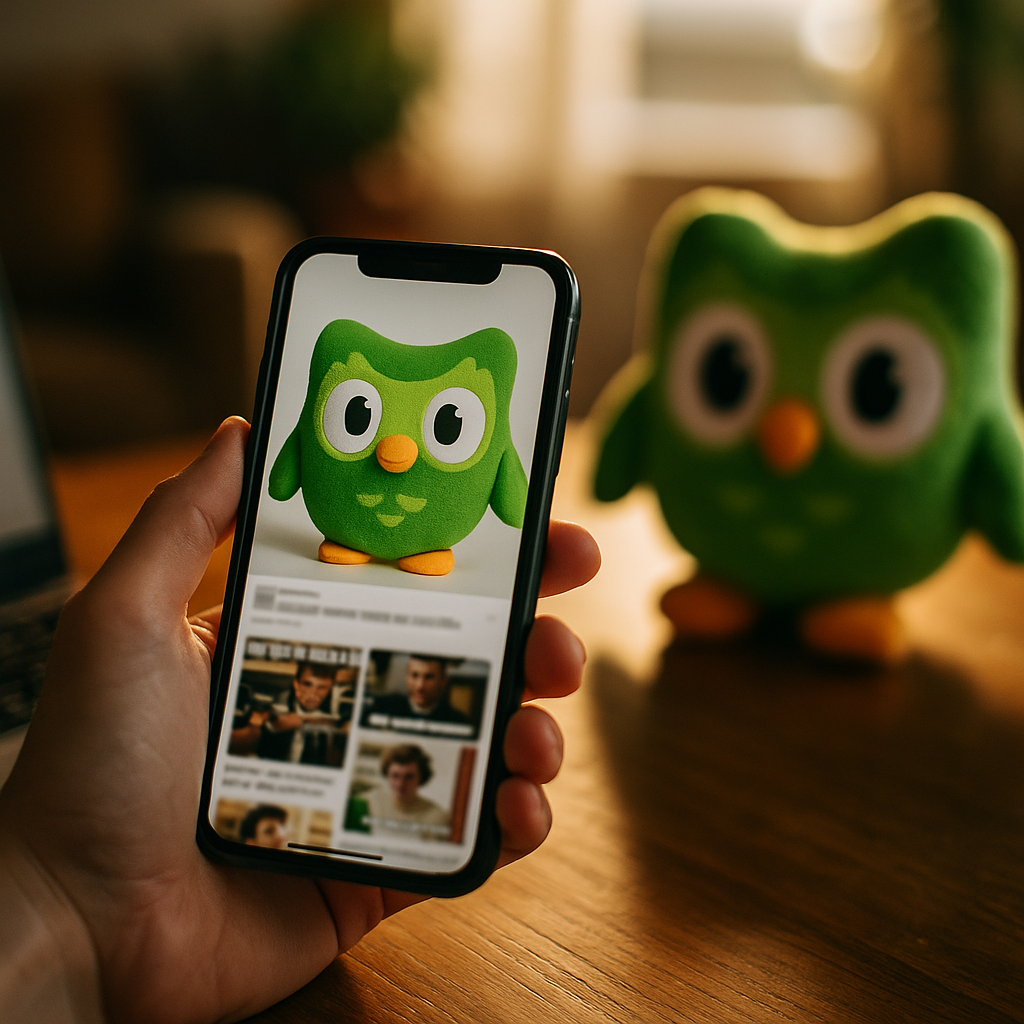
Duolingo spends almost nothing on paid social, yet its owl mascot generates more organic reach than most brands get from six-figure influencer budgets. That’s not luck. It’s a distribution system built on user-generated chaos, and it holds a blueprint every brand strategist should be studying right now. This case study breaks down how a language-learning app turned a green owl into a commerce engine without buying a single boosted post.
The Owl Wasn’t a Mascot Strategy. It Was a Distribution Strategy.
Most brands treat mascots as brand-safety exercises: cute, harmless, forgettable. Duolingo did the opposite. It let Duo the Owl be unhinged, threatening, thirsty, chronically online. The character became a proxy for the internet’s own absurdist humor, and that made it endlessly remixable.
Here’s the part brands miss: virality isn’t the goal. Remixability is. A joke that can only be told once dies fast. A format that invites a thousand variations compounds. Duolingo’s social team, led publicly by figures like Zaria Parvez, built content that functioned less like advertising and more like a meme template — open-ended enough that TikTok users wanted to riff on it themselves.
Duolingo’s TikTok account crossed tens of millions of followers with a content strategy that cost far less than a single national TV buy, and the owl became more recognizable to Gen Z than most airline or bank logos.
That’s the strategic reframe: the owl isn’t marketing collateral. It’s a distribution mechanism disguised as a character.
From Meme to Commerce: Closing the Loop
Virality without conversion is just noise. What separates Duolingo from a hundred other “quirky brand voice” accounts is that the UGC funnel actually terminates in app installs, subscriptions, and merch sales.
The mechanism works in three layers:
- Layer one — bait content. Official Duolingo posts feature the owl in absurd scenarios (fake death threats over missed lessons, cameos at award shows, random collabs with artists like Dua Lipa). These posts are designed to be screenshotted, stitched, and duetted.
- Layer two — user remix. Creators outside Duolingo’s owned channels build their own owl content: fan art, parody threat-texts, owl cosplay. None of this is paid. None of it is contractually obligated. It’s free distribution generated by affection for the character.
- Layer three — commerce capture. Duolingo funnels that attention into tangible revenue: plush owl toys that reportedly sold out within hours of launch, limited merch drops timed to cultural moments, and app-store conversion driven by sheer top-of-mind awareness during language-learning intent moments.
This is UGC-to-commerce distribution in its purest form: unpaid creator content acting as the top of funnel, with owned commerce products acting as the monetization layer. No affiliate codes. No paid partnerships. Just brand equity converted directly into purchase intent.
Why Paid Media Couldn’t Have Bought This
Ask yourself honestly: could a media buy replicate this? Paid social buys reach. It cannot buy the perception of authenticity that makes Gen Z audiences want to participate in a brand’s content rather than just watch it.
This matters more now than ever, given how platform algorithms have shifted. TikTok now ranks trust signals over reach, meaning content that drives comments, shares, and duets outperforms content that simply buys impressions. Duolingo’s owl was built for exactly this algorithmic environment before most brands even understood it was coming.
Compare that to the traditional influencer-marketing model, where brands pay for a single sponsored post and hope it resonates. Circana’s research already shows most brands underspend on creators relative to the ROI creators generate, but Duolingo flips that entirely: it never had to “spend on creators” in the traditional sense, because its own content became creator fodder.
The efficiency gap is staggering. A single sponsored TikTok from a mid-tier creator can run $5,000-$25,000 depending on niche and following. Duolingo generated equivalent or greater reach from an in-house social team and zero media spend, then multiplied that reach through thousands of unpaid remixes.
The Real Lesson: Character IP Is a Media Channel
Brand strategists tend to separate “brand character” from “media strategy.” Duolingo’s case proves that’s a false division. The owl functions as owned media infrastructure — always on, cost-free to activate, and immune to platform ad-rate inflation.
This matters increasingly as platform economics shift. Meta’s Andromeda algorithm update, for instance, rewards ad volume and punishes CPG brands that can’t sustain constant paid output. Brands without deep pockets need channels that don’t require perpetual ad spend to stay visible. A well-built character IP is one of the few assets that compounds instead of decaying the moment you stop paying for it.
There’s also a talking-head parallel worth noting. Research consistently shows unpolished, talking-head-style video outperforms polished ads in engagement and trust metrics. The owl operates on the same principle: rough, chaotic, low-production content reads as more authentic than a glossy brand campaign, even when it’s centrally planned and professionally executed behind the scenes.
What Other Brands Get Wrong When They Try to Copy This
Every quarter, another brand tries to launch its own “unhinged mascot” and it flops. Why?
Three common failure points:
- They treat the character as a campaign, not infrastructure. Duolingo’s owl has been active for years, consistently, across every platform shift. A three-month mascot activation cannot build the same equity.
- They over-brief the humor. Legal and compliance teams sanitize the content until nothing remixable remains. Duolingo’s social team reportedly operates with unusual creative freedom, a structural decision, not an accident.
- They don’t build a commerce layer. Virality without a monetization mechanism is just brand awareness. Duolingo built merch, subscription hooks, and app-store optimization around the moments when owl content peaks. Most brands generate the meme and stop there, leaving revenue on the table.
This is where retail and behavioral data increasingly matter. As retail data becomes the new trust signal in influencer measurement, brands need to track not just impressions but whether cultural moments actually convert into purchases or installs downstream. Duolingo’s merch sell-outs are a measurable commerce signal, not a vanity metric.
Operationalizing This Without a Duolingo-Sized Social Team
Not every brand has an in-house team dedicated to owl-based psychological warfare content. Fair. But the underlying mechanics are replicable at smaller scale:
- Build one consistent character or voice, not a rotating cast of campaign concepts. Consistency is what lets audiences build a relationship with the IP over time.
- Design content as templates, not finished statements. Ask: can someone else remix this format with their own twist? If not, it’s an ad, not a meme.
- Give the social team real autonomy, within clearly defined brand-safety guardrails. This matters even more given tightening regulatory scrutiny; brands should review converging youth safety laws before letting any character-led content target younger audiences unsupervised.
- Build the commerce layer before you need it. Merch drops, limited SKUs, or app-store optimization should be ready to capture demand spikes, not built reactively after a moment goes viral.
- Measure remix volume, not just views. Stitches, duets, and fan-made content are leading indicators of whether your character has become genuine cultural infrastructure or just a one-off viral hit.
This also connects to a broader shift in how brands should think about creator relationships generally. Data shows long-term creator partnerships beat one-off sponsorships, and the owl strategy is essentially that principle applied to owned IP instead of external talent: consistency and longevity compound, one-off stunts don’t.
For brands evaluating whether to build owned character IP versus continuing to rent reach through paid creator deals, it’s worth reviewing how reach is commoditizing across platforms. Owned, remixable IP is one of the few durable hedges against that commoditization, because it doesn’t depreciate every time a platform changes its ad auction dynamics.
Industry data from firms like eMarketer and Statista consistently shows paid social costs rising year over year, while organic reach for algorithmically-favored formats remains comparatively cheap if the content itself earns engagement. Platforms like TikTok’s advertising ecosystem and Meta’s business tools still favor content with organic traction in their distribution algorithms, which is precisely the mechanism Duolingo has been exploiting for years.
The Takeaway
Duolingo’s owl isn’t a mascot success story. It’s proof that owned character IP, built for remixability and backed by a real commerce layer, can outperform paid media at a fraction of the cost. Before your next budget cycle, ask whether your brand has any asset capable of doing that, and if not, start building one now rather than renting reach you’ll never own.
FAQs
What made Duolingo’s TikTok strategy different from typical brand mascot campaigns?
Duolingo built its owl as a remixable meme format rather than a polished brand asset, giving its social team creative autonomy and letting users generate free unpaid content around the character, which then fed directly into commerce outcomes like merch sales and app installs.
How does UGC-to-commerce distribution actually work?
It works in three stages: a brand publishes highly remixable “bait” content, users create their own derivative content without payment or contracts, and the brand captures that accumulated attention through owned commerce channels like merch drops or app-store conversion.
Can smaller brands replicate the Duolingo owl model without a large budget?
Yes, though scale will differ. The core principles, consistent character voice, remixable content templates, creative autonomy for social teams, and a ready commerce layer, are budget-agnostic and can be applied by mid-size brands with a small dedicated social team.
Why does this matter more now given platform algorithm changes?
Platforms increasingly reward engagement and trust signals over raw reach, meaning organically remixed content often outperforms paid placements. Brands relying solely on paid media face rising costs with diminishing returns, while owned, remixable IP continues compounding for free.
What’s the biggest mistake brands make when trying to copy this approach?
Treating it as a short-term campaign instead of long-term infrastructure, over-sanitizing content through legal review until nothing remixable remains, and failing to build a commerce mechanism to capture the attention the content generates.
FAQs
What made Duolingo’s TikTok strategy different from typical brand mascot campaigns?
Duolingo built its owl as a remixable meme format rather than a polished brand asset, giving its social team creative autonomy and letting users generate free unpaid content around the character, which then fed directly into commerce outcomes like merch sales and app installs.
How does UGC-to-commerce distribution actually work?
It works in three stages: a brand publishes highly remixable “bait” content, users create their own derivative content without payment or contracts, and the brand captures that accumulated attention through owned commerce channels like merch drops or app-store conversion.
Can smaller brands replicate the Duolingo owl model without a large budget?
Yes, though scale will differ. The core principles, consistent character voice, remixable content templates, creative autonomy for social teams, and a ready commerce layer, are budget-agnostic and can be applied by mid-size brands with a small dedicated social team.
Why does this matter more now given platform algorithm changes?
Platforms increasingly reward engagement and trust signals over raw reach, meaning organically remixed content often outperforms paid placements. Brands relying solely on paid media face rising costs with diminishing returns, while owned, remixable IP continues compounding for free.
What’s the biggest mistake brands make when trying to copy this approach?
Treating it as a short-term campaign instead of long-term infrastructure, over-sanitizing content through legal review until nothing remixable remains, and failing to build a commerce mechanism to capture the attention the content generates.
Top Influencer Marketing Agencies
The leading agencies shaping influencer marketing in 2026
Agencies ranked by campaign performance, client diversity, platform expertise, proven ROI, industry recognition, and client satisfaction. Assessed through verified case studies, reviews, and industry consultations.
Moburst

-
2

The Shelf
Boutique Beauty & Lifestyle Influencer AgencyA data-driven boutique agency specializing exclusively in beauty, wellness, and lifestyle influencer campaigns on Instagram and TikTok. Best for brands already focused on the beauty/personal care space that need curated, aesthetic-driven content.Clients: Pepsi, The Honest Company, Hims, Elf Cosmetics, Pure LeafVisit The Shelf → -
3

Audiencly
Niche Gaming & Esports Influencer AgencyA specialized agency focused exclusively on gaming and esports creators on YouTube, Twitch, and TikTok. Ideal if your campaign is 100% gaming-focused — from game launches to hardware and esports events.Clients: Epic Games, NordVPN, Ubisoft, Wargaming, Tencent GamesVisit Audiencly → -
4

Viral Nation
Global Influencer Marketing & Talent AgencyA dual talent management and marketing agency with proprietary brand safety tools and a global creator network spanning nano-influencers to celebrities across all major platforms.Clients: Meta, Activision Blizzard, Energizer, Aston Martin, WalmartVisit Viral Nation → -
5

The Influencer Marketing Factory
TikTok, Instagram & YouTube CampaignsA full-service agency with strong TikTok expertise, offering end-to-end campaign management from influencer discovery through performance reporting with a focus on platform-native content.Clients: Google, Snapchat, Universal Music, Bumble, YelpVisit TIMF → -
6

NeoReach
Enterprise Analytics & Influencer CampaignsAn enterprise-focused agency combining managed campaigns with a powerful self-service data platform for influencer search, audience analytics, and attribution modeling.Clients: Amazon, Airbnb, Netflix, Honda, The New York TimesVisit NeoReach → -
7

Ubiquitous
Creator-First Marketing PlatformA tech-driven platform combining self-service tools with managed campaign options, emphasizing speed and scalability for brands managing multiple influencer relationships.Clients: Lyft, Disney, Target, American Eagle, NetflixVisit Ubiquitous → -
8

Obviously
Scalable Enterprise Influencer CampaignsA tech-enabled agency built for high-volume campaigns, coordinating hundreds of creators simultaneously with end-to-end logistics, content rights management, and product seeding.Clients: Google, Ulta Beauty, Converse, AmazonVisit Obviously →