


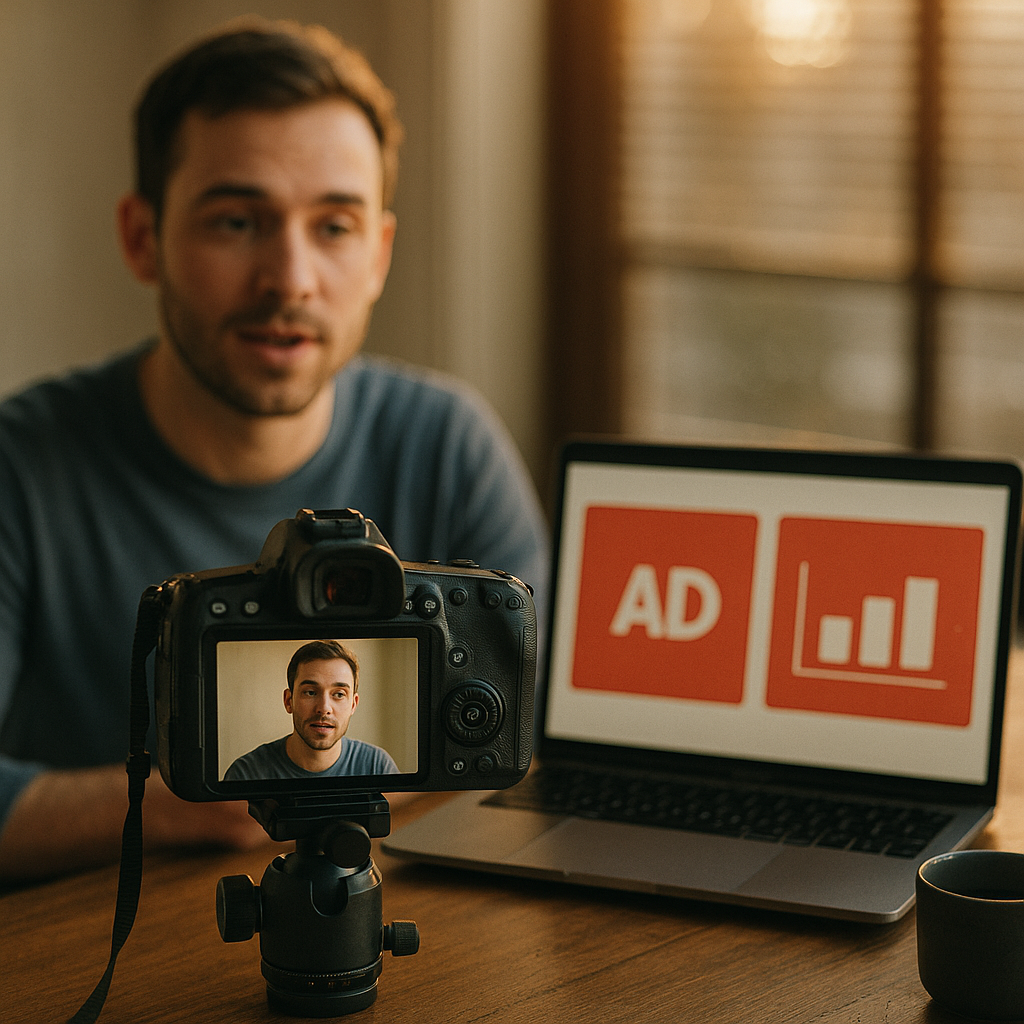
Seventy percent of top-performing TikTok ads in categories from finance to CPG still lean on a single person, a phone camera, and zero production budget. That’s not a fluke. It’s a signal. The talking-head video format has outlasted every “next big thing” thrown at it since Reels launched, and its persistence says more about audience psychology than about any platform’s algorithm.
The Format That Refuses to Die
Marketers have been predicting the death of talking-head content for years. Too basic, too repetitive, surely audiences will tire of it once AR effects and cinematic editing become table stakes? Instead, the opposite happened. Brands poured money into slicker production, and engagement on overproduced content quietly declined while unpolished, face-to-camera videos kept converting.
This isn’t nostalgia for “authentic” content as a buzzword. It’s a measurable pattern across platforms. TikTok’s own creative guidance still favors native-feeling video. Meta’s ad library shows direct-response advertisers repeatedly testing talking-head formats against studio-shot alternatives, and the plain-spoken version frequently wins on click-through and conversion.
When production value goes up, perceived trust often goes down. That inverse relationship is the single biggest reason talking-head content has proven so durable.
Why Audiences Are Rejecting Polish
Here’s the uncomfortable truth for brand teams: consumers have become extremely good at detecting when something is trying to sell them. Glossy editing, perfect lighting, scripted delivery — these are now instant signals of “ad,” and ads get skipped. A talking-head video shot in a bedroom or car reads as a recommendation from a person, not a pitch from a brand.
Add in the rise of AI-generated content, and the calculus shifts further. When synthetic avatars and AI voiceovers can produce technically flawless video in seconds, flawlessness stops being impressive. It becomes suspicious. Our earlier coverage of the AI trust discount found that audiences increasingly discount messaging the moment they suspect it’s synthetic or overly produced. Talking-head video, with its visible imperfections, is one of the few formats that still reads as unmistakably human.
Think about your own scroll behavior. Do you stop for the beautifully lit product shot, or the person mid-sentence saying “okay so I need to tell you about this”? Most people stop for the second one. That instinct is exactly what performance data keeps confirming.
What “Fatigue With Polish” Actually Means
Fatigue doesn’t mean audiences hate quality. It means they’ve developed a finely tuned filter for content that feels manufactured to persuade rather than inform. Polish, in excess, triggers that filter. A few things are driving this shift specifically:
- Ad-blindness has evolved. Consumers now pattern-match “produced” with “paid,” regardless of actual sponsorship status.
- Platform-native behavior sets expectations. Users trained on organic, low-fi content treat anything more polished as an interruption.
- Trust is now the scarce resource. With so much synthetic and semi-synthetic content in feeds, unedited human delivery has become a differentiator rather than a limitation.
- Speed matters more than beauty. A trending audio or format window closes fast. Studio production timelines simply can’t keep pace with feed velocity.
The ROI Case Brand Teams Can’t Ignore
This isn’t just an aesthetic preference; it’s a budget conversation. Talking-head content is dramatically cheaper to produce than studio work, and it’s outperforming that studio work on the metrics that matter to performance marketers: watch time, saves, shares, and conversion rate.
That combination, lower cost and higher output, is exactly why so many brands are shifting spend toward creator-led, low-production formats. It echoes what we’ve reported on creator retainers replacing one-off deals: brands want repeatable, scalable content relationships, not single polished hero assets that take three weeks to produce and get three days of relevance.
There’s also a risk-mitigation angle here that doesn’t get enough attention. Heavily produced brand content carries more legal and compliance overhead — usage rights, actor releases, agency contracts, revision cycles. Talking-head creator content, especially from established partners, tends to move through approval faster because the format itself is simpler and the creator relationship is often already governed by a standing agreement.
Brands managing multiple creator relationships are increasingly formalizing this through repeat partnership structures rather than one-off briefs, which further reduces the friction of greenlighting simple, fast-turnaround video.
Where This Shows Up in the Data
Industry spend data backs this up at scale. Creator-driven ad spend has been climbing steadily, with reporting on the sector showing creator ad spend hitting $44B even as that growth concentrates around fewer, higher-trust formats. Talking-head video sits squarely inside that concentration. It’s not the flashiest line item in a media plan, but it’s consistently one of the most efficient.
Platforms have noticed too. TikTok’s ranking systems and Meta’s ad delivery both reward watch-through and engagement signals, and simple, direct video tends to hold attention longer than heavily edited content that front-loads a hook and then loses momentum. TikTok’s advertising resources and Meta’s business guidance both continue to point creators and advertisers toward native-feeling formats over traditional commercial structures.
Is This a Trend or the New Baseline?
Fair question, and one every CMO should be asking before locking in next year’s production budget. The honest answer: talking-head video isn’t a trend anymore. It’s the baseline expectation for short-form video, and polish is now the exception that needs to justify itself.
That doesn’t mean high-production content is dead. Brand films, launch campaigns, and premium positioning still benefit from cinematic quality. But for always-on, performance-driven content — the stuff filling most feeds most days — the format that wins is the one that feels like it wasn’t made by a brand at all.
Consider how this plays out in category-specific behavior. TikTok Shop Live converts at roughly 30% versus 2-3% for static ecommerce, and live formats are, by nature, the least polished video experience possible. Real-time, unscripted, occasionally awkward. That performance gap is one of the clearest data points available on how little audiences care about production value when trust and immediacy are on the line.
The brands winning right now aren’t the ones with the best production teams. They’re the ones who figured out that “good enough, right now, from a real person” beats “perfect, eventually, from a studio.”
What This Means for Budget Allocation
For marketing leaders building next year’s plans, the implication is straightforward even if it’s uncomfortable for teams built around traditional production workflows. Reallocate spend from per-asset production costs toward creator relationships, retainers, and volume. A single well-produced :30 spot might cost as much as twelve months of talking-head content from three creators, and the latter will likely outperform it on every engagement metric platforms currently reward.
This connects directly to broader concerns about measurement. As we covered in creator ROI having no standard metric, brands still struggle to compare formats apples-to-apples. But directionally, the signal is consistent across platforms, verticals, and reporting from firms like eMarketer and Statista: lower-production, creator-led video is holding or gaining share of attention while traditional polished ad formats lose ground.
Practical Guardrails for Brand Teams
Embracing talking-head content doesn’t mean abandoning quality control. It means redefining what quality means in this context. A few operating principles worth adopting:
- Brief for authenticity, not aesthetics. Give creators talking points and boundaries, not shot lists and lighting diagrams.
- Keep disclosure compliant regardless of production value. Simple video still needs proper sponsorship disclosure under FTC endorsement guidelines. Low production isn’t a loophole for skipping disclosure requirements.
- Test against your own polished benchmarks. Don’t assume talking-head will win in your category. Run the comparison and let the data decide.
- Build for repeatability. One-off talking-head videos underperform relative to sustained creator relationships where the audience already trusts the person on screen.
None of this requires abandoning brand standards. It requires accepting that, for this format, the standard is credibility, not cinematography.
The takeaway for anyone planning next year’s creative budget: stop measuring talking-head content against your production department’s standards and start measuring it against your conversion goals. If it’s still winning on both cost and performance, that’s not a fad you’re watching. That’s the market telling you what audiences actually want.
FAQs
Why does talking-head video keep outperforming polished brand content?
Audiences associate high production value with advertising intent, which triggers skepticism. Talking-head video reads as a genuine recommendation rather than a paid pitch, which builds trust faster and drives stronger engagement and conversion, particularly on TikTok and Meta platforms.
Does this mean brands should stop investing in high-production video entirely?
No. Premium production still serves brand campaigns, product launches, and top-of-funnel awareness goals. The shift applies mainly to always-on, performance-driven content, where lower-cost, creator-led formats consistently outperform studio work on engagement and ROI.
How does this trend affect influencer marketing budgets?
It supports reallocating spend from per-asset production toward ongoing creator relationships and retainers. Brands get more usable content, faster turnaround, and better performance per dollar compared to single, heavily produced assets.
Is talking-head content harder to keep FTC-compliant?
Not inherently, but brands still need clear sponsorship disclosure regardless of production quality. Simple format doesn’t reduce compliance obligations under FTC endorsement guidance.
How can brands measure whether talking-head content is actually working for them?
Run direct comparisons against existing polished assets using watch-through rate, saves, shares, and conversion, not just impressions. Because there’s no universal creator ROI standard yet, category-specific testing remains the most reliable approach.
Top Influencer Marketing Agencies
The leading agencies shaping influencer marketing in 2026
Agencies ranked by campaign performance, client diversity, platform expertise, proven ROI, industry recognition, and client satisfaction. Assessed through verified case studies, reviews, and industry consultations.
Moburst

-
2

The Shelf
Boutique Beauty & Lifestyle Influencer AgencyA data-driven boutique agency specializing exclusively in beauty, wellness, and lifestyle influencer campaigns on Instagram and TikTok. Best for brands already focused on the beauty/personal care space that need curated, aesthetic-driven content.Clients: Pepsi, The Honest Company, Hims, Elf Cosmetics, Pure LeafVisit The Shelf → -
3

Audiencly
Niche Gaming & Esports Influencer AgencyA specialized agency focused exclusively on gaming and esports creators on YouTube, Twitch, and TikTok. Ideal if your campaign is 100% gaming-focused — from game launches to hardware and esports events.Clients: Epic Games, NordVPN, Ubisoft, Wargaming, Tencent GamesVisit Audiencly → -
4

Viral Nation
Global Influencer Marketing & Talent AgencyA dual talent management and marketing agency with proprietary brand safety tools and a global creator network spanning nano-influencers to celebrities across all major platforms.Clients: Meta, Activision Blizzard, Energizer, Aston Martin, WalmartVisit Viral Nation → -
5

The Influencer Marketing Factory
TikTok, Instagram & YouTube CampaignsA full-service agency with strong TikTok expertise, offering end-to-end campaign management from influencer discovery through performance reporting with a focus on platform-native content.Clients: Google, Snapchat, Universal Music, Bumble, YelpVisit TIMF → -
6

NeoReach
Enterprise Analytics & Influencer CampaignsAn enterprise-focused agency combining managed campaigns with a powerful self-service data platform for influencer search, audience analytics, and attribution modeling.Clients: Amazon, Airbnb, Netflix, Honda, The New York TimesVisit NeoReach → -
7

Ubiquitous
Creator-First Marketing PlatformA tech-driven platform combining self-service tools with managed campaign options, emphasizing speed and scalability for brands managing multiple influencer relationships.Clients: Lyft, Disney, Target, American Eagle, NetflixVisit Ubiquitous → -
8

Obviously
Scalable Enterprise Influencer CampaignsA tech-enabled agency built for high-volume campaigns, coordinating hundreds of creators simultaneously with end-to-end logistics, content rights management, and product seeding.Clients: Google, Ulta Beauty, Converse, AmazonVisit Obviously →