


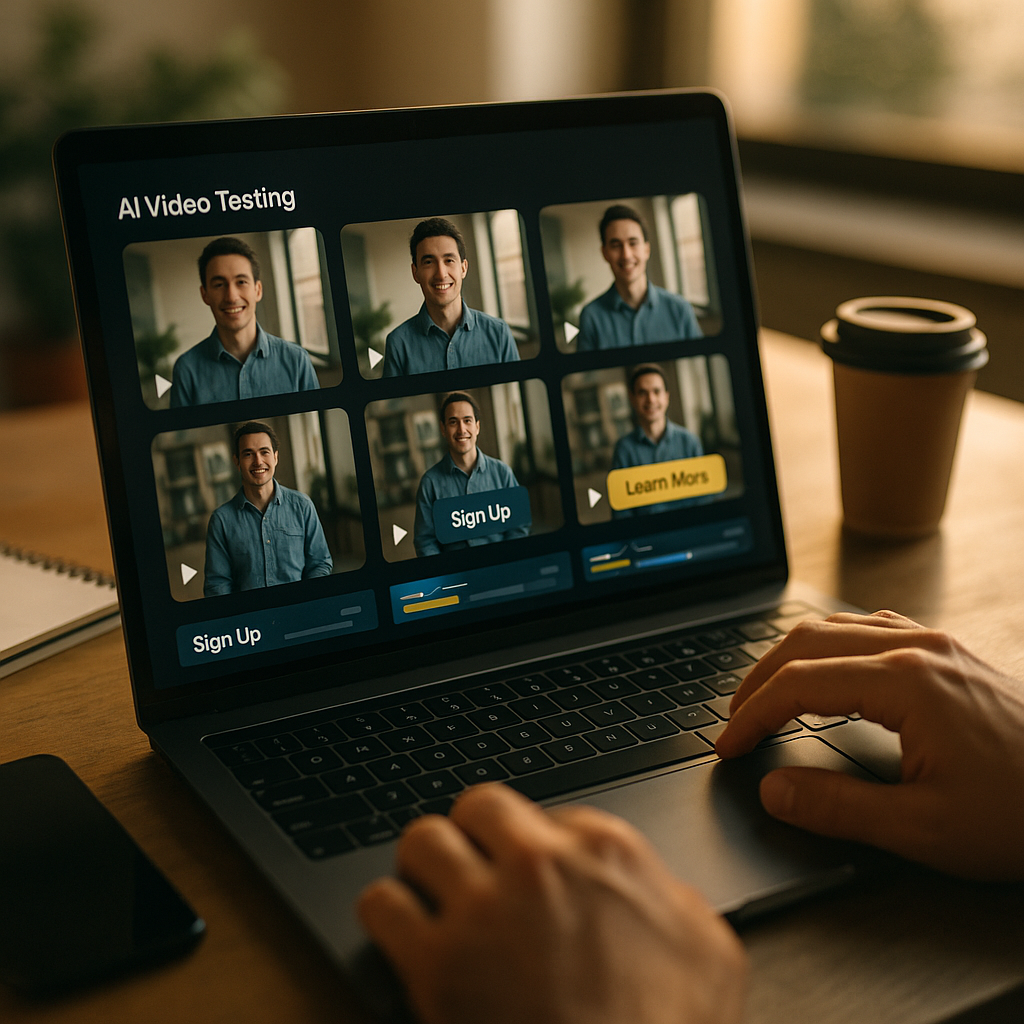
Most Brands Are Treating Creative Like a Sprint. It’s Actually a Science Experiment.
The average short-form video ad has about 1.7 seconds to earn a viewer’s attention before the scroll. That’s not a content problem. That’s a testing problem. And generative AI video production tools have finally made systematic creative testing operationally viable for brands that aren’t sitting on Netflix-level production budgets.
This is the core promise of the AI-powered short-form creative testing loop: generate dozens of hook and CTA variants at low marginal cost, run them against real audiences on TikTok and Meta Reels, and feed learnings back into a living creative database that compounds performance over time. One-time asset libraries are a relic. The brands winning paid social right now are building creative infrastructure.
Why the Hook-CTA Pairing Is the Unit of Measurement That Matters
Most brands obsess over middle-funnel creative quality. Better cinematography. More authentic creators. Tighter storytelling. All valuable. But statistically, the hook (first 1-3 seconds) and the CTA (final 3-5 seconds) are the two variables most predictive of both watch-through rate and conversion. Everything in between matters, but those bookends are where media spend gets made or wasted.
The practical implication: if you can isolate hooks and CTAs as modular variables and test them independently across a consistent body of content, you’re doing performance creative science rather than guessing. Tools like hook structures for Reels and modular briefs make this isolation possible at scale.
Generative AI makes it affordable. Platforms like Runway, Kling, and Pika Labs can now produce credible short-form video variations. Meanwhile, tools like Arcads and HeyGen allow brands to clone creator-style delivery across multiple script variants without re-shooting. The cost to generate a new hook variant has dropped from hundreds of dollars to single digits.
Building the Testing Architecture Before You Touch a Single Prompt
The mistake most marketing teams make is starting with the tool. They fire up an AI video generator, produce 20 versions of an ad, and push them live with no systematic framework for what they’re learning. That’s not a creative testing loop. That’s creative chaos with extra steps.
Before you generate anything, define your testing taxonomy:
- Hook typology: Question hooks, stat/shock hooks, pattern-interrupt visual hooks, testimonial opening hooks, problem-state hooks
- CTA typology: Urgency CTAs, social proof CTAs, curiosity gap CTAs, soft-offer CTAs, direct response CTAs
- Audience segment: Cold, warm retarget, lookalike
- Platform placement: TikTok For You Page, Meta Reels feed, Meta Stories
- Creative body (controlled variable): Keep the middle content consistent while you vary bookends
This taxonomy becomes the schema for your creative database. Every asset you produce gets tagged across these dimensions before it goes into testing. Every performance data point gets mapped back to the same schema. Over 90 days, you stop asking “which ad worked?” and start answering “which hook typology outperforms in cold TikTok audiences for our category?”
A creative database isn’t a folder of videos. It’s a structured knowledge system that connects creative variables to performance outcomes. Without the taxonomy, you have storage. With it, you have compound learning.
The AI Production Stack for High-Volume Variant Generation
You don’t need one tool. You need a coordinated stack with clear roles.
Script generation: Use large language models (ChatGPT, Claude, Gemini) with structured prompts that enforce your hook typology and CTA typology frameworks. Don’t write freeform prompts. Build templated prompt chains that output variants in a standardized format. For reference on how to structure briefs that feed AI systems effectively, see this guide on DTC creator briefs for AI pipelines.
AI video generation: Runway Gen-3 and Kling 1.6 are currently the strongest options for brand-adjacent visuals. For talking-head or spokesperson-style content, HeyGen and Arcads produce avatar-based delivery that passes casual scroll scrutiny. Synthesia remains the B2B default for corporate-tone content.
Voice and audio: ElevenLabs for voiceover generation. Keep a library of pre-approved voice profiles that match your brand tone. Audio consistency across variants matters for brand recall even in testing environments.
Assembly and formatting: CapCut’s business API and Adobe Express handle rapid final assembly, caption burning, and format adaptation. Don’t underestimate this step. A well-scripted hook rendered in the wrong aspect ratio or without captions will fail on platform before the algorithm even gets involved. For platform-specific formatting guidance, this breakdown on Meta 1:1 feed format requirements is operationally useful.
Asset management and tagging: Airtable or Notion databases with mandatory taxonomy tagging. Every asset must be tagged at upload, not retroactively. This discipline is what makes the database usable six months later.
Running the A/B Loop on TikTok and Meta: Practical Protocol
Platform mechanics differ. Account for them.
On TikTok Ads Manager, use the Creative Testing feature within campaigns. Set budgets at the ad group level, not the individual ad level, to let the system optimize without starving variants of delivery. Test 3-5 hook variants against a single CTA first, establish a hook winner, then test 3-5 CTA variants against the winning hook. Sequential isolation is faster than full factorial testing when you’re working with limited budget.
On Meta Ads Manager, Advantage+ Creative is increasingly auto-optimizing away from manual A/B purity. If you’re running systematic variant testing, use Campaign Budget Optimization with manual ad sets to maintain control. Meta’s Experiments tool (A/B test feature) is technically more rigorous but requires higher spend minimums to reach statistical significance faster.
Statistical significance target: 95% confidence minimum before declaring a winner. HubSpot’s testing frameworks and most paid social practitioners align on this threshold. Smaller teams often pull the plug at 80% and pay for it in false positives that waste the next sprint’s production budget.
For a deeper look at how to structure AI UGC variant testing at scale, including pacing variables that most brand teams overlook, that resource covers the operational detail most guides skip.
From Asset Library to Creative Intelligence System
After 60-90 days of disciplined testing, your database contains something more valuable than any individual ad: it contains predictive signal. You know which hook typologies outperform for specific audience temperatures. You know which CTAs convert for acquisition versus retargeting. You know which visual styles degrade fastest with frequency.
Feed those signals back into your brief creation process. If pattern-interrupt visual hooks are consistently outperforming question hooks for cold TikTok audiences in your category, that becomes a brief standard, not a suggestion. If urgency CTAs are burning out faster than social proof CTAs in retargeting, that’s a frequency management insight, not just a creative preference.
This is where the loop closes and compounds. Your AI generation prompts get updated with winning patterns. Your creator briefs reflect platform-validated structures. And your next round of testing starts from a higher baseline rather than zero. For teams building out creator partnerships alongside AI production, performance-linked creator briefs are a natural extension of this intelligence system into human-generated content.
The competitive moat isn’t in having better creative tools. It’s in having a better feedback loop. Brands that systematize learning from testing will outperform brands that rely on intuition, regardless of production budget.
Governance, Brand Safety, and Quality Floor Standards
Generative AI creates volume. That’s both the point and the risk. Without governance, you’ll ship off-brand content, potentially misleading claims, or visuals that violate platform policies faster than your legal team can review.
Establish a quality floor before any variant goes to testing. This means: a human creative director reviews all generated scripts for accuracy and brand compliance, a brand safety checklist is applied to all visual outputs (AI hallucinations in product representations are a real liability), and a compliance pass is run against FTC disclosure requirements if any generated content includes endorsement-adjacent language.
The review process doesn’t need to be slow. A trained creative ops team can review 20 AI-generated variants in under an hour with a standardized checklist. The volume advantage of AI production is preserved; you’re just adding a human gate at the right point in the workflow. For brands also working with human creators alongside AI assets, the modular UGC pipeline framework addresses how to manage both streams without governance conflicts.
One final operational note: document your AI tool usage for internal records. As regulatory scrutiny around AI-generated advertising increases across markets, having clear records of which assets were AI-generated versus human-produced will matter for compliance reviews, particularly in regulated categories like finance, health, and supplements.
Your immediate next step: Audit your last 90 days of paid social creative. Count how many unique hook variants you actually tested. If the number is under 10, you don’t have a creative testing program. You have a production schedule. That’s the gap AI tooling exists to close, and the taxonomy framework above is where to start building.
Frequently Asked Questions
How many hook and CTA variants should a brand test per campaign?
Most performance creative practitioners recommend testing a minimum of 5 hook variants and 3 CTA variants per campaign phase. This gives you enough variance to identify patterns without spreading budget so thin that no variant reaches statistical significance. Start with hook isolation (test hooks against a single CTA), establish a winner, then run CTA isolation against the winning hook. Scale the number of variants as your testing budget increases.
Can AI-generated video actually perform on par with human-produced creator content on TikTok and Meta?
For direct response and paid placement, AI-generated video increasingly holds its own, particularly for hook and CTA testing where the variable being measured is message and structure rather than authenticity. Native-style human creator content still outperforms AI video in organic reach and top-of-funnel brand affinity. The practical approach is to use AI generation for systematic testing and variant production, then invest human creator production in the proven winning formulas.
What metrics should define a “winning” hook variant?
On TikTok, 2-second video views and 6-second video views are the most reliable early signals for hook performance. On Meta, thumb-stop rate (2-second views divided by impressions) and video average play time are primary. Conversion metrics downstream (link clicks, purchases, ROAS) are the ultimate arbiter, but with limited budgets you often need to optimize on leading indicators first to get enough data to reach significance before the learning phase stalls.
How do you prevent brand dilution when generating high volumes of AI creative?
The solution is a strict quality floor review process combined with a locked brand asset library that feeds into your AI production stack. This means pre-approved color palettes, typography, logo placement rules, approved voice profiles, and product representation standards are all defined before any AI generation starts. Every output is reviewed against this checklist by a human before it enters the testing queue. Volume without governance is a brand safety risk; volume with governance is a competitive advantage.
How often should you update the creative database with new test learnings?
A biweekly review cadence works well for most paid social programs running continuous testing. At each review, winning patterns get codified into brief templates and AI generation prompts, losing patterns get flagged to avoid in future sprints, and the test roadmap for the next two weeks is updated based on open questions the current data raises. Quarterly, run a deeper audit to identify longer-term creative fatigue patterns and refresh your hook and CTA typology taxonomy based on accumulated data.
Top Influencer Marketing Agencies
The leading agencies shaping influencer marketing in 2026
Agencies ranked by campaign performance, client diversity, platform expertise, proven ROI, industry recognition, and client satisfaction. Assessed through verified case studies, reviews, and industry consultations.
Moburst

-
2

The Shelf
Boutique Beauty & Lifestyle Influencer AgencyA data-driven boutique agency specializing exclusively in beauty, wellness, and lifestyle influencer campaigns on Instagram and TikTok. Best for brands already focused on the beauty/personal care space that need curated, aesthetic-driven content.Clients: Pepsi, The Honest Company, Hims, Elf Cosmetics, Pure LeafVisit The Shelf → -
3

Audiencly
Niche Gaming & Esports Influencer AgencyA specialized agency focused exclusively on gaming and esports creators on YouTube, Twitch, and TikTok. Ideal if your campaign is 100% gaming-focused — from game launches to hardware and esports events.Clients: Epic Games, NordVPN, Ubisoft, Wargaming, Tencent GamesVisit Audiencly → -
4

Viral Nation
Global Influencer Marketing & Talent AgencyA dual talent management and marketing agency with proprietary brand safety tools and a global creator network spanning nano-influencers to celebrities across all major platforms.Clients: Meta, Activision Blizzard, Energizer, Aston Martin, WalmartVisit Viral Nation → -
5

The Influencer Marketing Factory
TikTok, Instagram & YouTube CampaignsA full-service agency with strong TikTok expertise, offering end-to-end campaign management from influencer discovery through performance reporting with a focus on platform-native content.Clients: Google, Snapchat, Universal Music, Bumble, YelpVisit TIMF → -
6

NeoReach
Enterprise Analytics & Influencer CampaignsAn enterprise-focused agency combining managed campaigns with a powerful self-service data platform for influencer search, audience analytics, and attribution modeling.Clients: Amazon, Airbnb, Netflix, Honda, The New York TimesVisit NeoReach → -
7

Ubiquitous
Creator-First Marketing PlatformA tech-driven platform combining self-service tools with managed campaign options, emphasizing speed and scalability for brands managing multiple influencer relationships.Clients: Lyft, Disney, Target, American Eagle, NetflixVisit Ubiquitous → -
8

Obviously
Scalable Enterprise Influencer CampaignsA tech-enabled agency built for high-volume campaigns, coordinating hundreds of creators simultaneously with end-to-end logistics, content rights management, and product seeding.Clients: Google, Ulta Beauty, Converse, AmazonVisit Obviously →