


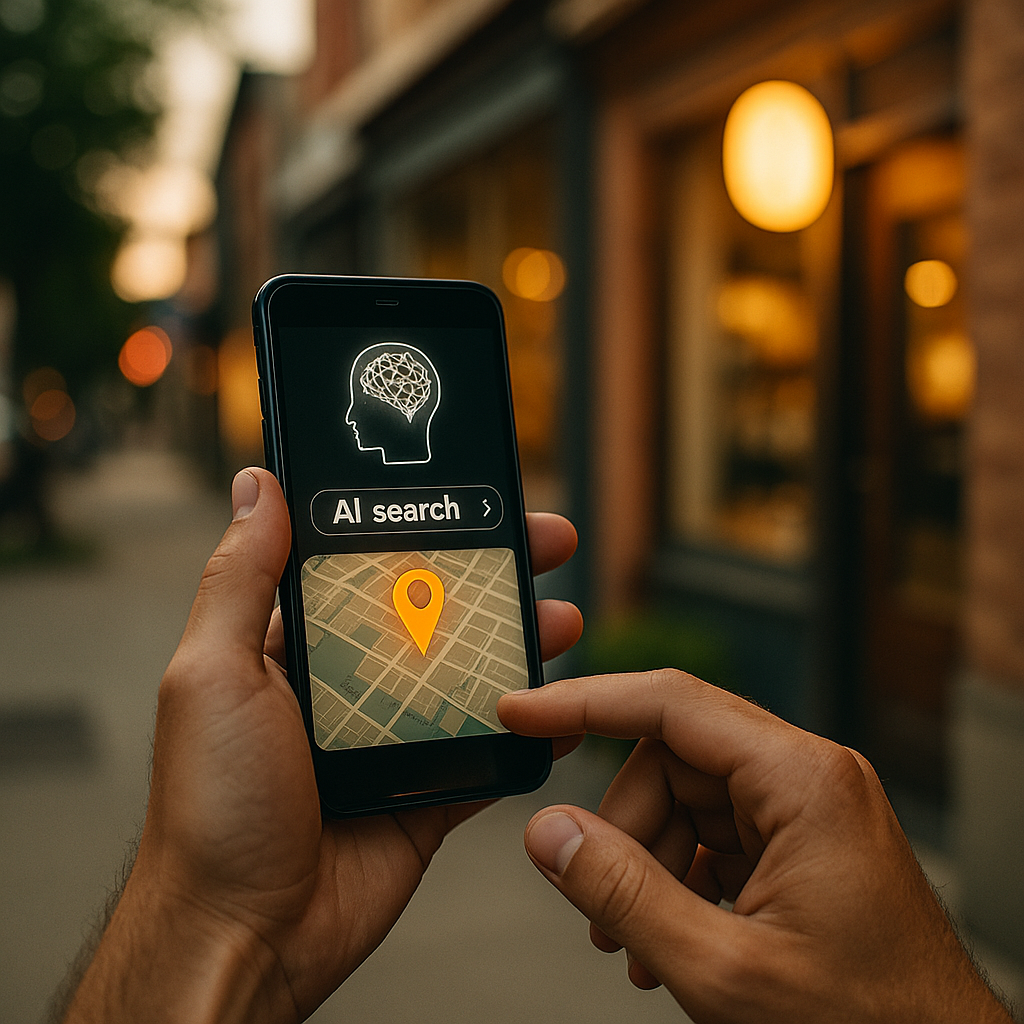
Forty-five percent of consumers now open ChatGPT or Gemini before they open Google Maps. If your brand has physical locations and you’re not engineering your creator content and product data for AI retrieval, you are invisible to nearly half your potential walk-in traffic. AI visibility frameworks for local business discovery are no longer experimental. They’re operational infrastructure.
Why Local Discovery Has Shifted to Conversational AI
The shift is structural, not seasonal. Consumers asking “best physical therapist near downtown Austin” or “top-rated Italian restaurant in Midtown with private dining” are getting synthesized answers from large language models, not a list of ten blue links. The LLM pulls from a curated mix of structured data, review aggregators, local citations, and increasingly, creator-published content that explicitly names locations, services, and outcomes.
Google’s own data confirms that AI Overviews now appear on a significant share of local-intent queries. Meanwhile, ChatGPT with browsing and Gemini with Google integration are routing local discovery through their own synthesis layers. The old playbook of “optimize your Google Business Profile and call it done” misses the new referral surface entirely.
LLMs don’t rank pages. They synthesize signals. If your location data, creator testimonials, and product descriptions aren’t structured for machine comprehension, no amount of follower count will get you cited in an AI recommendation.
The Four Signal Types AI Models Use for Local Recommendations
Before you brief a creator or audit your product feed, understand what LLMs are actually pulling. Based on how models like Gemini and ChatGPT currently handle local queries, there are four primary signal types that influence whether your location gets recommended:
- Structured local data: NAP (name, address, phone) consistency across Google Business Profile, Yelp, Apple Maps, and third-party directories. LLMs cross-reference these for factual grounding.
- Review corpus quality: Not just star ratings. The semantic content of reviews matters. Reviews that use specific service language (“the laser hair removal consultation was thorough,” not “great experience”) train the model’s association between your location and specific outcomes.
- Creator and editorial content: Long-form content from creators who explicitly name your location, describe the visit experience, and use category-specific language gives LLMs quotable, citable material.
- Product and service data schemas: Structured markup using Schema.org LocalBusiness, Service, and Product types. If your site doesn’t speak schema, it’s speaking a language the model can’t parse efficiently.
The interplay between these four matters. A location with 200 five-star reviews but no creator-published narrative and no schema markup will lose an AI recommendation to a competitor with 80 reviews, two strong creator posts, and clean structured data. That is the new competitive dynamic.
Creator Brief Architecture for AI-Readable Local Content
This is where most brands leave value on the table. Creator briefs for local discovery need to be written with LLM retrieval in mind, not just human engagement metrics. The GEO creator brief framework applies directly here. You’re not just asking a creator to generate impressions. You’re asking them to produce a structured narrative that an AI can extract, paraphrase, and cite.
Practically, that means your creator briefs should require:
- Explicit location mention in the first 100 words of any caption or video description (neighborhood, city, and venue name)
- Service or product category language that mirrors how consumers phrase queries (“where to get a deep tissue massage in Buckhead” not just “amazing spa day”)
- Outcome statements, not just experience statements (“my back pain was reduced after one session” versus “such a relaxing vibe”)
- A call-to-action that includes the business URL with location-specific landing pages, not a generic homepage link
The format matters too. Long-form blog posts and YouTube video descriptions are currently stronger AI citation sources than TikTok captions alone. If your creator program is purely short-form, you’re generating social proof for humans but minimal indexable signal for LLMs. Layer in at least one long-form creator asset per location per quarter. For the mechanics of writing briefs that LLMs can parse and cite, the LLM-compatible creator brief guide breaks down the exact structural requirements.
Structuring Product and Service Data for AI Retrieval
Your website is still a primary training and retrieval surface. For physical location brands, that means treating every service page as a structured data asset, not just a conversion page.
Implement Schema.org LocalBusiness markup with nested Service schema for each distinct offering. If you run a med spa with eight service lines, each service needs its own schema block with description, price range, and provider information. Google’s structured data documentation provides the technical spec, but the strategic point is this: schema markup gives LLMs a machine-readable summary they can cite without scraping unstructured prose. It reduces hallucination risk and increases citation accuracy.
Beyond schema, your FAQ pages are underutilized AI retrieval assets. Every “people also ask” type question relevant to your service category should be answered on a dedicated FAQ page using natural query language. “What should I expect during my first chiropractic adjustment at [Location Name]?” is a perfect FAQ entry that a model will find, parse, and surface when a consumer asks that exact question. The generative AI e-commerce audit framework covers how to identify gaps in your current structured data footprint.
Tracking Whether You’re Actually Getting Recommended
Most brands have no idea if they’re appearing in AI-generated local recommendations. That’s a measurement gap that needs to close immediately. Manual prompt testing is a starting point: run 20-30 location-specific queries across ChatGPT, Gemini, and Perplexity weekly, and track whether your brand appears, what context it appears in, and which competitors are getting cited instead of you.
Scale that with a share-of-model monitoring approach. The process for tracking share-of-model across AI platforms gives you the operational cadence for this. For multi-location brands, build a query matrix that covers each city, each service line, and common intent variations. The output tells you exactly where your AI visibility gaps are concentrated geographically and by service category.
Share-of-model is becoming the new share-of-voice. Brands that measure it now will have six months of optimization data before their competitors realize the metric exists.
Pair prompt testing with citation tracking. When a creator’s post or your FAQ page gets cited in an AI response, log it. Over time, you’ll see which content formats and which creator narratives consistently generate citations. That becomes your content production brief for the next quarter. For building the attribution layer that connects creator content to AI-driven foot traffic, the AI attribution pipeline framework is a practical starting point.
The Compliance and Brand Safety Layer
One consideration brands are sleeping on: the FTC’s disclosure requirements don’t disappear because a creator’s content is being cited by an AI. If a consumer gets an AI recommendation that synthesizes a paid creator’s content without disclosure context, and that consumer later discovers the commercial relationship, the reputational and regulatory exposure sits with your brand. The FTC’s endorsement guidelines require clear disclosure, and AI-mediated discovery doesn’t create an exemption.
Structure creator contracts to include language about how their content may be indexed and retrieved by AI systems. For brands running influencer programs at scale, creator contracts that address LLM training signals are now a standard risk management requirement, not an edge case.
Additionally, monitor what AI models are saying about your locations. Gemini and ChatGPT sometimes synthesize outdated or incorrect operational details (hours, parking, pricing) from stale web sources. A quarterly AI brand visibility audit catches these errors before they mislead consumers and damage trust.
Building the Framework Internally
For marketing leaders running multi-location brands, this is an organizational design question as much as a tactics question. AI visibility for local discovery requires coordination between your SEO team (structured data), your creator/influencer team (brief architecture), your local marketing leads (NAP hygiene, review management), and your analytics function (share-of-model tracking).
That coordination doesn’t happen without an owner. Assign a GEO (Generative Engine Optimization) lead, even if it’s a shared responsibility role initially. Set quarterly targets for share-of-model by market. Build creator briefs that explicitly serve AI retrieval goals alongside human engagement goals. Audit your schema quarterly. Test your citations monthly. Review resources like eMarketer’s AI commerce data and Sprout Social’s creator benchmark reports to stay calibrated on how consumer AI usage is evolving.
The brands winning AI-driven local recommendations right now aren’t necessarily the biggest spenders. They’re the ones treating LLM retrieval as a first-class channel with its own content strategy, data infrastructure, and measurement framework. Start there.
Frequently Asked Questions
What is an AI visibility framework for local business discovery?
An AI visibility framework for local business discovery is a structured approach to optimizing your brand’s structured data, creator content, and review corpus so that large language models like ChatGPT and Gemini surface your physical locations when consumers ask local-intent queries. It covers Schema.org markup, creator brief architecture, NAP consistency, and share-of-model measurement.
How do I get my local business recommended by ChatGPT or Gemini?
Focus on four areas: clean, consistent structured data (NAP across all directories and Schema.org LocalBusiness markup on your site), a rich review corpus that uses specific service language, creator-published long-form content that explicitly names your location and describes service outcomes, and FAQ pages written in natural query language. LLMs synthesize from all four sources when generating local recommendations.
Do creator posts help with AI-driven local search recommendations?
Yes, but only if the content is structured for machine comprehension. Creator posts that explicitly name the location, use category-specific service language, and include outcome statements give LLMs citable material. Short-form captions alone are less effective than long-form blog posts or YouTube video descriptions, which provide more indexable, semantically rich content for AI retrieval.
What is share-of-model and why does it matter for local brands?
Share-of-model measures how often your brand appears in AI-generated responses across platforms like ChatGPT, Gemini, and Perplexity relative to your competitors. For local brands, it functions like share-of-voice in traditional media: the more often your location is cited in AI recommendations for relevant local queries, the more consumer intent you capture. Tracking it requires regular manual and automated prompt testing across your key markets and service lines.
How often should I audit my brand’s AI visibility for local search?
At minimum, run a structured audit quarterly. This includes checking your Schema.org markup for accuracy, testing 20-30 location-specific prompts across major AI platforms, verifying that operational details (hours, pricing, parking) are accurate in AI-generated responses, and reviewing which creator content is being cited. For multi-location brands in competitive markets, monthly prompt testing with a documented share-of-model tracker is the recommended cadence.
Top Influencer Marketing Agencies
The leading agencies shaping influencer marketing in 2026
Agencies ranked by campaign performance, client diversity, platform expertise, proven ROI, industry recognition, and client satisfaction. Assessed through verified case studies, reviews, and industry consultations.
Moburst

-
2

The Shelf
Boutique Beauty & Lifestyle Influencer AgencyA data-driven boutique agency specializing exclusively in beauty, wellness, and lifestyle influencer campaigns on Instagram and TikTok. Best for brands already focused on the beauty/personal care space that need curated, aesthetic-driven content.Clients: Pepsi, The Honest Company, Hims, Elf Cosmetics, Pure LeafVisit The Shelf → -
3

Audiencly
Niche Gaming & Esports Influencer AgencyA specialized agency focused exclusively on gaming and esports creators on YouTube, Twitch, and TikTok. Ideal if your campaign is 100% gaming-focused — from game launches to hardware and esports events.Clients: Epic Games, NordVPN, Ubisoft, Wargaming, Tencent GamesVisit Audiencly → -
4

Viral Nation
Global Influencer Marketing & Talent AgencyA dual talent management and marketing agency with proprietary brand safety tools and a global creator network spanning nano-influencers to celebrities across all major platforms.Clients: Meta, Activision Blizzard, Energizer, Aston Martin, WalmartVisit Viral Nation → -
5

The Influencer Marketing Factory
TikTok, Instagram & YouTube CampaignsA full-service agency with strong TikTok expertise, offering end-to-end campaign management from influencer discovery through performance reporting with a focus on platform-native content.Clients: Google, Snapchat, Universal Music, Bumble, YelpVisit TIMF → -
6

NeoReach
Enterprise Analytics & Influencer CampaignsAn enterprise-focused agency combining managed campaigns with a powerful self-service data platform for influencer search, audience analytics, and attribution modeling.Clients: Amazon, Airbnb, Netflix, Honda, The New York TimesVisit NeoReach → -
7

Ubiquitous
Creator-First Marketing PlatformA tech-driven platform combining self-service tools with managed campaign options, emphasizing speed and scalability for brands managing multiple influencer relationships.Clients: Lyft, Disney, Target, American Eagle, NetflixVisit Ubiquitous → -
8

Obviously
Scalable Enterprise Influencer CampaignsA tech-enabled agency built for high-volume campaigns, coordinating hundreds of creators simultaneously with end-to-end logistics, content rights management, and product seeding.Clients: Google, Ulta Beauty, Converse, AmazonVisit Obviously →