


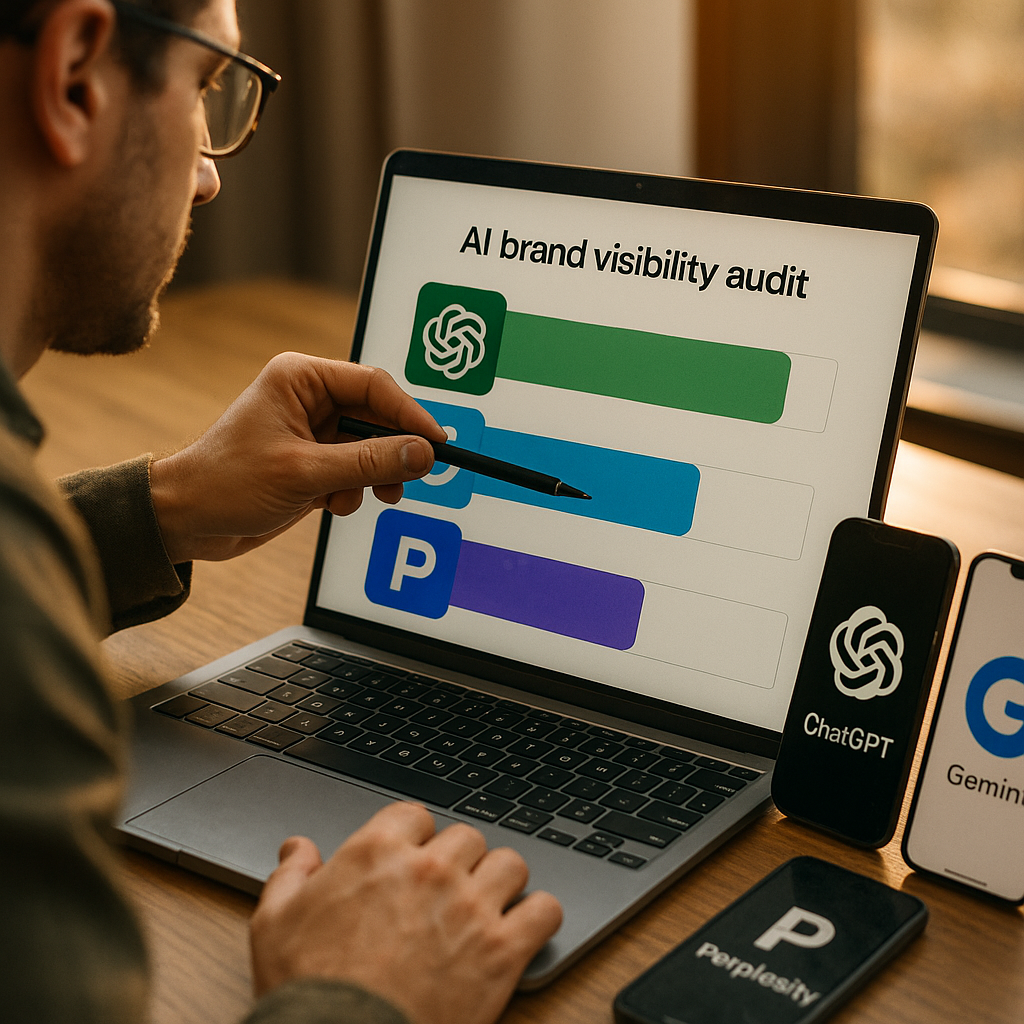
Your Brand Is Already Being Described in AI Search. You Just Haven’t Checked What It’s Saying.
Roughly 40% of U.S. consumers now use generative AI tools for product research before making a purchase decision, according to data tracked by eMarketer. If your brand’s digital team hasn’t run a structured generative search brand visibility audit, you’re flying blind through one of the most consequential shifts in brand perception since the rise of review platforms.
This is the practical guide your team needs to assess representation accuracy across ChatGPT, Gemini, and Perplexity, then build a correction roadmap that actually moves the needle.
Why “Good Enough” SEO Doesn’t Translate to AI Search
Traditional search surfaces links. Generative AI surfaces conclusions. That’s the operational difference that most brand teams are still underestimating.
When a procurement lead or category buyer types “best project management software for enterprise teams” into Perplexity, they don’t get a results page they can scan. They get a paragraph that either includes your brand, misrepresents your brand, or ignores it entirely. There’s no position three to fall back on. The stakes are binary.
The other complication: these models are trained on data that can be months or years old, scraped from sources your SEO team never prioritized. Your pricing has changed. Your product has new features. A competitor acquisition you completed reshuffled your positioning. None of that updates automatically in an LLM’s weights. Understanding how generative search changes brand content strategy is table stakes before you can audit anything effectively.
Generative AI doesn’t rank your brand. It characterizes it. And a single inaccurate characterization, repeated across thousands of AI-assisted buyer journeys, compounds into measurable revenue damage before your analytics team even flags the trend.
Phase 1: The Query Inventory
Before you open any AI interface, map your query universe. This is where most audits fail, because teams default to brand-name queries when the real exposure sits in product and category queries where your brand should appear but might not.
Build three query tiers:
- Brand-direct queries: “[Your brand name] features,” “[Your brand name] pricing,” “[Your brand name] vs [Competitor]”
- Category queries: “best [product category] for [use case],” “top [product category] tools”
- Problem-led queries: “how do I solve [specific pain point],” “what’s the easiest way to [task your product handles]”
Aim for 40 to 60 queries across these tiers. Weight heavily toward problem-led and category queries, because that’s where AI models make unsolicited brand recommendations that your team has zero visibility into right now.
For B2B brands with complex products, include queries that reflect different buyer personas. A CTO asking about your API reliability will get a different AI response than a marketing director asking about integrations. Both matter.
Running the Audit Across ChatGPT, Gemini, and Perplexity
Each platform has distinct behavior. Don’t collapse them into a single test.
ChatGPT (GPT-4o): Run queries in a fresh session without memory enabled. Note whether your brand appears, what claims are made about pricing, features, and positioning, and whether cited sources (if any) are accurate. ChatGPT often synthesizes confidently from older training data with minimal live retrieval unless Browse is explicitly triggered.
Gemini (Google’s model): Gemini has stronger real-time grounding through Google’s index, which means your structured data, Google Business Profile, and recent press coverage feed its responses more directly. This makes Gemini both more accurate and more immediately correctable. Understanding the GEO strategy for brand visibility is directly relevant here because Gemini’s grounding mechanisms respond to the same signals.
Perplexity: Perplexity shows its citations, which is a goldmine for your audit. When Perplexity describes your brand incorrectly, you can trace exactly which source fed the error. That’s your correction target.
Log every response in a structured spreadsheet. Columns should include: query, platform, brand mentioned (yes/no), accuracy rating (accurate/partial/inaccurate/missing), specific errors noted, and cited sources where visible. This gives you the data layer you need to build a prioritized correction roadmap.
Scoring What You Find
Not all errors carry equal weight. A misquoted price point is more damaging than an incomplete feature list. Build a severity matrix with three tiers:
- Critical: Factually wrong pricing, discontinued products being recommended, incorrect regulatory claims (especially relevant for fintech, health, or legal software), wrong founding story or ownership information
- Moderate: Missing key differentiators, outdated integrations list, competitor comparisons using stale benchmarks
- Low: Brand voice inconsistencies, incomplete use case coverage, missing recent product updates
Score each platform separately. You’ll likely find that your Perplexity representation is more accurate than ChatGPT’s because of citation recency, while Gemini’s accuracy correlates tightly with the freshness of your Google-indexed content. This scoring gives leadership a clear risk picture and gives your correction roadmap a sequencing logic.
For brands operating in regulated categories, critical errors aren’t just a brand problem. They’re a compliance exposure. Looping in legal before you publish any correction roadmap is worth the delay.
Building the Correction Roadmap
Correcting AI misrepresentation is not a single fix. It’s a multi-channel content and technical operation that unfolds over 60 to 90 days minimum. Here’s how to structure it.
Week 1-2: Source remediation. Using the Perplexity citation data and your own web crawl, identify the specific pages, third-party review sites, and publisher content feeding incorrect information. Wikipedia entries, G2 profiles, Capterra listings, and your own “About” pages are usually the primary culprits. Update them. This directly feeds LLM citation optimization strategies your content team should already be running.
Week 3-4: Structured data and entity reinforcement. Implement or clean up your schema markup. Organization, Product, and FAQPage schema types are particularly influential for how models understand and characterize your brand. Your Google Business Profile needs to reflect current pricing tiers, product names, and service areas. LLM discoverability checklists for content teams should be issued at this stage.
Week 5-8: Content depth and freshness campaign. Publish authoritative, factually dense content targeting the exact queries where your brand was misrepresented or absent. This isn’t blog content for its own sake. It needs to be structured, cited, and designed to be indexed and retrievable by AI grounding systems. This is where working with the AI product research layer in your influencer budget allocation becomes tactically relevant. Creator-generated content that accurately describes your product’s specifications and use cases adds citation surface area that models can pull from.
Week 9-12: Re-audit and delta measurement. Rerun your full query inventory across all three platforms. Score against your baseline. Expect meaningful movement on Gemini first (fastest index feedback loop), moderate movement on Perplexity, and slower improvement on ChatGPT where training data refresh cycles are less predictable.
The correction roadmap isn’t finished when AI responses improve. It becomes a recurring operational process, because your product evolves, your competitors pivot, and AI models periodically update. Schedule quarterly re-audits as a permanent function of your digital brand team.
The Organizational Question Nobody Asks
Who owns this? In most enterprise marketing orgs, generative search visibility falls between SEO, content, product marketing, and digital. That’s why it gets owned by nobody.
Assign a named owner. Give them cross-functional access to product, legal, and SEO. Budget for a quarterly audit cadence. The brands that will win the AI search visibility race over the next 24 months aren’t necessarily those with the biggest content operations. They’re the ones that treat AI representation as a managed brand asset rather than an ambient side effect of their existing SEO program.
For teams already managing complex attribution across channels, the data discipline required here aligns closely with clean pipeline thinking. See how data pipeline architecture principles apply directly to making your brand machine-readable at scale. And if you need a broader framework for brand content in AI-native environments, the generative search visibility guide is a practical companion to this audit process.
Run the audit this week. Fix the critical errors first. Then build the roadmap.
Frequently Asked Questions
What is a generative search brand visibility audit?
A generative search brand visibility audit is a structured process where a brand’s digital team tests how the brand is described, characterized, and recommended across AI platforms like ChatGPT, Gemini, and Perplexity. The audit identifies factual inaccuracies, missing brand mentions, and outdated information that could be influencing buyer decisions made through AI-assisted research.
How often should brands run a generative search audit?
Most brand teams should run a full generative search audit quarterly. Additional spot-checks are recommended after major product launches, pricing changes, rebranding initiatives, or competitive events like acquisitions. AI model updates can also shift how your brand is characterized, so a regular cadence is more effective than a one-time fix.
Which AI platform should brands prioritize for corrections first?
Brands should prioritize Gemini first because it has the tightest connection to Google’s live index, meaning corrections made to your website, structured data, and Google Business Profile will surface in Gemini responses relatively quickly. Perplexity is second priority because it shows citations, making it easier to trace and fix the specific sources feeding inaccurate information. ChatGPT’s correction timeline is less predictable due to its training data refresh cycles.
What causes AI search to misrepresent brands?
AI misrepresentation typically stems from outdated training data, third-party sources with stale or incorrect information (such as old G2 reviews, outdated Wikipedia entries, or superseded press coverage), weak structured data markup on the brand’s own website, and a lack of authoritative, factually dense content targeting product and category queries where the brand should appear.
Can influencer content improve generative search visibility?
Yes. Creator and influencer content that accurately describes product features, use cases, and specifications adds citation surface area that AI models can reference during grounding and retrieval. Structured, factually precise creator content published on indexable platforms contributes to how models characterize a brand, particularly in Perplexity and Gemini which rely on live web retrieval. Coordinating creator briefs to include accurate product details is an underused correction lever for most brand teams.
How do I measure improvement after making corrections?
Re-run your original query inventory across all three platforms after 30 to 60 days and score responses against your baseline accuracy matrix. Track the percentage of queries where your brand is mentioned accurately, the reduction in critical errors, and the improvement in category and problem-led query representation. Gemini typically shows the fastest measurable improvement due to its real-time indexing feedback loop.
Top Influencer Marketing Agencies
The leading agencies shaping influencer marketing in 2026
Agencies ranked by campaign performance, client diversity, platform expertise, proven ROI, industry recognition, and client satisfaction. Assessed through verified case studies, reviews, and industry consultations.
Moburst

-
2

The Shelf
Boutique Beauty & Lifestyle Influencer AgencyA data-driven boutique agency specializing exclusively in beauty, wellness, and lifestyle influencer campaigns on Instagram and TikTok. Best for brands already focused on the beauty/personal care space that need curated, aesthetic-driven content.Clients: Pepsi, The Honest Company, Hims, Elf Cosmetics, Pure LeafVisit The Shelf → -
3

Audiencly
Niche Gaming & Esports Influencer AgencyA specialized agency focused exclusively on gaming and esports creators on YouTube, Twitch, and TikTok. Ideal if your campaign is 100% gaming-focused — from game launches to hardware and esports events.Clients: Epic Games, NordVPN, Ubisoft, Wargaming, Tencent GamesVisit Audiencly → -
4

Viral Nation
Global Influencer Marketing & Talent AgencyA dual talent management and marketing agency with proprietary brand safety tools and a global creator network spanning nano-influencers to celebrities across all major platforms.Clients: Meta, Activision Blizzard, Energizer, Aston Martin, WalmartVisit Viral Nation → -
5

The Influencer Marketing Factory
TikTok, Instagram & YouTube CampaignsA full-service agency with strong TikTok expertise, offering end-to-end campaign management from influencer discovery through performance reporting with a focus on platform-native content.Clients: Google, Snapchat, Universal Music, Bumble, YelpVisit TIMF → -
6

NeoReach
Enterprise Analytics & Influencer CampaignsAn enterprise-focused agency combining managed campaigns with a powerful self-service data platform for influencer search, audience analytics, and attribution modeling.Clients: Amazon, Airbnb, Netflix, Honda, The New York TimesVisit NeoReach → -
7

Ubiquitous
Creator-First Marketing PlatformA tech-driven platform combining self-service tools with managed campaign options, emphasizing speed and scalability for brands managing multiple influencer relationships.Clients: Lyft, Disney, Target, American Eagle, NetflixVisit Ubiquitous → -
8

Obviously
Scalable Enterprise Influencer CampaignsA tech-enabled agency built for high-volume campaigns, coordinating hundreds of creators simultaneously with end-to-end logistics, content rights management, and product seeding.Clients: Google, Ulta Beauty, Converse, AmazonVisit Obviously →