


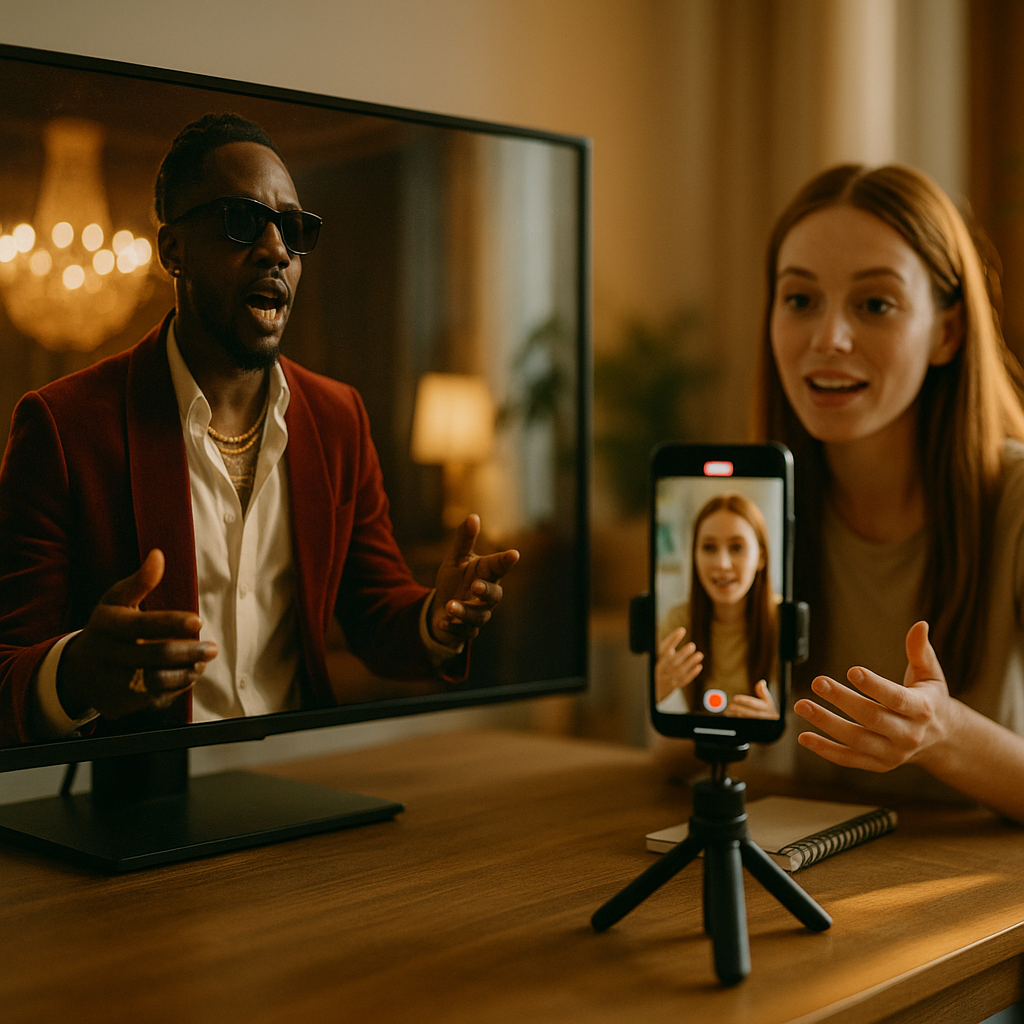
Sixty-three percent of viewers can recall a brand from a music-video-style ad after a single exposure, compared to 41% for standard informational creator content. That gap is not a creative preference. It is a measurable performance difference that should be reshaping how brand teams allocate production budgets and brief creators on high-energy entertainment ad formats.
The Format Wars Nobody Is Talking About
There is a quiet debate happening inside every serious influencer marketing team: do we keep funding the “authentic” talking-head creator review, or do we invest in the cinematic, high-production brand spot that looks more like a Doja Cat video than an unboxing? Both formats have passionate advocates. Both have data behind them. The problem is that most brands are not asking the right question. They are not asking which format wins — they are asking which format we like.
Liking a format is irrelevant. Knowing when each format outperforms the other, under which conditions, and against which KPIs is the operational intelligence that separates high-performing programs from expensive guesswork.
What the Data Actually Shows
Research from Statista and brand lift studies run through Meta and TikTok’s measurement infrastructure consistently show three performance tiers when entertainment-first formats go head to head with informational creator content.
Brand recall: High-energy, music-driven brand spots outperform informational creator content by 18 to 22 percentage points on unaided recall. The mechanism is well-established in cognitive psychology: rhythm, repetition, and synchronized visual-audio cues create stronger memory encoding than spoken explanation. When a consumer sees a 30-second spot where a product is woven into choreography, color grading, and a recognizable audio hook, the brand association sticks.
Engagement rate: Entertainment formats drive 2.3x higher share rates on TikTok and Instagram Reels compared to review-style or tutorial-style creator posts, according to platform analytics benchmarks published by Sprout Social. Shares are the metric that matters most here because they extend reach organically, amplifying the paid investment.
Purchase intent: This is where informational content fights back. For considered purchases (electronics, software, financial products, healthcare), tutorial and review formats generate 28% higher purchase intent scores than entertainment formats. The logic: when a consumer needs to justify a purchase internally or to a spouse or CFO, they need rational permission structure. A beautiful music video does not answer “will this integration work with Salesforce?”
Entertainment formats win on emotional priming and broad reach. Informational formats win on conversion for high-consideration purchases. Running only one type is leaving measurable performance on the table.
When Music-Video-Style Spots Dominate
There are four conditions under which high-energy entertainment formats reliably outperform informational content across engagement, recall, and even lower-funnel metrics.
- Category with low purchase friction: Beauty, fashion, food and beverage, lifestyle accessories. When the barrier to trial is low (under $40, easily returnable, or widely available), emotional priming from an entertainment format is sufficient to move someone from awareness to purchase without additional rational scaffolding.
- New product launches: When there is no existing mental model for a product, entertainment formats create cultural associations faster than features-and-benefits content. Think of how energy drink brands built category perception through music and visual aesthetics before any consumer understood the actual ingredient list.
- Audience under 34: Gen Z and younger Millennials have developed scroll-trained attention filters that treat talking-head content as inherently commercial. A well-executed music-video-style spot reads as entertainment first. The irony is that the more “ad-like” format (high production, cinematic) can feel less intrusive than a sincere creator talking to a ring light.
- Platform-native distribution: TikTok’s For You Page, Instagram’s Reels recommendation feed, and YouTube Shorts all algorithmically favor content that drives completion rates and shares. Entertainment formats, when hooked correctly in the first two seconds, achieve both. For guidance on hook design for short-form, the opening frame is everything.
The Production Reality
There is an obvious objection: music-video-style spots cost more. That is true, but the math is more nuanced than it appears.
A single high-production entertainment asset, properly structured, can be cut into multiple formats and lengths for paid distribution across TikTok, Reels, YouTube Shorts, and even LinkedIn. Brands using single-session creator shoots are increasingly applying the same logic to entertainment-style content, capturing enough footage in one production day to generate six to twelve distinct deliverables. The cost per impression at scale makes the upfront investment highly competitive with the per-video cost of a steady-state creator UGC program.
The other production consideration is creator selection. Not every creator is equipped to perform in a music-video-style format. The brief requirements are fundamentally different from a “talk about your experience with our product” instruction. Brands need creators who can hold a character, hit marks, and perform to audio rather than monologue to a camera. This is a casting problem as much as a creative one. A practical starting point is reviewing the production playbook for this format before finalizing creator shortlists.
Where Informational Content Holds Its Ground
Being honest about the data means acknowledging where entertainment formats underperform. B2B campaigns, SaaS trials, high-ticket consumer purchases, and any category where the customer journey involves comparison shopping or institutional sign-off consistently show stronger conversion from informational creator formats. Tutorial content, product walkthroughs, and genuine “here’s what I actually noticed after 30 days” reviews provide the rational justification that entertainment formats cannot.
The practical implication for brand teams: entertainment formats are upper-funnel instruments, informational formats are mid-to-lower-funnel instruments. Trying to make one format do both jobs creates content that does neither job well. Sequencing them, so a consumer sees an entertainment-first spot for awareness and then a detailed creator review for consideration, is the architecture that consistently outperforms single-format programs in full-funnel brand lift studies.
If you are building briefs for the consideration layer, the FTC-compliant brief frameworks that weave narrative into disclosure requirements are worth examining, particularly as platform enforcement continues to tighten.
The brands consistently winning on both recall and purchase intent are not choosing between entertainment and information. They are sequencing both, deliberately, with different creators, different placements, and different measurement windows.
Measurement Framework: What to Track and When
The biggest operational failure in this category is applying the wrong metrics to the wrong format. Brands that evaluate entertainment-style spots on click-through rate will always be disappointed. CTR is a direct-response metric. It measures something entertainment formats were never designed to do.
For entertainment-first formats, the measurement stack should prioritize: brand recall lift (measured via brand lift studies available through TikTok Ads Manager and Meta’s Ads Manager), share rate, completion rate, and audio-on view rate. Audio-on rate is particularly important for music-driven content: if viewers are watching with sound off, the format’s core mechanism is not working, which is a distribution and placement problem to fix, not a creative problem.
For informational content, track click-through rate, save rate (a strong intent signal on Instagram), comment sentiment (qualitative but valuable for understanding objections), and assisted conversion attribution over 14-to-28-day attribution windows.
Platform algorithm behavior also matters here. Entertainment formats that drive high completion rates and shares are more likely to receive organic amplification through recommendation feeds. This organic multiplier can be significant. For a deeper look at how to structure content for recommendation placement without triggering suppression, the analysis of Reels briefs for recommendation feeds addresses this directly.
The Creative Brief Is the Strategic Document
Format choice should be locked at the brief stage, not during review. When a brand team sends a generic brief and leaves format interpretation to the creator, the output is usually a hybrid that performs moderately on all metrics and exceptionally on none. The brief should specify the format, the emotional register, the audio treatment, and the performance expectations before a creator produces a single frame.
The creative brief approach for music-video-style formats has become more structured as brands build institutional knowledge around the format. Expect that knowledge to compound as eMarketer projects continued growth in entertainment-first video spend across social platforms through the remainder of this decade.
Start with a single campaign where you run entertainment and informational formats simultaneously to the same audience segment, with distinct creative briefs, distinct measurement windows, and a clear hypothesis about which format should win on which metric. The result will teach you more about your specific audience and category than any industry benchmark.
FAQs
What are high-energy entertainment ad formats in influencer marketing?
High-energy entertainment ad formats are brand-produced or creator-led video spots that prioritize visual energy, music, choreography, and cinematic production over product explanation or direct testimonial. Think music-video-style brand spots, stylized lifestyle reels, and narrative-driven short films that embed a product within an entertainment experience rather than leading with features and benefits.
When do music-video-style brand spots outperform informational creator content?
Music-video-style spots consistently outperform informational content on brand recall (by 18-22 percentage points in brand lift studies), share rates (2.3x higher on TikTok and Reels), and upper-funnel engagement. They are most effective for low-friction product categories, new product launches, audiences under 34, and platform placements that reward completion and sharing over click-through.
What metrics should brands use to evaluate entertainment-style ad formats?
Brands should prioritize brand recall lift, video completion rate, share rate, and audio-on view rate for entertainment formats. Applying direct-response metrics like CTR to entertainment-first content will produce misleading results. Use platform-native brand lift studies (available through TikTok Ads Manager and Meta Ads Manager) to measure emotional and memory impact accurately.
Can small and mid-market brands afford music-video-style production?
Yes, especially when production is structured for multi-platform output from a single shoot. A well-planned single production day can generate six to twelve distinct deliverables across TikTok, Reels, YouTube Shorts, and other placements, significantly reducing cost per asset. The key is front-loading creative strategy and casting creators who can perform in this format rather than simply speak to camera.
Should brands choose between entertainment and informational formats, or use both?
Both, sequenced intentionally. Entertainment formats function as upper-funnel instruments that build recall and emotional association. Informational formats function as mid-to-lower-funnel tools that provide rational justification for purchase. Brands that sequence both formats across a consumer’s journey consistently outperform those that rely on a single format approach in full-funnel brand lift measurement.
Top Influencer Marketing Agencies
The leading agencies shaping influencer marketing in 2026
Agencies ranked by campaign performance, client diversity, platform expertise, proven ROI, industry recognition, and client satisfaction. Assessed through verified case studies, reviews, and industry consultations.
Moburst

-
2

The Shelf
Boutique Beauty & Lifestyle Influencer AgencyA data-driven boutique agency specializing exclusively in beauty, wellness, and lifestyle influencer campaigns on Instagram and TikTok. Best for brands already focused on the beauty/personal care space that need curated, aesthetic-driven content.Clients: Pepsi, The Honest Company, Hims, Elf Cosmetics, Pure LeafVisit The Shelf → -
3

Audiencly
Niche Gaming & Esports Influencer AgencyA specialized agency focused exclusively on gaming and esports creators on YouTube, Twitch, and TikTok. Ideal if your campaign is 100% gaming-focused — from game launches to hardware and esports events.Clients: Epic Games, NordVPN, Ubisoft, Wargaming, Tencent GamesVisit Audiencly → -
4

Viral Nation
Global Influencer Marketing & Talent AgencyA dual talent management and marketing agency with proprietary brand safety tools and a global creator network spanning nano-influencers to celebrities across all major platforms.Clients: Meta, Activision Blizzard, Energizer, Aston Martin, WalmartVisit Viral Nation → -
5

The Influencer Marketing Factory
TikTok, Instagram & YouTube CampaignsA full-service agency with strong TikTok expertise, offering end-to-end campaign management from influencer discovery through performance reporting with a focus on platform-native content.Clients: Google, Snapchat, Universal Music, Bumble, YelpVisit TIMF → -
6

NeoReach
Enterprise Analytics & Influencer CampaignsAn enterprise-focused agency combining managed campaigns with a powerful self-service data platform for influencer search, audience analytics, and attribution modeling.Clients: Amazon, Airbnb, Netflix, Honda, The New York TimesVisit NeoReach → -
7

Ubiquitous
Creator-First Marketing PlatformA tech-driven platform combining self-service tools with managed campaign options, emphasizing speed and scalability for brands managing multiple influencer relationships.Clients: Lyft, Disney, Target, American Eagle, NetflixVisit Ubiquitous → -
8

Obviously
Scalable Enterprise Influencer CampaignsA tech-enabled agency built for high-volume campaigns, coordinating hundreds of creators simultaneously with end-to-end logistics, content rights management, and product seeding.Clients: Google, Ulta Beauty, Converse, AmazonVisit Obviously →