


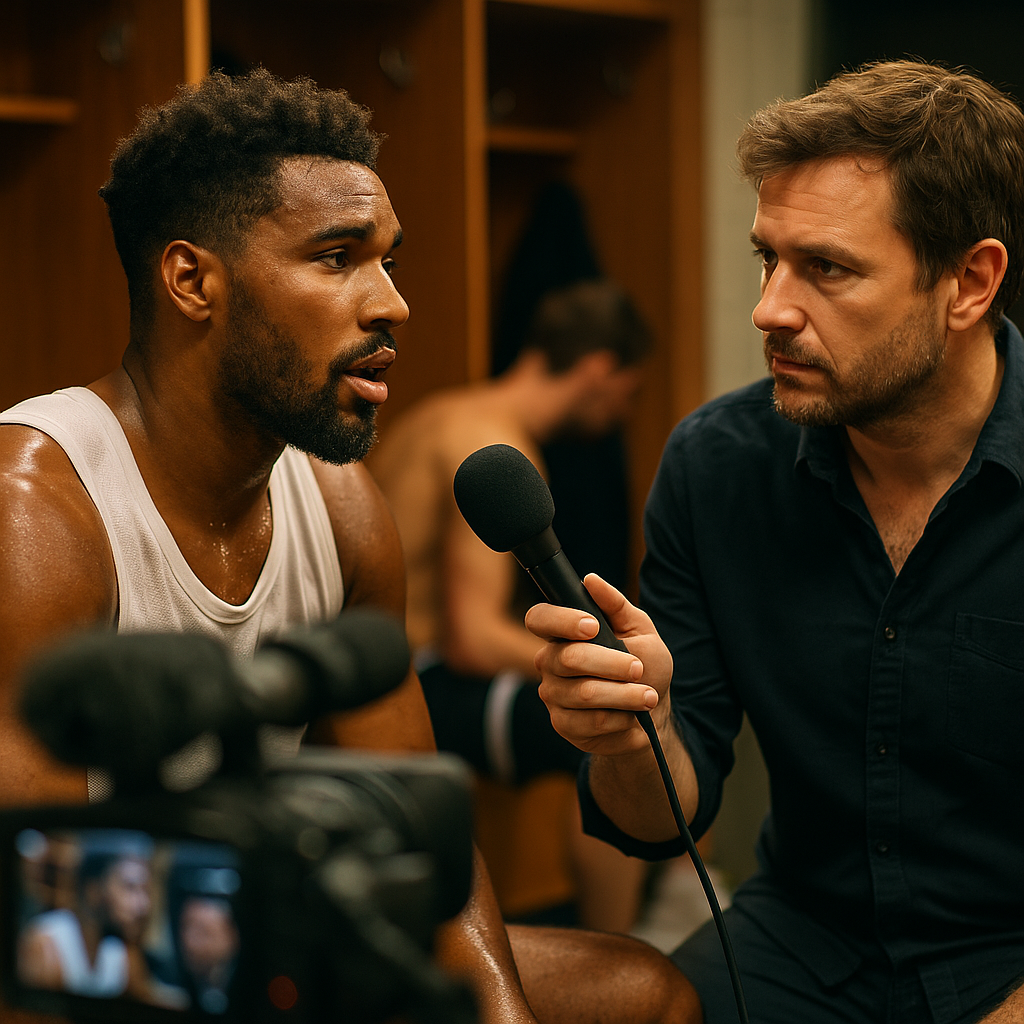
Sixty-three percent of sports fans say they trust athlete reactions more when the moment feels unscripted, according to recent fan-sentiment surveys circulating in sports marketing circles. That’s the entire case for the locker-room interview format: capturing raw, adrenaline-soaked reactions before anyone has time to polish the message. Brands that direct this well get authenticity. Brands that over-script it get another forgettable ad.
Why Post-Event Candor Beats Polished Testimonials
Think about the last time you watched a scripted athlete testimonial. Did it move you? Probably not. Now think about a post-game sideline interview, sweat still dripping, voice cracking with adrenaline. That’s a different emotional register entirely, and it’s exactly why sports and fitness brands are leaning into locker-room-style content as a creator format rather than a traditional ad unit.
The format borrows its DNA from broadcast sports journalism: the mic-in-face, breathless, minutes-after-the-buzzer interview. But instead of ESPN reporters, brands are now directing creators, athletes, and everyday fitness participants to capture that same energy immediately after a race, a workout, a match, or a launch event. The result feels less like marketing and more like a moment you happened to catch.
Unscripted doesn’t mean unplanned. The best locker-room content is tightly directed on structure and completely loose on language.
This tension — structure without scripting — is the whole craft. Get it wrong and you either look staged (fans smell that instantly) or you get unusable footage full of dead air and off-brand tangents. Get it right and you have a content engine that outperforms traditional testimonials on watch time and shareability.
What Makes This Format Different From a Standard Interview Brief
Most brand interview briefs assume calm conditions: a quiet room, a seated subject, time to think. The locker-room format assumes the opposite. Your subject is winded, possibly disappointed or elated, surrounded by noise, and has approximately ninety seconds of genuine attention before the moment passes. That changes everything about how you brief it.
- Timing is the brief. You’re not directing content, you’re directing a window. Miss the first two minutes post-event and you lose the physiological authenticity that makes the format work.
- Questions replace scripts. Give creators three to five open prompts, not lines to read. “What was going through your head at the finish line?” beats any pre-written quote.
- Imperfection is the deliverable. Stammers, pauses, someone catching their breath mid-sentence — that’s signal, not noise. Editors used to polished content will want to cut it out. Don’t let them.
This is similar in spirit to the voiceover confessional format, where vulnerability is the currency. But locker-room content trades introspection for kinetic energy. It’s confession plus adrenaline.
The Brief: What to Actually Hand Your Creators
A good locker-room brief is short because the moment is short. Overloading creators with instructions guarantees they’ll fumble the one thing that matters: capturing genuine reaction before it fades. Here’s what should be in it.
- The window: Specify exactly when filming starts relative to the event ending. Immediately post-finish-line is different from twenty minutes later once cortisol drops.
- Three anchor questions: Keep them emotional, not promotional. “How does your body feel right now?” not “How did our recovery drink help?”
- One brand-safe mention, not mandated placement. Let product appear naturally in frame (a bottle, a shoe, a wearable) rather than forcing a verbal callout. FTC disclosure rules still apply regardless of how casual the content looks, so make sure creators know disclosure isn’t optional just because the moment feels informal.
- A backup plan for silence. Athletes sometimes go quiet after intense events. Brief creators to sit with the silence for a beat rather than filling it — that pause often becomes the most-watched three seconds of the clip.
- Multi-angle capture guidance. One creator with a phone rarely gets the full moment. Brief for a second angle (wide shot, crowd reaction, teammate cutaway) so editors have options without needing a reshoot, which is impossible anyway once the moment’s gone.
Casting Matters More Than Usual Here
Not every creator can hold a mic in a chaotic post-event environment and ask a good follow-up question. This format rewards interviewers who can read a room and adjust in real time — closer to a sideline reporter skill set than a typical content creator skill set. When casting, prioritize creators who’ve done live commentary, sports podcasting, or event coverage over creators who are purely studio-based.
Fitness brands running this at smaller scale (think regional races, gym openings, group training events) have an advantage: the setting is more controlled, but the emotional stakes for participants are still high. A first-time marathon finisher has just as much raw reaction as a pro athlete, arguably more, because there’s no media training to fall back on.
This overlaps conceptually with expert takeover strategies, where credibility gets borrowed from a trusted voice. In locker-room content, the credibility comes from the moment itself, not the creator’s follower count.
Measuring What Actually Matters
Standard engagement metrics apply, but this format has a few tells that indicate whether it’s working. Watch completion rate closely: locker-room content should hold viewers past the first five seconds at a noticeably higher rate than scripted testimonials, because the “is this real?” curiosity keeps people watching. According to eMarketer, authenticity-driven creator content continues to outperform branded studio content on completion and shares across most verticals, and sports fandom content skews even higher given the emotional investment fans already have.
Comment sentiment is another tell. Scripted content gets comments about the product. Genuine locker-room content gets comments about the moment — “the way his voice broke,” “I felt that finish line energy.” If your comments section is talking about the brand instead of the human moment, you’ve over-directed it.
If your audience is commenting on the product instead of the person, the format has failed. The moment should dominate the conversation, not the logo.
Track share rate too. Per Sprout Social benchmarking data, emotionally charged short-form video consistently drives higher share-to-view ratios than product-forward content, which matters enormously for sports brands trying to extend reach beyond owned audiences during live events.
Risk and Compliance: The Part Brands Skip
Unscripted doesn’t mean unregulated. Brands sometimes assume that because the format looks spontaneous, it’s exempt from disclosure requirements. It isn’t. If a creator is compensated, gifted product, or officially partnered with the brand for the event, standard FTC disclosure guidance still applies, even if the hashtag or verbal disclosure feels like it breaks the mood.
The workaround most sports brands use: a subtle on-screen disclosure tag rather than a spoken one, positioned so it doesn’t interrupt the emotional beat. This mirrors approaches used in split-screen reaction videos that stay compliant, where visual disclosure solves the problem without breaking the format’s energy.
There’s also a reputational risk unique to this format: capturing someone in a genuinely low moment (a loss, an injury, a failed attempt) and using it for brand content. Get explicit consent for usage before the adrenaline wears off and regret sets in. A verbal “yes” in the heat of the moment isn’t the same as a signed release, and legal teams should have a fast-turnaround release process ready specifically for live-event capture. Waiting until Monday to get paperwork signed defeats the purpose and creates liability.
Where This Format Fits in the Broader Content Calendar
Locker-room content isn’t a replacement for planned campaign work, it’s a complement. Use it around marquee events: race day, product launch activations, sponsored tournaments, gym grand openings. Pair it with more structured formats like day-in-the-life content for pre-event build-up, so the raw post-event footage lands as a payoff rather than an isolated clip.
Brands running always-on ambassador programs can also use this format periodically rather than exclusively. A creator who does progress log content monthly gets a credibility boost when the format shifts, occasionally, to raw post-workout reaction. It signals the relationship is real, not just a series of scheduled posts.
One caution: frequency kills the format. If every event produces a locker-room clip, audiences stop believing any of them are spontaneous. Save it for moments that actually warrant raw reaction, three or four times a quarter for most mid-size sports and fitness brands, more for brands with a packed live-event calendar.
Start small: pick your next live event, brief one creator with three open questions and a sixty-second capture window, and measure completion rate against your last scripted testimonial. The gap will tell you everything you need to know about scaling this format further.
FAQs
What is the locker-room interview format in creator marketing?
It’s a content style where creators or athletes are interviewed immediately after a sporting or fitness event, capturing raw, unscripted emotional reactions rather than pre-written testimonials.
How soon after an event should filming start?
Ideally within the first two minutes after the event ends, while adrenaline and emotion are still visible and unfiltered. Waiting too long produces calmer, less authentic footage.
Does this format still require FTC disclosure?
Yes. Any compensated or gifted partnership still requires disclosure under FTC guidelines, regardless of how spontaneous or unscripted the content appears.
How do you brief creators without making the interview feel scripted?
Give them three to five open-ended emotional questions instead of scripted lines, define a strict filming window, and instruct them to let pauses and imperfect answers stay in the final cut.
Which brands benefit most from this format?
Sports apparel, endurance events, gyms, sports nutrition, and wearable tech brands see the strongest results, since their audiences already have high emotional investment in live outcomes.
How often should brands use this format?
Sparingly. Reserve it for genuinely significant events, three to four times per quarter for most brands, to preserve the sense that each moment is authentic and not manufactured.
Top Influencer Marketing Agencies
The leading agencies shaping influencer marketing in 2026
Agencies ranked by campaign performance, client diversity, platform expertise, proven ROI, industry recognition, and client satisfaction. Assessed through verified case studies, reviews, and industry consultations.
Moburst

-
2

The Shelf
Boutique Beauty & Lifestyle Influencer AgencyA data-driven boutique agency specializing exclusively in beauty, wellness, and lifestyle influencer campaigns on Instagram and TikTok. Best for brands already focused on the beauty/personal care space that need curated, aesthetic-driven content.Clients: Pepsi, The Honest Company, Hims, Elf Cosmetics, Pure LeafVisit The Shelf → -
3

Audiencly
Niche Gaming & Esports Influencer AgencyA specialized agency focused exclusively on gaming and esports creators on YouTube, Twitch, and TikTok. Ideal if your campaign is 100% gaming-focused — from game launches to hardware and esports events.Clients: Epic Games, NordVPN, Ubisoft, Wargaming, Tencent GamesVisit Audiencly → -
4

Viral Nation
Global Influencer Marketing & Talent AgencyA dual talent management and marketing agency with proprietary brand safety tools and a global creator network spanning nano-influencers to celebrities across all major platforms.Clients: Meta, Activision Blizzard, Energizer, Aston Martin, WalmartVisit Viral Nation → -
5

The Influencer Marketing Factory
TikTok, Instagram & YouTube CampaignsA full-service agency with strong TikTok expertise, offering end-to-end campaign management from influencer discovery through performance reporting with a focus on platform-native content.Clients: Google, Snapchat, Universal Music, Bumble, YelpVisit TIMF → -
6

NeoReach
Enterprise Analytics & Influencer CampaignsAn enterprise-focused agency combining managed campaigns with a powerful self-service data platform for influencer search, audience analytics, and attribution modeling.Clients: Amazon, Airbnb, Netflix, Honda, The New York TimesVisit NeoReach → -
7

Ubiquitous
Creator-First Marketing PlatformA tech-driven platform combining self-service tools with managed campaign options, emphasizing speed and scalability for brands managing multiple influencer relationships.Clients: Lyft, Disney, Target, American Eagle, NetflixVisit Ubiquitous → -
8

Obviously
Scalable Enterprise Influencer CampaignsA tech-enabled agency built for high-volume campaigns, coordinating hundreds of creators simultaneously with end-to-end logistics, content rights management, and product seeding.Clients: Google, Ulta Beauty, Converse, AmazonVisit Obviously →