


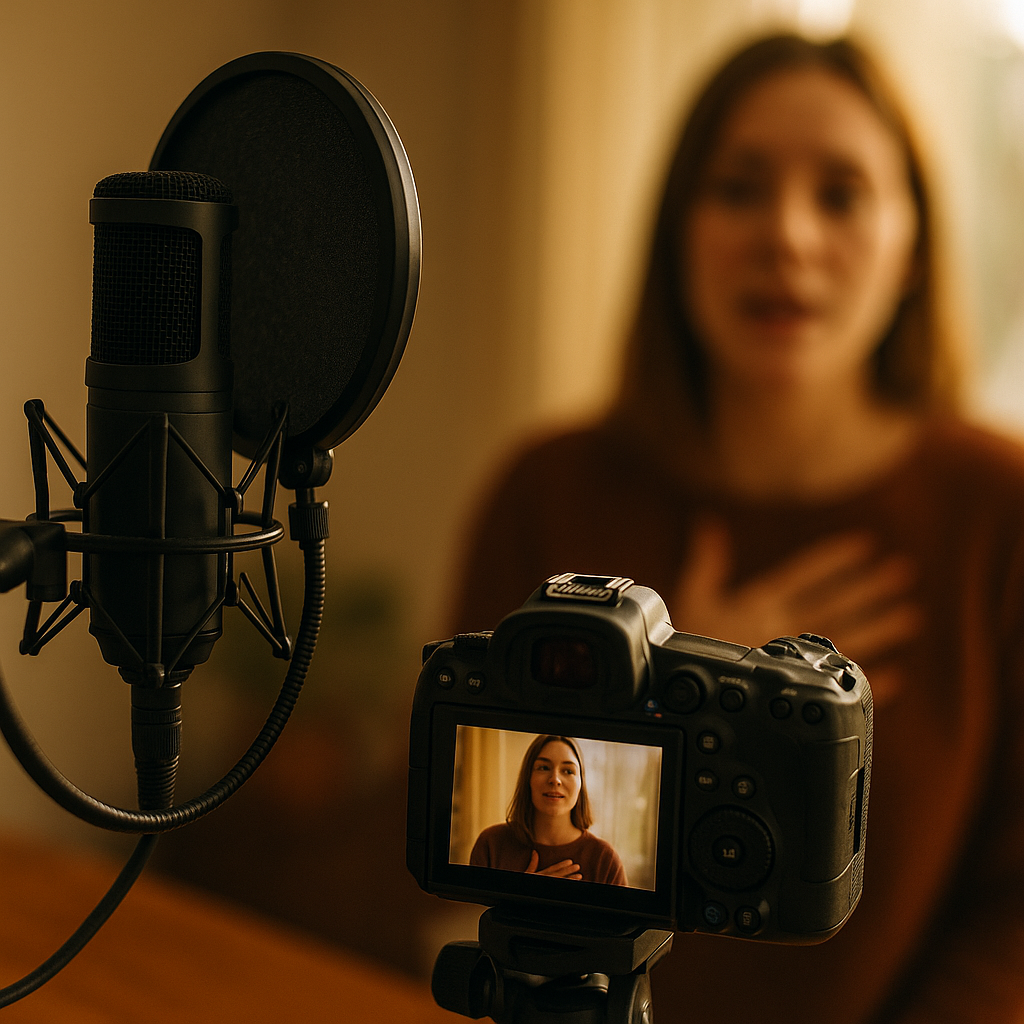
Ninety-four percent of consumers say authenticity influences which brands they support, yet most branded video still sounds like a press release with background music. Enter the voiceover confessional format: a creator’s raw narration laid over quiet, observational B-roll, no talking head, no performance. Just a voice telling the truth while the footage breathes. It’s quietly becoming one of the highest-converting formats brands aren’t briefing correctly.
What Is the Voiceover Confessional Format, Exactly?
Strip it down and it’s simple: a creator records an off-camera narration track, usually intimate, sometimes unpolished, and pairs it with visuals that never directly illustrate what’s being said. Think a creator’s voice cracking slightly as she admits she almost returned a product, while the footage shows her folding laundry or staring out a car window. No lip-syncing. No performative eye contact with the lens. The disconnect between voice and image is the point.
It borrows from documentary filmmaking and true-crime podcasts more than it borrows from advertising. That’s exactly why it works on audiences who’ve developed ad blindness to anything that looks like a testimonial shot in three takes.
Why This Format Is Landing Now
Audiences are exhausted by polish. Every brand deal now comes with a disclosure tag, a discount code, and a call-to-action that arrives suspiciously fast. The confessional format works because it slows down. It doesn’t ask viewers to trust a face performing sincerity to camera. It asks them to listen to a voice that sounds like it’s talking to one person, not a feed.
Voiceover confessionals convert not because they hide the ad, but because they remove the performance layer that makes ads feel like ads.
There’s also a practical production angle brands underrate: separating voice from visual gives you two variables to test independently. You can swap B-roll for different markets or seasons without re-recording narration. You can A/B test emotional intensity in the voiceover against the exact same footage. That’s an editorial efficiency most brief templates never account for.
The Brand Risk Nobody Talks About
Vulnerability is not the same as oversharing, and that line gets crossed constantly. A creator confessing genuine uncertainty about a product category builds trust. A creator manufacturing a fake crisis (“I almost gave up on my business before I found this planner”) to hit an emotional beat reads as manipulative the second an audience senses the seams. Gen Z audiences especially are fluent in spotting engineered vulnerability, and the backlash is swift and public.
This is where legal and brand safety teams need a seat at the brief table, not as an afterthought. The FTC’s endorsement guidance still applies regardless of tone: if the narration implies a personal experience with the product, the disclosure obligations are the same as any testimonial format. Confessional doesn’t mean exempt. Review the FTC’s endorsement guidelines before greenlighting scripts that lean hard into personal struggle narratives, especially around health, finance, or body image claims.
Compliance teams should also flag any narration that veers into medical, psychological, or financial claims dressed up as personal confession. “I was drowning in debt until this app” is a testimonial claim wearing a vulnerability costume. Treat it accordingly.
Briefing the Format Without Killing the Vulnerability
Over-directing kills this format faster than any other. Hand a creator a word-for-word script and the narration will sound read, not felt. The brief needs to work differently than a standard content brief.
- Give emotional beats, not lines. Tell the creator the arc: doubt, discovery, resolution. Let them find their own words for it.
- Separate the shoot days. Record B-roll first, without narration in mind. Record voiceover later, in a quiet space, ideally without the creator watching the footage while narrating. That disconnect is what makes the tone feel unrehearsed.
- Set a vulnerability ceiling. Define upfront what topics are in bounds (frustration, skepticism, past brand disappointment) and what’s off-limits (health conditions, financial hardship specifics, anything requiring a claims substantiation review).
- Ask for multiple takes at different emotional registers. One flatter, more matter-of-fact take; one warmer take. Editors need options, and creators rarely nail the exact tone on take one.
This pairs well with lessons from dialogue-free content briefs, where the visual has to carry emotional weight without spoken cues. The confessional format is almost the inverse problem: the voice carries the weight, and the visual has to resist over-explaining it.
B-Roll Selection Is the Hidden Craft Skill
Most brands treat B-roll as filler between the “real” shots. In this format, B-roll selection is the entire visual strategy. The best confessional edits use footage that’s tonally adjacent but not literal: hands making coffee while the voiceover discusses a career pivot, a walk through a parking lot while the creator admits she almost didn’t try the product a second time.
Literal B-roll (showing the product every time it’s mentioned) collapses the format into a standard ad read with extra steps. The tension between what’s said and what’s shown is what makes viewers lean in. If your editor’s first instinct is to cut to the product the second it’s mentioned in narration, pull that instinct back.
This is also where formats like process-driven visual briefs offer useful crossover thinking: footage that shows real texture and pacing, rather than staged demonstration, reads as more credible when paired with honest narration.
Where It Fits in the Funnel
Don’t put this format at the bottom of the funnel expecting a direct-response spike. It’s a trust-building asset, closer to a branded documentary short than a conversion ad. That said, it performs well as a retargeting asset for warm audiences who’ve already seen a product demo or reviewed pricing. The emotional context primes skepticism to soften before a harder-sell asset follows.
Brands running always-on influencer programs are increasingly slotting confessional-format content ahead of more direct formats. It’s not unlike how origin story micro-documentaries function: build emotional context first, let the harder CTA land in a follow-up asset once trust is established.
Platform fit matters too. TikTok and Instagram Reels reward the format when B-roll has strong visual rhythm even without narration comprehension (sound-off viewing is still roughly 40% of mobile video consumption per various platform reports). YouTube long-form gives the narration more room to breathe, useful if the confession has more than one beat. CTV and streaming placements can work but require re-editing pacing entirely, similar to the lesson in rebuilding ads for CTV rather than simply resizing them.
Measuring What Actually Matters
Standard CTR benchmarks undersell this format because it’s not built to interrupt scrolling with urgency. Track these instead:
- Average watch time and completion rate, since the format lives or dies on whether people stay through the narration arc.
- Save and share rate, a stronger signal of emotional resonance than likes.
- Comment sentiment, specifically whether viewers are sharing their own related stories (a strong proxy for parasocial trust transfer).
- Downstream branded search lift, since confessional content often drives delayed research behavior rather than immediate clicks.
Marketing teams using tools like Sprout Social for sentiment tracking or pulling benchmark data from eMarketer should segment this content separately from standard influencer posts. Blending it into aggregate engagement metrics hides its actual job: reducing skepticism, not spiking immediate action.
For agencies reporting to brand clients, it helps to frame this alongside broader creator economy benchmarking from HubSpot’s content marketing research, which consistently shows trust-building content outperforming direct-offer content on long-term customer value, even when short-term CTR looks weaker.
When the Format Backfires
It backfires when brands treat vulnerability as a checkbox rather than a genuine creative risk. Scripted “authenticity” is an oxymoron audiences catch instantly. It also backfires when the product category doesn’t warrant emotional weight, nobody needs a confessional about paper towels. Save this format for categories with genuine emotional stakes: wellness, finance, career, relationships, identity-adjacent products, home and family goods.
It also fails operationally when brands skip the legal review because the tone feels “soft.” Vulnerable framing doesn’t reduce disclosure obligations, and a mishandled health or financial claim inside a confessional narration creates more reputational damage than a botched hard-sell ad, precisely because audiences invested more trust in it.
Next step: before your next confessional-format brief goes out, run the script concept past legal for claims review, then test two B-roll cuts against the same narration track to see which visual distance actually earns the watch-through. That single test will tell you more about your audience’s trust threshold than any focus group.
FAQs
What makes the voiceover confessional format different from a standard testimonial video?
Standard testimonials show the creator speaking directly to camera, often scripted and performed. The confessional format separates voice from visual entirely, using narration over unrelated B-roll to create a more intimate, less performative tone.
Is the voiceover confessional format FTC compliant by default?
No. Disclosure requirements apply regardless of tone or format. If the narration implies personal product experience or makes claims, it needs the same clear disclosure treatment as any sponsored content under FTC guidance.
Which brand categories work best for this format?
Categories with genuine emotional stakes perform best: wellness, finance, career development, home and family, and identity-adjacent products. Low-stakes categories like commodity household goods rarely justify the emotional weight the format implies.
How long should a voiceover confessional video be?
Most effective versions run 45 to 90 seconds on short-form platforms, long enough to build an emotional arc without losing completion rate. Long-form YouTube versions can extend to two to three minutes if the narrative has multiple beats.
What metrics should brands prioritize when evaluating this format?
Watch time, completion rate, save and share rate, and branded search lift matter more than immediate click-through rate, since this format primarily builds trust rather than driving instant conversion.
FAQs
What makes the voiceover confessional format different from a standard testimonial video?
Standard testimonials show the creator speaking directly to camera, often scripted and performed. The confessional format separates voice from visual entirely, using narration over unrelated B-roll to create a more intimate, less performative tone.
Is the voiceover confessional format FTC compliant by default?
No. Disclosure requirements apply regardless of tone or format. If the narration implies personal product experience or makes claims, it needs the same clear disclosure treatment as any sponsored content under FTC guidance.
Which brand categories work best for this format?
Categories with genuine emotional stakes perform best: wellness, finance, career development, home and family, and identity-adjacent products. Low-stakes categories like commodity household goods rarely justify the emotional weight the format implies.
How long should a voiceover confessional video be?
Most effective versions run 45 to 90 seconds on short-form platforms, long enough to build an emotional arc without losing completion rate. Long-form YouTube versions can extend to two to three minutes if the narrative has multiple beats.
What metrics should brands prioritize when evaluating this format?
Watch time, completion rate, save and share rate, and branded search lift matter more than immediate click-through rate, since this format primarily builds trust rather than driving instant conversion.
Top Influencer Marketing Agencies
The leading agencies shaping influencer marketing in 2026
Agencies ranked by campaign performance, client diversity, platform expertise, proven ROI, industry recognition, and client satisfaction. Assessed through verified case studies, reviews, and industry consultations.
Moburst

-
2

The Shelf
Boutique Beauty & Lifestyle Influencer AgencyA data-driven boutique agency specializing exclusively in beauty, wellness, and lifestyle influencer campaigns on Instagram and TikTok. Best for brands already focused on the beauty/personal care space that need curated, aesthetic-driven content.Clients: Pepsi, The Honest Company, Hims, Elf Cosmetics, Pure LeafVisit The Shelf → -
3

Audiencly
Niche Gaming & Esports Influencer AgencyA specialized agency focused exclusively on gaming and esports creators on YouTube, Twitch, and TikTok. Ideal if your campaign is 100% gaming-focused — from game launches to hardware and esports events.Clients: Epic Games, NordVPN, Ubisoft, Wargaming, Tencent GamesVisit Audiencly → -
4

Viral Nation
Global Influencer Marketing & Talent AgencyA dual talent management and marketing agency with proprietary brand safety tools and a global creator network spanning nano-influencers to celebrities across all major platforms.Clients: Meta, Activision Blizzard, Energizer, Aston Martin, WalmartVisit Viral Nation → -
5

The Influencer Marketing Factory
TikTok, Instagram & YouTube CampaignsA full-service agency with strong TikTok expertise, offering end-to-end campaign management from influencer discovery through performance reporting with a focus on platform-native content.Clients: Google, Snapchat, Universal Music, Bumble, YelpVisit TIMF → -
6

NeoReach
Enterprise Analytics & Influencer CampaignsAn enterprise-focused agency combining managed campaigns with a powerful self-service data platform for influencer search, audience analytics, and attribution modeling.Clients: Amazon, Airbnb, Netflix, Honda, The New York TimesVisit NeoReach → -
7

Ubiquitous
Creator-First Marketing PlatformA tech-driven platform combining self-service tools with managed campaign options, emphasizing speed and scalability for brands managing multiple influencer relationships.Clients: Lyft, Disney, Target, American Eagle, NetflixVisit Ubiquitous → -
8

Obviously
Scalable Enterprise Influencer CampaignsA tech-enabled agency built for high-volume campaigns, coordinating hundreds of creators simultaneously with end-to-end logistics, content rights management, and product seeding.Clients: Google, Ulta Beauty, Converse, AmazonVisit Obviously →