


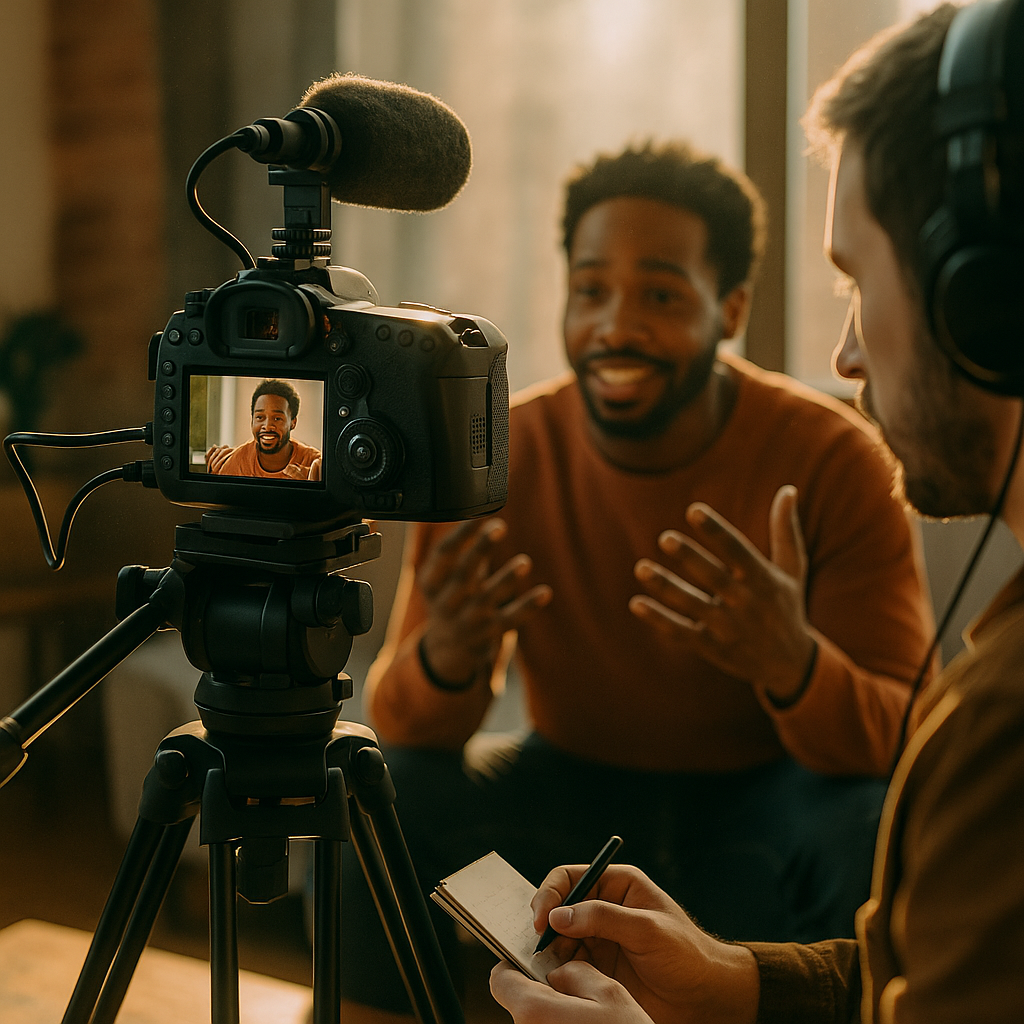
Founders get one shot at a scroll-stopping origin story before viewers bounce. The origin story micro-documentary format has become the default unit for founder-led brand content precisely because it respects that constraint: 90 seconds, one arc, zero wasted frames. So why do most brand teams still produce three-minute founder videos that die at the 12-second mark?
The data backs up the urgency. Attention on short-form video drops off hard after the first 15 seconds, and eMarketer has repeatedly flagged shrinking watch-through windows across TikTok, Reels, and Shorts. If your founder story doesn’t hook by frame three, it doesn’t matter how good the brand history is. Nobody’s there to hear it.
Why 90 Seconds Is the Ceiling, Not the Target
Ninety seconds isn’t a magic number pulled from a marketing textbook. It’s the practical ceiling for a founder narrative that needs to include a problem, a turning point, a proof moment, and a call to action, without losing the viewer’s thumb. Push past it and completion rates crater. Most high-performing origin docs actually land between 45 and 75 seconds, with 90 reserved for founder stories carrying real emotional weight (a health scare, a bankruptcy, an immigrant founder narrative).
Think of the runtime as a budget, not a goal. Every second spent on scene-setting is a second not spent on the payoff. Brand teams that treat 90 seconds as “how long we get” rather than “how long we need to fill” consistently produce tighter, more shareable content.
The best origin documentaries compress years of founder history into a single decision point — the moment everything changed — and build the entire arc around it.
The Four-Beat Arc That Actually Works
Strip away the documentary polish and every effective founder origin story follows the same skeleton. This isn’t formulaic in a bad way — it’s formulaic in the way that makes viewers stay.
- The friction (0-15 seconds): What was broken, missing, or unbearable. This is the hook. State it plainly, no throat-clearing.
- The pivot (15-40 seconds): The specific moment the founder decided to act. Specificity matters here — “I was laid off on a Tuesday” beats “I always wanted to start a business.”
- The proof (40-70 seconds): Evidence the decision worked. Customer reaction, a milestone, a visual transformation. This is where skepticism gets addressed, not dismissed.
- The stakes now (70-90 seconds): Why this still matters to the viewer today, not just to the founder’s biography.
Notice what’s missing: no “founded in,” no company timeline, no mission statement read verbatim off the website. Those belong on the About page, not in the arc. If your script has a sentence that could appear in a press release, cut it.
Briefing the Format: What to Give Creators and Founders
Most origin documentaries fail at the brief stage, not the edit stage. Brand teams hand founders a vague prompt (“tell your story”) and then wonder why the raw footage rambles for eleven minutes. Treat this like any other structured creator brief, because that’s exactly what it is.
A tight brief for this format includes:
- The single friction point the story should open on (pick one, not three)
- A required “pivot line” the founder must say in their own words, not scripted verbatim
- One piece of visual proof to capture on camera (a product, a location, an artifact)
- A hard stop instruction: no company history beyond the pivot moment
- The platform-specific cut length (60s for TikTok/Reels, up to 90s for YouTube Shorts or LinkedIn)
This is where the discipline of a good brief pays off. The same logic that governs confessional testimonial briefs applies here: give the talent guardrails, not a script, and the authenticity holds up on camera.
Sound, Captions, and the Silent Scroll Problem
Roughly the majority of social video is watched with sound off during the first few seconds, which means your founder’s opening line needs a caption doing the heavy lifting, not just their voice. If the friction point isn’t legible as text on screen within the first two seconds, you’ve lost half your audience before they’ve decided to unmute.
This is a production discipline problem more than a creative one. Origin docs should be storyboarded caption-first, the way sound-off video briefs are built for other formats. Write the on-screen text pass before you shoot a single frame of B-roll.
Where Founder Documentaries Go Wrong
A few recurring failure patterns show up across brand teams experimenting with this format for the first time.
Too many pivots. Founders love to tell the whole journey. Brand teams need to pick one turning point and defend that choice in the edit bay. A 90-second video with three “aha moments” has zero aha moments, because none of them land.
Corporate polish killing credibility. If the founder sounds like they’re reading investor deck copy, the format collapses. Origin documentaries work because they read as unscripted disclosure, not brand messaging. This is the same tension addressed in briefing content that doesn’t sound scripted: structure without sounding structured.
No proof point. A story about friction and pivot without any evidence the decision worked is just a monologue. Viewers want the receipt, whether it’s a customer quote, a before-and-after visual, or a hard number.
Ignoring disclosure requirements. If the founder video doubles as paid promotion, or if it features claims about product performance (“this cured my skin,” “this saved my business”), it needs to meet FTC disclosure standards. Founder authenticity doesn’t exempt a brand from compliance obligations, and regulators have made that increasingly clear. Review the same functional-claims framework used in functional claims compliance guides before publishing anything that implies a specific outcome.
An origin documentary with no proof point is a monologue with better lighting. Viewers stay for evidence, not sentiment.
Where This Format Fits in the Broader Content Mix
Origin documentaries aren’t a standalone campaign. They’re most effective as an anchor asset that seeds other formats: a 90-second founder story on YouTube can be cut into three or four vertical clips for TikTok and Reels, each isolating a single beat from the arc. The pivot moment alone often outperforms the full cut on completion rate, because it’s self-contained and dramatic without needing setup.
This mirrors how brand teams are already thinking about format taxonomy more broadly. If you’re mapping founder content into a larger content calendar, the frameworks in social-first format taxonomy guides are worth cross-referencing before you lock a production schedule.
Platform selection matters too. LinkedIn audiences tolerate a slightly longer, more reflective cut (closer to the full 90 seconds), while TikTok and Reels audiences reward the tightest possible version, often the 45-60 second range with the friction point front-loaded even further. LinkedIn’s business content guidance and TikTok’s creative best practices both point toward this same platform-native pacing logic, even though the specifics differ.
Measuring Whether It Worked
Completion rate is the primary signal for this format, more than views or even engagement rate. A founder documentary that gets watched to the end and generates saves or shares is doing its job: building trust at scale without a salesperson in the room. Sprout Social’s benchmarking research consistently shows completion rate correlating more tightly with downstream conversion than surface-level engagement metrics for narrative-driven video.
Track drop-off points specifically. If viewers are bailing at the 15-second mark, your friction hook isn’t sharp enough. If they’re leaving right after the pivot, your proof section is weak or arrives too late. Treat the arc like a funnel, because it is one, just compressed into a minute and a half.
FAQs
Frequently Asked Questions
What is an origin story micro-documentary?
It’s a short-form video, typically 45 to 90 seconds, that compresses a founder’s origin narrative into a single arc: friction, pivot, proof, and present-day stakes. It’s built for social platforms where attention drops sharply after the first few seconds.
How long should a founder origin video actually be?
Most high-performing versions land between 45 and 75 seconds. Ninety seconds is the practical ceiling, reserved for stories with genuine emotional weight that need the extra time to land the proof point.
Do these videos need FTC disclosure?
Yes, if the video makes performance claims about the product or service, or if it’s part of a paid or sponsored campaign. Founder authenticity doesn’t override disclosure requirements under FTC guidelines.
Should the founder read a script?
No. Give founders a structural brief (the friction point, the required pivot line, the proof to show) rather than a word-for-word script. Scripted delivery undermines the credibility that makes this format work.
Can one origin documentary be repurposed across platforms?
Yes, and it should be. A single 90-second YouTube cut can be broken into shorter clips for TikTok and Reels, with the pivot moment often performing best as a standalone piece.
What metric matters most for this format?
Completion rate. It’s the strongest proxy for whether the narrative arc actually landed, and it correlates more closely with downstream trust and conversion than raw view counts.
Next step: pull your founder’s raw, unscripted answer to “what was the exact moment things changed,” time it, and see if it fits inside 20 seconds. If it doesn’t, that’s your edit, not your script.
Top Influencer Marketing Agencies
The leading agencies shaping influencer marketing in 2026
Agencies ranked by campaign performance, client diversity, platform expertise, proven ROI, industry recognition, and client satisfaction. Assessed through verified case studies, reviews, and industry consultations.
Moburst

-
2

The Shelf
Boutique Beauty & Lifestyle Influencer AgencyA data-driven boutique agency specializing exclusively in beauty, wellness, and lifestyle influencer campaigns on Instagram and TikTok. Best for brands already focused on the beauty/personal care space that need curated, aesthetic-driven content.Clients: Pepsi, The Honest Company, Hims, Elf Cosmetics, Pure LeafVisit The Shelf → -
3

Audiencly
Niche Gaming & Esports Influencer AgencyA specialized agency focused exclusively on gaming and esports creators on YouTube, Twitch, and TikTok. Ideal if your campaign is 100% gaming-focused — from game launches to hardware and esports events.Clients: Epic Games, NordVPN, Ubisoft, Wargaming, Tencent GamesVisit Audiencly → -
4

Viral Nation
Global Influencer Marketing & Talent AgencyA dual talent management and marketing agency with proprietary brand safety tools and a global creator network spanning nano-influencers to celebrities across all major platforms.Clients: Meta, Activision Blizzard, Energizer, Aston Martin, WalmartVisit Viral Nation → -
5

The Influencer Marketing Factory
TikTok, Instagram & YouTube CampaignsA full-service agency with strong TikTok expertise, offering end-to-end campaign management from influencer discovery through performance reporting with a focus on platform-native content.Clients: Google, Snapchat, Universal Music, Bumble, YelpVisit TIMF → -
6

NeoReach
Enterprise Analytics & Influencer CampaignsAn enterprise-focused agency combining managed campaigns with a powerful self-service data platform for influencer search, audience analytics, and attribution modeling.Clients: Amazon, Airbnb, Netflix, Honda, The New York TimesVisit NeoReach → -
7

Ubiquitous
Creator-First Marketing PlatformA tech-driven platform combining self-service tools with managed campaign options, emphasizing speed and scalability for brands managing multiple influencer relationships.Clients: Lyft, Disney, Target, American Eagle, NetflixVisit Ubiquitous → -
8

Obviously
Scalable Enterprise Influencer CampaignsA tech-enabled agency built for high-volume campaigns, coordinating hundreds of creators simultaneously with end-to-end logistics, content rights management, and product seeding.Clients: Google, Ulta Beauty, Converse, AmazonVisit Obviously →