


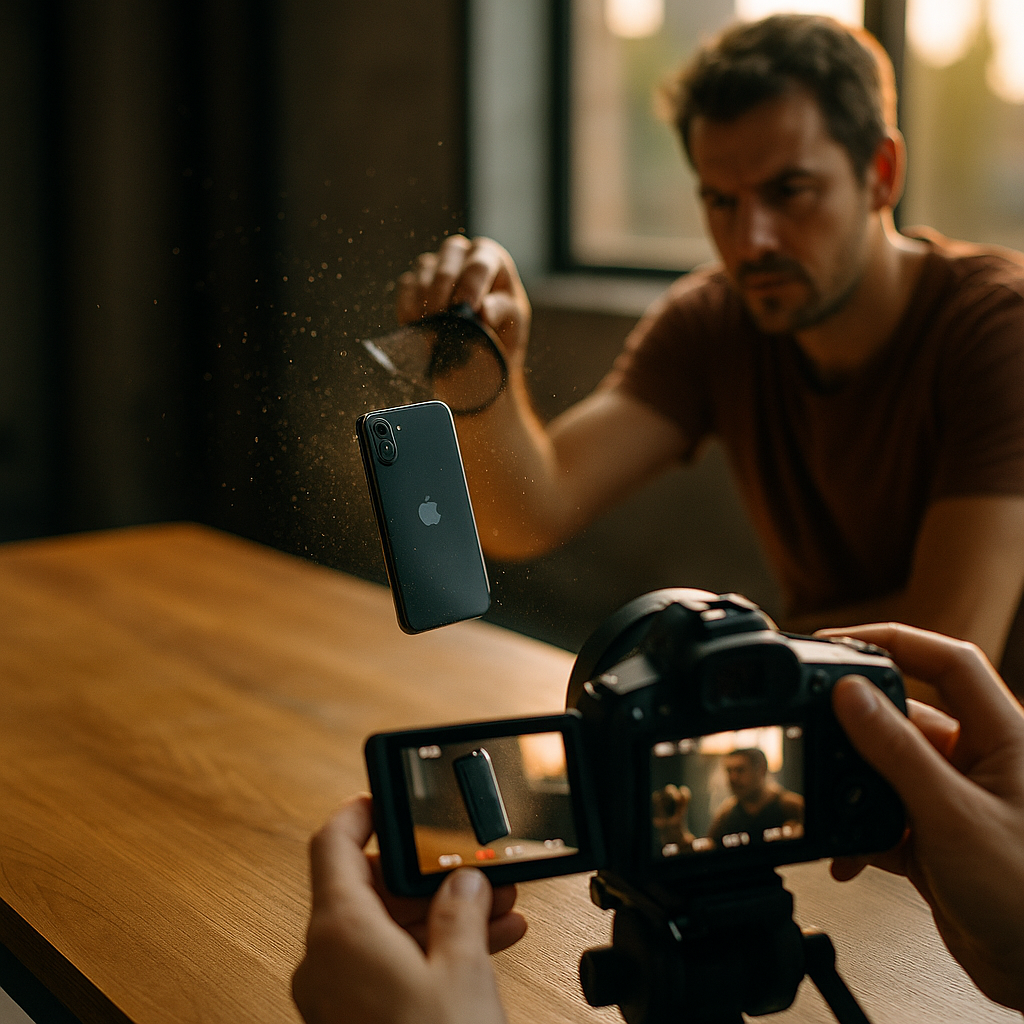
A four-second reveal can outperform a thirty-second ad. That’s not a typo — it’s what happens when a brand slows down instead of speeding up. The slow-motion product reveal has quietly become one of the highest-converting creative techniques in influencer marketing, and most brand teams are still ignoring it in favor of jump cuts and hype-pace editing.
Why does slowing down work when everything else in the feed screams for speed? Because contrast is attention. When every other video is cutting every 0.8 seconds, a deliberate three-second hold on a product feels like a luxury moment. It signals confidence. It says: this doesn’t need to shout.
The Physics of Wanting Something
Slow motion isn’t just an aesthetic choice. It’s a psychological lever. Research on consumer perception has long shown that dwell time correlates with perceived value — the longer a viewer’s eye rests on an object, the more premium it registers, even when the object itself is unremarkable. A $12 candle filmed in slow-motion pour looks like a $60 candle. A protein shaker filmed mid-drip looks engineered rather than mass-produced.
This is the same principle that’s made product-as-character storytelling so effective across creator content — treating an object with cinematic weight changes how an audience relates to it. If you haven’t already, it’s worth reviewing how to brief product-as-character content before building out a slow-motion campaign, because the two techniques share a brief structure: the product needs a “moment,” not just a mention.
Slow motion doesn’t make a product look better. It makes the viewer feel like they’re being shown something worth waiting for — and that perception of exclusivity is what drives the purchase intent, not the frame rate itself.
What Actually Makes a Reveal Cinematic (Hint: It’s Not the Camera)
Brand teams overspend on gear and underspend on choreography. A reveal shot on an iPhone at 240fps with the right light and timing will outperform a $15,000 cinema camera rig with sloppy blocking. Here’s what actually separates an aspirational reveal from a slowed-down mess:
- Negative space before the reveal. The product should be withheld, obscured, or partially visible for at least a beat before it’s fully shown. Anticipation is the mechanism, not the slow motion itself.
- A single light source with intention. Backlighting, rim light, or a hard key light creates the shadow-play that makes textures — condensation, fabric weave, metallic finish — read as premium.
- Sound design that matches the pace. A cap unscrewing, a zipper pulling, a lid lifting — foley sound slowed and pitched down reads as satisfying, almost ASMR-adjacent. This overlaps heavily with the sensory techniques covered in ASMR product demo briefs, and creators who already understand sensory pacing tend to nail slow-motion reveals faster.
- A hard cut after the peak moment. Don’t let the shot linger past its climax. The reveal should end right as the audience’s curiosity peaks, not after.
Notice none of that requires a six-figure production budget. It requires a brief that specifies pacing, light, and sound — not just “make it look cinematic,” which is the single most useless instruction a brand can give a creator.
Where This Format Actually Belongs in a Content Calendar
Slow-motion reveals aren’t a full-funnel format. They’re a top-of-funnel and consideration-stage tool. Used at the wrong moment, they feel indulgent or out of place — nobody wants a five-second dramatic pour in a bottom-funnel discount ad. But paired correctly, they do heavy lifting:
- Product launches: the reveal becomes the hero moment, ideal for teaser content ahead of a drop.
- Rebrand or packaging refresh: slow motion draws attention to design details a quick cut would bury.
- Gifting and seasonal campaigns: unboxing-adjacent content benefits enormously from a deliberate reveal beat, similar in spirit to the pacing used in packing guide briefs, where the “reveal” of a bundled product set drives the save-and-share behavior.
Data from eMarketer continues to show that short-form video remains the dominant discovery channel for younger buying cohorts, but discovery alone doesn’t convert. The reveal format works because it bridges discovery and desire in a single shot — it’s not informational content, it’s aspirational content, and brands need both in the mix.
Is This Just Repackaged Luxury-Brand Technique?
Mostly, yes. Watch a Chanel or Rolex ad and you’ll see the exact grammar: withheld reveal, single light source, deliberate pacing, minimal dialogue. What’s changed is who has access to it. Creator-shot content on a mid-range phone can now approximate that grammar convincingly, which means a $40 skincare brand can borrow visual codes that used to be exclusive to nine-figure ad budgets.
This democratization is exactly why the format is spreading fast on TikTok and Instagram Reels. Platforms have leaned into it too — TikTok’s ad guidance increasingly favors native-feeling, sensory-first content over polished traditional ads, and Meta’s creative best practices point in the same direction: authenticity in framing, sophistication in pacing.
Briefing Creators for the Reveal Without Sounding Like a Film School Syllabus
Most creators aren’t cinematographers, and they shouldn’t have to become one to execute this well. The brief needs to translate cinematic principles into plain instructions. A workable structure looks like this:
- The setup (2-4 seconds): Product is present but not fully visible — hand covering it, shadow across it, or it’s slightly out of frame.
- The build (1-2 seconds): A physical action begins — opening, unwrapping, lifting, pouring — filmed or captured in slow motion.
- The reveal (1-2 seconds): Full product visibility, ideally at the moment of peak light or motion (a splash, a shimmer, a snap-back of fabric).
- The hold (1 second): A still beat. Let the audience actually look at the thing.
Six to nine seconds total. That’s the whole reveal. Anything longer risks losing the platform’s retention curve, and anything shorter won’t register as deliberate.
The most common mistake brands make in these briefs is asking for “slow motion throughout.” A reveal that’s slow from start to finish has no contrast, and contrast is the entire mechanism that makes the technique work.
It’s also worth specifying what happens after the reveal. Does the creator speak? Does text overlay appear? Many of the strongest examples let the reveal breathe in silence for a beat before any voiceover or caption enters — a technique that pairs well with the pacing logic used in time-lapse and hyper-lapse briefs, where withholding information is itself the hook.
Compliance and Realism: The Part Brands Skip
Slow motion can drift into misleading territory faster than brands realize. If a slowed-down pour makes a product look thicker, richer, or more saturated than it actually is, that’s a disclosure and accuracy problem, not just a creative flourish. The FTC’s endorsement guidance is clear that visual demonstrations must reflect genuine product performance — slow motion that exaggerates texture, viscosity, or effect can cross into deceptive advertising territory.
Practical safeguards:
- Don’t slow footage past the point where physical properties (pour rate, texture, color) look artificially enhanced.
- Keep unedited reference footage on file in case a claim gets challenged.
- Brief creators the same way you’d brief a before-and-after compliant format — assume regulators will ask what’s real and what’s enhanced.
This isn’t a reason to avoid the technique. It’s a reason to build compliance into the brief from the start, rather than fixing it after legal flags a finished asset.
Measuring Whether It’s Actually Working
The reveal format lives or dies on retention graphs, not just view counts. If you have access to a platform’s native analytics or a tool like Sprout Social, look specifically at the second-by-second retention curve around your reveal timestamp. A well-executed reveal should show a retention spike or plateau right at the payoff moment — if you see a drop-off instead, the anticipation build was too long, or the payoff didn’t deliver enough visual reward.
Saves and shares matter more than likes here. An aspirational object gets saved for later reference — a wishlist behavior — more than it gets commented on. If your reveal content isn’t generating save rates comparable to formats like carousel briefs built for saves, that’s a signal the aspirational quality isn’t landing, regardless of how the footage looks.
Track it against a control. Run the same product with a standard cut-heavy demo and a slow-reveal version, similar to the logic behind split-test reaction formats. The lift, or lack of it, tells you whether the aesthetic investment is worth scaling across your creator roster.
The Takeaway
Slow motion isn’t a filter, it’s a briefing discipline: withhold, build, reveal, hold. Brands that treat it as a directorial choice rather than a post-production toggle will see the retention and save-rate lift that makes the format worth repeating. Start with one SKU, one creator, and a six-to-nine-second reveal structure — then measure against your standard cut before rolling it out further.
FAQs
What makes a slow-motion product reveal different from a standard product demo?
A standard demo shows function. A slow-motion reveal is built around anticipation and payoff — it withholds the product briefly, then reveals it at a moment of peak visual or physical action, creating a perceived value lift that a straightforward demo doesn’t produce.
Do I need expensive camera equipment to shoot this format?
No. Most modern smartphones shoot at 120fps or 240fps slow motion natively. The technique depends far more on lighting, timing, and sound design than on camera specs.
How long should a slow-motion reveal actually be?
Six to nine seconds total, broken into a setup, a build, the reveal itself, and a brief still hold. Longer reveals risk losing viewer retention on short-form platforms.
Is slow-motion footage a compliance risk?
It can be, if the slowed footage exaggerates a product’s actual texture, pour rate, or effect. Brands should keep unedited reference footage and brief creators to avoid visual claims that misrepresent real product performance, in line with FTC endorsement guidance.
Which products benefit most from this technique?
Anything with a physical, visual “moment” — pours, unwraps, texture reveals, fabric movement, or light interaction. Beauty, food and beverage, apparel, and packaged goods tend to see the strongest lift.
How do I know if a slow-motion reveal is actually driving results?
Watch the retention curve at the exact reveal timestamp and compare save rates against a standard-format control. A genuine lift shows up as a retention plateau or spike at the payoff moment, not just higher overall view counts.
Top Influencer Marketing Agencies
The leading agencies shaping influencer marketing in 2026
Agencies ranked by campaign performance, client diversity, platform expertise, proven ROI, industry recognition, and client satisfaction. Assessed through verified case studies, reviews, and industry consultations.
Moburst

-
2

The Shelf
Boutique Beauty & Lifestyle Influencer AgencyA data-driven boutique agency specializing exclusively in beauty, wellness, and lifestyle influencer campaigns on Instagram and TikTok. Best for brands already focused on the beauty/personal care space that need curated, aesthetic-driven content.Clients: Pepsi, The Honest Company, Hims, Elf Cosmetics, Pure LeafVisit The Shelf → -
3

Audiencly
Niche Gaming & Esports Influencer AgencyA specialized agency focused exclusively on gaming and esports creators on YouTube, Twitch, and TikTok. Ideal if your campaign is 100% gaming-focused — from game launches to hardware and esports events.Clients: Epic Games, NordVPN, Ubisoft, Wargaming, Tencent GamesVisit Audiencly → -
4

Viral Nation
Global Influencer Marketing & Talent AgencyA dual talent management and marketing agency with proprietary brand safety tools and a global creator network spanning nano-influencers to celebrities across all major platforms.Clients: Meta, Activision Blizzard, Energizer, Aston Martin, WalmartVisit Viral Nation → -
5

The Influencer Marketing Factory
TikTok, Instagram & YouTube CampaignsA full-service agency with strong TikTok expertise, offering end-to-end campaign management from influencer discovery through performance reporting with a focus on platform-native content.Clients: Google, Snapchat, Universal Music, Bumble, YelpVisit TIMF → -
6

NeoReach
Enterprise Analytics & Influencer CampaignsAn enterprise-focused agency combining managed campaigns with a powerful self-service data platform for influencer search, audience analytics, and attribution modeling.Clients: Amazon, Airbnb, Netflix, Honda, The New York TimesVisit NeoReach → -
7

Ubiquitous
Creator-First Marketing PlatformA tech-driven platform combining self-service tools with managed campaign options, emphasizing speed and scalability for brands managing multiple influencer relationships.Clients: Lyft, Disney, Target, American Eagle, NetflixVisit Ubiquitous → -
8

Obviously
Scalable Enterprise Influencer CampaignsA tech-enabled agency built for high-volume campaigns, coordinating hundreds of creators simultaneously with end-to-end logistics, content rights management, and product seeding.Clients: Google, Ulta Beauty, Converse, AmazonVisit Obviously →