


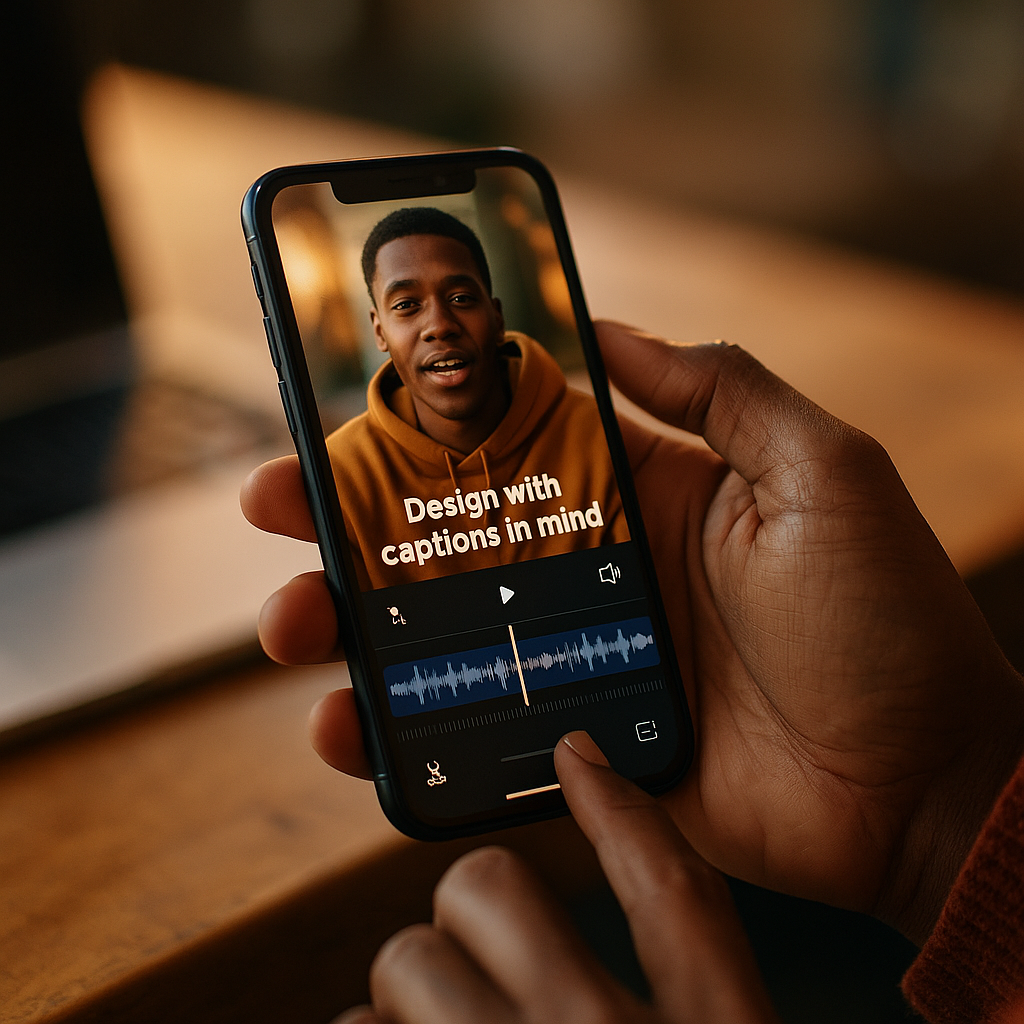
85% of Facebook video views happen with the sound off, and the number isn’t much different on Instagram or LinkedIn. Yet most brand video briefs still treat audio as the primary storytelling device. If your creative strategy assumes people are listening, you’re optimizing for a minority. The sound-off creative standard isn’t a nice-to-have anymore. It’s the baseline.
Marketers keep asking creators for “engaging voiceovers” and “punchy audio hooks” as if that solves discovery. It doesn’t. Feeds autoplay muted by default across nearly every major platform, and users have to actively opt in to sound. That single design decision, made by platform product teams years ago, still shapes what wins and what dies in the first three seconds of a scroll.
Why Silent Autoplay Changed the Creative Brief Forever
Meta popularized muted autoplay back on Facebook, and TikTok, Instagram, and LinkedIn all inherited the default. The logic is simple: nobody wants their phone blaring in a waiting room or on a train. So platforms protect the user experience by muting first, and creators have to earn the tap that unmutes.
Most never get it. Industry estimates from Sprout Social and eMarketer consistently put sound-on rates in the 15-20% range across major feeds, even lower on desktop. That means your carefully scripted VO, your brand jingle, your celebrity voice cameo, is invisible to four out of five viewers unless the visual and caption layer carries the message on its own.
If your video can’t communicate its core message with the sound off, you don’t have a video strategy, you have an audio strategy that happens to include pictures.
This isn’t just a TikTok problem. LinkedIn’s native video player defaults to muted in-feed, and B2B marketers running LinkedIn video ads see the same drop-off pattern. Even YouTube Shorts, built by a platform obsessed with watch time, mutes by default on first load in many placements documented in Google’s support resources.
What “Sound-Off Ready” Actually Means for a Brief
A sound-off ready video isn’t just one with captions slapped on in post. That’s the lazy version, and audiences can tell. True sound-off design starts at the storyboard stage, treating captions, on-screen text, and visual pacing as the primary narrative engine, with audio as an enhancement layer for the minority who opt in.
Here’s what that looks like in practice:
- Text carries the hook, not the voiceover. The first line of on-screen text needs to do the job a spoken hook would do on a podcast. If you cut the audio entirely, does the opening still stop the scroll?
- Captions are burned in, not reliant on platform auto-generation. Auto-captions lag, mistranslate brand names, and often clip mid-sentence when a viewer scrolls fast. Native, styled captions are a production line item, not an afterthought.
- Visual sequencing does the emotional lifting. Facial expressions, product reveals, and cut timing need to convey tone since a musical sting or vocal inflection won’t land for muted viewers.
- Text pacing matches reading speed, not talking speed. A common failure mode: captions timed to match spoken cadence, which is often too fast for a viewer skimming while scrolling.
Brands that get this right treat the caption track almost like a second script, written and edited independently of the spoken one. It’s more production work upfront. It pays off in completion rate.
The Data Behind Why This Matters to Your Budget
Completion rate and watch-time are the two metrics most platforms weight heavily in their algorithms, and both are directly influenced by whether a muted viewer understands what’s happening in the first two seconds. Statista and platform-reported benchmarks both show that videos with strong on-screen text hooks retain viewers meaningfully longer than voiceover-dependent content in muted conditions, because the viewer isn’t forced to gamble on tapping the speaker icon.
Think about the ad spend implications. If you’re running a paid amplification budget behind creator content, and the creative doesn’t work muted, you’re paying to reach people who bounce in the first second. That’s not a creative problem you can fix with more budget. It’s a brief problem.
Optimizing for sound-off isn’t a defensive move against a platform default, it’s a direct lever on CPM efficiency and completion-rate-based algorithmic reach.
This connects to broader format decisions brands are already making. The social-first format taxonomy approach treats caption-driven design as one input among many when deciding budget allocation across formats, and it should sit alongside decisions about POV, myth-busting, or day-in-the-life structures.
Where Brands Get This Wrong
The most common mistake isn’t skipping captions. It’s writing captions as a transcript instead of a script. A transcript follows the spoken words verbatim, including filler words, false starts, and tangents that work fine when heard but read as clutter on screen.
A caption script strips that out. It’s edited for reading, condensed for pacing, and often diverges slightly from what’s spoken, prioritizing clarity over fidelity. Agencies producing high-volume creator content, like those running day-in-the-life briefs at scale, have learned to budget separate editorial time for caption polish rather than treating it as a QA checkbox.
The second mistake: over-reliance on platform auto-captioning as a compliance shortcut. Auto-captions are useful for accessibility baseline, and they matter for FTC-adjacent disclosure requirements around clear and conspicuous claims, since a disclosure that only exists in muted audio a viewer never hears arguably isn’t disclosed at all. But auto-captions frequently mangle branded terms, mispronounce creator names, and misjudge sentence breaks. If your brief includes a specific claim, especially a functional or comparative one, verify the caption renders it accurately. This overlaps directly with guidance covered in functional claims compliance work, where the visual disclosure has to match the spoken one exactly.
Format-Specific Notes: What Changes by Platform
Not every feed treats captions the same way, and briefs should reflect that.
- TikTok rewards dense, fast-paced on-screen text paired with trending audio that plays a secondary, rhythmic role rather than a narrative one. Viewers who unmute are often reacting to sound choice, not relying on it for meaning.
- Instagram Reels leans toward cleaner caption styling since the platform’s own text tool is more visually integrated. Overloading text can clash with Instagram’s more polished aesthetic expectations.
- LinkedIn audiences are frequently viewing muted in a work setting, so B2B briefs should assume near-100% sound-off consumption and design captions as the entire message, not a supplement.
- YouTube Shorts sits between the two, with a wider mix of unmuted-later viewing on desktop, so briefs should ensure the video still holds up if sound clicks on mid-view.
This platform variance is why a one-size caption template rarely works across a multi-platform creator campaign. What retains attention on YouTube Shorts won’t necessarily perform the same way natively on TikTok, even with identical footage.
Briefing Creators for Sound-Off Success
Give creators a caption-first shot list, not just a script. Ask for:
- A written hook line meant to appear on screen in the first second, separate from any spoken intro.
- Explicit shot notes on where text overlays will sit, so filming leaves visual space (the classic mistake is text covering a face or product).
- A caption pacing pass during editing, reviewed independently of the audio edit.
- A muted watch-through as a QA step before final approval, every time.
That last step catches more problems than any other single check. Watch the final cut with your phone speaker off. If you’re confused, bored, or lost, so is your audience.
This discipline pairs naturally with other retention-focused formats. Brands using poll-driven video or cliffhanger series structures already understand that retention is engineered shot by shot, not left to chance. Caption-driven design is the same discipline applied to the audio layer.
Accessibility Is the Business Case, Too
There’s a compounding benefit here that often gets underweighted: sound-off design overlaps almost entirely with accessibility for Deaf and hard-of-hearing audiences. Brands already investing in neuro-inclusive creator briefs will recognize the pattern. Good captioning isn’t a compliance tax, it’s an audience expansion strategy that happens to also improve performance for everyone else.
Treat it that way in budget conversations. It’s easier to justify caption production spend as an accessibility and reach investment than as a nice-to-have polish item, and both framings are true simultaneously.
Next Step
Audit your last three creator campaigns muted, no sound, no exceptions. If the hook, the offer, and any required disclosure aren’t clear within two seconds of silence, rewrite the brief before you shoot the next one.
FAQs
What percentage of social video is watched with sound off?
Estimates vary by platform, but muted viewing typically ranges from 70-85% across Facebook, Instagram, and LinkedIn feeds, with only a minority of viewers actively tapping to unmute.
Do auto-generated captions meet FTC disclosure requirements?
Not reliably. Auto-captions can misrender words, drop text, or mistime disclosures. Brands should manually verify that any required disclosure appears accurately and clearly in the on-screen caption track, not just in spoken audio.
How is caption-driven video different from just adding subtitles?
Subtitles are typically a transcript afterthought. Caption-driven video treats on-screen text as the primary script, written, paced, and styled independently to carry the full message without audio.
Does sound-off design hurt creative quality or make videos feel less authentic?
Not when done well. The best sound-off creative still uses voice and music, it just doesn’t depend on them. Audio becomes an enhancement for the viewers who opt in, rather than a requirement for comprehension.
Which platforms require the strictest sound-off approach?
LinkedIn generally sees the highest muted-viewing rates given its workplace context, followed closely by Facebook and Instagram feeds. TikTok viewers unmute more often but usually for music discovery, not narrative comprehension.
Top Influencer Marketing Agencies
The leading agencies shaping influencer marketing in 2026
Agencies ranked by campaign performance, client diversity, platform expertise, proven ROI, industry recognition, and client satisfaction. Assessed through verified case studies, reviews, and industry consultations.
Moburst

-
2

The Shelf
Boutique Beauty & Lifestyle Influencer AgencyA data-driven boutique agency specializing exclusively in beauty, wellness, and lifestyle influencer campaigns on Instagram and TikTok. Best for brands already focused on the beauty/personal care space that need curated, aesthetic-driven content.Clients: Pepsi, The Honest Company, Hims, Elf Cosmetics, Pure LeafVisit The Shelf → -
3

Audiencly
Niche Gaming & Esports Influencer AgencyA specialized agency focused exclusively on gaming and esports creators on YouTube, Twitch, and TikTok. Ideal if your campaign is 100% gaming-focused — from game launches to hardware and esports events.Clients: Epic Games, NordVPN, Ubisoft, Wargaming, Tencent GamesVisit Audiencly → -
4

Viral Nation
Global Influencer Marketing & Talent AgencyA dual talent management and marketing agency with proprietary brand safety tools and a global creator network spanning nano-influencers to celebrities across all major platforms.Clients: Meta, Activision Blizzard, Energizer, Aston Martin, WalmartVisit Viral Nation → -
5

The Influencer Marketing Factory
TikTok, Instagram & YouTube CampaignsA full-service agency with strong TikTok expertise, offering end-to-end campaign management from influencer discovery through performance reporting with a focus on platform-native content.Clients: Google, Snapchat, Universal Music, Bumble, YelpVisit TIMF → -
6

NeoReach
Enterprise Analytics & Influencer CampaignsAn enterprise-focused agency combining managed campaigns with a powerful self-service data platform for influencer search, audience analytics, and attribution modeling.Clients: Amazon, Airbnb, Netflix, Honda, The New York TimesVisit NeoReach → -
7

Ubiquitous
Creator-First Marketing PlatformA tech-driven platform combining self-service tools with managed campaign options, emphasizing speed and scalability for brands managing multiple influencer relationships.Clients: Lyft, Disney, Target, American Eagle, NetflixVisit Ubiquitous → -
8

Obviously
Scalable Enterprise Influencer CampaignsA tech-enabled agency built for high-volume campaigns, coordinating hundreds of creators simultaneously with end-to-end logistics, content rights management, and product seeding.Clients: Google, Ulta Beauty, Converse, AmazonVisit Obviously →