


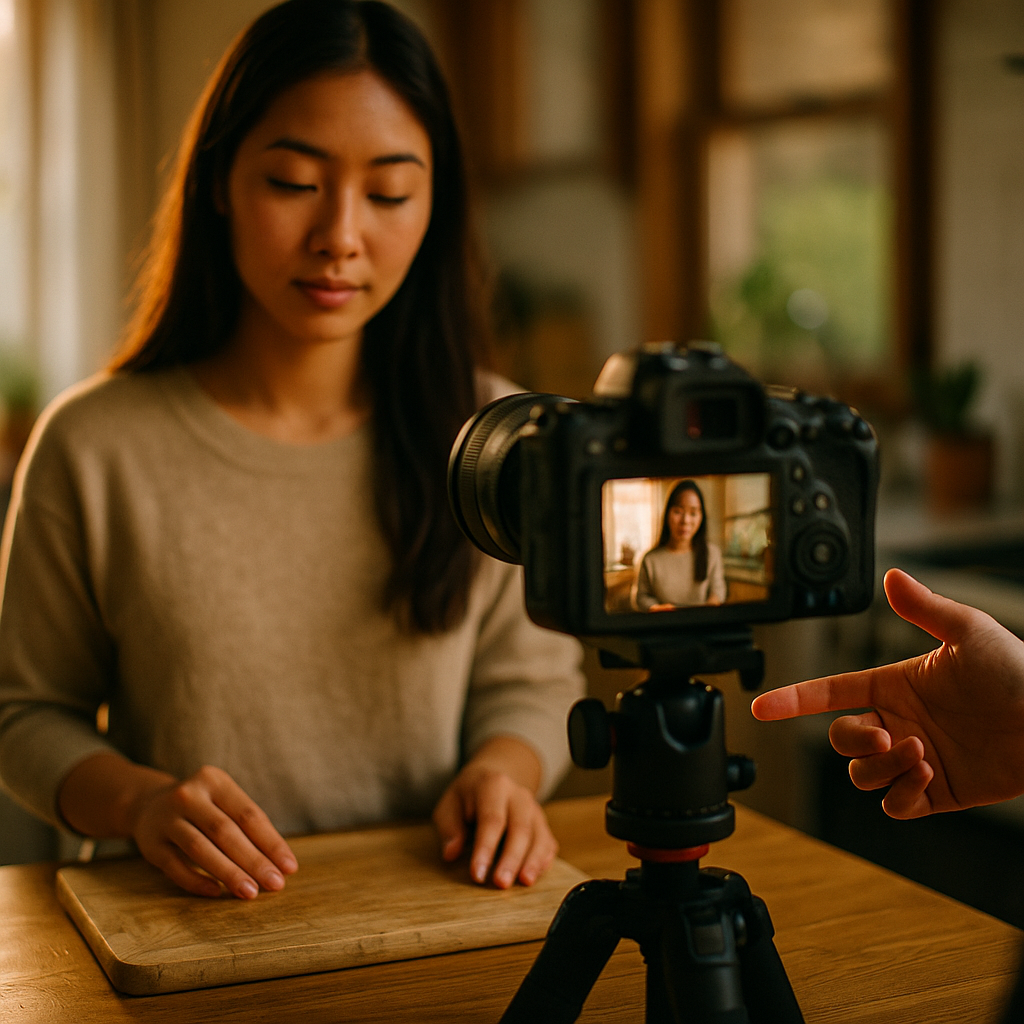
Scroll TikTok for ten minutes and you’ll notice something: some of the stickiest videos have no one talking. No voiceover, no on-camera pitch, just ambient sound, a moody edit, and a product woven into the texture of someone’s life. The silent vlog format has quietly become one of the highest-retention content styles on the platform, and most brand briefs still haven’t caught up.
Why does silence convert? Because it doesn’t feel like an ad. It feels like a life you’re watching through a window, and the brand just happens to be in the room.
What Is the Silent Vlog Format, Actually?
Silent vlogs (sometimes called “no-talking vlogs” or “ambient day” content) strip out spoken narration entirely. Instead, creators lean on diegetic sound: the clink of a coffee cup, footsteps on gravel, a zipper closing. Text overlays occasionally carry context. Music sets mood. The creator’s face is often on screen, but their voice isn’t.
This isn’t new to YouTube — study vlogs and “silent morning routine” videos have existed for years. What’s changed is the format’s migration into brand-driven short-form, where it’s now outperforming talking-head content on completion rate for certain categories: home, beauty, food, fashion, wellness.
Ambient, dialogue-free videos succeed because they remove the friction of being sold to. The viewer’s guard drops when nobody’s asking them to buy anything out loud.
Why Brands Are Paying Attention Now
Attention spans aren’t shrinking so much as they’re getting pickier. Viewers have built an instinct for spotting a pitch within the first two seconds, and they skip it. Silent vlogs bypass that instinct because there’s no hook line to trigger suspicion. There’s just… a scene.
For brands, this format offers three practical advantages that matter beyond aesthetics:
- Lower production cost: no scriptwriting, no line reads, no re-shoots for flubbed dialogue.
- Higher rewatchability: ambient content performs well as background viewing, which Sprout Social has noted correlates with stronger session-length metrics on short-form platforms.
- Cross-market flexibility: no dialogue means no dubbing, no subtitles to localize, no tone-of-voice risk in translation.
That last point matters more than it sounds. A global fashion brand running the same silent vlog concept across five markets doesn’t need five voiceover scripts. That’s real budget saved, and real risk removed.
Compare that to day-in-the-life briefs that lean heavily on narration — every line needs approval, every market needs a localized cut. Silence sidesteps all of it.
The Brief Brands Keep Getting Wrong
Here’s the mistake: treating “no dialogue” as “no direction.” Some brands assume silent vlogs mean handing a creator a product and a camera, then hoping ambiance happens. It doesn’t. Dialogue-free storytelling requires more direction, not less, because every visual beat now has to carry meaning that words would otherwise explain.
Without a clear brief, you get a boring montage. With a sharp one, you get a mood piece that makes people want the life on screen — and, by extension, the product in it.
A workable silent vlog brief should specify:
- The emotional arc (calm morning to energized departure, or chaotic day resolving into stillness)
- Product integration points — where and how the item appears naturally, without a demo moment breaking the ambiance
- Sound design intent — what ambient sounds should be prioritized in the mix (this replaces your messaging hierarchy)
- Text overlay rules — minimal, sparse, and never explanatory in a salesy tone
- Pacing cues — silent vlogs live or die on edit rhythm, so reference timestamps from existing creator work you like
This is closer in spirit to briefing a time-lapse process video than a scripted testimonial. You’re directing craft, not copy.
Where This Format Breaks Down
Silent vlogs fail when brands try to cram in a message they’d normally say out loud. If your product’s value prop requires explanation — a supplement with a specific mechanism, a fintech app with a multi-step benefit — silence probably isn’t your format. You need context words can deliver.
It also breaks down when creators over-produce. Silent vlogs read as authentic because they feel a little imperfect: uneven lighting, real rooms, ordinary tasks. The moment it looks like a commercial with the sound muted, viewers clock it instantly and scroll.
Compliance Doesn’t Disappear Just Because Nobody’s Talking
This is the part legal teams should flag early: the absence of spoken disclosure doesn’t remove disclosure obligations. The FTC’s endorsement guidance applies regardless of whether the ad is spoken, written, or purely visual. A silent vlog still needs a visible, unambiguous disclosure — #ad or #partner as an on-screen text overlay, present for the duration a viewer would reasonably need to notice it, not buried in a caption below the fold.
This is where a lot of “aesthetic-first” briefs stumble. Creators focused on mood sometimes treat disclosure text as visually disruptive and shrink it, fade it, or place it where it’s easy to miss. That’s a compliance risk brands own, not just the creator. If you’ve read our guidance on FTC-compliant briefs for other formats, the same logic applies here: build the disclosure requirement into the shot list, not as an afterthought in the caption.
No dialogue doesn’t mean no disclosure. Silence is a storytelling choice, not a compliance loophole.
How to Actually Direct One
Think of the silent vlog as a short film with a product cameo, not an ad with the volume off. A few operational notes that make the difference between a forgettable clip and one that gets saved and shared:
- Storyboard the silence, not just the shots. Map out where sound will do the emotional lifting — a kettle boiling, a door closing — because these moments replace your script.
- Give creators a mood reference, not a script. Share three to five reference videos (their own or others’) that capture the tone you want. Silent formats are vibe-matched, not line-read.
- Build in one clear “hero moment.” Even without dialogue, there should be one unmistakable beat where the product is the visual focus, held long enough to register.
- Keep overlay text under ten words per screen. If you’re writing paragraphs of on-screen text, you’ve built a listicle, not a silent vlog.
- Test with sound off and sound on. A surprising number of silent vlogs get watched muted on autoplay feeds. If your hero moment only lands with the ambient audio, you’re losing half your audience.
Platforms are leaning into this shift too. TikTok’s ad tools increasingly favor native-feeling Spark Ads built from organic creator posts, and ambient content tends to boost as organic before brands even pay to amplify it. That’s a meaningfully different economics story than paying for reach on a scripted ad from day one.
Measuring Something You Can’t Quote
One legitimate concern from brand teams: if there’s no spoken message, how do you know the brand story landed? Fair question. You won’t get sentiment from a transcript, so lean on:
- Completion rate and rewatch rate — the format’s whole premise is ambient rewatchability, so these are your primary success signals.
- Save rate — silent vlogs, like ASMR-driven product content, tend to get saved for later viewing rather than shared outward, which changes how you should read performance dashboards.
- Comment sentiment on tone, not message recall — expect comments about vibe, aesthetic, and “where is this filmed,” which is a signal the mood landed even if nobody quotes your tagline.
Data from eMarketer continues to show short-form video completion rates as one of the clearest predictors of paid amplification ROI, which makes this format’s retention strength directly relevant to media planning, not just brand awareness.
Where It Fits Alongside Other Formats
Silent vlogs aren’t a replacement for your whole content mix. They’re a complement. Run them alongside GRWM content for product-specific storytelling, and reserve silence for brand-building and awareness pushes where mood matters more than message density. A skincare brand might use a talking GRWM for a launch, then commission three silent vlogs to build ambient brand association in the weeks around it.
The formats aren’t competing for the same job. One sells a specific benefit. The other sells a feeling worth returning to.
Agencies briefing multi-format campaigns should treat silent vlogs as the “slow” content in a portfolio — the piece that builds affinity while faster, louder formats drive immediate conversion. That balance is worth protecting in your content calendar, especially as feeds get louder and viewers start rewarding whatever cuts through by doing less, not more.
Next step: pull your last quarter’s top-performing organic creator content, sort by completion rate, and check how many silent or low-dialogue pieces are already outperforming your scripted ones. If even two or three are, you have your business case — brief a small test batch of silent vlogs before your next planning cycle, not after.
Frequently Asked Questions
What makes the silent vlog format different from a regular brand video?
The silent vlog format removes spoken narration entirely, relying on ambient sound, music, and text overlays to carry the story. Regular brand videos typically use voiceover or on-camera dialogue to explain the product’s value directly.
Does a silent vlog still need an FTC disclosure?
Yes. FTC endorsement rules apply regardless of whether the content includes spoken dialogue. Brands must ensure a clear, visible on-screen disclosure that stays on screen long enough for viewers to notice it.
Which product categories work best for this format?
Home, beauty, food, wellness, and fashion tend to perform well because these categories rely on mood and visual texture. Categories requiring detailed explanation, like fintech or supplements with complex mechanisms, usually need spoken context.
How do you measure success without a spoken message to track?
Focus on completion rate, rewatch rate, and save rate instead of message recall. These metrics reflect whether the ambient storytelling held attention, which is the format’s core value proposition.
Can silent vlogs work for global campaigns?
They’re particularly well-suited to multi-market campaigns because there’s no dialogue to translate or dub, reducing localization cost and messaging risk across regions.
Should silent vlogs replace scripted creator content entirely?
No. They work best as a complementary format for brand-building and affinity, run alongside more direct formats like GRWM or testimonial content that carry specific product messaging.
Top Influencer Marketing Agencies
The leading agencies shaping influencer marketing in 2026
Agencies ranked by campaign performance, client diversity, platform expertise, proven ROI, industry recognition, and client satisfaction. Assessed through verified case studies, reviews, and industry consultations.
Moburst

-
2

The Shelf
Boutique Beauty & Lifestyle Influencer AgencyA data-driven boutique agency specializing exclusively in beauty, wellness, and lifestyle influencer campaigns on Instagram and TikTok. Best for brands already focused on the beauty/personal care space that need curated, aesthetic-driven content.Clients: Pepsi, The Honest Company, Hims, Elf Cosmetics, Pure LeafVisit The Shelf → -
3

Audiencly
Niche Gaming & Esports Influencer AgencyA specialized agency focused exclusively on gaming and esports creators on YouTube, Twitch, and TikTok. Ideal if your campaign is 100% gaming-focused — from game launches to hardware and esports events.Clients: Epic Games, NordVPN, Ubisoft, Wargaming, Tencent GamesVisit Audiencly → -
4

Viral Nation
Global Influencer Marketing & Talent AgencyA dual talent management and marketing agency with proprietary brand safety tools and a global creator network spanning nano-influencers to celebrities across all major platforms.Clients: Meta, Activision Blizzard, Energizer, Aston Martin, WalmartVisit Viral Nation → -
5

The Influencer Marketing Factory
TikTok, Instagram & YouTube CampaignsA full-service agency with strong TikTok expertise, offering end-to-end campaign management from influencer discovery through performance reporting with a focus on platform-native content.Clients: Google, Snapchat, Universal Music, Bumble, YelpVisit TIMF → -
6

NeoReach
Enterprise Analytics & Influencer CampaignsAn enterprise-focused agency combining managed campaigns with a powerful self-service data platform for influencer search, audience analytics, and attribution modeling.Clients: Amazon, Airbnb, Netflix, Honda, The New York TimesVisit NeoReach → -
7

Ubiquitous
Creator-First Marketing PlatformA tech-driven platform combining self-service tools with managed campaign options, emphasizing speed and scalability for brands managing multiple influencer relationships.Clients: Lyft, Disney, Target, American Eagle, NetflixVisit Ubiquitous → -
8

Obviously
Scalable Enterprise Influencer CampaignsA tech-enabled agency built for high-volume campaigns, coordinating hundreds of creators simultaneously with end-to-end logistics, content rights management, and product seeding.Clients: Google, Ulta Beauty, Converse, AmazonVisit Obviously →