


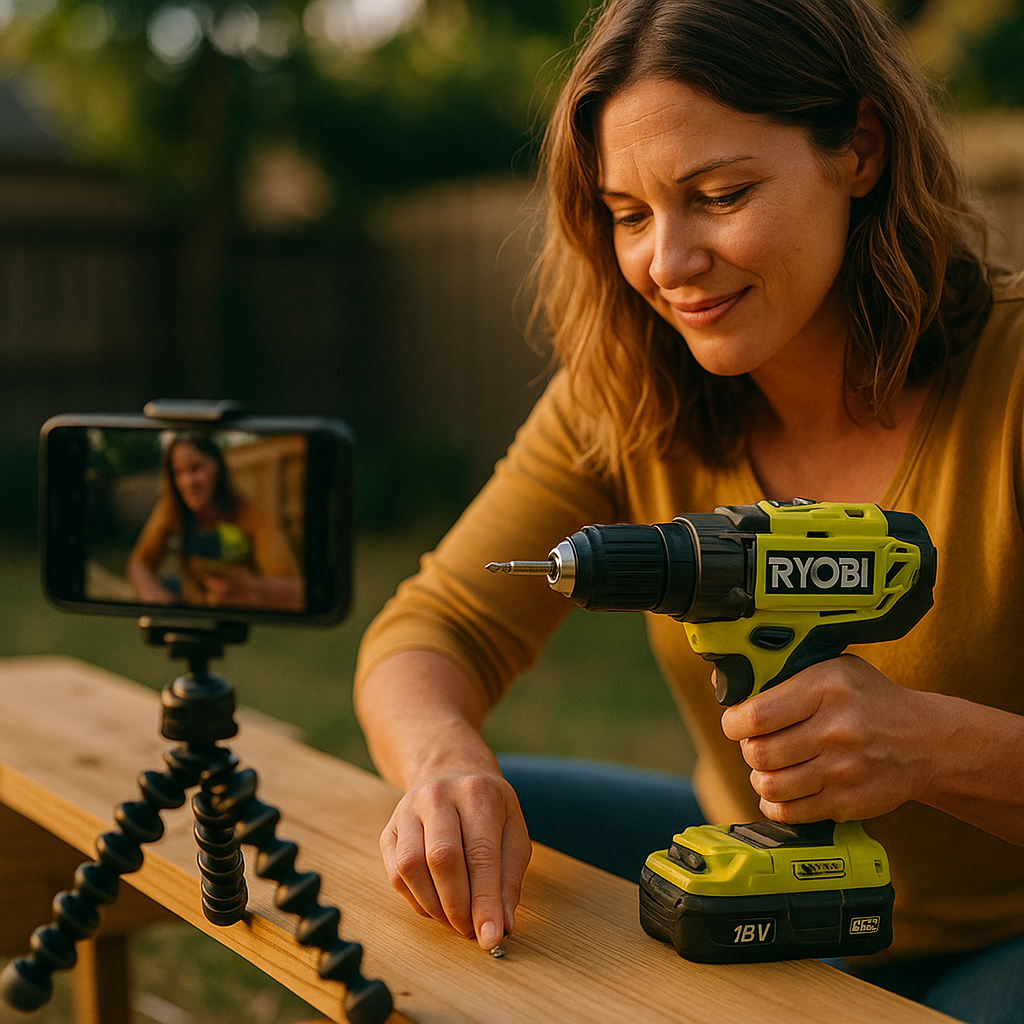
A power tool brand outspent by every category giant just proved that 500 followers can beat 500,000. Ryobi’s nano-influencer network of garage builders, weekend renovators, and tool-hoarding DIYers now outperforms its paid social and even its celebrity-adjacent partnerships on return per dollar spent. No agency roster of polished creators. No six-figure sponsorships. Just a tool-focused micro-creator network that figured out something most brands still miss: the smaller the audience, the higher the trust, and the higher the trust, the higher the conversion.
The Problem With Chasing Reach in Tool Marketing
Power tools are a weird category for influencer marketing. The purchase decision isn’t emotional in the way skincare or fashion is. It’s technical. Buyers want torque specs, battery life comparisons, and proof that a drill won’t die mid-project. A 30-second glam video from a mid-tier lifestyle creator does almost nothing for that buyer. What works is watching someone actually use the tool, badly at first, then competently, in a real garage with real sawdust.
Ryobi’s marketing team reportedly noticed this years ago when reviewing engagement data across creator tiers. Macro-influencers with huge followings generated impressions. They rarely generated add-to-carts. Meanwhile, small-scale creators posting garage builds, deck renovations, and tool organization hacks were driving disproportionate click-throughs relative to their tiny audiences. That gap became the thesis for an entirely restructured creator strategy.
Ryobi’s nano-creator tier — accounts under 15,000 followers — now reportedly drives return on ad spend multiples higher than the brand’s traditional paid social campaigns, according to industry commentary on the program’s structure.
What “Tool-Focused” Actually Means Here
Ryobi didn’t just recruit anyone with a home improvement hashtag. The network is built around a specific creator profile: people already buying and using tools before any brand relationship exists. Weekend woodworkers. First-time homeowners tackling a bathroom remodel. Landscapers documenting side hustles. Garage-organization obsessives who treat their workshop like a shrine.
That specificity matters more than most brands realize. A generalist “lifestyle creator” talking about a cordless drill for fifteen seconds between a skincare routine and a coffee order reads as an ad. A dedicated DIYer who’s used four different drill brands and has opinions reads as a source. Ryobi built its network around the latter.
The brand’s approach mirrors a pattern showing up across categories: seed products to people who already have category credibility, rather than paying for reach among people who don’t. It’s the same logic behind nano-creator seeding strategies in the beverage space and the retail-focused creator programs retailers like Lowe’s have leaned into for DIY audiences, detailed in this breakdown of a creator DIY series driving in-store lift. Tools and home improvement are naturally suited to this model because the content doubles as proof of performance.
How the Network Actually Operates
Structurally, Ryobi’s micro-creator program looks less like a traditional influencer campaign and more like an ongoing community pipeline. A few operational patterns stand out:
- Product seeding over paid contracts. Most nano-creators in the network receive tools, not cash. The ROI math works because product cost per creator is low, and volume replaces individual spend.
- Volume over exclusivity. Rather than locking in a handful of “brand ambassadors,” Ryobi reportedly rotates through hundreds of smaller creators across project categories, spreading risk and avoiding overexposure to any single personality.
- Project-based content briefs. Creators aren’t asked to “talk about” a product. They’re asked to complete a real project, a deck rebuild, a garage shelving system, a bathroom vanity, and document it naturally.
- Repurposing rights baked in. Contracts typically include usage rights for Ryobi’s owned channels, turning nano-creator content into a low-cost UGC library for paid social, email, and retail media.
This last point is underrated. Most brands treat influencer content and paid media as separate budgets. Ryobi treats nano-creator output as raw material for everything else, which quietly improves ROAS across the entire media mix, not just the influencer line item.
Why ROAS Is Higher Here Than Anywhere Else in the Mix
The economics are almost embarrassingly simple once you break them down. A macro-influencer deal might run $15,000-$50,000 for a single video with uncertain conversion tracking. Ryobi’s nano-creator equivalent costs a product bundle worth a few hundred dollars, sometimes less. Multiply that across a network of hundreds of creators and you get far more total content, far more search-indexable video, and far more long-tail discovery, at a fraction of the spend per unit of content.
eMarketer’s research on influencer tiers has consistently shown nano and micro creators posting higher engagement rates than macro and celebrity tiers, often by a wide margin. Ryobi’s internal ROAS data reportedly reflects that same pattern, but with a category-specific twist: tool content has unusually long shelf life. A “how to build a raised garden bed with a Ryobi drill” video doesn’t expire. It keeps getting discovered on YouTube and Pinterest for years, generating conversions long after the original campaign budget was spent.
That durability is the real ROAS unlock. Paid social decays within days. Nano-creator DIY content compounds for months, sometimes years, as an evergreen search asset.
Content with a functional shelf life, like a tutorial, keeps converting long after a paid campaign ends. That’s the structural advantage nano-creator DIY content has over almost any paid media format.
Trust Signals: Why Small Audiences Convert Better
There’s a psychological mechanism behind this that’s worth naming directly. Audiences under 15,000 followers tend to have real relationships with their followers, not parasocial-at-scale relationships. Comments sections read like conversations between neighbors, not fans addressing a celebrity. When that creator says a battery lasts through an entire deck build, the audience believes it because they’ve watched this person struggle through other projects honestly, including failures.
Compare that to a mid-tier influencer whose feed is a rotating door of sponsored content. Audiences have gotten good at spotting the pattern. Skepticism has become a default response to obvious paid placements, and Sprout Social’s consumer trust research has repeatedly flagged declining trust in influencer content as follower count and posting frequency both climb past certain thresholds.
Ryobi’s nano-creator network sidesteps that skepticism almost entirely, not because nano-creators are more honest people, but because the format itself, a real project, filmed imperfectly, reviewed critically, doesn’t trigger the same “ad detection” instinct as polished sponsored content.
The Compliance Angle Brands Keep Underestimating
Running hundreds of micro-partnerships instead of a dozen macro deals creates a different kind of operational risk: disclosure compliance at scale. It’s one thing to manage FTC disclosure requirements across ten creator contracts. It’s another to manage it across several hundred nano-creators who may not fully understand FTC endorsement guidelines or apply them consistently.
Brands scaling nano-creator programs need standardized disclosure language built into every brief, not left to creator discretion. This isn’t optional risk management, it’s the difference between a defensible program and a regulatory headache. Any brand replicating Ryobi’s model should budget for a compliance layer: templated disclosure copy, periodic audits of live posts, and a clear escalation path when a creator posts something off-brand or non-compliant.
The upside of scale (hundreds of authentic voices) comes with the downside of scale (hundreds of compliance touchpoints). Brands that skip this step are gambling with FTC exposure to save on legal review time. That’s a bad trade.
What Other Categories Can Steal From This Playbook
Ryobi’s model isn’t exclusive to power tools. The underlying logic transfers to any category where product performance is provable on camera and purchase decisions hinge on demonstrated competence rather than aspiration. Home fitness equipment, outdoor gear, automotive accessories, even B2B hardware, all fit this pattern.
The brands already applying similar logic across other categories back this up. Vessi’s approach to turning a single piece of organic content into a referral engine shows how product-demonstration content can outperform paid campaigns when it’s genuinely useful. Unilever’s shift toward discovering creators based on interest over follower count reflects the same underlying insight Ryobi built its whole model around: relevance beats reach.
For marketing teams evaluating whether this model fits their category, a few honest questions help:
- Does your product’s value show up visually, in use, not just in a spec sheet?
- Do you have (or can you build) a seeding pipeline that doesn’t require six-figure creator contracts?
- Can your legal and compliance team support disclosure management at higher creator volume?
- Is your content team set up to repurpose creator output across paid and owned channels, not just let it live on one platform?
If the answer to most of these is yes, a nano-creator network isn’t a nice-to-have experiment. It’s a channel that, done right, can beat your paid media ROAS within a couple of quarters.
Next Step
Brands sitting on a paid social budget that’s plateaued should audit their creator tiers before requesting more spend: a shift toward nano and micro partnerships, backed by a real compliance framework, is often the faster path to ROAS gains than another round of paid impressions.
FAQs
What counts as a nano-influencer in a program like Ryobi’s?
Nano-influencers typically have follower counts between 1,000 and 15,000. In tool and home improvement categories, they’re usually everyday DIYers with genuine project history, not creators who built an audience specifically to work with brands.
Why does nano-creator content outperform macro-influencer campaigns on ROAS?
Lower cost per creator, higher audience trust, and longer content shelf life all compound together. Product-seeded nano content also doubles as reusable UGC for paid and owned channels, improving efficiency across the entire media mix, not just the influencer budget line.
How does a brand manage FTC compliance across hundreds of micro-creators?
Standardize disclosure language in every creator brief, run periodic audits of live posts, and set a clear escalation process for non-compliant content. Scale multiplies risk exposure, so compliance can’t be handled ad hoc the way it might be with a handful of macro-influencer contracts.
Does this model work outside the tool and home improvement category?
It works best in categories where product performance is visually demonstrable on camera, think outdoor gear, fitness equipment, automotive accessories, or B2B hardware. Categories driven more by aspiration or lifestyle signaling may need a different creator mix.
What’s the biggest operational challenge in running a nano-creator network at scale?
Coordination. Managing product seeding logistics, content rights, and compliance across hundreds of small creators requires more process than a dozen high-touch macro deals, even though the total spend is often lower.
Top Influencer Marketing Agencies
The leading agencies shaping influencer marketing in 2026
Agencies ranked by campaign performance, client diversity, platform expertise, proven ROI, industry recognition, and client satisfaction. Assessed through verified case studies, reviews, and industry consultations.
Moburst

-
2

The Shelf
Boutique Beauty & Lifestyle Influencer AgencyA data-driven boutique agency specializing exclusively in beauty, wellness, and lifestyle influencer campaigns on Instagram and TikTok. Best for brands already focused on the beauty/personal care space that need curated, aesthetic-driven content.Clients: Pepsi, The Honest Company, Hims, Elf Cosmetics, Pure LeafVisit The Shelf → -
3

Audiencly
Niche Gaming & Esports Influencer AgencyA specialized agency focused exclusively on gaming and esports creators on YouTube, Twitch, and TikTok. Ideal if your campaign is 100% gaming-focused — from game launches to hardware and esports events.Clients: Epic Games, NordVPN, Ubisoft, Wargaming, Tencent GamesVisit Audiencly → -
4

Viral Nation
Global Influencer Marketing & Talent AgencyA dual talent management and marketing agency with proprietary brand safety tools and a global creator network spanning nano-influencers to celebrities across all major platforms.Clients: Meta, Activision Blizzard, Energizer, Aston Martin, WalmartVisit Viral Nation → -
5

The Influencer Marketing Factory
TikTok, Instagram & YouTube CampaignsA full-service agency with strong TikTok expertise, offering end-to-end campaign management from influencer discovery through performance reporting with a focus on platform-native content.Clients: Google, Snapchat, Universal Music, Bumble, YelpVisit TIMF → -
6

NeoReach
Enterprise Analytics & Influencer CampaignsAn enterprise-focused agency combining managed campaigns with a powerful self-service data platform for influencer search, audience analytics, and attribution modeling.Clients: Amazon, Airbnb, Netflix, Honda, The New York TimesVisit NeoReach → -
7

Ubiquitous
Creator-First Marketing PlatformA tech-driven platform combining self-service tools with managed campaign options, emphasizing speed and scalability for brands managing multiple influencer relationships.Clients: Lyft, Disney, Target, American Eagle, NetflixVisit Ubiquitous → -
8

Obviously
Scalable Enterprise Influencer CampaignsA tech-enabled agency built for high-volume campaigns, coordinating hundreds of creators simultaneously with end-to-end logistics, content rights management, and product seeding.Clients: Google, Ulta Beauty, Converse, AmazonVisit Obviously →