


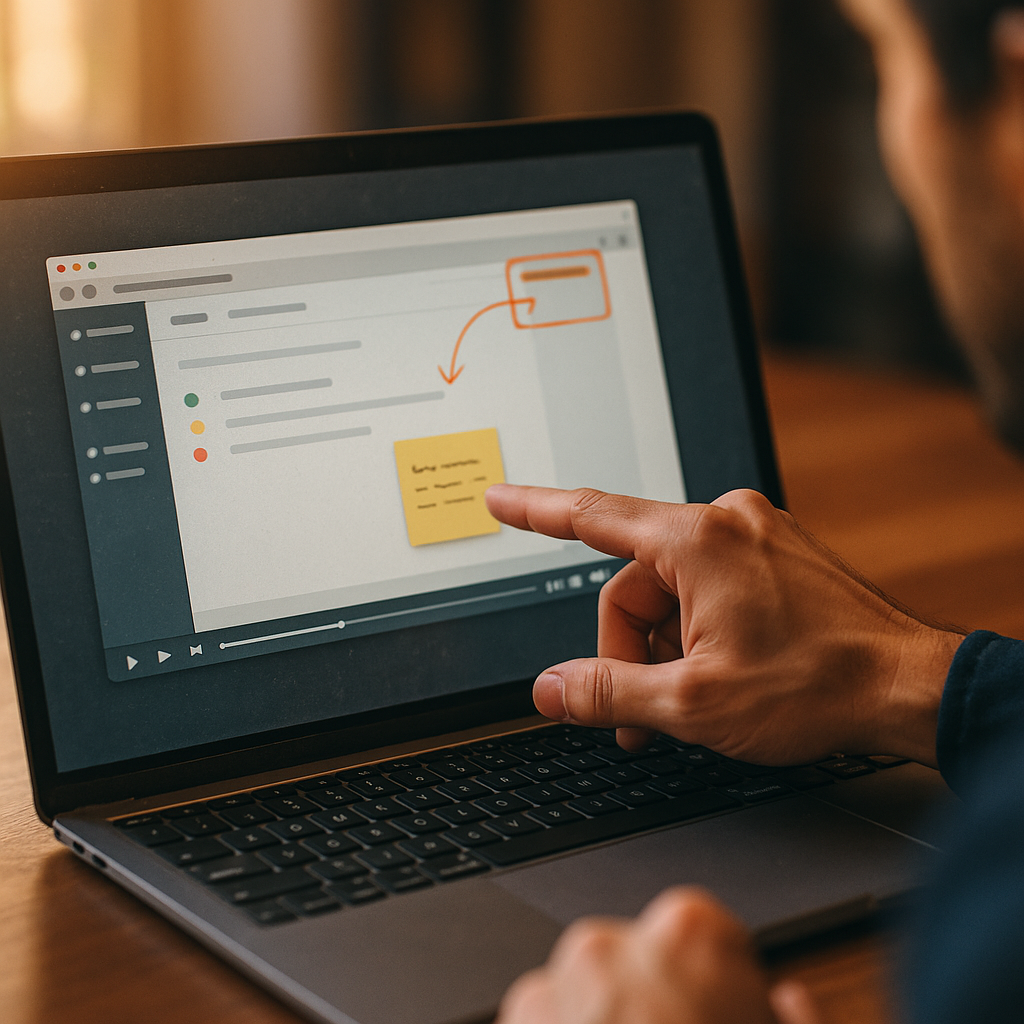
Skip rates on traditional demo content are climbing past 65% on some platforms, according to recent eMarketer benchmarks. Viewers don’t trust a script. They trust a screen. The annotated screen-record format hands creators their own phone, hits record, and asks them to talk through a real purchase decision as it unfolds — tabs open, prices compared, doubts spoken aloud.
This isn’t a new tactic dressed up. It’s a format built for an audience that’s exhausted by polish and starving for process.
What This Format Actually Is
An annotated screen-record is exactly what it sounds like: a creator records their own device screen while narrating a live decision. Think of it as a director’s commentary track, except the “film” is a Safari browser with fourteen tabs open and the commentary is unscripted reasoning. The creator might be comparing your product against three competitors, reading reviews out loud, or hesitating over a price point before adding to cart.
The “annotated” part matters. It’s not a passive screen capture. Creators circle text, highlight reviews, pause on a spec sheet, or jump back to a comparison chart mid-sentence. The narration and the on-screen action are locked together in a way that feels like watching a smart friend shop, not watching an ad.
The format works because it replicates the one thing viewers actually do before buying: open ten tabs and argue with themselves. Creators are just doing it out loud.
Why Brands Are Greenlighting It Now
Three forces are converging here. First, trust in polished influencer content has eroded — Sprout Social’s research consistently shows authenticity outranking production value as a purchase driver. Second, platforms are rewarding longer watch time on screen-recorded and tutorial-style content because it signals genuine engagement, not just a scroll-past. Third, procurement teams want content that doubles as usable UGC across paid channels, and a screen-record with clear narration is easier to repurpose into a Meta or TikTok ad than a lifestyle shoot.
There’s also a compliance upside brands don’t talk about enough. When a creator narrates their actual reasoning — including the moment they almost bought a competitor — it reads as disclosure-friendly by default. There’s no “results not typical” problem when the content is literally showing the decision, not the outcome.
This pairs well with formats we’ve covered before, like the product swap brief, which also leans on visible comparison rather than claims. Both formats share a core insight: showing the decision beats stating the conclusion.
Briefing It Without Killing the Authenticity
Here’s the tension every brand manager runs into: you want narration that hits key selling points, but the moment it sounds rehearsed, the format’s entire value proposition collapses. So the brief has to work differently than a standard content brief.
Don’t write talking points. Write decision criteria. Give the creator the actual questions a buyer would ask themselves — “is this worth $40 more than the alternative,” “does this ingredient list actually matter to me,” “will this fit my routine” — and let them answer those questions live, in their own words, using your product page or app.
- Give real access, not staged access. The creator should be looking at your actual site, actual reviews, actual checkout flow. If you sanitize the environment, the audience smells it.
- Specify the comparison set. Tell them which 2-3 competitors are fair game. This protects your brand from an unflattering surprise and gives the creator permission to be genuinely critical elsewhere.
- Require at least one moment of hesitation. A screen-record with zero friction reads as a paid placement instantly. Ask for a pause point — a price check, a re-read of a return policy, a “let me see if there’s a discount code” moment.
- Set a annotation minimum. Two to four on-screen highlights or circles per minute keeps the format visually active without turning it into a tutorial.
This is closer in spirit to the customer service screen-recording format than to a standard demo brief. Both rely on the screen itself as the credibility mechanism, not the creator’s face or delivery.
The Script You Shouldn’t Write
Marketing teams instinctively want a script for anything customer-facing. Resist it here. A screen-record with a scripted narration track is one of the easiest formats for audiences to detect as fake, because the cadence of real decision-making is halting, non-linear, and occasionally contradictory. Real people say “wait, actually” and “hold on, let me check something.” A script never does.
Instead, brief the shape of the video, not the words. A workable structure looks like this:
- Opening frame: what are you trying to decide right now (10-15 seconds)
- Research phase: open tabs, compare, react honestly (60-90 seconds)
- The pivot: something that almost changes their mind (15-20 seconds)
- The resolution: what tipped the decision and why (20-30 seconds)
- Optional: the actual checkout or booking moment
Note that step 3 is non-negotiable. Without a genuine pivot point, the video is just an ad with extra steps. With it, viewers stay because they don’t know how it ends.
Measurement: What “Working” Looks Like
Standard influencer KPIs undersell this format. View-through rate and average watch duration matter more than likes here, because the format’s entire value is attention retention through a multi-minute narrative. If a screen-record is losing viewers at the research phase, the annotation pacing is probably too slow, or the creator picked a comparison set that’s boring.
Track click-through from the specific moment the creator lands on your product page — platforms like TikTok and Meta both support timestamped link overlays now, so you can literally see if conversion spikes align with the “pivot” moment in the video. That’s a diagnostic tool most brands aren’t using yet.
If your screen-record content isn’t generating a watch-time curve that holds steady (not declining) through the comparison section, the brief needs a real friction point, not more product features.
Also worth tracking: saves and shares, which tend to run higher on this format than on standard reviews because viewers use it as reference material. Someone deciding between two skincare serums will bookmark a screen-record comparison the same way they’d bookmark a spreadsheet. That’s a strong signal of purchase-intent proximity, arguably stronger than a like.
Where It Breaks
This format isn’t a fit for every category. High-consideration purchases (SaaS, financial products, big-ticket electronics) work well because the “research phase” mirrors real behavior. Impulse categories — snacks, cheap apparel — feel artificial when stretched into a multi-minute decision narrative, because nobody actually screen-records themselves agonizing over a $6 lip gloss.
It also requires creators who can think out loud coherently, which is a narrower skill than it sounds. Some creators are excellent on-camera talents but freeze up narrating unscripted reasoning. Casting for this format should include a short unscripted audition: hand them a product page cold, ask them to talk through whether they’d buy it, and see if the reasoning is fluent or stilted.
There’s also a legal wrinkle worth flagging early with legal or compliance teams. If a creator’s “pivot” moment involves a specific competitor by name, in a way that could read as disparaging, that’s a different review process than a generic aside. The FTC’s endorsement guidance covers disclosure requirements clearly, but comparative claims about named competitors carry separate legal exposure that disclosure alone doesn’t solve. Loop in legal before the comparison set is finalized, not after the video is live.
How It Complements Other Formats in Rotation
Annotated screen-records shouldn’t be a standalone tactic; they work best as one node in a broader trust-building content mix. Pair them with before-and-after briefs for outcome proof, and myth-busting videos for objection handling. The screen-record format sits in the middle of the funnel: it’s not top-of-funnel awareness content, and it’s not bottom-of-funnel hard conversion. It’s the “help me decide” layer that a lot of brand content calendars are missing entirely.
If you’re running quarterly content audits, check whether your creator roster has any decision-stage content at all. Most brands are heavy on aspirational and demo content, light on anything that mirrors actual research behavior. That gap is exactly what this format fills.
FAQs
Frequently Asked Questions
What is the annotated screen-record format in influencer marketing?
It’s a content format where a creator records their device screen while narrating a real purchase decision, using on-screen annotations like highlights and circles to draw attention to specific details as they compare products or read reviews.
How is this different from a standard product review video?
Standard reviews present a conclusion after the fact. Annotated screen-records show the live decision-making process, including hesitation and comparison, which reads as more credible because viewers can see the reasoning unfold in real time rather than being told the outcome.
Does this format require a full script?
No, and scripting it usually backfires. Brands should provide decision criteria and a loose structural shape (research, pivot, resolution) rather than word-for-word narration, since scripted cadence is easy for audiences to detect and undermines the format’s credibility.
What KPIs matter most for this format?
Watch-time retention through the comparison section, timestamped click-through at the product-page moment, and save/share rates matter more than likes, since the format’s value lies in sustained attention and reference-worthy content.
Is it FTC compliant?
It can be, since showing an authentic decision process is inherently more disclosure-friendly than making outcome claims. However, comparative statements naming specific competitors carry separate legal exposure beyond standard endorsement disclosure, so legal review of the comparison set is recommended.
Which product categories work best for this format?
High-consideration categories like software, financial products, and higher-priced electronics or beauty items work best, since they mirror genuine research behavior. Low-cost impulse categories tend to feel artificial when stretched into a multi-minute decision narrative.
Brief for the pivot, not the pitch: the moment a creator almost chooses something else is what makes the rest of the video believable. Build your next screen-record brief around that single requirement and measure watch-time retention before you touch anything else.
Top Influencer Marketing Agencies
The leading agencies shaping influencer marketing in 2026
Agencies ranked by campaign performance, client diversity, platform expertise, proven ROI, industry recognition, and client satisfaction. Assessed through verified case studies, reviews, and industry consultations.
Moburst

-
2

The Shelf
Boutique Beauty & Lifestyle Influencer AgencyA data-driven boutique agency specializing exclusively in beauty, wellness, and lifestyle influencer campaigns on Instagram and TikTok. Best for brands already focused on the beauty/personal care space that need curated, aesthetic-driven content.Clients: Pepsi, The Honest Company, Hims, Elf Cosmetics, Pure LeafVisit The Shelf → -
3

Audiencly
Niche Gaming & Esports Influencer AgencyA specialized agency focused exclusively on gaming and esports creators on YouTube, Twitch, and TikTok. Ideal if your campaign is 100% gaming-focused — from game launches to hardware and esports events.Clients: Epic Games, NordVPN, Ubisoft, Wargaming, Tencent GamesVisit Audiencly → -
4

Viral Nation
Global Influencer Marketing & Talent AgencyA dual talent management and marketing agency with proprietary brand safety tools and a global creator network spanning nano-influencers to celebrities across all major platforms.Clients: Meta, Activision Blizzard, Energizer, Aston Martin, WalmartVisit Viral Nation → -
5

The Influencer Marketing Factory
TikTok, Instagram & YouTube CampaignsA full-service agency with strong TikTok expertise, offering end-to-end campaign management from influencer discovery through performance reporting with a focus on platform-native content.Clients: Google, Snapchat, Universal Music, Bumble, YelpVisit TIMF → -
6

NeoReach
Enterprise Analytics & Influencer CampaignsAn enterprise-focused agency combining managed campaigns with a powerful self-service data platform for influencer search, audience analytics, and attribution modeling.Clients: Amazon, Airbnb, Netflix, Honda, The New York TimesVisit NeoReach → -
7

Ubiquitous
Creator-First Marketing PlatformA tech-driven platform combining self-service tools with managed campaign options, emphasizing speed and scalability for brands managing multiple influencer relationships.Clients: Lyft, Disney, Target, American Eagle, NetflixVisit Ubiquitous → -
8

Obviously
Scalable Enterprise Influencer CampaignsA tech-enabled agency built for high-volume campaigns, coordinating hundreds of creators simultaneously with end-to-end logistics, content rights management, and product seeding.Clients: Google, Ulta Beauty, Converse, AmazonVisit Obviously →