


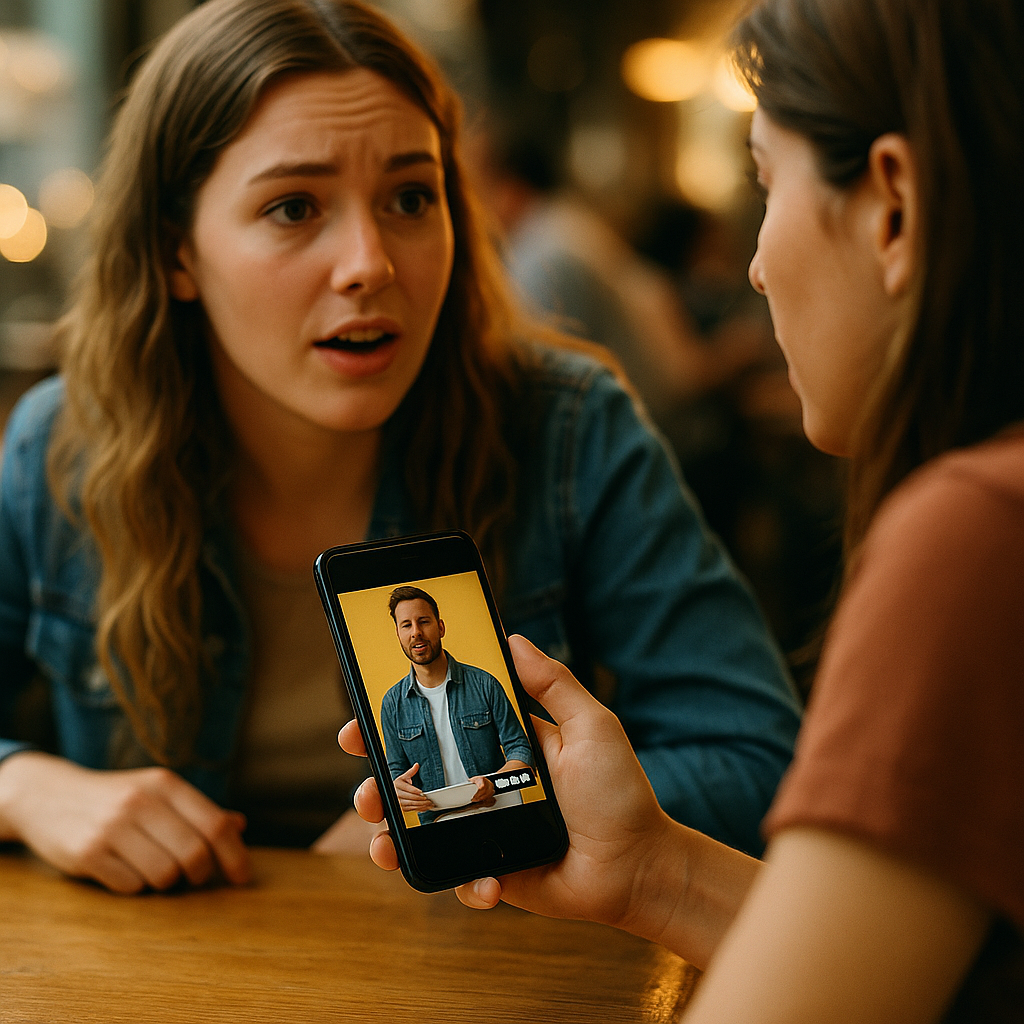
Skip rates on obvious ad reads now exceed 65% on some platforms, according to internal creator analytics shared with agencies this year. Viewers have developed pitch radar, and they fire it the second a creator turns to camera and says “so I’ve been using this.” The overheard conversation format sidesteps that radar entirely by burying product information inside dialogue that was never meant to be heard by you in the first place — or at least, that’s the illusion.
What This Format Actually Is
The overheard conversation format is scripted ambient dialogue, usually between two people, that a viewer appears to stumble into mid-conversation. Think of it as the audio equivalent of a candid photo. Two friends in a kitchen. A couple unpacking groceries. Roommates debating what to order for dinner. The product gets mentioned the way it would in real life: in passing, with disagreement, with a joke attached. Nobody looks at the camera. Nobody says “link in bio.”
It’s not documentary. It’s not improv, either, despite how loose it sounds. Every beat is scripted, timed, and usually rehearsed more than a standard talking-head ad, because naturalism is harder to fake than enthusiasm.
Why Brands Are Testing It Now
Ad fatigue isn’t a new problem, but the tools for measuring it have gotten sharper. Platforms like TikTok and Meta now surface completion-rate and skip-rate data at the creative level, and brands are watching viewers bail in the first three seconds of anything that smells like a pitch. That data is pushing briefs toward formats that hide the sell inside something else: a moment, a scene, a slice of life.
This isn’t unrelated to the rise of other indirect formats. Silent vlog briefs strip out dialogue entirely and let visuals carry the message. The overheard conversation format goes the opposite direction — it leans entirely on dialogue, but dialogue that pretends it isn’t performing for anyone.
The overheard conversation format works because it exploits a simple truth: people trust what they accidentally hear far more than what they’re told directly.
The Mechanics of Believable Ambient Dialogue
Getting this right is harder than it looks, and most brand-side teams underestimate the scripting discipline required. A few structural rules separate the format from a bad, obviously-staged skit:
- The product mention must be incidental to the scene’s actual conflict. Two roommates arguing about whose turn it is to do dishes, and one mentions the dish soap smells better than the old brand — that’s a beat inside a bigger beat, not the point of the scene.
- Someone should push back. Real conversations have friction. If one person praises the product and the other says “eh, I don’t really notice a difference,” it reads as authentic and gives the format built-in social proof for skeptics.
- No eye contact with the lens. The moment a performer glances at camera, the illusion collapses and viewers register it as an ad again.
- Ambient sound matters more than in most formats. Real kitchen noise, real traffic outside a window, real overlapping speech — silence under dialogue is the fastest way to expose the scene as a set.
- Keep the benefit vague enough to sound like memory, not marketing copy. “It held up in the wash” beats “50% more durable fibers,” every time.
This is the same discipline that makes voiceover confessional formats land — specificity and imperfection read as truth, polish reads as ad copy.
Where It Fits in the Funnel
Overheard conversation content isn’t a conversion tool. It’s a trust primer. Brands running it well tend to slot it into upper and mid-funnel placements: cold audience prospecting on TikTok, awareness-stage Reels, or as a pattern-break inserted into a paid sequence dominated by direct-response creative. It resets viewer skepticism before a harder sell shows up later in the same campaign.
Some agencies pair it with product swap format briefs in a two-stage sequence: the overheard conversation introduces the product ambiently, and a follow-up swap video gives the explicit before/after comparison once trust is established. That sequencing matters. Lead with the pitch and the ambient format loses its entire reason for existing.
It also performs well as connected TV filler between programmatic breaks, in the same spirit as brands rebuilding creative for the format rather than resizing existing assets — a lesson covered in CTV ad rebuild strategy.
The Compliance Question Nobody Wants to Ask
Here’s where marketing and legal start arguing. If a piece of content is designed to look like the viewer is overhearing an unscripted moment, and it’s actually scripted, paid, and produced to promote a product — does it need a disclosure?
Yes. Unambiguously, yes.
The FTC’s endorsement guidelines don’t care how naturalistic your dialogue sounds. If there’s a material connection between the brand and the people speaking, disclosure is required, and it needs to be clear and conspicuous — not buried in a description box three lines down. The FTC’s official guidance is explicit that the format or style of an ad doesn’t exempt it from disclosure obligations, and “ambient” or “overheard” staging is exactly the kind of format regulators flag as needing extra scrutiny, because it’s specifically designed to obscure that an ad is happening.
If your creative brief includes the phrase “make it look like they don’t know they’re being filmed,” your legal team needs to see that brief before production, not after.
Practically, this means an on-screen text overlay (“Paid partnership” or “#ad”) at the start of the clip, even if it breaks the illusion slightly. Brands that have gotten burned on this usually made the same mistake made in before-and-after compliance failures: they prioritized the illusion over the disclosure, and regulators or platforms caught it later.
If you’re in the UK, the same principle applies under the ICO’s guidance on advertising and data practices, and ASA rules on covert advertising are, if anything, stricter than the FTC’s.
Casting Is the Real Skill Here
Most format failures in this category aren’t scripting failures. They’re casting failures. Two performers with no chemistry will make even a well-written scene feel like a bad commercial audition. Brands that outsource this to creators who already have an established two-person dynamic — real roommates, real couples, real siblings who create together — see meaningfully higher believability scores in post-campaign surveys, according to agency reporting shared with clients running comparison tests.
This mirrors what’s already been learned from two-creator debate video briefs: chemistry can’t be scripted into existence. It has to already exist, and the brief just needs to give it room to show up on camera.
A few casting notes worth putting directly into the brief:
- Prioritize creators with existing collaborative content — proof they can riff together naturally.
- Avoid pairing a big-name creator with a much smaller one; power imbalance reads on camera as performance, not friendship.
- Give performers the scene’s goal and let them improvise the exact wording within guardrails, rather than handing over word-for-word dialogue. Verbatim scripts almost always sound stiff.
Measuring Something That’s Designed to Feel Invisible
Standard ad metrics undersell this format. Click-through rate on an ambient conversation clip will usually look worse than a direct-response ad, because that’s not the job it’s doing. Better signals: view-through rate on retargeted audiences after exposure, branded search lift, and completion rate compared to skip-heavy direct-pitch creative in the same media plan.
Brands running this at scale are increasingly borrowing measurement frameworks from eMarketer’s creative performance research and adapting them for indirect-format content, since traditional performance marketing dashboards weren’t built with “the ad’s job is to not feel like an ad” as a stated objective. Sprout Social’s social listening tools can also help track unprompted brand mentions post-exposure — the closest proxy for whether the ambient approach actually shifted how people talk about the product organically.
Getting the Brief Right
A brief for this format needs to specify three things most standard influencer briefs skip: the emotional register of the scene, the friction point in the dialogue, and the exact placement of the disclosure. Everything else — camera angle, location, wardrobe — should stay loose enough for the performers to make it feel lived-in.
If you’re building your first version of this brief, borrow structure from formats that already solved the “make it feel unscripted while staying legally sound” problem, like day-in-the-life brief frameworks. The overlap in discipline is bigger than it looks on the surface.
FAQs
Frequently Asked Questions
Does the overheard conversation format require an FTC disclosure?
Yes. Any paid or incentivized content promoting a product requires clear and conspicuous disclosure under FTC guidelines, regardless of how naturalistic or ambient the format appears. Staging content to look unscripted does not remove the disclosure requirement.
How is this different from a standard testimonial video?
A testimonial addresses the viewer directly and states the product’s benefit explicitly. The overheard conversation format has performers speaking to each other, not the viewer, with the product mentioned in passing rather than as the scene’s central topic.
What platforms perform best for this format?
TikTok and Instagram Reels tend to perform best for cold-audience prospecting, since the format relies on pattern-breaking against skippable feed content. It also works well as connected TV filler between programmatic ad breaks.
Can this format work for B2B products?
It’s possible but harder, since B2B purchase conversations rarely happen in casual settings believably. It tends to work better for consumer packaged goods, home products, food and beverage, and lifestyle categories where product mentions naturally arise in daily conversation.
How do you measure success if click-through rate looks weak?
Focus on completion rate, view-through conversions on retargeted audiences, branded search lift, and unprompted brand mention tracking through social listening tools rather than direct-response metrics like click-through rate.
Next step: before greenlighting your first overheard conversation script, run it past legal for disclosure placement and past your media buyer for where it sits in the funnel — this format only works as a trust primer, not a closer.
Top Influencer Marketing Agencies
The leading agencies shaping influencer marketing in 2026
Agencies ranked by campaign performance, client diversity, platform expertise, proven ROI, industry recognition, and client satisfaction. Assessed through verified case studies, reviews, and industry consultations.
Moburst

-
2

The Shelf
Boutique Beauty & Lifestyle Influencer AgencyA data-driven boutique agency specializing exclusively in beauty, wellness, and lifestyle influencer campaigns on Instagram and TikTok. Best for brands already focused on the beauty/personal care space that need curated, aesthetic-driven content.Clients: Pepsi, The Honest Company, Hims, Elf Cosmetics, Pure LeafVisit The Shelf → -
3

Audiencly
Niche Gaming & Esports Influencer AgencyA specialized agency focused exclusively on gaming and esports creators on YouTube, Twitch, and TikTok. Ideal if your campaign is 100% gaming-focused — from game launches to hardware and esports events.Clients: Epic Games, NordVPN, Ubisoft, Wargaming, Tencent GamesVisit Audiencly → -
4

Viral Nation
Global Influencer Marketing & Talent AgencyA dual talent management and marketing agency with proprietary brand safety tools and a global creator network spanning nano-influencers to celebrities across all major platforms.Clients: Meta, Activision Blizzard, Energizer, Aston Martin, WalmartVisit Viral Nation → -
5

The Influencer Marketing Factory
TikTok, Instagram & YouTube CampaignsA full-service agency with strong TikTok expertise, offering end-to-end campaign management from influencer discovery through performance reporting with a focus on platform-native content.Clients: Google, Snapchat, Universal Music, Bumble, YelpVisit TIMF → -
6

NeoReach
Enterprise Analytics & Influencer CampaignsAn enterprise-focused agency combining managed campaigns with a powerful self-service data platform for influencer search, audience analytics, and attribution modeling.Clients: Amazon, Airbnb, Netflix, Honda, The New York TimesVisit NeoReach → -
7

Ubiquitous
Creator-First Marketing PlatformA tech-driven platform combining self-service tools with managed campaign options, emphasizing speed and scalability for brands managing multiple influencer relationships.Clients: Lyft, Disney, Target, American Eagle, NetflixVisit Ubiquitous → -
8

Obviously
Scalable Enterprise Influencer CampaignsA tech-enabled agency built for high-volume campaigns, coordinating hundreds of creators simultaneously with end-to-end logistics, content rights management, and product seeding.Clients: Google, Ulta Beauty, Converse, AmazonVisit Obviously →