



Pew Research found that only 1% of users clicked a link inside an AI summary. So when an AI visibility audit tool hands you a single “visibility score,” what exactly is it predicting? Citations are scarce, and budgets follow them. This guide covers which metrics deserve your trust and which are decoration.
The score problem: one number, no mechanism
Most audit dashboards compress everything into a composite. A 72 here, a 41 there. Nobody can tell you what moves it.
Ask the vendor a blunt question: which input in this score has a documented link to being cited? If the answer is a proprietary blend, treat the score as marketing. A metric earns a place on your dashboard only if you can name the mechanism behind it, and if you can change it through work your team controls.
We have covered the reliability gap before. AI citation trackers disagree with each other on the same brand and the same prompts, which is a warning in itself. If two tools cannot agree on your baseline, neither number is ground truth.
What Google says drives citations in its own AI features
Start with the one engine that documents its behavior. Google’s guide states that its generative features are rooted in core Search ranking and quality systems, using retrieval-augmented generation and query fan-out. That gives us two mechanisms we can actually measure.
- Retrieval: Your page has to be crawlable, indexed and relevant enough to be pulled into the candidate set.
- Fan-out: The model spawns related sub-queries. Google’s own example turns a lawn weed question into searches for herbicides, chemical-free removal and prevention.
The same guide says unique, non-commodity content will likely influence presence in generative search more than any other suggestion it lists. It contrasts first-hand experience with summaries that restate what exists elsewhere. That is a content-quality claim, and no dashboard can score it directly. Hold that thought.
If a metric cannot be traced to retrieval, fan-out coverage or source quality, it is a vanity metric with a nice chart.
Metrics worth paying for
Citation share across a fixed prompt panel
Count how often your domain is cited across a defined set of prompts, run repeatedly, split by engine. Repetition matters because answers vary run to run. A single pull is an anecdote. Ten pulls start to look like a rate.
The panel is the real asset. Build it from buyer language, not from the vendor’s default list. We argued for this in query panels over third-party scores, and the logic holds: you own the prompts, so you own the trend line.
Fan-out coverage
For each core prompt, list the sub-questions an engine plausibly generates. Then check whether you have a page that answers each one well. Gaps here are fixable and diagnostic. Be careful, though. Google warns that building separate pages for every query variation primarily to manipulate AI responses violates its scaled content abuse policy. Coverage means depth on real user needs, not page farming.
Retrieval eligibility
Before arguing about content, check the plumbing. Can crawlers reach the page? Is it indexed? Does it render without a blocked script? This is the cheapest metric to audit and the most embarrassing to miss. A tool that reports “AI readiness” without surfacing crawl blocks is skipping the first gate. Our piece on how to audit crawl barriers walks through it.
Source-type mix
Which kinds of pages get cited for your category? Pew’s analysis, as reported by Search Engine Journal, found Reddit, Wikipedia and YouTube among the most cited sources. If your category’s answers lean on forums and video, a blog-only strategy will underperform no matter how polished the posts are. For brands working with creators, this is where creator proof becomes a visibility input, not just a reach play.
Metrics that sound predictive but are not proven
Some popular inputs deserve skepticism. Not because they are always useless, but because the evidence is thin or the engine owner contradicts them.
- llms.txt presence: Search Engine Journal’s coverage of Google’s guide says llms.txt, content chunking, AI-specific rewriting and special schema aren’t needed for its generative features. A tool that grades you down for lacking them is grading against a myth, at least for Google.
- Special schema: Structured data still helps with rich results and entity clarity, but there is no AI-specific markup. We covered the nuance in why schema clarifies but does not rank.
- Raw mention volume: Counting mentions is easy. Google’s guide, per the same coverage, says seeking inauthentic mentions is less helpful than it appears because quality systems and spam defenses sit behind the results. Volume without authenticity is a risk, not a lever.
- Sentiment-adjusted scores: Useful in principle. Fragile in practice, because models misread tone, as shown in our sarcasm benchmark.
One caveat. Google documents Google. ChatGPT, Perplexity and Claude do not publish equivalent guides, so any claim about their selection logic is inference. Treat vendor assertions about those engines as hypotheses to test on your own panel.
How do you test a vendor before you buy?
Run a short pilot built to fail. Four steps are enough.
- Freeze a baseline. Use 40 to 60 prompts from your CRM and sales calls. Run each several times per engine and record citation rate and variance.
- Compare against the tool. Does the vendor’s score rank your brand, and your competitors, the same way your raw panel does? If not, find out why.
- Change one input. Fix a crawl block, publish a first-hand page for one fan-out gap, or place an expert contribution in a source type the engines already cite. Hold everything else constant.
- Re-measure after a set window. If the vendor’s “predictive” metric moved but citations did not, the metric failed. Write down the kill criteria in advance so nobody rationalizes later.
That last step is where most evaluations go soft. We have seen teams renew because the dashboard went up, even when nothing citable changed. A comparison like Otterly, Peec and Profound only helps if you run the same panel through each.
Does citation even pay off?
Fair question. Pew found that users who saw an AI summary visited a website through a standard result link in 8% of visits, versus 15% without one. Clicks shrink. So the business case for citations rests on brand presence in the answer itself and on assisted conversion, not on traffic alone.
That changes what you report. Pair citation share with branded search trends, direct visits and sales-reported source. Be honest with finance that the link is correlational. Don’t promise attribution the data cannot support.
Report citation share as a leading indicator of brand presence, never as a revenue number, until your own pilot shows the link.
Red flags in a vendor pitch
- A single composite score with no input breakdown.
- One-time prompt runs presented as trends.
- Guarantees of citation placement.
- Recommendations built on llms.txt or chunking as core fixes, with no crawl diagnostics.
- No export of raw answers, so you cannot verify anything.
If a provider also sells services, read our GEO agency vetting guide first. Google itself points site owners to its guidance on evaluating third-party SEO advice, and the same skepticism applies here.
Your next step: before any demo, build your own 50-prompt panel and run it three times per engine this week. Then make every vendor explain, against that baseline, which metric would have predicted your results.
FAQs
What is an AI visibility audit tool?
It is software that tracks whether and how your brand or domain appears in answers from AI engines such as Google AI Overviews, ChatGPT and Perplexity. Most report citations, mentions and a composite score, often compared with competitors.
Which metrics best predict citations in AI answer engines?
The most defensible ones tie to mechanisms: retrieval eligibility (crawlable and indexed pages), fan-out coverage, source-type fit and content that offers a unique point of view. Citation share across a fixed prompt panel is the outcome metric you validate them against.
Do I need llms.txt or special schema to get cited?
For Google’s generative features, no. Its guidance, as covered by Search Engine Journal, says these are not needed. Structured data remains useful for rich results and clarity. Other engines have not published comparable guidance, so test rather than assume.
Is a visibility score reliable?
Only if you can see its inputs and it correlates with citation rates on your own prompts. Composite scores from different tools often disagree, so validate any score against a panel you control.
How long should a vendor pilot run?
Long enough to capture variance and see an effect from one controlled change. Many teams use a few weeks, with repeated prompt runs and kill criteria written down beforehand.
Are AI citations worth investing in if clicks are falling?
They can be, but justify them through brand presence and assisted conversion rather than traffic. Pew data shows lower click rates when an AI summary appears, so measure downstream signals and be transparent that attribution is partial.
Is GEO different from SEO?
Google says optimizing for generative AI search is still SEO. In practice, the foundations overlap heavily, so audit technical and content quality first and treat engine-specific tactics as experiments.
Top Influencer Marketing Agencies
The leading agencies shaping influencer marketing in 2026
Agencies ranked by campaign performance, client diversity, platform expertise, proven ROI, industry recognition, and client satisfaction. Assessed through verified case studies, reviews, and industry consultations.
Moburst
-
2

The Shelf
Boutique Beauty & Lifestyle Influencer AgencyA data-driven boutique agency specializing exclusively in beauty, wellness, and lifestyle influencer campaigns on Instagram and TikTok. Best for brands already focused on the beauty/personal care space that need curated, aesthetic-driven content.Clients: Pepsi, The Honest Company, Hims, Elf Cosmetics, Pure LeafVisit The Shelf → -
3
Audiencly
Niche Gaming & Esports Influencer AgencyA specialized agency focused exclusively on gaming and esports creators on YouTube, Twitch, and TikTok. Ideal if your campaign is 100% gaming-focused — from game launches to hardware and esports events.Clients: Epic Games, NordVPN, Ubisoft, Wargaming, Tencent GamesVisit Audiencly → -
4
Viral Nation
Global Influencer Marketing & Talent AgencyA dual talent management and marketing agency with proprietary brand safety tools and a global creator network spanning nano-influencers to celebrities across all major platforms.Clients: Meta, Activision Blizzard, Energizer, Aston Martin, WalmartVisit Viral Nation → -
5
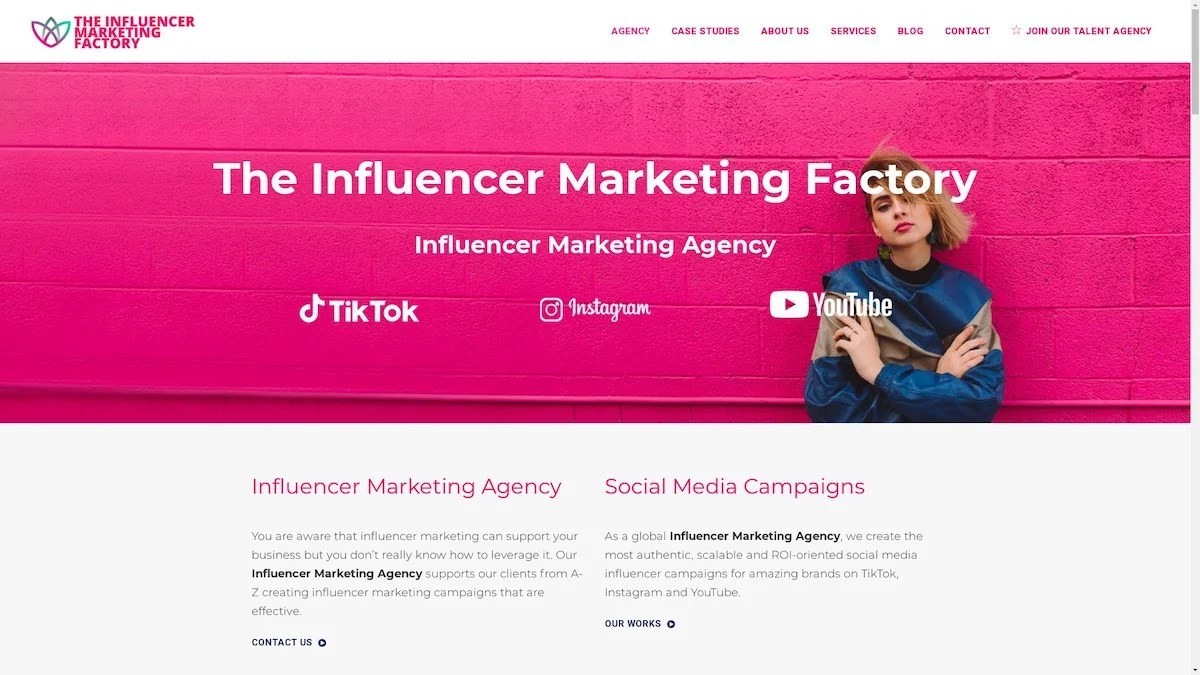
The Influencer Marketing Factory
TikTok, Instagram & YouTube CampaignsA full-service agency with strong TikTok expertise, offering end-to-end campaign management from influencer discovery through performance reporting with a focus on platform-native content.Clients: Google, Snapchat, Universal Music, Bumble, YelpVisit TIMF → -
6
NeoReach
Enterprise Analytics & Influencer CampaignsAn enterprise-focused agency combining managed campaigns with a powerful self-service data platform for influencer search, audience analytics, and attribution modeling.Clients: Amazon, Airbnb, Netflix, Honda, The New York TimesVisit NeoReach → -
7
Ubiquitous
Creator-First Marketing PlatformA tech-driven platform combining self-service tools with managed campaign options, emphasizing speed and scalability for brands managing multiple influencer relationships.Clients: Lyft, Disney, Target, American Eagle, NetflixVisit Ubiquitous → -
8

Obviously
Scalable Enterprise Influencer CampaignsA tech-enabled agency built for high-volume campaigns, coordinating hundreds of creators simultaneously with end-to-end logistics, content rights management, and product seeding.Clients: Google, Ulta Beauty, Converse, AmazonVisit Obviously →