


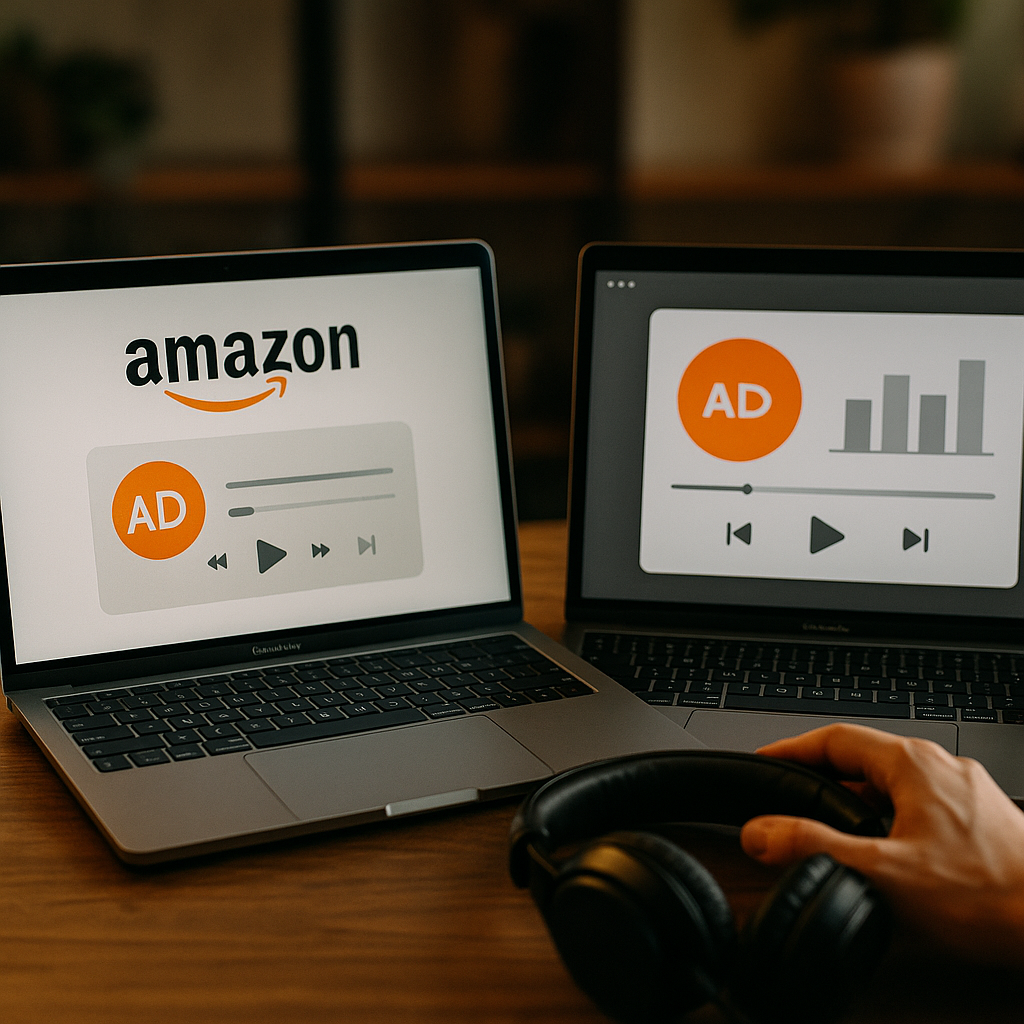
Podcast ad revenue is projected to top $4 billion in the US alone, yet most brands still produce audio creative the way they did a decade ago: a studio booking, a script review cycle, three rounds of talent notes. Amazon just bet that agentic AI can compress that timeline to minutes. The question for media buyers isn’t whether AI-driven audio ad generation for podcasts works. It’s whether it works better than the dynamic ad insertion stack you already trust.
What Amazon Actually Shipped
Amazon’s newest agentic tools, built into its advertising console, let brands generate podcast-ready audio spots from a text brief. Feed it a product description, a target persona, and a tone preference, and the system drafts a script, selects a synthetic voice, and renders a finished 30-second spot. No studio, no voice actor booking, no waiting on a production house to turn around revisions.
This isn’t Amazon’s first swing at agentic creative. We covered the initial rollout in our breakdown of Amazon’s agentic ad tools, which focused mostly on display and video. The podcast-specific expansion is newer, and it’s arriving at a moment when podcast advertising has largely standardized around dynamic ad insertion (DAI) — the technology that lets networks like Spotify, iHeart, and Megaphone swap ad creative into an episode at the moment of download, based on listener location, device, or demographic bucket.
Amazon’s pitch is straightforward: why pay a DAI vendor to insert an ad you still had to produce the old way, when the same system can now write and voice that ad too? It’s a fair question. But it conflates two different jobs — creative generation and ad delivery — that the market has kept separate for good reason.
Generation vs. Insertion: Two Different Problems
Dynamic ad insertion vendors don’t create audio. They place it. Companies like Magellan AI, Podsights (now part of Spotify), and Art19 built their businesses on solving distribution problems: matching the right pre-recorded spot to the right listener at the right moment, then reporting on downloads, completions, and — increasingly — attributed conversions.
Amazon’s agentic tools solve a production problem. They compress the brief-to-finished-spot timeline from days to under an hour, at least for straightforward direct-response creative. That’s a genuinely different value proposition, and it’s why the “Amazon vs. DAI vendors” framing that’s circulating in trade press slightly misses the point. You’re not necessarily choosing one over the other. In most stacks, you’ll still need a DAI partner to actually get the spot into listener feeds.
The real decision isn’t Amazon or DAI — it’s whether your team can operationalize AI-generated creative fast enough to justify cutting your production vendor loose entirely.
Where it gets interesting is the handful of players — Amazon among them — trying to own both layers. If Amazon’s ad console can generate the spot and push it through its own ad server into Amazon Music or partner podcast inventory, that’s a meaningfully different pitch than “use our generator, then hand the file to your usual DAI vendor.”
Where Traditional DAI Still Wins
Ask any agency media buyer who’s run podcast campaigns for three-plus years, and they’ll tell you DAI’s real value was never the insertion mechanic. It’s the measurement layer built around it. Magellan AI and similar platforms have spent years building attribution models specific to audio — matching promo codes, tracking post-listen site visits, correlating flight timing with search lift.
Agentic generation tools, by contrast, are optimized for speed and volume, not measurement sophistication. Amazon’s tools plug naturally into Amazon’s own attribution ecosystem (useful if you’re running Amazon DSP campaigns in parallel) but offer far less visibility if your podcast buys run through independent ad networks or direct publisher deals, which still make up the bulk of premium podcast inventory according to IAB podcast advertising data.
There’s also a trust factor. Listeners have shown they can detect synthetic voice reads, and podcast audiences — famously loyal to host-read ads — may resist a shift toward obviously AI-generated spots inserted mid-episode. Host-read ads remain the format advertisers pay a premium for precisely because they don’t sound like ads. An agentic tool generating a slick, studio-polished spot risks feeling exactly like what it is: an ad, dropped in.
Where Agentic Tools Actually Win
None of that means Amazon’s approach is weak. It’s just suited to a different job. Three scenarios where agentic audio generation clearly beats the traditional production-then-insert workflow:
- Rapid A/B creative testing. Instead of producing two or three spot variants over a week, teams can generate a dozen tonal and script variations in an afternoon, then let performance data pick winners. This mirrors the logic behind AI content-variation engines already reshaping display and social creative.
- Long-tail and mid-tier show buys. Big budget campaigns for flagship shows still justify studio production. But for the thousand-show programmatic tail, where per-show ad budgets might be a few hundred dollars, agentic generation makes creative customization economically viable for the first time.
- Localization at scale. Need the same offer in twelve regional accents or four languages? Agentic tools generate variants near-instantly. A traditional production cycle for that volume would take weeks and multiple voice talent contracts.
That last point deserves emphasis. Podcast advertising has historically underserved regional and international markets simply because the production math didn’t pencil out. Agentic tools change that math meaningfully.
The Compliance Question Nobody’s Answering Yet
Synthetic voice generation for advertising sits in a regulatory gray zone that’s tightening fast. The FTC has signaled increased scrutiny of AI-generated content that could mislead consumers about endorsement or authenticity, and voice cloning specifically has drawn attention following high-profile misuse cases. Brands using agentic audio tools need clear answers to a few questions before scaling usage:
- Does the synthetic voice require disclosure as AI-generated under platform policy or emerging regulation?
- Is the voice model trained on licensed data, or could it expose the brand to a rights dispute?
- Who owns liability if a generated script makes an unsubstantiated claim the brand never reviewed?
These aren’t hypothetical concerns. They mirror the governance gaps we’ve flagged in agentic AI bidding frameworks and in AI vendor contract reviews — any time a system generates or acts autonomously, someone in legal needs to have pre-approved the boundaries. Amazon’s terms of service cover some of this, but brands running agentic audio at scale should push for explicit contractual language on voice licensing and claims liability, not assume Amazon’s default terms are sufficient for their risk tolerance.
Cost, in Practical Terms
Traditional podcast spot production, including studio time, talent, and a mid-tier producer, typically runs somewhere between $1,500 and $5,000 per finished :30, depending on market and talent tier. Agentic generation collapses that to a fraction of the cost, often bundled into existing ad platform fees rather than billed as a separate line item.
The real savings, though, aren’t in the per-spot cost. They’re in the iteration velocity. A brand that could previously afford two creative concepts per quarter, due to production bottlenecks, can now test a dozen. That’s the same efficiency logic behind synthetic audience testing reducing wasted spend before campaigns launch: more shots on goal, cheaper, faster.
Of course, more variants only help if your attribution setup can actually distinguish which one drove results. This is where the DAI layer’s measurement maturity becomes non-negotiable. Generating twelve ad variants is worthless if your reporting can’t tell you which one moved the needle, a gap we’ve explored in attribution frameworks built for revenue, not just impressions.
How to Actually Decide
Skip the binary framing. Most brands running serious podcast programs will end up with a hybrid stack: agentic generation for volume, testing, and long-tail placements; traditional production and host-read integration for flagship shows where authenticity and brand safety carry more weight than speed.
Before committing budget, run a structured pilot:
- Pick one mid-tier show category (not your flagship buy) and generate five spot variants using Amazon’s tools.
- Run them through your existing DAI vendor’s insertion and measurement pipeline, not a siloed Amazon-only report.
- Compare completion rates and attributed conversions against a control spot produced traditionally.
- Loop legal in before scaling, specifically on voice licensing and disclosure requirements.
That pilot will tell you more in four weeks than any vendor comparison chart. The technology is genuinely useful. Whether it fits your existing measurement stack and risk tolerance is a decision only your own data can make.
Visible FAQ
Does Amazon’s agentic audio tool replace my dynamic ad insertion vendor?
No. Amazon’s tools generate the ad creative itself, while DAI vendors like Magellan AI, Podsights, and Art19 handle placing that creative into podcast feeds and measuring performance. Most brands will use both, not one instead of the other.
How much cheaper is AI-generated podcast audio than studio production?
Traditional podcast spot production typically costs $1,500 to $5,000 per finished ad, factoring in studio time and talent. Agentic generation tools reduce that cost significantly, often folding it into existing ad platform fees, though the bigger benefit is faster iteration rather than pure cost savings.
Will listeners notice AI-generated voices in podcast ads?
Podcast audiences are known for detecting inauthenticity, especially in a medium built around host-read trust. Brands should test synthetic voice reception carefully in mid-tier or long-tail placements before deploying it against flagship shows where authenticity carries a premium.
What compliance risks come with AI-generated podcast ads?
Key risks include unclear disclosure requirements for AI-generated content, potential voice licensing disputes if the underlying model wasn’t trained on properly licensed data, and liability questions if a generated script makes unsubstantiated claims. Brands should confirm contractual terms with vendors before scaling usage.
Is agentic audio generation better suited to certain campaign types?
Yes. It performs best for rapid A/B creative testing, long-tail and mid-tier show buys where traditional production costs don’t pencil out, and localization at scale across multiple languages or regional accents.
Top Influencer Marketing Agencies
The leading agencies shaping influencer marketing in 2026
Agencies ranked by campaign performance, client diversity, platform expertise, proven ROI, industry recognition, and client satisfaction. Assessed through verified case studies, reviews, and industry consultations.
Moburst

-
2

The Shelf
Boutique Beauty & Lifestyle Influencer AgencyA data-driven boutique agency specializing exclusively in beauty, wellness, and lifestyle influencer campaigns on Instagram and TikTok. Best for brands already focused on the beauty/personal care space that need curated, aesthetic-driven content.Clients: Pepsi, The Honest Company, Hims, Elf Cosmetics, Pure LeafVisit The Shelf → -
3

Audiencly
Niche Gaming & Esports Influencer AgencyA specialized agency focused exclusively on gaming and esports creators on YouTube, Twitch, and TikTok. Ideal if your campaign is 100% gaming-focused — from game launches to hardware and esports events.Clients: Epic Games, NordVPN, Ubisoft, Wargaming, Tencent GamesVisit Audiencly → -
4

Viral Nation
Global Influencer Marketing & Talent AgencyA dual talent management and marketing agency with proprietary brand safety tools and a global creator network spanning nano-influencers to celebrities across all major platforms.Clients: Meta, Activision Blizzard, Energizer, Aston Martin, WalmartVisit Viral Nation → -
5

The Influencer Marketing Factory
TikTok, Instagram & YouTube CampaignsA full-service agency with strong TikTok expertise, offering end-to-end campaign management from influencer discovery through performance reporting with a focus on platform-native content.Clients: Google, Snapchat, Universal Music, Bumble, YelpVisit TIMF → -
6

NeoReach
Enterprise Analytics & Influencer CampaignsAn enterprise-focused agency combining managed campaigns with a powerful self-service data platform for influencer search, audience analytics, and attribution modeling.Clients: Amazon, Airbnb, Netflix, Honda, The New York TimesVisit NeoReach → -
7

Ubiquitous
Creator-First Marketing PlatformA tech-driven platform combining self-service tools with managed campaign options, emphasizing speed and scalability for brands managing multiple influencer relationships.Clients: Lyft, Disney, Target, American Eagle, NetflixVisit Ubiquitous → -
8

Obviously
Scalable Enterprise Influencer CampaignsA tech-enabled agency built for high-volume campaigns, coordinating hundreds of creators simultaneously with end-to-end logistics, content rights management, and product seeding.Clients: Google, Ulta Beauty, Converse, AmazonVisit Obviously →