


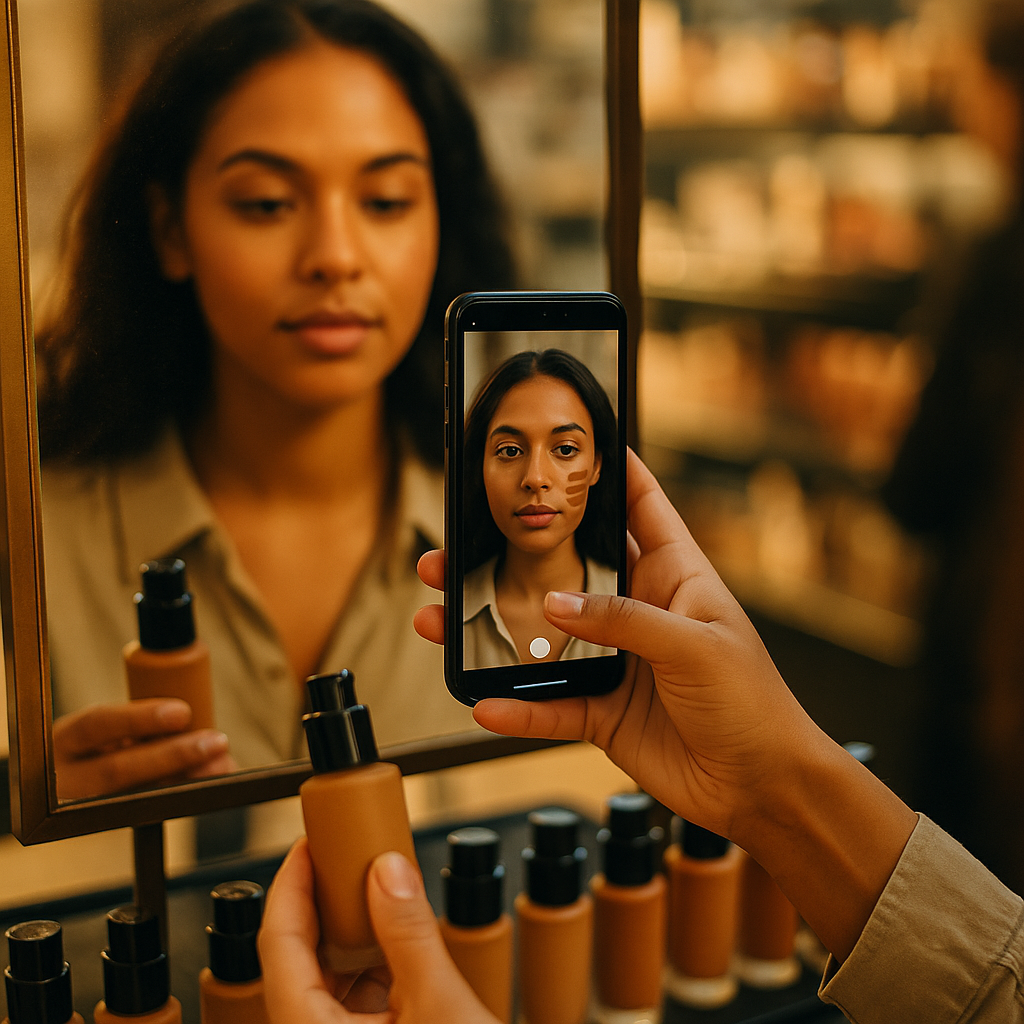
Return rates for beauty products bought online sit between 15% and 40%, depending on category, and shade mismatch is the number one culprit. What if the fix wasn’t a better product description or a bigger size chart, but a filter? AR try-on filters have quietly become one of the highest-ROI creative formats in beauty ecommerce, and brands still treating them as a gimmick are leaving margin on the table.
Why Shade Mismatch Is Bleeding Beauty Margins
Foundation, lipstick, and concealer are the worst offenders in ecommerce returns. A shopper sees a swatch on a screen calibrated differently than their own, orders three shades “just in case,” and sends back two. That’s not a customer service problem. It’s a photography and lighting problem that no amount of customer support scripting can solve.
Augmented reality try-on filters attack this at the source. Instead of guessing from a static swatch, the shopper sees the product rendered on their own face, in their own lighting, through their own camera. Sephora’s Virtual Artist tool and L’Oreal’s ModiFace-powered try-on have been public case studies for years, but the technology has matured fast. Snap, TikTok, and Instagram now offer native AR shopping ad formats that let any beauty brand, not just the giants, plug into try-on infrastructure without building a custom app.
Brands running AR try-on filters on product pages report return rate reductions in the 20% to 40% range for shade-dependent categories, according to data cited by beauty tech vendors and echoed across emarketer’s retail research. That’s not a rounding error. That’s a line item CFOs notice.
How the Format Actually Works for Brands
An AR try-on filter is a layer of face-tracking software that maps color, texture, or product placement onto a live camera feed. For beauty, that usually means:
- Shade matching: lipstick, foundation, blush, and eyeshadow rendered in real time across a shopper’s own skin tone.
- Texture simulation: matte versus dewy finishes, glitter density, or gloss levels shown dynamically.
- Multi-product layering: letting a shopper build a full look, not just one product, which increases basket size.
- Social handoff: filters built for TikTok or Instagram that let creators demo the try-on experience natively, then link out to the product page.
The technical lift varies. A brand can license a plug-and-play widget from a vendor like Perfect Corp or ModiFace, or build a custom Snap Lens or TikTok Effect for campaign-specific pushes. Either route beats the alternative: shoppers guessing, ordering wrong, and returning.
It’s Not Just a Website Feature Anymore
The bigger shift in the format is where it lives. AR try-on used to be locked inside brand.com product pages. Now it’s embedded directly in creator content. A beauty influencer posts a TikTok using a branded AR lens, viewers try the shade on their own face mid-scroll, and tap through to buy the exact one that matched. That closes the gap between discovery and purchase intent faster than any swatch grid ever could.
This is also why the format pairs so well with before and after swipe reels. Both formats are built around visual proof, and stacking them in a content calendar reinforces the same message from two angles: “this will actually look like this on you.”
The ROI Case Brands Actually Care About
Reduced returns are the headline metric, but they’re not the only one. Retailers running AR try-on consistently report longer session times and higher add-to-cart rates, because shoppers who “try” a product before buying are demonstrating higher purchase intent than someone who is just browsing swatches.
There’s also a compliance upside that doesn’t get discussed enough. Beauty brands face constant scrutiny over shade-range inclusivity claims. An AR try-on filter that renders accurately across a wide range of skin tones is, in effect, a public demonstration of shade range performance. Get it wrong and you’ll hear about it fast on social. Get it right and it becomes proof, not just a promise.
Here’s the math a lot of DTC beauty operators are running internally: if returns cost roughly $10 to $20 per unit once you factor shipping, restocking, and often disposal (many returned cosmetics can’t be resold for hygiene reasons), a 25% reduction in shade-related returns on a product doing 50,000 units a month isn’t a marketing nice-to-have. It’s a seven-figure annual saving.
Cosmetics returned for hygiene reasons often can’t be resold at all, meaning every prevented return isn’t just a saved shipping cost, it’s a saved unit of inventory.
Where Creators Fit Into the AR Try-On Strategy
Brands that treat AR filters purely as a website widget are missing half the value. The format performs best when creators are briefed to use it as content, not just link to it.
A few patterns working well right now:
- Creators doing “shade match” content where they test a filter live against their actual skin tone, proving accuracy rather than just describing it.
- Comparison content where a creator tries multiple shades in the same video using the AR tool, cutting the need for multiple physical samples. This overlaps naturally with comparison demo scripts, which already lift conversion when structured well.
- Silent, sound-off demos where the visual match does the selling, similar to the mechanics behind silent product demos already winning watch time on TikTok.
The brief matters here. Ask a creator to “try the AR filter” and you’ll get generic content. Ask them to try it against three different lighting conditions, or compare it to how the shade looks in daylight versus indoor lighting, and you get content that actually builds trust because it shows the tool’s limits as well as its strengths. Radical transparency, weirdly, sells more than a flawless demo.
What About the Accuracy Problem?
Let’s be honest: AR try-on isn’t perfect. Camera quality, ambient lighting, and phone hardware all affect how accurately a filter renders. A shopper on an older Android device in dim light is not getting the same rendering fidelity as someone on a new iPhone in daylight. Brands that oversell the technology’s precision risk the same shade mismatch complaints they were trying to avoid in the first place.
The smarter move is pairing AR try-on with clear disclaimers and, where possible, a secondary confirmation step like a shade-matching quiz or a physical sample program for first-time buyers of a new shade range. Treat AR as a strong filter for narrowing choices, not a guarantee.
Platform Mechanics Worth Knowing
Each major platform handles AR shopping slightly differently, and brand teams need to know the mechanics before briefing agencies or creators.
- TikTok: Effect House lets brands build custom AR effects that can be tied to Spark Ads and creator content, with try-on effects showing strong engagement in beauty and fashion verticals according to TikTok for Business resources.
- Instagram and Facebook: Meta’s Spark AR successor tools integrate directly with Shops, letting a try-on experience link straight to checkout. See Meta for Business for current specs.
- Snapchat: Long the pioneer of face-tracking AR, Snap’s Lens Studio remains a go-to for beauty brands building sponsored try-on lenses with measurable “try rate” and “share rate” metrics.
- Brand.com: Widget-based solutions (Perfect Corp, ModiFace, Revieve) integrate at the product page level and typically report the clearest return-rate data because purchase and try-on happen in the same session.
Cross-platform consistency matters more than most teams plan for. If the filter renders a shade one way on TikTok and differently on the brand site, that’s a trust gap, not a technical footnote.
Building the Business Case Internally
Getting budget for AR development usually means proving the ROI before the full build. A lean way to test the waters: run a limited AR filter campaign on one hero product with a handful of creators, track return rates on that SKU for 60 to 90 days against a control SKU without the filter, and present the delta. Most finance teams respond better to a controlled before-and-after than a projection.
It also helps to loop in customer service data early. Return reason codes (“wrong shade,” “didn’t match description”) are usually sitting in a CRM already. Pulling that data before building the AR case gives marketing teams hard numbers instead of estimates, which speeds up approval cycles that often stall in creative approval bottlenecks.
For teams working across multiple creators and multiple SKUs, standardizing how AR try-on gets briefed and produced avoids duplicated effort. The same discipline used in vertical video style guides applies here: one clear system, applied consistently, beats a fresh brief every time.
Next Step
Pick one shade-dependent hero SKU, run a 60-day AR try-on pilot with a small creator cohort, and measure the return rate delta against a control product. If the numbers move the way early adopters report, the case for scaling builds itself.
FAQs
Do AR try-on filters actually reduce beauty product returns?
Yes. Brands using AR try-on on shade-dependent products like foundation and lipstick report return rate reductions in the 20% to 40% range, largely because shoppers make more accurate shade choices before purchasing.
What’s the fastest way for a brand to test AR try-on without a big development budget?
License a plug-and-play widget from a vendor like Perfect Corp or ModiFace, or build a single TikTok Effect House lens tied to a creator campaign. Both routes avoid custom app development.
Does AR try-on accuracy vary by device or lighting?
Yes. Rendering fidelity depends on camera quality and ambient lighting, so results can differ between devices. Brands should pair AR try-on with clear disclaimers rather than presenting it as a perfect guarantee.
Which platforms support AR try-on for beauty brands?
TikTok’s Effect House, Meta’s AR tools tied to Instagram and Facebook Shops, Snapchat’s Lens Studio, and brand.com widgets from vendors like ModiFace and Revieve all support beauty try-on experiences.
How should creators be briefed to use AR try-on filters effectively?
Ask creators to test the filter under varied lighting or compare multiple shades in one video, rather than simply demoing it once. This builds trust by showing both the tool’s strengths and its limits.
FAQs
Top Influencer Marketing Agencies
The leading agencies shaping influencer marketing in 2026
Agencies ranked by campaign performance, client diversity, platform expertise, proven ROI, industry recognition, and client satisfaction. Assessed through verified case studies, reviews, and industry consultations.
Moburst

-
2

The Shelf
Boutique Beauty & Lifestyle Influencer AgencyA data-driven boutique agency specializing exclusively in beauty, wellness, and lifestyle influencer campaigns on Instagram and TikTok. Best for brands already focused on the beauty/personal care space that need curated, aesthetic-driven content.Clients: Pepsi, The Honest Company, Hims, Elf Cosmetics, Pure LeafVisit The Shelf → -
3

Audiencly
Niche Gaming & Esports Influencer AgencyA specialized agency focused exclusively on gaming and esports creators on YouTube, Twitch, and TikTok. Ideal if your campaign is 100% gaming-focused — from game launches to hardware and esports events.Clients: Epic Games, NordVPN, Ubisoft, Wargaming, Tencent GamesVisit Audiencly → -
4

Viral Nation
Global Influencer Marketing & Talent AgencyA dual talent management and marketing agency with proprietary brand safety tools and a global creator network spanning nano-influencers to celebrities across all major platforms.Clients: Meta, Activision Blizzard, Energizer, Aston Martin, WalmartVisit Viral Nation → -
5

The Influencer Marketing Factory
TikTok, Instagram & YouTube CampaignsA full-service agency with strong TikTok expertise, offering end-to-end campaign management from influencer discovery through performance reporting with a focus on platform-native content.Clients: Google, Snapchat, Universal Music, Bumble, YelpVisit TIMF → -
6

NeoReach
Enterprise Analytics & Influencer CampaignsAn enterprise-focused agency combining managed campaigns with a powerful self-service data platform for influencer search, audience analytics, and attribution modeling.Clients: Amazon, Airbnb, Netflix, Honda, The New York TimesVisit NeoReach → -
7

Ubiquitous
Creator-First Marketing PlatformA tech-driven platform combining self-service tools with managed campaign options, emphasizing speed and scalability for brands managing multiple influencer relationships.Clients: Lyft, Disney, Target, American Eagle, NetflixVisit Ubiquitous → -
8

Obviously
Scalable Enterprise Influencer CampaignsA tech-enabled agency built for high-volume campaigns, coordinating hundreds of creators simultaneously with end-to-end logistics, content rights management, and product seeding.Clients: Google, Ulta Beauty, Converse, AmazonVisit Obviously →