


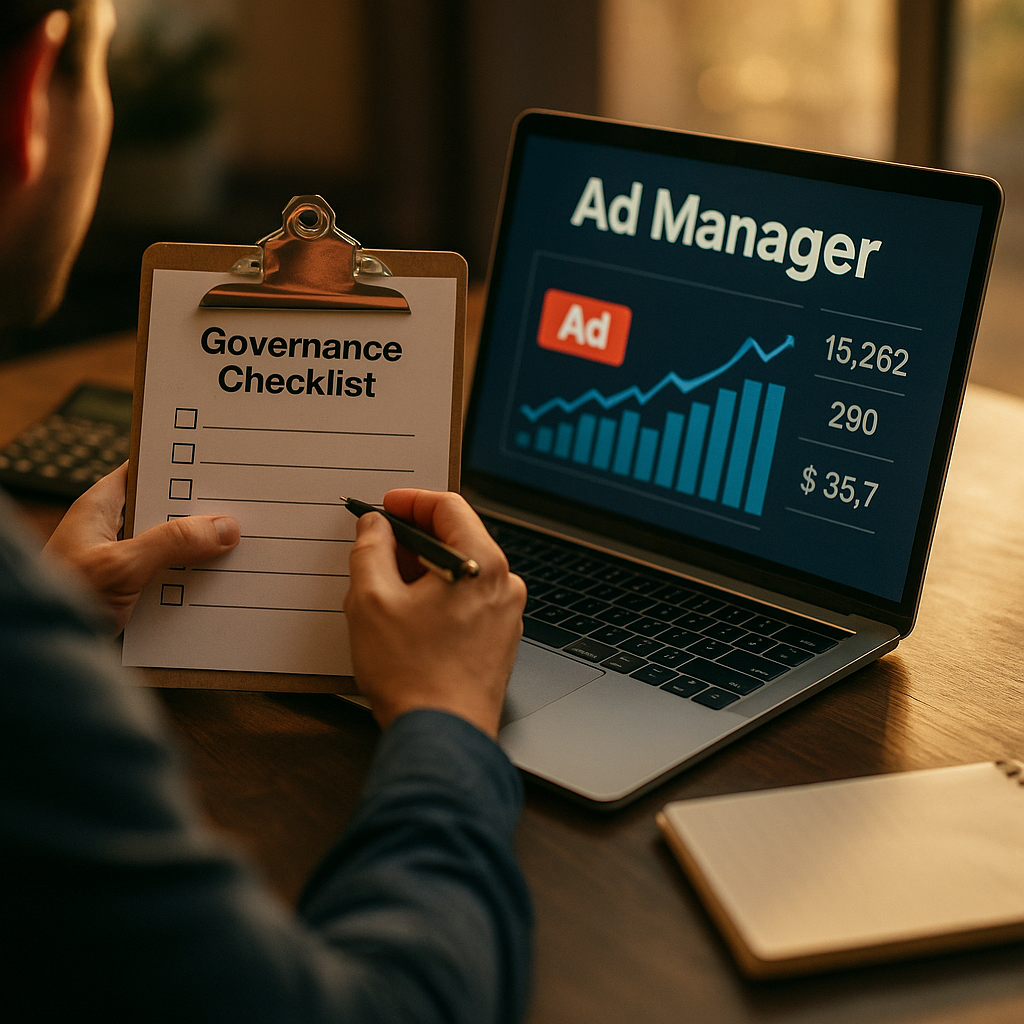
Would you hand a first-year media planner your entire quarterly budget and walk away for a week? That’s effectively what granting autonomous spend authority to agentic media-buying platforms means, and most brands haven’t built the guardrails to make it safe. Google’s Ask Ad Manager rollout has pushed this question from theoretical to urgent almost overnight.
Agencies are being pitched autonomous budget reallocation as the next competitive edge. Fair enough. But autonomy without governance is how a six-figure campaign burns through spend on the wrong audience segment before anyone notices. Before you flip the switch, you need a checklist, not a vibe.
Why This Decision Can’t Wait for Next Quarter
Google Ask Ad Manager lets marketers issue natural-language directives — “shift 15% of budget toward top-performing creative in the Northeast” — and the system executes across campaigns without a human clicking “approve” on each move. It’s fast. It’s also a live wire connected directly to your bank account.
The pitch is compelling: faster reaction to performance signals, less manual bid management, fewer wasted impressions. Google’s own materials point to efficiency gains from automated bidding systems that have been maturing for years inside Performance Max and Smart Bidding (Google Ads Help). Ask Ad Manager extends that logic from bidding to full budget orchestration, including creative swaps and channel shifts.
The problem: efficiency and control are not the same thing. Marketers who treated Performance Max as a black box already learned this the hard way, especially when auto-cropped video assets quietly went live in placements nobody reviewed. Our team broke down exactly how that oversight gap plays out in this audit of Performance Max video handling. Autonomous spend authority raises the stakes considerably beyond creative formatting.
Gartner has forecast that roughly 40% of agentic AI projects will be scrapped by the back half of the decade due to unclear ROI or inadequate risk controls — a number that should sit uncomfortably with anyone about to grant an AI system checkbook access.
That stat isn’t a reason to avoid agentic media buying. It’s a reason to treat governance as the price of entry, not an afterthought. We’ve written previously about what that budget conversation should look like at the CMO level in this CMO budget guide.
The Governance Checklist: Six Non-Negotiables
Here’s the framework we’d bring into any vendor evaluation or internal risk review before granting autonomous spend authority to Ask Ad Manager or a comparable platform.
1. Spend Ceilings With Hard Stops, Not Soft Alerts
An “alert” that fires after the agent has already spent the money isn’t governance. It’s a postmortem. Insist on hard-coded daily and campaign-level ceilings that the system cannot exceed without a human override, full stop. Ask your Google rep directly: what happens at the ceiling — does the agent pause, or does it request approval and keep running on existing allocations? The answer matters more than the marketing deck suggests.
2. Data Lineage: Where Are the Signals Coming From?
Autonomous reallocation decisions are only as good as the data feeding them. If your CRM, CDP, and ad platform aren’t cleanly synced, the agent is optimizing against stale or duplicated conversion signals. This is the exact failure mode we outlined in diagnosing bad data versus weak governance — and it applies doubly when the AI controls the checkbook, not just the dashboard.
Before granting spend authority, audit your identity resolution setup. Are you merging on deterministic keys or probabilistic matches? The distinction changes how much you should trust automated budget shifts, a topic covered in depth in this comparison of merge-key strategies.
3. Attribution Model Transparency
If the agent is reallocating budget based on last-click attribution while your actual buying journey involves five touchpoints across search, social, and AI answer engines, you’re funding a distorted picture of what’s working. The rise of zero-click discovery through tools like ChatGPT and Perplexity has already scrambled traditional attribution — see this breakdown of zero-click revenue measurement — and an autonomous agent making decisions on incomplete attribution data will confidently make the wrong calls, fast.
Ask the vendor point blank which attribution model powers the reallocation logic, and whether it accounts for AI referral traffic. Our analysis of GA4 AI referral traffic versus organic search found meaningful gaps in how platforms classify this traffic even six months into broader adoption — gaps that compound when spend decisions are automated.
4. A Kill Switch That Actually Works
Every vendor says there’s a kill switch. Test it before launch, not during a crisis. Simulate a scenario: creative drifts off-brand, or the agent starts overspending in a low-value geo. How fast can a human actually halt execution? Minutes matter here. If the kill switch requires escalating through three layers of account management before spend stops, that’s not a kill switch — it’s a suggestion box.
5. Audit Trails for Every Autonomous Decision
Regulators and internal compliance teams will eventually ask why the agent moved money from Campaign A to Campaign B. “The AI decided” is not an acceptable answer in a board review, and it’s increasingly not acceptable to regulators either. The FTC has signaled growing scrutiny of automated decision systems in advertising and consumer-facing contexts (FTC.gov), and UK advertisers should keep an eye on parallel guidance from the ICO on automated processing.
Demand a full, timestamped log of every autonomous action: what changed, why, based on what signal, and what the counterfactual spend would have been. If the platform can’t produce that on request, you don’t have governance — you have faith.
6. Vendor Due Diligence Beyond the Sales Deck
This is where most teams cut corners. Treat an agentic media-buying platform request the same way you’d treat a third-party AI agent asking for CRM write-access. The risk categories overlap heavily — data exposure, unauthorized actions, unclear liability. We’ve mapped this exact due-diligence process in this CRM write-access risk framework, and most of it transfers directly to media-buying autonomy.
If a vendor can’t clearly answer “what happens if this agent makes a $50,000 mistake at 2 a.m.,” you’re not ready to grant autonomous spend authority — regardless of how good the demo looked.
What Ask Ad Manager Gets Right (And Where It Still Needs a Human)
Credit where due: Google’s approach does bake in some guardrails that earlier agentic tools skipped. Budget pacing controls, brand safety filters, and campaign-level permission tiers are more granular than what shipped with first-generation autonomous bidding tools. eMarketer data on ad tech adoption suggests marketers are increasingly comfortable with automated bid management, provided oversight layers exist (eMarketer).
Comfort with bidding automation, though, is not the same as comfort with full budget and creative orchestration running unsupervised. Bidding adjusts within a fixed budget. Ask Ad Manager can move the budget itself. That’s a meaningfully bigger blast radius, and it deserves a proportionally bigger governance investment.
Where does the human still need to sit in the loop? Three places, minimum: initial strategy and audience definition, creative approval before any new variant goes live at scale (a lesson learned the hard way with auto-generated personalized assets — see this piece on AI-personalized campaign assets), and quarterly review of the reallocation logic itself. Agents drift. Models get retrained. What worked as a decision rule last quarter might be actively wrong this quarter if market conditions shifted.
Building the Internal Charter Before You Sign Anything
Don’t let procurement sign off on autonomous spend authority without an internal governance charter first. This isn’t bureaucratic box-checking — it’s the document that protects your team when something goes sideways. A solid charter defines: who can adjust spend ceilings, what triggers automatic escalation to a human, how disputes over attribution get resolved, and what the rollback procedure looks like if a campaign underperforms after autonomous changes.
We’ve outlined a similar structure specifically for real-time bidding contexts in this governance charter framework, and most of that structure ports directly to broader media-buying autonomy. Don’t reinvent it — adapt it.
One more thing worth stating plainly: agentic autonomy without a governance charter isn’t innovation. It’s an unmanaged liability wearing an innovation costume. Brands that skip this step tend to find out the hard way, usually in a budget reconciliation meeting nobody wants to attend.
The Bottom Line
Autonomous spend authority isn’t inherently risky — ungoverned autonomous spend authority is. The checklist above isn’t about slowing down adoption of Google Ask Ad Manager or comparable platforms. It’s about making sure the speed you gain doesn’t come at the cost of control you can’t get back once budget’s already spent.
Run a 90-day pilot with hard spend ceilings and full audit logging before granting unrestricted authority — treat the first quarter as a stress test, not a rollout.
FAQs
What is Google Ask Ad Manager?
Google Ask Ad Manager is a natural-language agentic interface that lets marketers issue directives for campaign optimization, budget reallocation, and creative adjustments, which the system then executes autonomously across Google’s ad ecosystem.
What does “autonomous spend authority” actually mean in practice?
It means the platform can move budget, adjust bids, or swap creative without requiring case-by-case human approval, operating within pre-set parameters rather than under direct manual control.
How much oversight should stay human-led even with agentic media buying?
Strategy definition, creative approval for new variants, and quarterly review of the agent’s decision logic should remain human-led at minimum, even in a mature autonomous setup.
What’s the biggest governance risk with agentic media-buying platforms?
The biggest risk is granting autonomy before data lineage, attribution accuracy, and kill-switch responsiveness have been tested, which can lead to fast, confident, and wrong budget decisions.
How do I test a platform’s kill switch before committing budget?
Run a simulated scenario, such as off-brand creative drift or overspend in a low-value segment, and time exactly how long it takes for a human override to actually halt execution.
FAQs
What is Google Ask Ad Manager?
Google Ask Ad Manager is a natural-language agentic interface that lets marketers issue directives for campaign optimization, budget reallocation, and creative adjustments, which the system then executes autonomously across Google’s ad ecosystem.
What does “autonomous spend authority” actually mean in practice?
It means the platform can move budget, adjust bids, or swap creative without requiring case-by-case human approval, operating within pre-set parameters rather than under direct manual control.
How much oversight should stay human-led even with agentic media buying?
Strategy definition, creative approval for new variants, and quarterly review of the agent’s decision logic should remain human-led at minimum, even in a mature autonomous setup.
What’s the biggest governance risk with agentic media-buying platforms?
The biggest risk is granting autonomy before data lineage, attribution accuracy, and kill-switch responsiveness have been tested, which can lead to fast, confident, and wrong budget decisions.
How do I test a platform’s kill switch before committing budget?
Run a simulated scenario, such as off-brand creative drift or overspend in a low-value segment, and time exactly how long it takes for a human override to actually halt execution.
Top Influencer Marketing Agencies
The leading agencies shaping influencer marketing in 2026
Agencies ranked by campaign performance, client diversity, platform expertise, proven ROI, industry recognition, and client satisfaction. Assessed through verified case studies, reviews, and industry consultations.
Moburst

-
2

The Shelf
Boutique Beauty & Lifestyle Influencer AgencyA data-driven boutique agency specializing exclusively in beauty, wellness, and lifestyle influencer campaigns on Instagram and TikTok. Best for brands already focused on the beauty/personal care space that need curated, aesthetic-driven content.Clients: Pepsi, The Honest Company, Hims, Elf Cosmetics, Pure LeafVisit The Shelf → -
3

Audiencly
Niche Gaming & Esports Influencer AgencyA specialized agency focused exclusively on gaming and esports creators on YouTube, Twitch, and TikTok. Ideal if your campaign is 100% gaming-focused — from game launches to hardware and esports events.Clients: Epic Games, NordVPN, Ubisoft, Wargaming, Tencent GamesVisit Audiencly → -
4

Viral Nation
Global Influencer Marketing & Talent AgencyA dual talent management and marketing agency with proprietary brand safety tools and a global creator network spanning nano-influencers to celebrities across all major platforms.Clients: Meta, Activision Blizzard, Energizer, Aston Martin, WalmartVisit Viral Nation → -
5

The Influencer Marketing Factory
TikTok, Instagram & YouTube CampaignsA full-service agency with strong TikTok expertise, offering end-to-end campaign management from influencer discovery through performance reporting with a focus on platform-native content.Clients: Google, Snapchat, Universal Music, Bumble, YelpVisit TIMF → -
6

NeoReach
Enterprise Analytics & Influencer CampaignsAn enterprise-focused agency combining managed campaigns with a powerful self-service data platform for influencer search, audience analytics, and attribution modeling.Clients: Amazon, Airbnb, Netflix, Honda, The New York TimesVisit NeoReach → -
7

Ubiquitous
Creator-First Marketing PlatformA tech-driven platform combining self-service tools with managed campaign options, emphasizing speed and scalability for brands managing multiple influencer relationships.Clients: Lyft, Disney, Target, American Eagle, NetflixVisit Ubiquitous → -
8

Obviously
Scalable Enterprise Influencer CampaignsA tech-enabled agency built for high-volume campaigns, coordinating hundreds of creators simultaneously with end-to-end logistics, content rights management, and product seeding.Clients: Google, Ulta Beauty, Converse, AmazonVisit Obviously →