


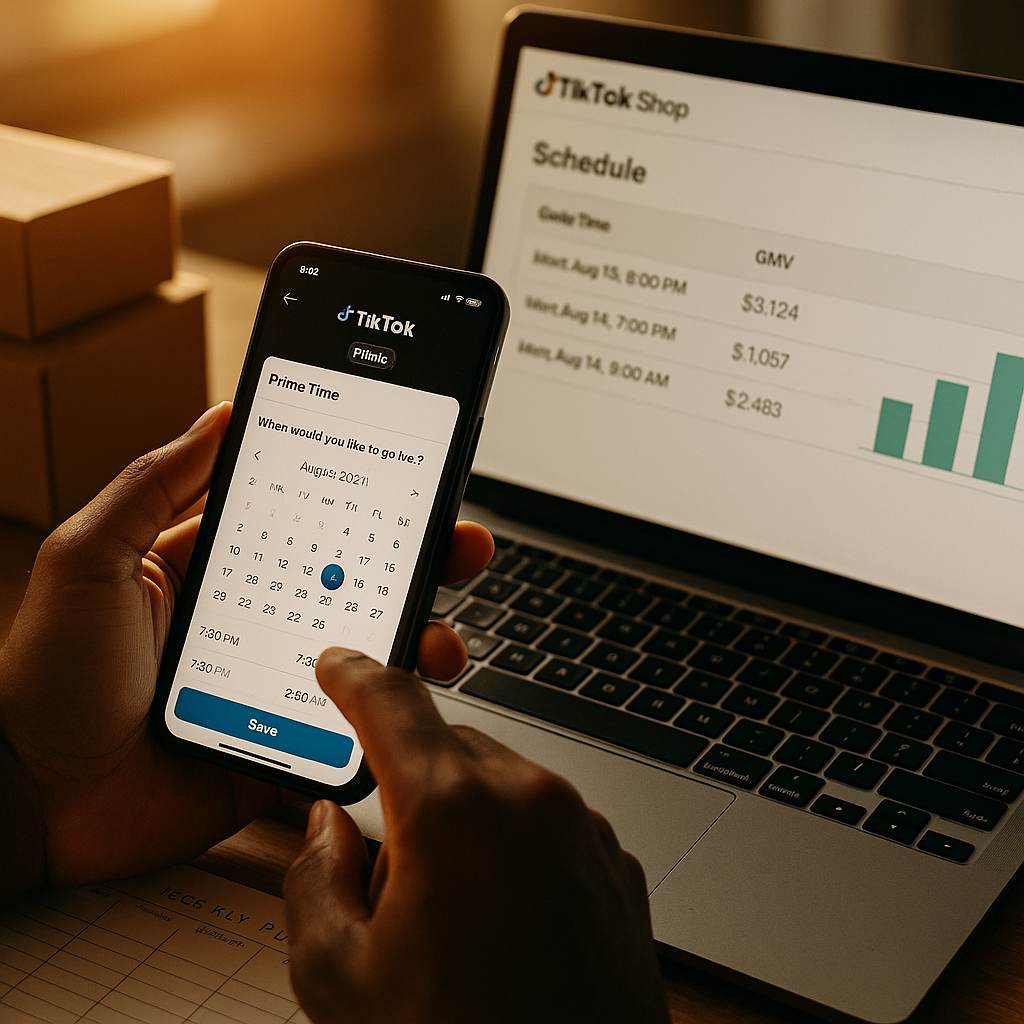
Brands that schedule TikTok Shop livestreams during the platform’s self-reinforcing “prime time” windows see materially higher GMV per hour than those streaming whenever a creator happens to be free. That is not a coincidence. TikTok’s recommendation system rewards streams that catch momentum early, and TikTok Shop prime time livestream scheduling has quietly become one of the highest-leverage, lowest-cost optimizations in the entire program. Most brands are still leaving it to chance.
Why Timing Beats Talent in TikTok Shop Live
Here’s an uncomfortable truth for anyone obsessing over creator selection: a mediocre host streaming at the right hour often outperforms a great host streaming at the wrong one. TikTok’s live algorithm distributes initial viewer pushes based on real-time signals: concurrent viewer density, category competition, and historical engagement velocity for that time slot. Stream into a dead zone and you’re fighting for scraps of organic reach. Stream into prime time and the algorithm hands you a running start.
This isn’t theoretical. Agencies running dozens of TikTok Shop livestreams weekly report that identical products, identical hosts, and identical scripts can produce two to three times the GMV simply by shifting the start time by ninety minutes. That’s the gap between guessing and operating with a playbook.
A stream that opens strong in its first ten minutes gets algorithmic momentum that compounds for the rest of the broadcast. A slow open rarely recovers, no matter how good the product demo is later.
What Actually Counts as Prime Time on TikTok Shop?
Prime time isn’t a single universal window. It’s a layered concept that shifts by category, audience geography, and day of week. That said, several patterns hold consistently across verticals:
- Evening commuter and wind-down window (7pm to 10pm local time): The highest overall concurrent user base, especially for beauty, fashion, and home goods.
- Lunch break micro-window (11:30am to 1pm): Shorter sessions but surprisingly strong conversion for impulse-priced items under $30.
- Weekend late morning (10am to noon Saturday and Sunday): Lower competition from other brands, higher dwell time per viewer.
- Payday adjacency: Streams scheduled within 48 hours of common payroll cycles consistently post higher average order values.
None of this replaces testing your own audience data. TikTok Shop Seller Center provides hour-by-hour viewer overlap data specific to your follower base, and that should always override generic benchmarks. Generic windows are a starting hypothesis, not gospel.
The Algorithm Doesn’t Reward the Stream, It Rewards the Momentum
This is the part most brand teams misunderstand. TikTok’s live distribution engine isn’t evaluating your stream in isolation. It’s comparing your early engagement velocity against every other live stream competing for the same viewer attention in that moment. Scheduling during prime time means your stream launches into a larger pool of active, shoppable-intent users, which makes hitting velocity thresholds easier in the first critical minutes.
Those thresholds typically include viewer retention rate in the first five minutes, comment frequency, share actions, and cart clicks relative to viewer count. Hit them early and the algorithm pushes you into more “For You” live placements. Miss them and your stream gets buried under better-performing concurrent broadcasts, regardless of how good your product actually is.
This mirrors what we’ve seen play out on other platforms too. The logic behind distribution signal weighting on YouTube Shorts follows a similar early-velocity principle: the platform bets more reach on content that proves itself fast.
Building a Scheduling Calendar That Actually Holds Up
Most brands build a livestream calendar around creator availability. That’s backwards. The calendar should start with algorithmic prime time windows, and creator scheduling should fit around those, not the other way around. Here’s a practical sequencing approach:
- Pull 30 days of Seller Center analytics to identify your own audience’s peak concurrent viewer hours, broken out by weekday and weekend.
- Cross-reference with category competition density. If every beauty brand streams at 8pm, consider a 9:15pm slot to catch the algorithm handing off attention as competitors’ streams wind down.
- Lock a recurring weekly cadence. TikTok’s recommendation system rewards consistency; followers who know you stream every Tuesday and Thursday at 8pm show up with higher purchase intent.
- Reserve a secondary “testing” slot each week to probe new windows without risking your anchor time slot’s performance history.
- Brief hosts on the first ten minutes specifically. Scripted hooks, early giveaways, and direct calls to comment are not optional, they are the mechanism that triggers algorithmic push.
Treat the calendar as a living document. Rebuild it quarterly as your follower base grows and shifts geographically, because yesterday’s prime time can quietly decay as your audience composition changes.
Don’t Ignore GMV Velocity, It’s the Metric That Ties Timing to Payout
Scheduling discipline only matters if you’re measuring the right output. GMV velocity (sales generated per hour of live airtime) is the cleanest way to validate whether a time slot is actually working, and it’s also the metric TikTok’s affiliate ranking system weighs heavily when deciding which products and creators get algorithmic favor. If you haven’t mapped how velocity ties to ranking outcomes, the breakdown in this GMV velocity formula guide is worth reviewing alongside your scheduling tests.
Operationally, this means your reporting dashboard needs to track GMV per hour by time slot, not just total GMV per stream. A three-hour stream that generates $3,000 looks identical to a ninety-minute stream generating the same amount on a surface-level report, but the velocity tells you which slot is actually more efficient to repeat.
Creator Pools and Scheduling Don’t Operate in Isolation
If you’re scaling across multiple creators or using an AI-assisted creator matching system, scheduling complexity multiplies fast. Coordinating a dozen creators across staggered prime time windows, without cannibalizing each other’s viewer pools, requires real operational planning. Brands using structured creator pool systems have an advantage here, since AI creator pool scaling approaches can help allocate talent to specific time slots based on historical performance data rather than gut feel.
Similarly, if your brand runs affiliate-driven models through network platforms, scheduling needs to account for how those networks structure creator incentives. The MyyShop network scaling model is a useful reference point for brands trying to coordinate timing across a distributed creator roster rather than a single in-house host.
Common Mistakes That Quietly Tank Performance
A few recurring errors show up across brands we’ve tracked:
- Streaming at the same time regardless of day of week. Weekday and weekend prime times are rarely identical, and treating them the same wastes reach.
- Ignoring time zone splits for national audiences. A single 8pm Eastern slot abandons West Coast viewers during their lowest-engagement window.
- Overloading the calendar with overlapping streams. Running two brand streams simultaneously across different accounts can split your own viewer base and depress both.
- Underinvesting in the first ten minutes. Teams spend hours on product scripts but leave the hook improvised, which is exactly the segment the algorithm weighs most.
- Failing to log compliance and payment checks before go-live. A stream flagged mid-broadcast for a payment or policy issue loses momentum instantly; reviewing a payment compliance checklist before scaling stream frequency saves real headaches.
None of these are exotic problems. They’re operational discipline issues, and they’re entirely fixable with a documented scheduling process.
Putting It Into Practice Without Overengineering It
You don’t need a data science team to run this well. Start with four weeks of disciplined testing: two fixed anchor slots per week, one experimental slot, and rigorous GMV-per-hour tracking across all three. Industry benchmarking from sources like eMarketer’s social commerce research and Statista’s livestream shopping data can help validate whether your category-level assumptions match broader market trends, but your own Seller Center data should always be the deciding factor. Platform guidance from TikTok’s advertiser resources also gets updated periodically with shifts to the live algorithm, so it’s worth a recurring quarterly check rather than a one-time read.
For brands managing broader social scheduling across platforms, tools referenced in Sprout Social’s platform scheduling research can help contextualize how TikTok Shop live timing fits into a wider content calendar, even though live commerce scheduling requires more granular, platform-specific attention than standard post scheduling.
Frequently Asked Questions
What is TikTok Shop prime time livestream scheduling?
It refers to deliberately timing TikTok Shop livestreams to align with the platform’s highest-traffic viewer windows, which increases the likelihood of early engagement velocity that triggers stronger algorithmic distribution and ultimately higher GMV per broadcast hour.
How do I find my brand’s specific prime time window?
Pull 30 days of hourly viewer and engagement data from TikTok Shop Seller Center, broken out by weekday and weekend, then cross-reference against category competition density to identify windows where your audience is active and competing streams are lighter.
Does prime time scheduling matter more than creator selection?
Not more, but comparably. A strong host streaming at a weak time slot frequently underperforms a weaker host streaming during a high-traffic window, because the algorithm’s early distribution push is driven heavily by real-time concurrent viewer density and engagement velocity.
How often should I update my livestream schedule?
Review performance monthly and rebuild the full schedule quarterly, since follower geography, category competition, and platform algorithm weighting all shift over time and can quietly erode a previously strong time slot.
What’s the single biggest scheduling mistake brands make?
Underinvesting in the first ten minutes of a stream. Since the algorithm weighs early engagement velocity heavily, an unscripted or slow opening during an otherwise good time slot can still tank distribution for the entire broadcast.
Start by auditing your last eight livestreams against actual GMV-per-hour by time slot, not total revenue, then lock two anchor windows for the next month before adding any new creators to the mix.
Top Influencer Marketing Agencies
The leading agencies shaping influencer marketing in 2026
Agencies ranked by campaign performance, client diversity, platform expertise, proven ROI, industry recognition, and client satisfaction. Assessed through verified case studies, reviews, and industry consultations.
Moburst

-
2

The Shelf
Boutique Beauty & Lifestyle Influencer AgencyA data-driven boutique agency specializing exclusively in beauty, wellness, and lifestyle influencer campaigns on Instagram and TikTok. Best for brands already focused on the beauty/personal care space that need curated, aesthetic-driven content.Clients: Pepsi, The Honest Company, Hims, Elf Cosmetics, Pure LeafVisit The Shelf → -
3

Audiencly
Niche Gaming & Esports Influencer AgencyA specialized agency focused exclusively on gaming and esports creators on YouTube, Twitch, and TikTok. Ideal if your campaign is 100% gaming-focused — from game launches to hardware and esports events.Clients: Epic Games, NordVPN, Ubisoft, Wargaming, Tencent GamesVisit Audiencly → -
4

Viral Nation
Global Influencer Marketing & Talent AgencyA dual talent management and marketing agency with proprietary brand safety tools and a global creator network spanning nano-influencers to celebrities across all major platforms.Clients: Meta, Activision Blizzard, Energizer, Aston Martin, WalmartVisit Viral Nation → -
5

The Influencer Marketing Factory
TikTok, Instagram & YouTube CampaignsA full-service agency with strong TikTok expertise, offering end-to-end campaign management from influencer discovery through performance reporting with a focus on platform-native content.Clients: Google, Snapchat, Universal Music, Bumble, YelpVisit TIMF → -
6

NeoReach
Enterprise Analytics & Influencer CampaignsAn enterprise-focused agency combining managed campaigns with a powerful self-service data platform for influencer search, audience analytics, and attribution modeling.Clients: Amazon, Airbnb, Netflix, Honda, The New York TimesVisit NeoReach → -
7

Ubiquitous
Creator-First Marketing PlatformA tech-driven platform combining self-service tools with managed campaign options, emphasizing speed and scalability for brands managing multiple influencer relationships.Clients: Lyft, Disney, Target, American Eagle, NetflixVisit Ubiquitous → -
8

Obviously
Scalable Enterprise Influencer CampaignsA tech-enabled agency built for high-volume campaigns, coordinating hundreds of creators simultaneously with end-to-end logistics, content rights management, and product seeding.Clients: Google, Ulta Beauty, Converse, AmazonVisit Obviously →