


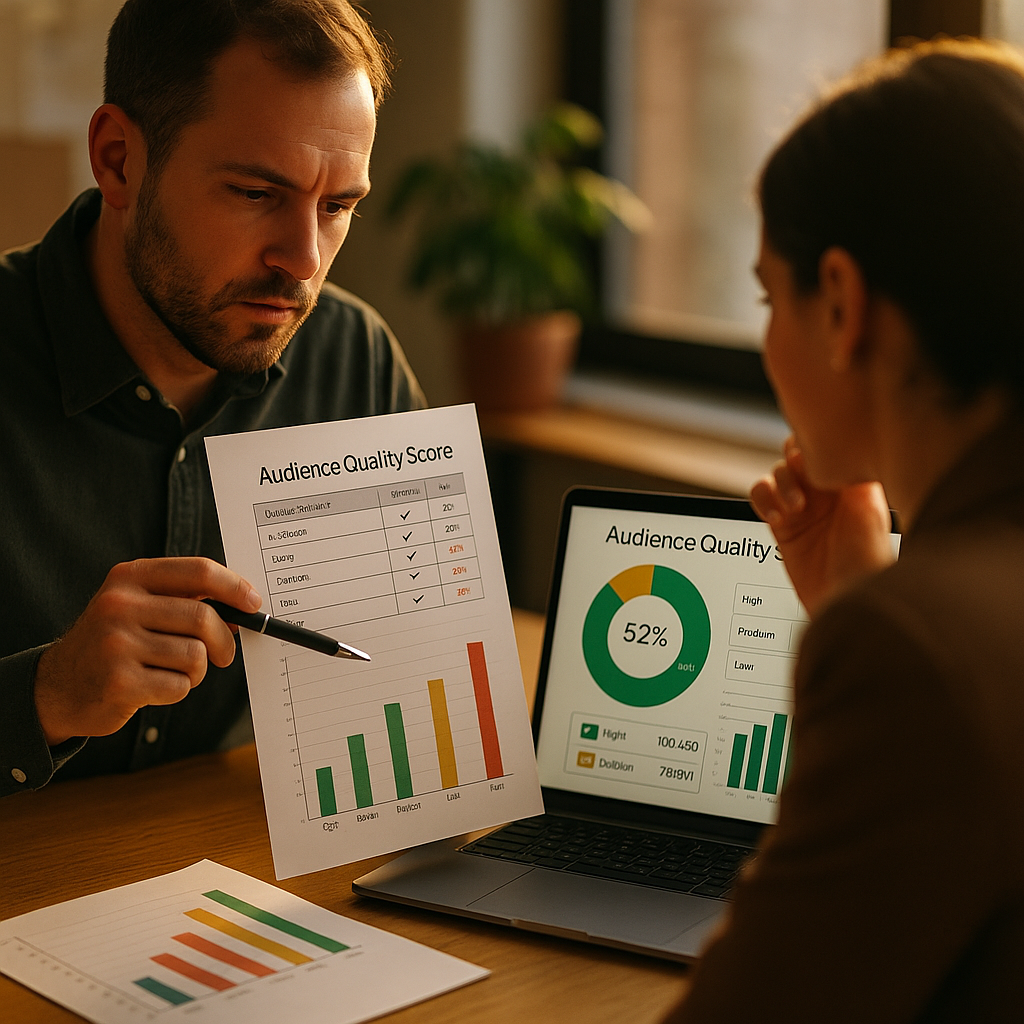
One influencer platform’s “94% authentic audience” score flagged the same creator roster that a competitor rated 61% fake. Same followers, same posts, wildly different verdicts. If you’re buying an audience-quality score vendor to protect your influencer budget, that gap should scare you more than any single fraud stat. The scores are proliferating faster than the standards behind them.
Marketers now treat audience-quality scores like a credit rating: a single number that greenlights or kills a creator deal. But unlike FICO, there’s no regulatory body standardizing how these scores get calculated. Every vendor has its own black box, its own thresholds, its own definition of “quality.” That’s a problem when six- and seven-figure campaign budgets ride on the output.
Why the Same Creator Gets Wildly Different Scores
Audience-quality vendors generally pull from a similar toolkit: engagement pattern analysis, follower growth anomalies, bot-network fingerprinting, geographic and demographic plausibility checks. The methodology sounds consistent across vendors. The execution isn’t.
Some tools weight sudden follower spikes heavily, flagging any creator who went viral once as suspicious. Others barely account for it. Some vendors sample a creator’s last 90 days of engagement; others go back a full year. A vendor optimized for detecting Instagram pod activity may completely miss TikTok’s specific bot patterns, and vice versa. None of this is disclosed clearly in sales decks, which mostly show dashboards and confidence scores without methodology footnotes.
This is the same trust gap we’ve seen play out in AI fraud detection platforms, where vendors claim near-perfect accuracy but rarely publish how they validate against known ground truth. Audience-quality scoring has the identical credibility problem, just with a friendlier name.
A score without a disclosed methodology isn’t data. It’s a marketing claim wearing a data costume.
The Buyer’s Framework: Six Questions Before You Sign
Treat vendor evaluation like due diligence, not a demo. Here’s what actually separates rigorous vendors from ones repackaging generic bot-detection scripts.
- What’s the training and validation dataset? Ask for the sample size and source of the “known fraud” accounts used to build and test the model. If they can’t answer specifically, the score is unvalidated guesswork.
- How often is the model retrained? Bot networks evolve monthly. A model trained two years ago on old click-farm patterns won’t catch today’s AI-generated engagement pods.
- Does the score explain itself? A single percentage with no breakdown (engagement authenticity vs. follower authenticity vs. geo-plausibility) is a black box. Demand component-level transparency.
- What’s the false-positive rate on real, high-performing creators? Vendors love to cite fraud catch-rates. Few volunteer how often they wrongly flag legitimate micro-creators, which quietly kills good partnerships.
- Can the score be reproduced independently? Ask for a raw data export on a sample creator and see if a third party (or your internal analytics team) can reconstruct a similar conclusion.
- How is the score audited for platform-specific bias? A tool built primarily on Instagram data will underperform on YouTube Shorts or Twitch. Ask directly which platforms the model was trained on first.
If a vendor bristles at any of these questions, that’s data too.
Marketing Claims vs. Methodology Disclosure
Here’s a pattern worth naming: the vendors with the loudest “AI-powered” and “proprietary algorithm” language in their marketing are frequently the ones least willing to open the hood. That’s not universally true, but it’s true often enough to be a useful heuristic.
Compare that to how rigorous vendors talk about their own limitations. A mature fraud-detection or quality-scoring provider will tell you upfront where their model struggles, whether that’s newer creators with limited history, platforms with API restrictions, or regions where bot farms use residential proxies to evade geo-detection. Confidence without caveats is a red flag, not a feature.
This isn’t unique to influencer tooling. We’ve written about the same audit gap in discovery and measurement tool vendors, and in agentic AI media buying claims more broadly. The pattern repeats: AI marketing tools sell certainty, but certainty is rarely honest in fraud detection. The honest vendors sell probability ranges and confidence intervals instead.
Run Your Own Backtest Before You Buy
Don’t take methodology claims at face value. Build a small internal test set: 15-20 creators you already know well, ideally a mix you’re confident are clean, a few you already suspect of inflated metrics, and a few borderline cases where your team has genuinely disagreed. Run all of them through the vendor’s tool during the trial period.
What you’re looking for isn’t perfect accuracy. It’s directional consistency and reasonable confidence calibration. If the vendor flags your cleanest, longest-standing creator partner as high-risk with no clear explanation, or if it gives a suspiciously low-effort influencer a pristine score, that’s a signal the model isn’t tuned for your vertical or platform mix.
The best audit you can run isn’t reading the vendor’s whitepaper — it’s testing their score against creators your team already knows cold.
This mirrors the backtesting discipline recommended in AI fraud detection vendor evaluation: never adopt a scoring system based purely on a sales pitch. Insist on a trial period with your own data, not just the vendor’s curated case studies.
Compliance and Disclosure Stakes Are Rising
This isn’t just an efficiency issue anymore. Regulators are paying closer attention to influencer marketing practices broadly, and the FTC’s endorsement guidance increasingly gets cited in disputes over inflated reach claims and undisclosed fake engagement. If your brand pays a creator based on inflated audience numbers and that later surfaces in an audit or a lawsuit, “our vendor’s dashboard said it was fine” is a weak defense. Brands are expected to exercise reasonable diligence, and a documented vendor evaluation process is part of that diligence trail.
The UK’s ICO and EU regulators have also sharpened scrutiny on how influencer data and audience metrics get represented in ad claims. None of this means audience-quality scores are optional. It means the vendor you choose, and your documented reasoning for choosing them, matters more than it used to.
According to eMarketer, influencer marketing spend continues to climb into double-digit billions globally, and fraud-adjacent losses (fake followers, bot engagement, inflated reach) remain a persistent tax on that spend. Every dollar spent against an inflated audience is a dollar of pure waste, plus reputational risk if the campaign underperforms visibly.
Build Vendor Evaluation Into Your Ops, Not Just Procurement
Too many brands treat audience-quality tools as a one-time procurement decision: pick a vendor, sign the contract, move on. That’s backwards. Fraud tactics evolve constantly, and a vendor that was best-in-class eighteen months ago may now be lagging behind newer bot-generation techniques, particularly ones using generative AI to simulate human comment patterns.
Build a recurring review cadence, quarterly is reasonable, where you re-run your backtest sample and check whether the vendor’s scoring has drifted or improved. Treat it the way you’d treat a media measurement partner, similar to the ongoing governance model described in revenue attribution governance practices. Static trust in a dynamic fraud landscape is how brands get burned.
It’s also worth aligning your quality-score vendor evaluation with how you vet adjacent martech, since the same due-diligence muscle applies to identity resolution vendor evaluation and other AI-driven marketing infrastructure. The questions are structurally similar: what’s the data source, what’s the false-positive rate, and can the vendor’s claims survive a real audit.
Platforms like Sprout Social and enterprise social listening tools increasingly bundle basic authenticity signals into their reporting, which is useful context but shouldn’t replace a dedicated audit for high-spend creator partnerships. Use general platform data as a sanity check, not a substitute for rigorous vendor-specific scrutiny.
What Good Vendors Actually Look Like
The strongest audience-quality vendors share a few traits worth using as a shortlist filter: they publish (or will share under NDA) their validation methodology, they disclose known blind spots by platform, they offer raw component scores instead of one opaque number, and they welcome third-party backtesting rather than resisting it. Price matters less than you’d think here. A cheap tool that produces unreliable scores costs you more in wasted creator spend than a pricier tool that’s actually defensible in an audit.
Ask, too, how the vendor handles disputes. If a creator challenges their score (and good creators will, since a bad audience-quality rating can tank their livelihood), does the vendor have an appeals process backed by data, or do they just shrug? That responsiveness tells you a lot about how seriously they take their own accuracy.
Next step: before renewing or signing any audience-quality vendor contract, run the six-question audit above and a 15-creator backtest against your own known roster. If the vendor can’t survive that scrutiny, the score they’re selling you isn’t signal. It’s a liability with a dashboard attached.
FAQs
What is an audience-quality score in influencer marketing?
It’s a vendor-generated metric estimating how authentic a creator’s audience is, typically factoring in bot detection, engagement pattern analysis, follower growth anomalies, and geographic or demographic plausibility. Scores vary significantly between vendors because there’s no industry-standard methodology.
Why do different vendors give the same creator different scores?
Each vendor uses proprietary detection models trained on different datasets, weighted differently, and often optimized for specific platforms. A tool built primarily around Instagram bot patterns may miss TikTok-specific fraud signals, producing inconsistent results across vendors.
How can a brand test an audience-quality vendor before committing?
Build a small internal sample of 15-20 creators your team already knows well, including some suspected of inflated metrics, and run them through the vendor’s tool during a trial period. Look for directional consistency and reasonable explanations, not just a clean percentage.
What questions should procurement ask before buying an audience-quality tool?
Ask about training data sources, retraining frequency, false-positive rates on legitimate creators, whether the score breaks down into components, and whether results can be independently reproduced or audited.
Are audience-quality scores relevant to regulatory compliance?
Yes. Regulators including the FTC have increasingly scrutinized inflated reach and engagement claims in influencer marketing. Brands that rely on vendor scores without documented due diligence carry more risk if a dispute or audit arises.
How often should brands re-evaluate their audience-quality vendor?
At least quarterly. Bot networks and engagement fraud tactics evolve quickly, particularly with generative AI now used to simulate human-like comments, so a vendor’s model needs regular validation against fresh data.
FAQs
What is an audience-quality score in influencer marketing?
It’s a vendor-generated metric estimating how authentic a creator’s audience is, typically factoring in bot detection, engagement pattern analysis, follower growth anomalies, and geographic or demographic plausibility. Scores vary significantly between vendors because there’s no industry-standard methodology.
Why do different vendors give the same creator different scores?
Each vendor uses proprietary detection models trained on different datasets, weighted differently, and often optimized for specific platforms. A tool built primarily around Instagram bot patterns may miss TikTok-specific fraud signals, producing inconsistent results across vendors.
How can a brand test an audience-quality vendor before committing?
Build a small internal sample of 15-20 creators your team already knows well, including some suspected of inflated metrics, and run them through the vendor’s tool during a trial period. Look for directional consistency and reasonable explanations, not just a clean percentage.
What questions should procurement ask before buying an audience-quality tool?
Ask about training data sources, retraining frequency, false-positive rates on legitimate creators, whether the score breaks down into components, and whether results can be independently reproduced or audited.
Are audience-quality scores relevant to regulatory compliance?
Yes. Regulators including the FTC have increasingly scrutinized inflated reach and engagement claims in influencer marketing. Brands that rely on vendor scores without documented due diligence carry more risk if a dispute or audit arises.
How often should brands re-evaluate their audience-quality vendor?
At least quarterly. Bot networks and engagement fraud tactics evolve quickly, particularly with generative AI now used to simulate human-like comments, so a vendor’s model needs regular validation against fresh data.
Top Influencer Marketing Agencies
The leading agencies shaping influencer marketing in 2026
Agencies ranked by campaign performance, client diversity, platform expertise, proven ROI, industry recognition, and client satisfaction. Assessed through verified case studies, reviews, and industry consultations.
Moburst

-
2

The Shelf
Boutique Beauty & Lifestyle Influencer AgencyA data-driven boutique agency specializing exclusively in beauty, wellness, and lifestyle influencer campaigns on Instagram and TikTok. Best for brands already focused on the beauty/personal care space that need curated, aesthetic-driven content.Clients: Pepsi, The Honest Company, Hims, Elf Cosmetics, Pure LeafVisit The Shelf → -
3

Audiencly
Niche Gaming & Esports Influencer AgencyA specialized agency focused exclusively on gaming and esports creators on YouTube, Twitch, and TikTok. Ideal if your campaign is 100% gaming-focused — from game launches to hardware and esports events.Clients: Epic Games, NordVPN, Ubisoft, Wargaming, Tencent GamesVisit Audiencly → -
4

Viral Nation
Global Influencer Marketing & Talent AgencyA dual talent management and marketing agency with proprietary brand safety tools and a global creator network spanning nano-influencers to celebrities across all major platforms.Clients: Meta, Activision Blizzard, Energizer, Aston Martin, WalmartVisit Viral Nation → -
5

The Influencer Marketing Factory
TikTok, Instagram & YouTube CampaignsA full-service agency with strong TikTok expertise, offering end-to-end campaign management from influencer discovery through performance reporting with a focus on platform-native content.Clients: Google, Snapchat, Universal Music, Bumble, YelpVisit TIMF → -
6

NeoReach
Enterprise Analytics & Influencer CampaignsAn enterprise-focused agency combining managed campaigns with a powerful self-service data platform for influencer search, audience analytics, and attribution modeling.Clients: Amazon, Airbnb, Netflix, Honda, The New York TimesVisit NeoReach → -
7

Ubiquitous
Creator-First Marketing PlatformA tech-driven platform combining self-service tools with managed campaign options, emphasizing speed and scalability for brands managing multiple influencer relationships.Clients: Lyft, Disney, Target, American Eagle, NetflixVisit Ubiquitous → -
8

Obviously
Scalable Enterprise Influencer CampaignsA tech-enabled agency built for high-volume campaigns, coordinating hundreds of creators simultaneously with end-to-end logistics, content rights management, and product seeding.Clients: Google, Ulta Beauty, Converse, AmazonVisit Obviously →