


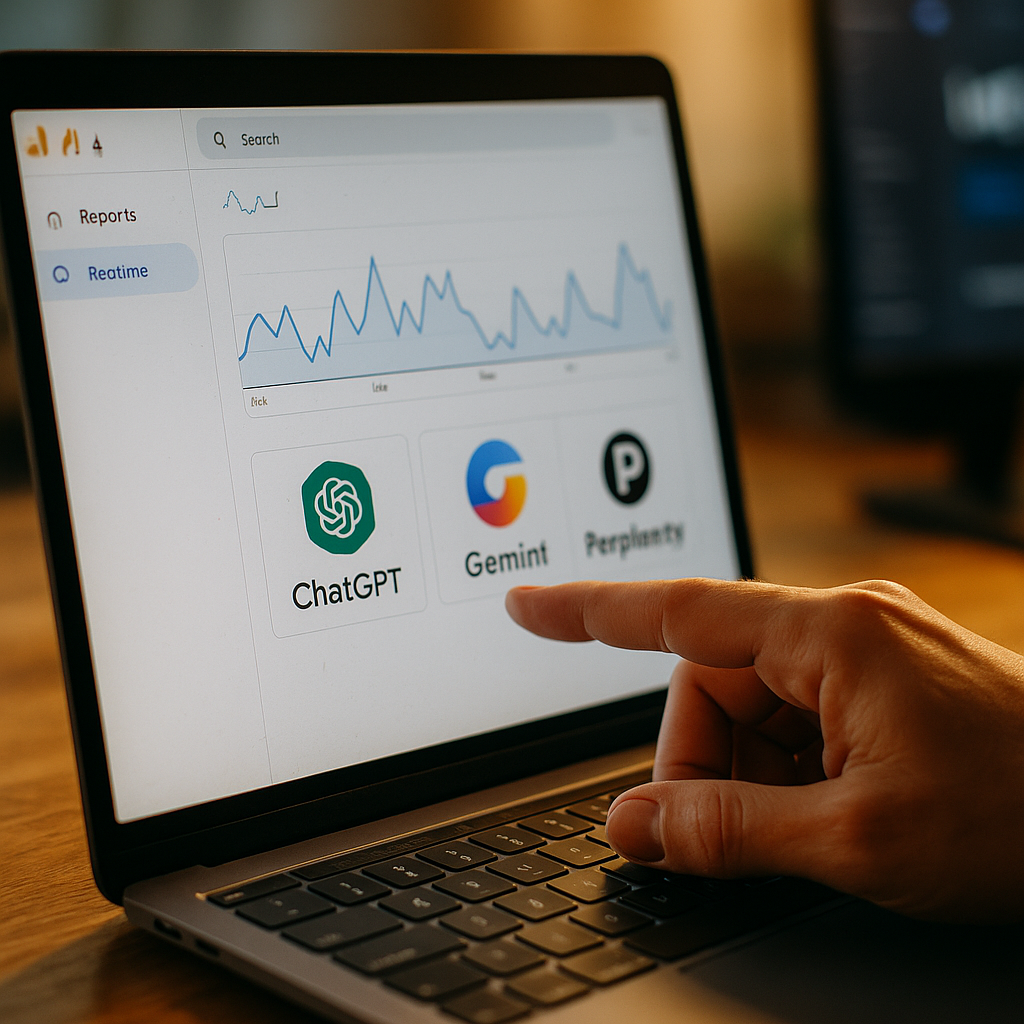
Roughly a third of B2B buyers now start research in an AI chat interface instead of Google. Yet most GA4 properties still lump ChatGPT, Gemini, and Perplexity referrals into “unassigned” or bury them inside generic referral traffic. If your GA4 AI assistant traffic tagging setup can’t isolate these sources, you’re flying blind on one of the fastest-growing acquisition channels in marketing.
That’s not a small gap. It’s a reporting blind spot that’s actively getting worse as more assistants ship browsing and citation features.
Why Default GA4 Channel Grouping Fails You Here
GA4’s default channel grouping logic was built for a search-and-social world. It classifies traffic using source/medium rules that predate generative AI referrals entirely. When someone clicks a citation link inside a ChatGPT response, GA4 often tags it as “Referral” or, worse, “Direct” if the referrer header gets stripped, which happens more often than marketers realize.
Gemini traffic behaves differently again. Because it’s embedded inside Google’s own ecosystem, some Gemini-driven visits carry a google.com referrer, making them indistinguishable from organic search unless you dig into landing page and session-level parameters. Perplexity, meanwhile, tends to pass a clean referrer domain, but GA4 still won’t bucket it separately from your existing referral channel unless you tell it to.
If you’re not manually isolating AI assistant referrals, you’re likely underreporting a channel that could represent 5-15% of your organic-adjacent traffic within the next year.
This matters for budget conversations. If a CMO asks “what’s our ChatGPT traffic worth,” and the honest answer is “we can’t tell because it’s mixed into referral,” that’s a credibility problem. Fixing it isn’t hard, but it does require deliberate configuration work most teams haven’t prioritized yet.
The Core Setup: Custom Channel Groups
The most durable fix is building a custom channel group inside GA4 rather than relying on ad hoc segments. Custom channel groups let you define rules that evaluate before GA4 falls back to default logic, which means you can carve out AI assistants as their own category permanently, across all reports.
Here’s the practical sequence:
- Navigate to Admin > Data display > Channel groups and create a new custom channel group rather than editing the default one. This preserves your baseline reporting while you test.
- Define a condition set that matches session source against known AI referrer domains: chat.openai.com, chatgpt.com, gemini.google.com, perplexity.ai, copilot.microsoft.com, and claude.ai. Add these as an “OR” condition group.
- Create sub-channels for each assistant rather than one catch-all “AI Traffic” bucket. You want ChatGPT, Gemini, and Perplexity broken out individually, because their user intent and conversion behavior differ meaningfully.
- Order your rules correctly. Channel group logic evaluates top-down, so your AI assistant rules need to sit above generic referral and organic search rules, or they’ll never fire.
One nuance that trips people up: Gemini’s in-SERP citations sometimes fire with a source value of “google” and a medium of “referral” rather than “organic,” which is different from standard organic search behavior. You’ll need a condition that specifically checks medium equals referral AND source contains google AND excludes known ad click IDs, or you’ll accidentally sweep in paid search clicks too.
Don’t Skip UTM Discipline on Your Own Side
Custom channel groups handle inbound classification, but you should also control what you can control. If you’re running any citation-seeking content plays or submitting content to answer engines, tag your own outbound links with consistent UTM parameters so you can cross-reference GA4’s automatic detection against your own campaign tracking. This becomes especially important as brands invest more in generative-engine marketing strategies that blend paid placement with organic citation building.
Building the BigQuery Fallback for Referrer Gaps
Here’s the uncomfortable truth: referrer-based tagging misses a meaningful chunk of AI-driven traffic. Many assistant apps, particularly mobile ChatGPT and Gemini apps, don’t pass a referrer at all. That traffic lands in GA4 as “Direct,” indistinguishable from someone typing your URL from memory.
You can partially recover this signal by exporting raw event data to BigQuery and looking for behavioral fingerprints: landing page bounce patterns, session duration anomalies, and referrer-less sessions that spike in correlation with specific content publishing dates. It’s not perfect attribution, it’s forensic reconstruction. But it’s better than pretending the gap doesn’t exist.
This is the same underlying measurement problem covered in our piece on zero-click revenue measurement: when the referral chain breaks, you need probabilistic methods to fill the gap, not just cleaner tagging rules. Teams building serious AI traffic attribution should also read up on merge key strategies for AI agents, since the same identity resolution logic applies here.
Segment Overlays: Confirming What Channel Groups Miss
Don’t rely solely on your custom channel group. Build a parallel segment (or Exploration) using regex matching on the full referrer string as a sanity check. GA4’s channel group UI is good, but it’s also easy to mistype a domain condition and silently lose data for weeks before anyone notices.
A simple regex like chatgpt\.com|chat\.openai\.com|gemini\.google\.com|perplexity\.ai applied against the session source dimension in an Exploration report gives you a quick cross-check. If your channel group totals and your regex segment totals diverge significantly, you’ve got a rule ordering problem or a missed subdomain.
Also watch for app-based referrers. Perplexity’s mobile app sometimes passes “com.perplexity.ai” as an app-referrer style value rather than a standard web domain, and Gemini’s Android integration can pass values tied to the Google app package rather than the gemini.google.com domain. If you only test in a desktop browser, you’ll miss these entirely.
What to Do With the Data Once You Have It
Isolating the traffic is step one. The real value comes from what you do next.
Compare conversion rates and engagement quality for AI-referred sessions against your traditional organic and paid channels. Early data across B2B SaaS properties suggests ChatGPT-referred sessions often show higher time-on-page but lower immediate conversion, consistent with users who are still in research mode when the assistant surfaces your content. That’s a different funnel stage than someone clicking a bottom-funnel Google ad, and your nurture strategy should reflect it.
For a deeper breakdown of how to structure this comparison inside GA4’s native reporting interface, our guide on building a GA4 AI referral report walks through the exact exploration templates worth cloning.
Treat AI assistant traffic as a distinct funnel stage, not a subcategory of referral. The behavioral signature is different enough to warrant its own reporting cadence and its own success metrics.
You should also loop this data into whatever revenue attribution process your RevOps team already runs. If AI-referred sessions convert on a longer timeline, standard last-click models will undercount them, which mirrors the governance issues raised in our piece on revenue attribution governance. Getting finance and marketing aligned on how AI-influenced pipeline gets counted avoids an awkward quarterly review later.
Structured Data Still Matters Upstream
None of this tagging work matters if assistants aren’t citing you in the first place. Make sure your product and content pages carry clean structured data so crawlers used by these assistants can parse and cite your content accurately. Our guide on prepping product feeds for AI citation covers the schema markup priorities worth tackling first.
Maintenance: This Isn’t a Set-and-Forget Job
Assistant referrer patterns change without warning. OpenAI, Google, and Perplexity have all adjusted their outbound link structures in the past year, sometimes without public documentation. Set a recurring calendar reminder, monthly is reasonable, to audit your channel group’s “Unassigned” and “Direct” buckets for new referrer domains sneaking in unrecognized.
Search-adjacent industry trackers like eMarketer and Statista publish periodic updates on AI referral traffic share that are useful benchmarks for whether your isolated numbers look directionally reasonable compared to industry norms. If your GA4 setup shows dramatically lower AI referral volume than published benchmarks suggest for your vertical, that’s a signal your tagging rules need another pass, not necessarily that your content isn’t getting cited.
For the official mechanics of channel group configuration, Google’s own GA4 support documentation is the definitive reference, though it lags behind real-world AI referrer behavior by months in most cases.
Next Step
Set up your custom channel group this week, not next quarter. Every month you wait, more AI-driven sessions get silently absorbed into “Direct” or “Referral,” and you lose the historical baseline you’ll eventually need to prove this channel’s growth to leadership.
Frequently Asked Questions
Why doesn’t GA4 automatically detect ChatGPT or Gemini traffic?
GA4’s default channel grouping rules predate generative AI assistants and rely on source/medium patterns designed for search engines and social platforms. AI assistant referrers don’t match those legacy rules, so traffic often falls into generic “Referral,” “Direct,” or even “Organic Search” buckets depending on how each platform passes its referrer header.
What’s the difference between custom channel groups and segments for this purpose?
Custom channel groups apply globally across all your GA4 standard reports and persist over time, while segments and Explorations are more useful as one-off analysis or verification tools. Use a custom channel group as your primary fix and a regex-based segment as a periodic audit check.
Can I recover AI traffic that shows up as Direct?
Not with full certainty. You can approximate it using BigQuery exports and behavioral pattern analysis, looking for referrer-less sessions with landing page and engagement patterns that correlate with content you know is being cited by assistants. This is probabilistic reconstruction, not deterministic attribution.
How often do AI referrer domains change?
Frequently enough to warrant a monthly audit. OpenAI, Google, and Perplexity have all modified outbound linking behavior without extensive public notice, so channel group rules built once and forgotten will drift out of accuracy within a few months.
Should I break out each AI assistant separately or group them together?
Break them out individually where possible. ChatGPT, Gemini, and Perplexity referrals show different engagement and conversion patterns, and lumping them into one “AI Traffic” bucket hides insights you’d otherwise use to prioritize content and citation strategy by platform.
Top Influencer Marketing Agencies
The leading agencies shaping influencer marketing in 2026
Agencies ranked by campaign performance, client diversity, platform expertise, proven ROI, industry recognition, and client satisfaction. Assessed through verified case studies, reviews, and industry consultations.
Moburst

-
2

The Shelf
Boutique Beauty & Lifestyle Influencer AgencyA data-driven boutique agency specializing exclusively in beauty, wellness, and lifestyle influencer campaigns on Instagram and TikTok. Best for brands already focused on the beauty/personal care space that need curated, aesthetic-driven content.Clients: Pepsi, The Honest Company, Hims, Elf Cosmetics, Pure LeafVisit The Shelf → -
3

Audiencly
Niche Gaming & Esports Influencer AgencyA specialized agency focused exclusively on gaming and esports creators on YouTube, Twitch, and TikTok. Ideal if your campaign is 100% gaming-focused — from game launches to hardware and esports events.Clients: Epic Games, NordVPN, Ubisoft, Wargaming, Tencent GamesVisit Audiencly → -
4

Viral Nation
Global Influencer Marketing & Talent AgencyA dual talent management and marketing agency with proprietary brand safety tools and a global creator network spanning nano-influencers to celebrities across all major platforms.Clients: Meta, Activision Blizzard, Energizer, Aston Martin, WalmartVisit Viral Nation → -
5

The Influencer Marketing Factory
TikTok, Instagram & YouTube CampaignsA full-service agency with strong TikTok expertise, offering end-to-end campaign management from influencer discovery through performance reporting with a focus on platform-native content.Clients: Google, Snapchat, Universal Music, Bumble, YelpVisit TIMF → -
6

NeoReach
Enterprise Analytics & Influencer CampaignsAn enterprise-focused agency combining managed campaigns with a powerful self-service data platform for influencer search, audience analytics, and attribution modeling.Clients: Amazon, Airbnb, Netflix, Honda, The New York TimesVisit NeoReach → -
7

Ubiquitous
Creator-First Marketing PlatformA tech-driven platform combining self-service tools with managed campaign options, emphasizing speed and scalability for brands managing multiple influencer relationships.Clients: Lyft, Disney, Target, American Eagle, NetflixVisit Ubiquitous → -
8

Obviously
Scalable Enterprise Influencer CampaignsA tech-enabled agency built for high-volume campaigns, coordinating hundreds of creators simultaneously with end-to-end logistics, content rights management, and product seeding.Clients: Google, Ulta Beauty, Converse, AmazonVisit Obviously →