


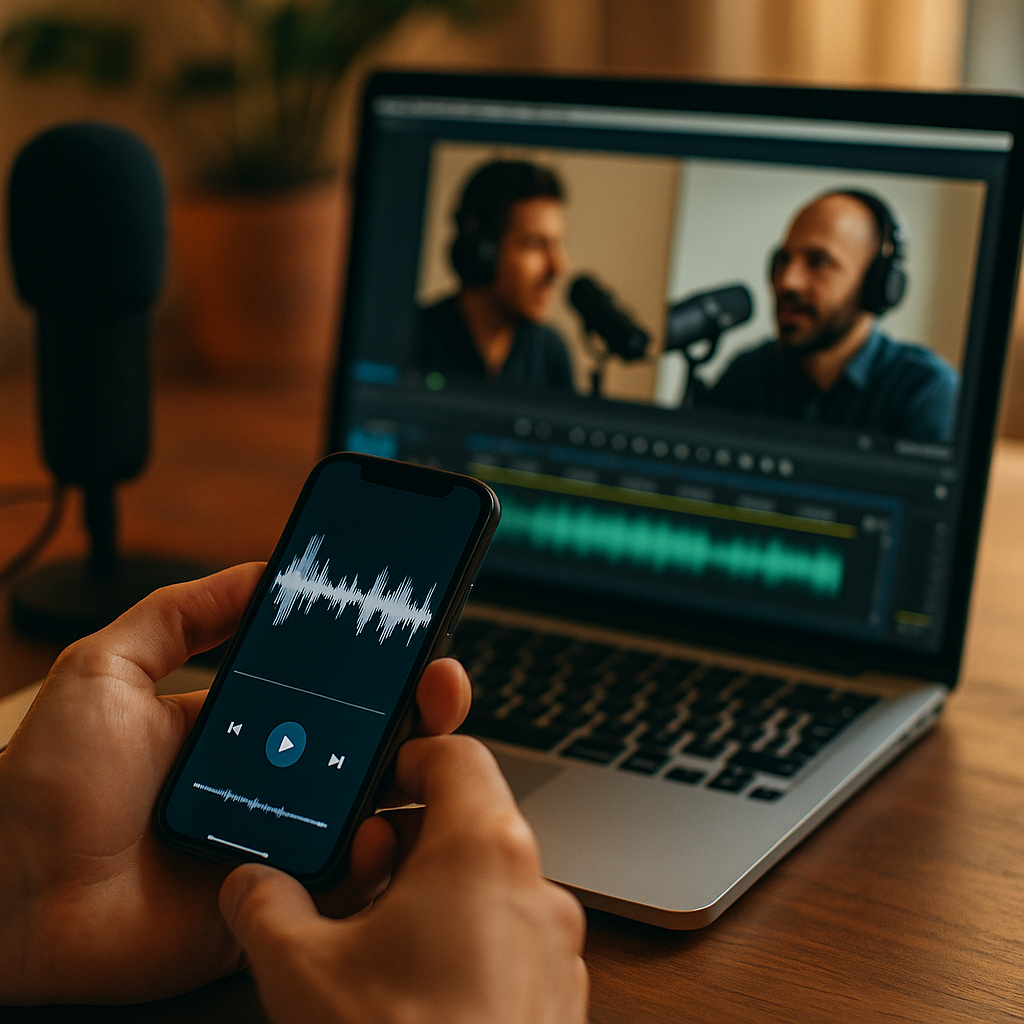
Podcast downloads are flat in several verticals this year, but audiogram clips are quietly driving some of the best cost-per-engagement numbers in a brand’s entire content mix. Why? Because a 45-minute creator interview nobody has time to watch becomes a 30-second waveform video that people actually share. If your podcast strategy stops at the RSS feed, you’re leaving reach, retention, and repurposing budget on the table.
What Exactly Is an Audiogram Clip?
An audiogram clip pairs an audio waveform (or animated soundwave) with static or lightly animated visuals, usually captions, a brand watermark, and a still image of the speaker. Think of it as the missing link between a full podcast episode and a native video. Tools like Hubspot‘s content templates and dedicated audiogram makers (Headliner, Audiotype, Descript’s clip feature) let editors pull a punchy soundbite from a longer interview and turn it into something Instagram, LinkedIn, and X will actually rank favorably.
Unlike full video podcast cuts, audiograms don’t require a camera crew, studio lighting, or a talent release for on-screen appearances beyond the still photo. That’s the operational hook for brand teams: lower production lift, faster turnaround, and a format that performs well even when the guest never agreed to video.
Why Brands Are Suddenly Prioritizing This Format
Influencer podcast interviews generate a strange asset problem. Brands pay for access to a creator’s audience, record 40 minutes of genuinely useful commentary, publish the episode, and then… nothing. The clip-worthy insight buried at minute 22 never sees daylight outside the full episode. Audiogram clips solve the distribution gap without asking for a second production day.
A single 45-minute podcast interview can realistically yield 8 to 12 audiogram clips, each one a standalone social asset with its own hook, caption, and CTA.
That math changes the ROI conversation entirely. Instead of measuring one podcast episode against one download count, brand teams can measure a content system: one recording session, a dozen distributable assets, spread across platforms and time zones. It’s the same logic behind short-form creator drops, just sourced from long-form audio instead of scripted video.
The Compliance Angle Nobody Talks About
Here’s where a lot of marketing teams get sloppy. Pulling a 20-second clip from a sponsored podcast interview and reposting it as a standalone social asset still counts as a paid partnership if the original episode was sponsored. The FTC’s endorsement guidance doesn’t stop applying just because you cropped the audio and added captions. If the full episode carried a #ad disclosure, the clip needs one too, every time it’s republished as a discrete post.
Review the FTC’s endorsement guidelines before your team builds a clip factory around interview content. This matters even more when clips get reposted by the creator’s own channels, by the brand’s channels, and sometimes by a third-party media outlet covering the interview. Track disclosure at the clip level, not just the episode level, or you’ll end up explaining a compliance gap to legal after the fact.
Where Audiogram Clips Actually Outperform Video
Not every platform rewards this format equally, and pretending otherwise wastes budget. LinkedIn audiences, for instance, engage well with audiogram clips featuring executive or founder commentary because the format reads as credible and low-effort to consume during a scroll break. Instagram Reels and TikTok are trickier: the waveform visual alone rarely holds attention past three seconds unless it’s paired with aggressive caption text and a strong opening line.
- LinkedIn: Best for B2B interview clips, thought-leadership soundbites, and founder commentary. Captions matter more than visual polish here.
- Instagram: Works when paired with a strong visual anchor (guest photo, brand graphic) and captions that front-load the hook.
- X (Twitter): Strong for quote-driven clips under 30 seconds, especially when tied to a trending topic or news cycle.
- TikTok: Weakest native fit unless the audio itself is inherently viral or controversial. Consider this platform secondary for the format.
This isn’t a “post everywhere” format. It’s a “match the clip to the platform’s attention economy” format. A brand team that treats audiograms as a copy-paste asset across every channel will see mediocre results and conclude the format doesn’t work. It works. It just needs platform-specific captioning, which is a lesson that also shows up in caption-heavy formats that rely on text to carry meaning without sound.
Building an Audiogram Pipeline Without Burning Your Editing Team
Small teams struggle here because clipping feels like an afterthought, something assigned after the “real” content is done. That’s backwards. Treat clip extraction as part of the interview brief, not a post-production scramble.
A workable pipeline looks like this: brief the podcast host beforehand to flag three or four moments they expect will land as standalone quotes. Record the full interview. Use AI transcription (Descript, Otter, or similar) to generate a searchable transcript within hours, not days. Pull timestamped highlights, run them through an audiogram template, and batch-export captions in platform-specific aspect ratios. The entire clip production cycle should take one editor half a day for a 45-minute interview, not a full week.
Speed matters because podcast interview content has a shelf life tied to news relevance and creator momentum. A clip that goes out three weeks after the full episode drops loses the algorithmic tailwind the original episode generated. If your team can’t turn clips around within 48 hours of the raw recording, you’re leaving reach on the table every single cycle.
Measuring What Actually Matters
Vanity metrics on audiogram clips can mislead brand teams fast. A clip racking up views but zero saves or shares is basically a wallpaper impression, pleasant but not driving anything measurable. Focus instead on:
- Click-through to full episode: Does the clip drive listeners back to the source, or does it satisfy curiosity and stop there?
- Save and share rate: A high save rate signals the quote itself has standalone value, a strong indicator for future clip selection.
- Comment sentiment: Audiogram clips featuring opinionated soundbites tend to generate more comment volume than neutral summaries. That’s useful signal for what to clip next time.
Platforms like Sprout Social and native analytics dashboards from Meta Business Suite can help isolate clip-level performance separate from the parent episode, which is the only way to know if your clipping strategy is actually working or just generating noise.
The Creator Relationship Angle
Audiogram clips also solve a diplomacy problem. Not every creator wants their podcast interview cut into a dozen social videos featuring their unedited face and awkward pauses. Audio-first clips sidestep that friction. A still image and waveform feel less exposing than a jump-cut video reel, which makes creators more willing to approve wide clip distribution rights in the original agreement.
Build clip rights into your creator contract from the start. Specify how many clips you intend to produce, where they’ll run, and whether the creator gets approval rights on individual clips or blanket approval on the category of content. This avoids the back-and-forth that kills momentum when your editing team is ready to publish and the creator suddenly wants to review each 20-second cut individually. It’s the same operational discipline that makes fast-approval response content workable at scale: negotiate the framework once, execute repeatedly.
Where This Format Is Headed
Expect more brands to treat the podcast interview itself as raw material rather than a finished product. The interview becomes the input; audiogram clips, quote graphics, and short video cuts become the actual distributed output. This mirrors what’s already happening with vertical documentary shorts, where long-form footage gets systematically broken into distributable fragments rather than published as a single monolithic asset.
The brands getting this right aren’t necessarily producing more podcast interviews. They’re extracting more value from the ones they already record. That’s the efficiency story CFOs actually want to hear when budget season comes around.
FAQs
Frequently Asked Questions
What software do brands use to make audiogram clips?
Common tools include Headliner, Descript’s clip export feature, and Audiotype. Most integrate transcription, waveform animation, and caption burning into a single workflow, which cuts editing time significantly compared to manual video editing software.
Do audiogram clips need FTC disclosure if the podcast episode already had one?
Yes. Each standalone clip republished as its own social post needs its own disclosure if the underlying content involved a paid partnership. Disclosure at the episode level doesn’t automatically carry over to clips distributed separately, so review FTC guidance for your specific setup.
How many audiogram clips can you realistically pull from one interview?
Most 40 to 50 minute interviews yield 8 to 12 usable clips when the interview is briefed well beforehand and the host flags quotable moments during recording. Poorly briefed interviews often yield far fewer usable moments.
Which platforms perform best for audiogram clips?
LinkedIn and X tend to outperform for quote-driven and B2B commentary clips. Instagram works when paired with strong visual captions. TikTok is generally the weakest native fit unless the audio itself carries inherent virality.
Is audiogram content worth the production investment compared to full video podcasts?
Audiograms cost far less to produce than video podcast cuts since they don’t require camera equipment, additional talent releases, or complex editing. For brands prioritizing distribution volume over visual polish, the cost-per-asset math strongly favors audiograms.
Next step: Before your next creator podcast interview, brief the host to flag three quotable moments during recording, and assign an editor to deliver the first audiogram clip within 48 hours of the raw file landing. That single process change is usually the difference between a podcast episode that disappears and one that keeps generating impressions for weeks.
Top Influencer Marketing Agencies
The leading agencies shaping influencer marketing in 2026
Agencies ranked by campaign performance, client diversity, platform expertise, proven ROI, industry recognition, and client satisfaction. Assessed through verified case studies, reviews, and industry consultations.
Moburst

-
2

The Shelf
Boutique Beauty & Lifestyle Influencer AgencyA data-driven boutique agency specializing exclusively in beauty, wellness, and lifestyle influencer campaigns on Instagram and TikTok. Best for brands already focused on the beauty/personal care space that need curated, aesthetic-driven content.Clients: Pepsi, The Honest Company, Hims, Elf Cosmetics, Pure LeafVisit The Shelf → -
3

Audiencly
Niche Gaming & Esports Influencer AgencyA specialized agency focused exclusively on gaming and esports creators on YouTube, Twitch, and TikTok. Ideal if your campaign is 100% gaming-focused — from game launches to hardware and esports events.Clients: Epic Games, NordVPN, Ubisoft, Wargaming, Tencent GamesVisit Audiencly → -
4

Viral Nation
Global Influencer Marketing & Talent AgencyA dual talent management and marketing agency with proprietary brand safety tools and a global creator network spanning nano-influencers to celebrities across all major platforms.Clients: Meta, Activision Blizzard, Energizer, Aston Martin, WalmartVisit Viral Nation → -
5

The Influencer Marketing Factory
TikTok, Instagram & YouTube CampaignsA full-service agency with strong TikTok expertise, offering end-to-end campaign management from influencer discovery through performance reporting with a focus on platform-native content.Clients: Google, Snapchat, Universal Music, Bumble, YelpVisit TIMF → -
6

NeoReach
Enterprise Analytics & Influencer CampaignsAn enterprise-focused agency combining managed campaigns with a powerful self-service data platform for influencer search, audience analytics, and attribution modeling.Clients: Amazon, Airbnb, Netflix, Honda, The New York TimesVisit NeoReach → -
7

Ubiquitous
Creator-First Marketing PlatformA tech-driven platform combining self-service tools with managed campaign options, emphasizing speed and scalability for brands managing multiple influencer relationships.Clients: Lyft, Disney, Target, American Eagle, NetflixVisit Ubiquitous → -
8

Obviously
Scalable Enterprise Influencer CampaignsA tech-enabled agency built for high-volume campaigns, coordinating hundreds of creators simultaneously with end-to-end logistics, content rights management, and product seeding.Clients: Google, Ulta Beauty, Converse, AmazonVisit Obviously →