


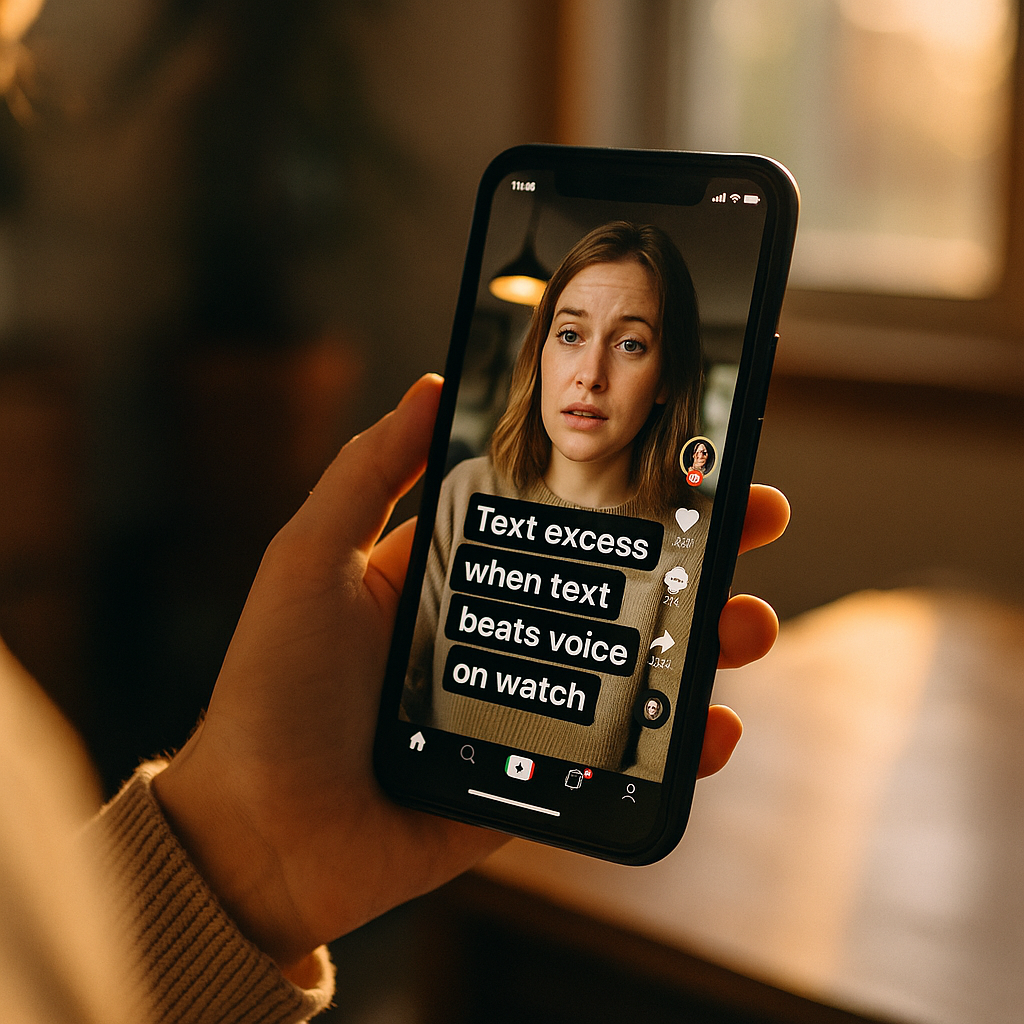
Sound-off viewing now accounts for the majority of TikTok watch time in commuting, workplace, and public settings, which means your carefully scripted voiceover might be getting muted before the hook even lands. Caption-heavy storytelling, the practice of building a video’s narrative primarily through on-screen text rather than narration, is quietly outperforming voiceover-driven content across completion rate, shareability, and even conversion. If your brand is still treating captions as an accessibility afterthought, you’re leaving performance on the table.
The Numbers Behind the Shift
Marketers love a good voiceover. It feels premium, it’s easier to brief, and it lets a creator’s personality carry the ad. But the data tells a different story about how people actually consume short-form video. A large share of mobile video consumption happens with sound off by default, whether that’s someone scrolling in a waiting room, on a train, or half-watching during a meeting. When the audio is off, a voiceover-only video is functionally silent, and silence kills retention.
Text-on-screen content solves this by front-loading meaning visually. The viewer doesn’t need to guess what’s happening or wait for context. They read it in half a second and decide whether to keep watching. That decision point, the first two seconds, is where caption-heavy videos consistently win.
Videos that communicate their hook through on-screen text in the first two seconds retain viewers at meaningfully higher rates than those relying on spoken narration alone, because the message lands regardless of audio settings.
This isn’t a niche TikTok quirk either. Reels and Shorts creators are reporting the same pattern: captioned, text-forward edits are getting reshared more often than narrated equivalents, largely because text is easier to screenshot, quote, and repost as a meme or reaction.
Why Voiceover Content Is Losing Ground
Voiceover isn’t dead. But it’s carrying baggage that text doesn’t have.
- Production friction. Voiceover requires clean audio, a script that sounds natural spoken aloud, and often a re-record when the brand legal team flags a claim. Text edits happen in minutes inside CapCut.
- Accent and clarity barriers. Not every viewer processes fast-talking creators easily, especially across international audiences. Text removes the ambiguity.
- Localization cost. Dubbing a voiceover into ten markets is expensive and slow. Swapping caption text is nearly free by comparison, which is part of why brands are pairing this approach with one shoot, multiple language workflows to stretch a single piece of creator content further.
- Algorithmic signals. Platforms increasingly auto-generate captions and index on-screen text for search and recommendation. A video with deliberate, well-placed text is easier for the algorithm to categorize correctly than one relying purely on tone of voice.
None of this means voiceover has no place. It still works well for emotionally driven storytelling where tone of voice does real work, think founder narratives or testimonial-style content. But as a default format for top-of-funnel discovery content, it’s increasingly the weaker choice.
What “Caption-Heavy” Actually Means (It’s Not Just Subtitles)
There’s a difference between auto-generated subtitles bolted onto a talking-head video and genuine caption-driven storytelling. The former is a transcription. The latter is a script written specifically to be read, with pacing, emphasis, and reveal built into the text itself.
Strong caption-heavy content typically does three things well:
- Sequences information for suspense. Text appears in beats, not all at once, so the viewer keeps watching to see what’s revealed next. This is the same mechanic behind formats like suspense-paced reveal videos, where withholding the payoff is the entire retention strategy.
- Uses visual hierarchy. Bold, size, and color changes tell the eye what matters most in a given frame, mimicking how a good editor would pace a voiceover script.
- Leaves room for ambient audio or music. Removing narration doesn’t mean removing sound entirely. Trending audio or natural background noise still does emotional heavy lifting, similar to what’s happening in the quiet vlog trend reshaping brand voice on the platform.
The brands getting this right aren’t just slapping subtitles on existing scripts. They’re briefing creators to write for the eye first, the ear second.
The Brand Risk Angle Nobody Talks About
Here’s the part that should matter most to anyone managing compliance and legal review: captioned text is far easier to audit, archive, and approve than spoken word.
Voiceover claims are notoriously hard to catch in review. A creator ad-libs a line, says something that sounds fine in the moment, and suddenly your brand has a substantiation problem with the FTC because a claim about efficacy or results wasn’t disclosed properly. Text on screen, by contrast, is scriptable, trackable, and reviewable in a spreadsheet before the video ever gets filmed. If your team is already using a review process similar to the one outlined in brand safety style guides for messy content, caption-first briefs slot into that workflow almost seamlessly.
A word appearing on screen for two seconds is a claim your legal team can flag before it airs. A word spoken by a creator mid-take is a claim you discover after it’s already public.
There’s also an accessibility dimension that doubles as a compliance win. Captioned content supports viewers who are deaf or hard of hearing, and it aligns with the accessibility guidance platforms increasingly recommend, including resources from Google’s support documentation on captioning best practices. That’s not just good ethics, it’s a wider addressable audience for the same piece of content.
How to Brief Creators for Text-First Content
Most creator briefs are still written like radio scripts: dialogue-first, with a note at the bottom that says “add captions.” Flip that structure.
Start the brief with the on-screen text sequence, beat by beat, and treat spoken audio (if any) as a secondary layer. A few practical adjustments that make a measurable difference:
- Specify text timing in the brief, not just wording. “Reveal line two at the 3-second mark” gets you a better edit than “include the product benefit somewhere.”
- Ask creators to shoot with intentional pauses or silent beats where text can breathe on screen without competing against rapid dialogue.
- Build in a short, punchy caption structure similar to the pacing used in 15-second retention-focused drops, where every second has a job.
- Encourage comment-bait phrasing sparingly and compliantly, borrowing from frameworks like the ones covered in comment-bait format guidance, since text-driven hooks often double as engagement prompts.
Also worth noting: text-first briefs are faster to approve internally, because reviewers can read the entire script in thirty seconds instead of watching a rough cut with placeholder audio.
Where This Fits Into Broader Platform Strategy
According to platform guidance from TikTok’s advertising resources, creative that performs well organically tends to translate more efficiently into paid spend, meaning a caption-heavy organic post that already proves out retention is a safer bet to boost than an unvalidated voiceover ad. Industry data tracked by firms like eMarketer and social benchmarking platforms such as Sprout Social consistently shows short-form video engagement skewing toward formats that work with sound off, reinforcing that this isn’t a passing aesthetic trend but a consumption pattern brands need to plan around.
For teams building out always-on content calendars, this also has budget implications. Text-forward edits are cheaper to produce, faster to localize, and easier to repurpose across formats, including the kind of serialized storytelling covered in episodic creator series, where consistent visual text treatment builds brand recognition episode over episode.
None of this requires abandoning voiceover entirely. The smarter move is treating text as the primary narrative layer and audio as reinforcement, then measuring which combination actually holds attention for your specific audience using tools like HubSpot’s content analytics or your platform’s native insights.
FAQs
Common questions marketing teams ask when shifting budget toward caption-heavy formats.
Frequently Asked Questions
Why do text-on-screen TikToks outperform voiceover videos?
Most short-form video is watched with sound off, so on-screen text delivers the message regardless of audio settings. This keeps completion rates higher because viewers don’t lose context in the critical first few seconds.
Does this mean brands should stop using voiceover entirely?
No. Voiceover still works well for testimonial-style or emotionally driven content where tone of voice carries meaning. The recommendation is to treat text as the primary storytelling layer and audio as a secondary enhancement, not to eliminate narration altogether.
How do you brief a creator for caption-heavy content?
Write the on-screen text sequence first, beat by beat, including timing cues for when each line should appear. Treat dialogue or voiceover as a secondary layer added after the visual text structure is locked.
Is caption-heavy content easier to get through compliance review?
Generally, yes. Text on screen is scriptable and reviewable before filming, which makes it easier to catch problematic claims early compared to ad-libbed spoken lines that only surface after the video is live.
Does caption-heavy storytelling help with accessibility?
Yes. Prioritizing on-screen text naturally supports viewers who are deaf or hard of hearing and aligns with accessibility guidance from major platforms, widening the addressable audience for the same piece of content.
Next step: Audit your last ten posted videos, note which relied primarily on voiceover versus on-screen text, and compare completion rates side by side. Then rewrite your next creator brief text-first and measure the difference before committing more budget to narrated formats.
Top Influencer Marketing Agencies
The leading agencies shaping influencer marketing in 2026
Agencies ranked by campaign performance, client diversity, platform expertise, proven ROI, industry recognition, and client satisfaction. Assessed through verified case studies, reviews, and industry consultations.
Moburst

-
2

The Shelf
Boutique Beauty & Lifestyle Influencer AgencyA data-driven boutique agency specializing exclusively in beauty, wellness, and lifestyle influencer campaigns on Instagram and TikTok. Best for brands already focused on the beauty/personal care space that need curated, aesthetic-driven content.Clients: Pepsi, The Honest Company, Hims, Elf Cosmetics, Pure LeafVisit The Shelf → -
3

Audiencly
Niche Gaming & Esports Influencer AgencyA specialized agency focused exclusively on gaming and esports creators on YouTube, Twitch, and TikTok. Ideal if your campaign is 100% gaming-focused — from game launches to hardware and esports events.Clients: Epic Games, NordVPN, Ubisoft, Wargaming, Tencent GamesVisit Audiencly → -
4

Viral Nation
Global Influencer Marketing & Talent AgencyA dual talent management and marketing agency with proprietary brand safety tools and a global creator network spanning nano-influencers to celebrities across all major platforms.Clients: Meta, Activision Blizzard, Energizer, Aston Martin, WalmartVisit Viral Nation → -
5

The Influencer Marketing Factory
TikTok, Instagram & YouTube CampaignsA full-service agency with strong TikTok expertise, offering end-to-end campaign management from influencer discovery through performance reporting with a focus on platform-native content.Clients: Google, Snapchat, Universal Music, Bumble, YelpVisit TIMF → -
6

NeoReach
Enterprise Analytics & Influencer CampaignsAn enterprise-focused agency combining managed campaigns with a powerful self-service data platform for influencer search, audience analytics, and attribution modeling.Clients: Amazon, Airbnb, Netflix, Honda, The New York TimesVisit NeoReach → -
7

Ubiquitous
Creator-First Marketing PlatformA tech-driven platform combining self-service tools with managed campaign options, emphasizing speed and scalability for brands managing multiple influencer relationships.Clients: Lyft, Disney, Target, American Eagle, NetflixVisit Ubiquitous → -
8

Obviously
Scalable Enterprise Influencer CampaignsA tech-enabled agency built for high-volume campaigns, coordinating hundreds of creators simultaneously with end-to-end logistics, content rights management, and product seeding.Clients: Google, Ulta Beauty, Converse, AmazonVisit Obviously →