


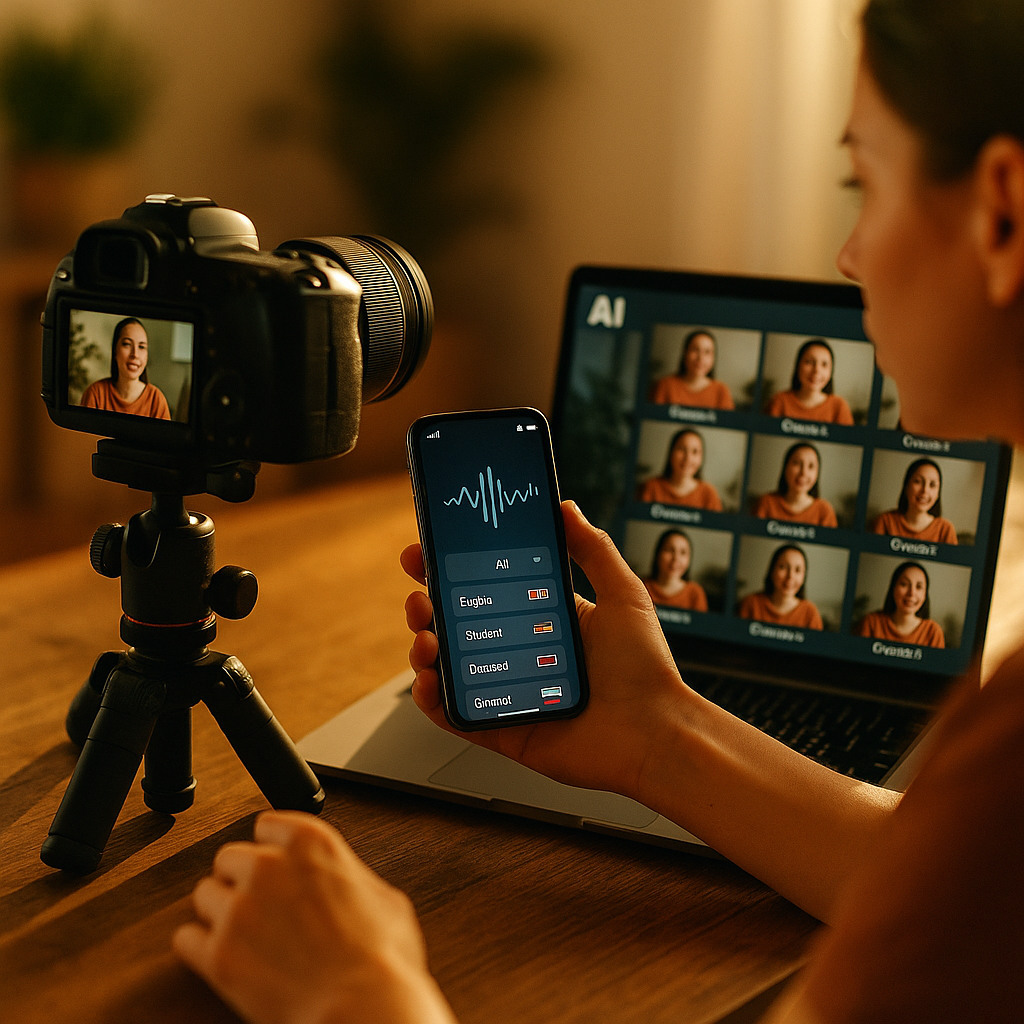
One creator shoot. Ten markets. Zero reshoots. That’s the pitch behind AI-dubbed creator content, and it’s why brands running global campaigns are quietly ripping up their old localization budgets. Tools like ElevenLabs and HeyGen can now clone a creator’s voice, match their lip movements, and output a version in Spanish, Hindi, or Japanese in under an hour. The question isn’t whether AI dubbing works anymore. It’s whether your team knows how to brief for it.
Why This Format Is Suddenly Everywhere
Localization used to mean picking a handful of priority markets and hiring local creators for each one. That’s still the gold standard for authenticity, but it’s slow and expensive, and most brands can’t afford ten separate creator relationships for ten regions. AI dubbing flips the math: shoot once with your best-performing creator, then localize the audio track using synthetic voice cloning that preserves tone, pacing, and even emotional inflection.
The result isn’t a dubbed movie with mismatched mouths. Modern tools sync lip movement to the new language, so a UGC-style video in English can pass as native content in Portuguese without looking like a dub at all. That matters because audiences are brutal about spotting inauthentic localization, and a bad dub kills trust faster than no localization at all.
Brands using AI dubbing for creator content report localization costs dropping by 60 to 80 percent compared to hiring regional creators for every market, according to workflow data shared by dubbing platforms like ElevenLabs.
What the Format Actually Requires
AI-dubbed creator content isn’t a “set it and forget it” workflow. It requires a specific production approach from day one, because the source video has to be built for translation, not just for its original market.
- Clean audio isolation. Background noise, music beds, and overlapping dialogue confuse voice cloning models. Shoot with a lav mic and keep ambient sound separate so the AI has a clean track to clone.
- Simple, universal gestures. A creator pointing at a product works in every language. A creator making a culturally specific hand gesture or idiom does not. Brief for gestures and phrasing that translate, not just words that do.
- Pacing built for dubbing. Sentences with awkward pauses or rapid-fire jokes often break timing when translated, since some languages need more syllables to say the same thing. German and Finnish run longer than English; Mandarin often runs shorter. Build in buffer room.
- Rights and consent for voice cloning. Creators need to explicitly consent to having their voice cloned and reused across markets. This isn’t optional. It’s a contract line item now.
This is where a lot of teams stumble. They treat AI dubbing as a post-production fix instead of a pre-production decision, and it shows in the output. If you’re already building briefs designed for scale, this pairs well with a studio-style production approach where one shoot day is engineered to generate multiple deliverables.
Picking Your Ten Languages (It’s Not Just Population)
Ten languages sounds like a nice round number for a headline, but the real decision is which ten. Population size is the obvious metric and the wrong one to lead with. What actually matters is where your paid media spend is going, where your affiliate or influencer partnerships already have traction, and where your product has commercial readiness (shipping, payment methods, customer support).
A reasonable starting stack for a US-based DTC brand expanding internationally: Spanish (Latin America and US bilingual audiences), Portuguese (Brazil), French, German, Italian, Japanese, Korean, Hindi, Arabic, and Indonesian. That list covers massive commerce markets and regions where short-form video consumption is exploding, per eMarketer’s ongoing tracking of global social commerce growth.
But don’t just localize the language. Localize the hook. A cold open that works for a US TikTok audience might land flat in Japan, where pacing and directness norms differ. AI dubbing solves the audio problem, not the cultural relevance problem. You still need a human review pass in each market before publishing.
The Workflow, Step by Step
Here’s roughly how the production pipeline runs once you’ve got source footage locked:
- Transcribe and translate the script. Use a professional translation service or a hybrid AI-plus-human editor pass. Machine translation alone still produces stiff, literal phrasing that native speakers flag immediately.
- Generate the cloned voice track. Feed the creator’s isolated audio into the voice cloning tool along with the translated script. Most platforms let you adjust emotional tone and pacing manually.
- Sync lip movement. Tools like HeyGen and Synthesia offer lip-sync layers that adjust mouth movement to match the new audio, which is the difference between “obviously dubbed” and “looks native.”
- Run a native speaker QA pass. Non-negotiable. Have someone fluent in the target market review for tone, slang accuracy, and cultural fit before it goes live.
- Add localized captions and on-screen text. Don’t just dub the audio and leave English captions. Mismatched text and audio reads as lazy and can hurt watch time.
- Test on a small paid budget before scaling. Run each localized version through a modest test spend to confirm retention and conversion before committing to full rollout.
Step four is where most teams cut corners because it feels like the “manual” step in an otherwise automated process. Don’t skip it. A single mistranslated phrase or unintentionally offensive slang term can tank a campaign in a new market, and the reputational cost is far higher than the QA cost would have been.
Where This Breaks Down
AI dubbing isn’t magic, and it has real limits worth planning around.
Humor doesn’t translate cleanly. Jokes built on wordplay or cultural references often need a full rewrite, not a direct translation. If your source video leans heavily on humor, budget for a copywriter in each target market rather than relying purely on the dubbing pipeline.
Regional dialects get flattened. Spanish in Mexico isn’t Spanish in Spain. Arabic varies significantly by region. Most AI dubbing tools default to a “standard” version of a language that can sound slightly off to native ears in specific countries. If a market is high priority, consider a dialect-specific pass rather than the default output.
Disclosure and compliance rules don’t disappear. If the original video includes a paid partnership disclosure, the localized version needs the equivalent disclosure under that market’s rules, not just a translated version of the US disclosure language. The FTC’s endorsement guidelines apply to US audiences regardless of language, and other markets have their own regulators with different requirements. The UK’s ICO guidance on data and consent is worth a look too if you’re handling audience data across regions for retargeting.
A dubbed video that skips localized disclosure language isn’t just a compliance risk. It’s a trust risk in markets where regulators and audiences are increasingly attentive to influencer transparency.
Does It Actually Perform Better Than Native Creators?
Short answer: it depends on the goal. For top-of-funnel awareness and paid social scaling, AI-dubbed content from a single strong creator often outperforms a patchwork of unknown regional creators, simply because the original performance data (hook rate, watch time, conversion) already proved the creative works. You’re scaling a known winner, not gambling on an unknown one.
For deep community trust building, though, nothing beats an actual local creator who understands the market’s humor, slang, and platform norms natively. Brands running long-term ambassador programs in specific countries still need real local voices. AI dubbing is best treated as a scaling layer for proven creative, not a replacement for genuine regional creator partnerships. Think of it as sitting alongside your other conversion tools, similar to how a content ladder approach stretches one shoot across funnel stages, just stretched across geography instead.
It’s also worth pairing with strong watch-time fundamentals. If your source video has weak hooks or pacing issues, dubbing it into ten languages just multiplies a mediocre asset. Fix the hook and pacing structure before you localize, not after.
Budget and Tooling Reality Check
Most AI dubbing platforms charge per minute of output audio, and pricing has dropped sharply as competition between ElevenLabs, HeyGen, Synthesia, and newer entrants intensifies. A 60-second video localized into ten languages typically runs a few hundred dollars total in tooling costs, plus whatever you pay for professional translation and native QA review. Compare that to hiring ten separate creators at even a modest micro-influencer rate, and the savings are obvious.
The bigger budget line isn’t the dubbing itself. It’s the human review layer: translators, native QA reviewers, and a project manager coordinating ten simultaneous localized launches. Don’t cut that layer to save money. It’s the part protecting your brand from the exact mistakes that make AI dubbing look cheap and careless instead of smart and scalable.
Platforms like Sprout Social and native platform ad managers (TikTok Ads Manager, Meta Business Suite) can help you track performance by market once your localized versions are live, so you can double down on the languages actually converting and cut the ones that aren’t.
Next Step
Pick one high-performing creator video, three target languages that map to real commercial opportunity, and run the full pipeline including native QA before you scale to ten. Prove the workflow small, then let performance data decide which markets earn the remaining seven.
FAQs
What is AI-dubbed creator content?
It’s creator video localized into other languages using AI voice cloning and lip-sync technology instead of hiring separate creators or human dubbing actors for each market. The original creator’s voice and delivery style are preserved across every language version.
Which tools are commonly used for AI dubbing?
ElevenLabs, HeyGen, and Synthesia are among the most widely used platforms for voice cloning and lip-sync dubbing in creator marketing workflows as of now.
Is AI voice cloning legal without creator consent?
No. Creators must explicitly consent to having their voice cloned and reused for localized versions. This should be written into the original content agreement, not assumed or added after the fact.
How much does it cost to localize one video into ten languages?
Tooling costs for a short video typically run a few hundred dollars total across ten languages, though total cost including professional translation and native QA review can run higher depending on video length and market complexity.
Does AI dubbing work for humor-heavy content?
Not reliably. Jokes built on wordplay or cultural references usually need a full script rewrite for each market rather than a direct AI translation, so budget extra copywriting time for humor-driven creative.
Do disclosure requirements change across localized versions?
Yes. Each market may have different regulatory requirements for sponsored content disclosure, and a translated version of a US disclosure isn’t automatically compliant elsewhere. Check local regulator guidance for each target market.
Top Influencer Marketing Agencies
The leading agencies shaping influencer marketing in 2026
Agencies ranked by campaign performance, client diversity, platform expertise, proven ROI, industry recognition, and client satisfaction. Assessed through verified case studies, reviews, and industry consultations.
Moburst

-
2

The Shelf
Boutique Beauty & Lifestyle Influencer AgencyA data-driven boutique agency specializing exclusively in beauty, wellness, and lifestyle influencer campaigns on Instagram and TikTok. Best for brands already focused on the beauty/personal care space that need curated, aesthetic-driven content.Clients: Pepsi, The Honest Company, Hims, Elf Cosmetics, Pure LeafVisit The Shelf → -
3

Audiencly
Niche Gaming & Esports Influencer AgencyA specialized agency focused exclusively on gaming and esports creators on YouTube, Twitch, and TikTok. Ideal if your campaign is 100% gaming-focused — from game launches to hardware and esports events.Clients: Epic Games, NordVPN, Ubisoft, Wargaming, Tencent GamesVisit Audiencly → -
4

Viral Nation
Global Influencer Marketing & Talent AgencyA dual talent management and marketing agency with proprietary brand safety tools and a global creator network spanning nano-influencers to celebrities across all major platforms.Clients: Meta, Activision Blizzard, Energizer, Aston Martin, WalmartVisit Viral Nation → -
5

The Influencer Marketing Factory
TikTok, Instagram & YouTube CampaignsA full-service agency with strong TikTok expertise, offering end-to-end campaign management from influencer discovery through performance reporting with a focus on platform-native content.Clients: Google, Snapchat, Universal Music, Bumble, YelpVisit TIMF → -
6

NeoReach
Enterprise Analytics & Influencer CampaignsAn enterprise-focused agency combining managed campaigns with a powerful self-service data platform for influencer search, audience analytics, and attribution modeling.Clients: Amazon, Airbnb, Netflix, Honda, The New York TimesVisit NeoReach → -
7

Ubiquitous
Creator-First Marketing PlatformA tech-driven platform combining self-service tools with managed campaign options, emphasizing speed and scalability for brands managing multiple influencer relationships.Clients: Lyft, Disney, Target, American Eagle, NetflixVisit Ubiquitous → -
8

Obviously
Scalable Enterprise Influencer CampaignsA tech-enabled agency built for high-volume campaigns, coordinating hundreds of creators simultaneously with end-to-end logistics, content rights management, and product seeding.Clients: Google, Ulta Beauty, Converse, AmazonVisit Obviously →