


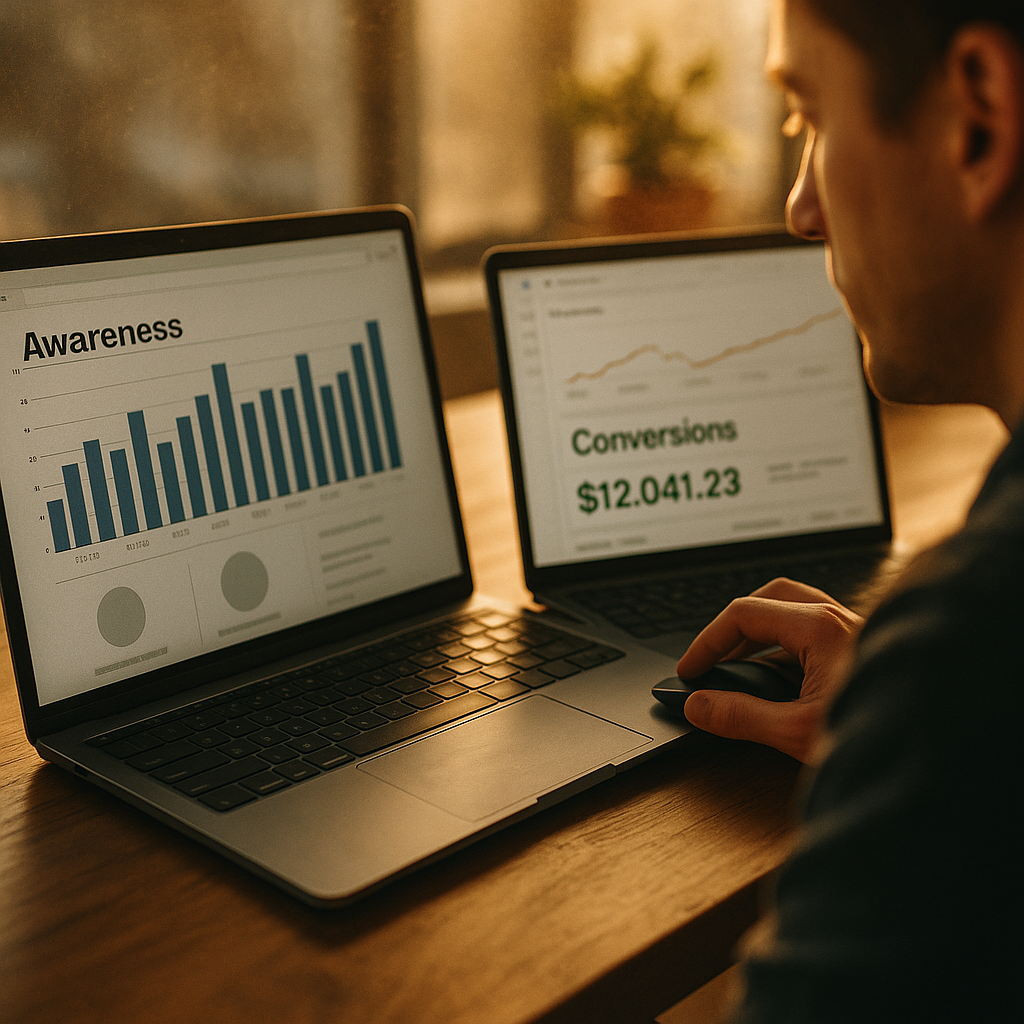
Marketers can now trace a TikTok view to a checkout page in under 72 hours. So why can’t anyone tell you what a brand awareness campaign actually bought you? That gap, between what’s measurable and what’s trusted, is the biggest unresolved question in influencer marketing heading into next year. Bottom funnel conversion tracking has never been sharper. Awareness campaign ROI, meanwhile, still runs on vibes, reach numbers, and hope.
The Funnel Got Easy to Measure at the Bottom
Something real happened over the past two years. Pay per conversion deals, UTM-tagged creator links, and promo code attribution turned the bottom of the funnel into something finance teams can actually audit. Brands no longer have to guess whether a creator partnership drove sales. They can watch it happen in a dashboard, in near real time.
That shift is documented in detail in our coverage of how pay per conversion deals are replacing flat CPM arrangements across the industry. Performance marketing logic has colonized influencer budgets, and for good reason. When a CFO asks “what did we get for this,” conversion data gives a clean answer.
Blended creator strategies have accelerated this trend further. Programs that mix conversion incentives with content licensing are closing what used to be a measurement black hole, as we detailed in our piece on conversion blended creator plans. The tooling exists. The appetite exists. The bottom funnel is, functionally, solved.
So Why Can’t We Prove Awareness Works?
Here’s the uncomfortable part. The same brands celebrating their conversion dashboards still can’t answer a simpler question: did the awareness campaign move anyone who hadn’t already decided to buy?
Awareness lives upstream of intent. By definition, it touches people who aren’t searching, clicking, or ready to convert. That makes it nearly impossible to tag with a last-click model. A viewer who sees a creator’s unboxing video today might not purchase for six months, switch devices twice, and land on the brand’s site through an organic search that has zero trace of the original touchpoint. Multi-touch attribution tools try to stitch this together, but they’re built on probabilistic modeling, not hard data. Ask three attribution vendors for the same campaign’s true awareness lift and you’ll get three different numbers.
Bottom funnel metrics answer “did it work.” Awareness metrics can only ever answer “did it probably help,” and that distinction is where most measurement arguments inside brand marketing teams actually live.
Industry data backs up the frustration. Survey work from eMarketer has repeatedly found that marketers rate brand awareness as a top campaign objective while simultaneously ranking it among the hardest outcomes to measure with confidence. That contradiction isn’t new, but the stakes are higher now that conversion budgets have a clear, provable track record to compete against internally.
Attribution Models Weren’t Built for This
Most attribution infrastructure was designed to answer direct response questions: which ad, which click, which code drove this specific sale. Awareness doesn’t fit that shape. It’s cumulative, slow, and often invisible until it shows up months later as a lift in branded search volume or unaided recall in a survey.
Brand lift studies exist to fill this gap, but they come with real limitations. They’re expensive, they require large sample sizes to be statistically meaningful, and platforms like Meta often run them as a managed service rather than something a brand can self-serve and validate independently. Smaller and mid-market brands frequently can’t justify the cost, which means they’re flying blind on exactly the metric their CMO cares about most.
This measurement gap isn’t unique to influencer marketing, but the creator channel feels it acutely because budgets have grown so fast. Our analysis of how influencer budgets grew 171 percent while measurement infrastructure stagnated shows the scale of the mismatch. Spend outpaced the tools built to justify it, and awareness is where that gap is widest.
Procurement Doesn’t Care About Nuance
Here’s where it gets political inside organizations. Procurement teams, increasingly involved in influencer spend decisions as covered in our piece on creator ad spend hitting 37 billion, want numbers that fit into a spreadsheet. Conversion rate, cost per acquisition, return on ad spend: these translate cleanly into procurement logic. Awareness lift, brand favorability shifts, and share of voice do not translate nearly as cleanly, and procurement teams are not shy about saying so.
The result is a quiet but real budget bias. Dollars migrate toward what’s provable, even when marketing science suggests awareness spend is what makes the conversion engine work in the first place. You can’t harvest demand you never planted. But try explaining that to a finance team staring at two line items where only one has a clean ROI number attached.
This dynamic isn’t limited to influencer marketing. HubSpot’s own marketing research has flagged similar tension between brand marketers and growth marketers fighting over the same shrinking budget pool, each side armed with different definitions of what counts as proof.
AI Tools Promise Answers, Mostly Deliver Estimates
A new wave of AI-powered attribution platforms claims to solve the awareness measurement problem by modeling incrementality across the entire customer journey. Some of this is genuinely useful. Agentic platforms that execute and adjust campaigns in real time, as explored in our coverage of agentic martech replacing dashboards, can surface directional signals faster than quarterly brand studies ever could.
But directional signals aren’t the same as proof. Marketers report using AI tools daily without being able to benchmark whether those tools actually improved outcomes, a finding we covered in detail when looking at how 61 percent use AI daily yet few can prove the ROI. Automation adoption has outpaced measurement discipline across the board, not just in awareness campaigns specifically, as our reporting on marketers automating tasks without proof of ROI makes clear.
What Smart Teams Are Actually Doing
The brands making peace with this uncertainty aren’t waiting for a perfect attribution model. They’re adopting a portfolio mindset instead.
- Set separate success criteria. Awareness campaigns get judged on reach quality, engagement depth, and branded search lift, not last-click conversion.
- Run holdout tests. Geographic or audience holdout groups remain one of the few methods that produce genuinely causal evidence of awareness impact, even if they’re operationally harder to execute.
- Track branded search as a proxy. A spike in branded search volume following a creator awareness push is a far more reliable signal than impressions or video views alone.
- Protect a fixed percentage of budget. Teams that ring-fence awareness spend before the fiscal year starts avoid the slow bleed toward conversion-only allocation.
- Benchmark against category norms. Tools from Sprout Social and similar platforms offer engagement benchmarks that, while imperfect, give awareness campaigns something to be measured against beyond raw vanity metrics.
None of this fully closes the measurement gap. But it reframes the conversation from “prove it worked” to “prove it’s directionally sound,” which is a fight brand teams can actually win internally.
The Risk of Over-Correcting Toward Conversion
There’s a quieter danger here that doesn’t get enough attention: brands that chase only measurable conversion may be starving the top of their own funnel without realizing it. Creator content increasingly doubles as paid ad creative, a shift we detailed in our piece on creator content turning into ad creative, and that repurposing only works if there’s a healthy volume of fresh, awareness-stage content being produced in the first place.
Cut awareness spend too aggressively and the conversion engine eventually runs dry of new audiences to convert. It’s a slow leak, not a sudden collapse, which is exactly why it’s so easy for budget committees to miss until pipeline numbers start softening a few quarters later.
FAQs
Frequently Asked Questions
Why is awareness campaign ROI so much harder to measure than conversion ROI?
Awareness campaigns target people earlier in the decision journey, often months before any purchase intent forms. Last-click attribution models can’t connect that early exposure to a later sale, so marketers rely on proxies like brand lift studies, branded search volume, and recall surveys, none of which offer the clean, auditable trail that conversion tracking provides.
Are brand lift studies worth the investment?
For large brands with significant media budgets, yes, they offer statistically meaningful signal. For mid-market and smaller brands, the cost and sample size requirements often make them impractical, which leaves those teams with weaker proxy metrics instead.
Should brands shift all budget toward bottom funnel conversion since it’s easier to prove?
No. Over-indexing on conversion spend risks depleting the audience pool that conversion campaigns depend on. Most mature marketing teams protect a fixed percentage of budget for awareness work regardless of measurement difficulty, treating it as a long-term investment rather than a quarterly line item.
What’s a reliable proxy metric for awareness campaign performance?
Branded search volume is one of the stronger available proxies. A measurable lift in searches for the brand name following a creator or awareness campaign suggests the message registered, even without a direct conversion trail.
Will AI attribution tools eventually solve this measurement gap?
They’re improving the quality of directional estimates, but current AI attribution models still rely on probabilistic modeling rather than deterministic proof. They can inform decisions faster, but they haven’t replaced the need for holdout testing and brand lift studies for genuinely causal evidence.
The takeaway: stop trying to force awareness campaign ROI into a conversion-shaped box. Ring-fence a fixed budget for upper-funnel work, measure it against branded search and holdout tests instead of last-click data, and let the bottom funnel’s clean numbers do what they’re good at: proving the engine you built upstream.
Frequently Asked Questions
Top Influencer Marketing Agencies
The leading agencies shaping influencer marketing in 2026
Agencies ranked by campaign performance, client diversity, platform expertise, proven ROI, industry recognition, and client satisfaction. Assessed through verified case studies, reviews, and industry consultations.
Moburst

-
2

The Shelf
Boutique Beauty & Lifestyle Influencer AgencyA data-driven boutique agency specializing exclusively in beauty, wellness, and lifestyle influencer campaigns on Instagram and TikTok. Best for brands already focused on the beauty/personal care space that need curated, aesthetic-driven content.Clients: Pepsi, The Honest Company, Hims, Elf Cosmetics, Pure LeafVisit The Shelf → -
3

Audiencly
Niche Gaming & Esports Influencer AgencyA specialized agency focused exclusively on gaming and esports creators on YouTube, Twitch, and TikTok. Ideal if your campaign is 100% gaming-focused — from game launches to hardware and esports events.Clients: Epic Games, NordVPN, Ubisoft, Wargaming, Tencent GamesVisit Audiencly → -
4

Viral Nation
Global Influencer Marketing & Talent AgencyA dual talent management and marketing agency with proprietary brand safety tools and a global creator network spanning nano-influencers to celebrities across all major platforms.Clients: Meta, Activision Blizzard, Energizer, Aston Martin, WalmartVisit Viral Nation → -
5

The Influencer Marketing Factory
TikTok, Instagram & YouTube CampaignsA full-service agency with strong TikTok expertise, offering end-to-end campaign management from influencer discovery through performance reporting with a focus on platform-native content.Clients: Google, Snapchat, Universal Music, Bumble, YelpVisit TIMF → -
6

NeoReach
Enterprise Analytics & Influencer CampaignsAn enterprise-focused agency combining managed campaigns with a powerful self-service data platform for influencer search, audience analytics, and attribution modeling.Clients: Amazon, Airbnb, Netflix, Honda, The New York TimesVisit NeoReach → -
7

Ubiquitous
Creator-First Marketing PlatformA tech-driven platform combining self-service tools with managed campaign options, emphasizing speed and scalability for brands managing multiple influencer relationships.Clients: Lyft, Disney, Target, American Eagle, NetflixVisit Ubiquitous → -
8

Obviously
Scalable Enterprise Influencer CampaignsA tech-enabled agency built for high-volume campaigns, coordinating hundreds of creators simultaneously with end-to-end logistics, content rights management, and product seeding.Clients: Google, Ulta Beauty, Converse, AmazonVisit Obviously →