


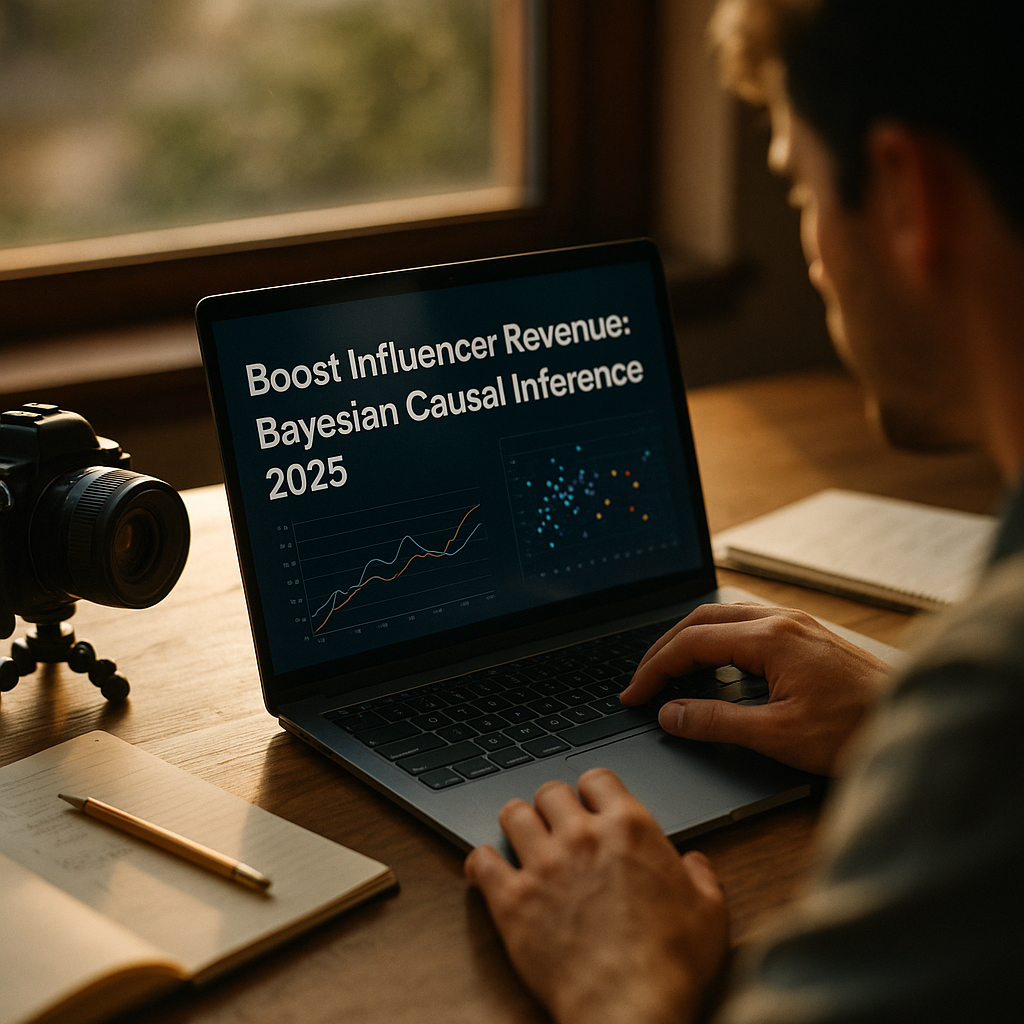
Unlock the power of Bayesian causal inference to precisely attribute revenue lift to influencer marketing campaigns. This advanced statistical method empowers marketers to move past guesswork and accurately isolate the financial impact of influencers. Discover how you can apply Bayesian techniques to drive smarter decisions and gain a measurable edge in influencer marketing today.
Understanding Bayesian Causal Inference for Marketing Analytics
Bayesian causal inference is revolutionizing how businesses attribute value to their marketing channels. By using probability theory and prior knowledge, it allows marketers to answer causal questions—such as “Did this influencer really boost my sales?”—with statistical rigor. Rather than relying on simplistic “before and after” comparisons, Bayesian methods model uncertainty, dependence, and variability, producing more robust and reliable insights.
According to recent research published in 2024, marketers who implement Bayesian approaches report a 31% improvement in attribution accuracy compared to conventional analytics. This uptick reflects the method’s adaptability to real-world complexity, such as overlapping campaigns, seasonality, and varying consumer behaviors. The primary advantage? Marketers can finally separate influencer-driven revenue lift from the noise of other promotional efforts.
Designing the Right Experiment to Detect Influencer-Driven Revenue
To utilize Bayesian inference effectively, you must start with a sound experimental design. This often means creating a natural or randomized controlled experiment that isolates influencer impact from other variables. For example, you might:
- Segment your audience into exposed and unexposed groups
- Track revenue and behavior across both groups over a defined period
- Use randomized rollout of influencer content to eliminate selection bias
Proper experimentation forms the backbone of trustworthy causal inference. By ensuring that your data collection is unbiased and granular, you maximize the reliability of any subsequent Bayesian models and analyses. It’s crucial to pre-register your hypotheses, keep treatment and control samples large and representative, and log all influencing factors—even those not directly related to the influencer campaign, such as concurrent promotions or seasonal spikes.
Applying Bayesian Statistical Models to Attribute Revenue Lift
Once your data is collected, Bayesian statistical modeling begins. At its core, the process follows these steps:
- Establish Prior Beliefs: Start with what you already know—historical campaign data, industry benchmarks, or expert predictions.
- Set Up a Likelihood Function: Model how likely your observed results are, given various levels of influencer impact. This might mean modeling daily revenue as a function of influencer visibility, holding other factors constant.
- Update With Data: Use Bayes’ theorem to update your prior beliefs with observed campaign data. The result is a posterior distribution that quantifies the probable causal effect of the influencer.
Compared to traditional A/B testing, Bayesian approaches deliver probabilities and credible intervals. For example, rather than concluding, “Influencer X raised sales by $40,000,” you’ll report, “There is a 95% probability that Influencer X increased sales by $35,000–$45,000 during the campaign period.” This nuanced approach empowers decision-makers to act on quantified uncertainty, managing risk more intelligently.
Interpreting Bayesian Results for Actionable Insights
Understanding how to interpret your Bayesian outputs is vital. Look for these key indicators:
- Posterior Mean and Median: The expected value of the influencer’s contribution.
- Credible Interval: The range of values that captures your desired confidence, usually 90% or 95%—this replaces classical confidence intervals but offers a more direct probability statement.
- Probability of Positive Impact: Unlike p-values, Bayesian stats can directly state, “There’s a 98% probability this influencer drove revenue lift.”
In 2025, most advanced marketing analytics platforms incorporate visual dashboards powered by Bayesian engines, enabling marketers to simulate “what-if” scenarios and forecast influencer efficacy under various market conditions. Use these insights to allocate budgets, negotiate influencer contracts, and optimize future campaigns with precision.
Best Practices for Integrating Bayesian Causal Inference in Your Workflow
Success with Bayesian causal inference depends on repeatable processes and the right technology infrastructure. Leading organizations follow these principles:
- Automate Data Pipelines: Invest in tools that integrate influencer data, sales transactions, and external variables (like seasonality or competitor activity) into a clean analysis-ready format.
- Continuous Learning: Treat each influencer campaign as a new source of prior information—use today’s findings to refine tomorrow’s analyses.
- Transparent Reporting: Communicate results in probabilistic terms, highlighting both evidence and uncertainty, to foster trust with stakeholders.
- Cross-Functional Collaboration: Bridge marketing, data science, and finance teams to ensure that insights translate into business action.
By embedding Bayesian thinking into campaign measurement, teams gain a future-ready framework—ensuring that influencer ROI estimates are always grounded in data, never in speculation.
The Strategic Advantage: Why Bayesian Causal Inference Matters in 2025
Today’s influencer landscape is more competitive and data-driven than ever. Brands that deploy Bayesian causal inference gain a direct strategic advantage: they pinpoint true revenue lift, refine influencer selection, and minimize wasted budget. This approach helps de-risk investments and uncovers influencer synergies and diminishing returns—insight that generic analytics overlook.
With rapid changes in influencer platforms and shifting consumer attention, traditional heuristics can’t keep up. Bayesian methods thrive in this dynamic environment—a natural match for brands seeking clarity and impact in 2025’s evolving marketplace.
Frequently Asked Questions
-
What is Bayesian causal inference?
Bayesian causal inference applies probability theory to establish whether a cause (such as an influencer campaign) leads to a specific effect (revenue lift), providing nuanced, probabilistic answers rather than simple yes/no conclusions.
-
How does Bayesian inference improve influencer revenue attribution?
It separates influencer-driven revenue from other factors, models uncertainty, and delivers confidence levels for each conclusion. The approach is especially useful for overlapping or complex campaigns typical in influencer marketing.
-
Do I need advanced technical skills to use Bayesian causal inference?
Modern analytics platforms increasingly automate the process, but having a team member with statistical or data science expertise helps maximize effectiveness and interpret results accurately.
-
How long does it take to see actionable results?
Depending on data quality and campaign complexity, actionable Bayesian insights can emerge within a few weeks, especially if you’ve established automation and strong data governance practices.
-
Is Bayesian causal inference only for large brands?
No—brands of all sizes benefit from the improved accuracy. Small and medium businesses can use scalable solutions or consultancies to unlock these advanced insights without major infrastructure investment.
Leveraging Bayesian causal inference in 2025 lets you isolate influencer-driven revenue lift with unmatched accuracy. By combining rigorous data collection, advanced modeling, and transparent reporting, marketers empower their teams to make smarter, evidence-based decisions—and maximize influencer ROI in a competitive digital ecosystem.
Top Influencer Marketing Agencies
The leading agencies shaping influencer marketing in 2026
Agencies ranked by campaign performance, client diversity, platform expertise, proven ROI, industry recognition, and client satisfaction. Assessed through verified case studies, reviews, and industry consultations.
Moburst

-
2

The Shelf
Boutique Beauty & Lifestyle Influencer AgencyA data-driven boutique agency specializing exclusively in beauty, wellness, and lifestyle influencer campaigns on Instagram and TikTok. Best for brands already focused on the beauty/personal care space that need curated, aesthetic-driven content.Clients: Pepsi, The Honest Company, Hims, Elf Cosmetics, Pure LeafVisit The Shelf → -
3

Audiencly
Niche Gaming & Esports Influencer AgencyA specialized agency focused exclusively on gaming and esports creators on YouTube, Twitch, and TikTok. Ideal if your campaign is 100% gaming-focused — from game launches to hardware and esports events.Clients: Epic Games, NordVPN, Ubisoft, Wargaming, Tencent GamesVisit Audiencly → -
4

Viral Nation
Global Influencer Marketing & Talent AgencyA dual talent management and marketing agency with proprietary brand safety tools and a global creator network spanning nano-influencers to celebrities across all major platforms.Clients: Meta, Activision Blizzard, Energizer, Aston Martin, WalmartVisit Viral Nation → -
5

The Influencer Marketing Factory
TikTok, Instagram & YouTube CampaignsA full-service agency with strong TikTok expertise, offering end-to-end campaign management from influencer discovery through performance reporting with a focus on platform-native content.Clients: Google, Snapchat, Universal Music, Bumble, YelpVisit TIMF → -
6

NeoReach
Enterprise Analytics & Influencer CampaignsAn enterprise-focused agency combining managed campaigns with a powerful self-service data platform for influencer search, audience analytics, and attribution modeling.Clients: Amazon, Airbnb, Netflix, Honda, The New York TimesVisit NeoReach → -
7

Ubiquitous
Creator-First Marketing PlatformA tech-driven platform combining self-service tools with managed campaign options, emphasizing speed and scalability for brands managing multiple influencer relationships.Clients: Lyft, Disney, Target, American Eagle, NetflixVisit Ubiquitous → -
8

Obviously
Scalable Enterprise Influencer CampaignsA tech-enabled agency built for high-volume campaigns, coordinating hundreds of creators simultaneously with end-to-end logistics, content rights management, and product seeding.Clients: Google, Ulta Beauty, Converse, AmazonVisit Obviously →