


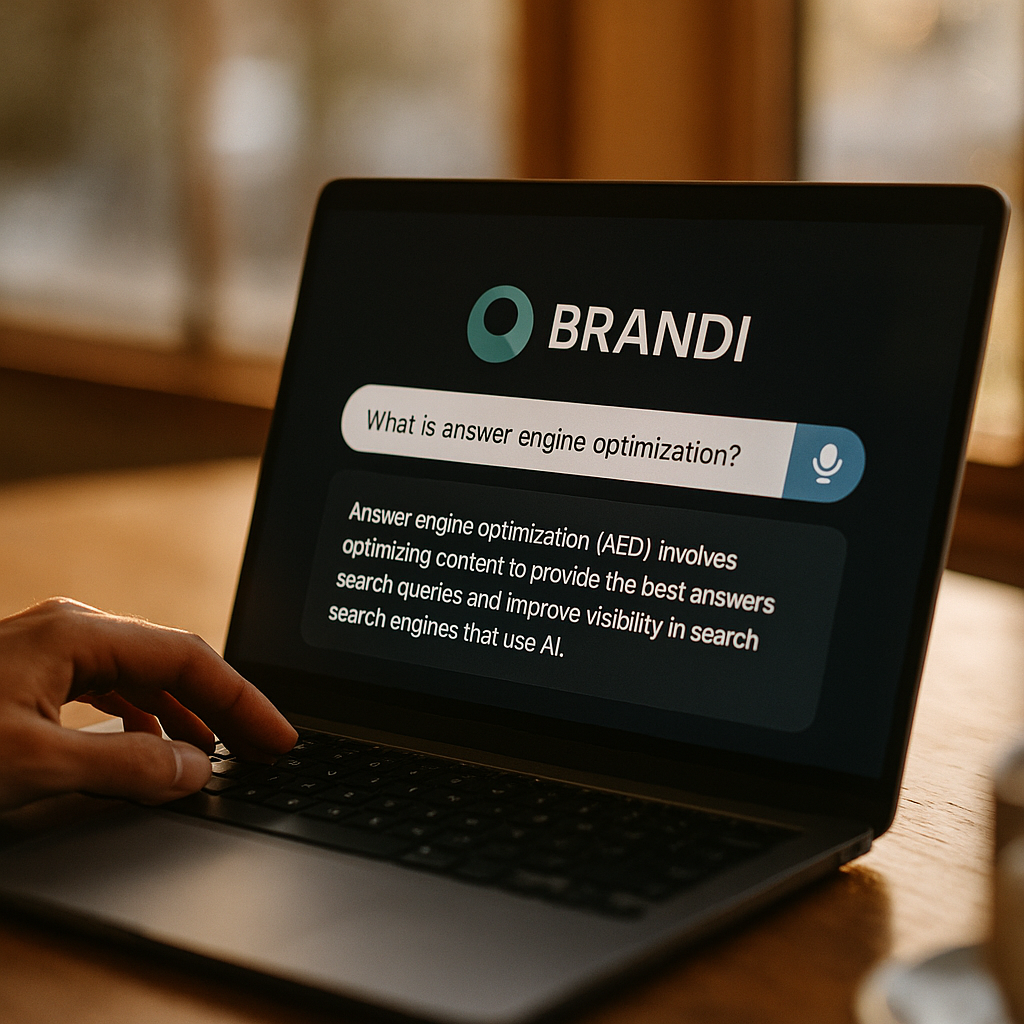
Nearly 60% of Google searches now end without a click, and a growing share of those queries get answered directly inside an AI Overview or a ChatGPT response. If your brand isn’t showing up in that answer, you don’t just lose a click. You lose the conversation entirely. That’s the premise behind answer engine optimization, and it’s why a tool like Brandi AI recently getting industry recognition matters more than the headline suggests.
This isn’t a story about one startup winning an award. It’s a signal that brand visibility inside generative AI has become a measurable, budgetable line item — and most marketing teams are still flying blind.
What Brandi AI’s Recognition Actually Signals
Brandi AI positions itself as a monitoring layer for how brands appear (or don’t) across large language model outputs. Its recent recognition in marketing tech circles wasn’t for flashy creative work. It was for solving a boring, unglamorous problem: brands have no idea what ChatGPT, Gemini, or Google’s AI Overviews say about them.
Think about that for a second. Marketing teams spend six or seven figures tracking share of voice on search engines, social platforms, and review sites. Yet ask most CMOs what ChatGPT says when a prospect asks “best CRM for mid-market SaaS” or “most sustainable sneaker brands,” and you’ll get a shrug. That blind spot is exactly the gap tools like Brandi AI are built to close.
The brands winning in generative search aren’t necessarily the ones with the biggest SEO budgets — they’re the ones who figured out that AI Overviews and chatbot answers are a new distribution channel, not a search ranking factor to be gamed the old way.
The recognition matters because it validates a category. When analysts and trade publications start covering “citation tracking” as a distinct discipline, separate from traditional SEO reporting, that’s a market maturing in real time.
Why Brand Citations Are the New SERP Ranking
For two decades, marketers optimized for position one on a search results page. That model is breaking down. When a user asks an AI assistant a question, there’s no page of ten blue links to compete for. There’s one synthesized answer, built from sources the model decides to cite — or not cite at all.
Being “cited” inside an AI-generated answer is the new equivalent of ranking on page one. Except it’s binary. You’re either mentioned or you’re invisible. There’s no page two to fall back on.
This changes the entire calculus of visibility. A brand could dominate traditional organic search results and still get zero mentions in ChatGPT’s answer to a category-defining question. That’s because LLMs draw on training data, retrieval-augmented sources, and real-time web crawling in ways that don’t map cleanly to PageRank logic. Google’s own documentation on AI-generated search features acknowledges the systems pull from a different signal set than classic ranking algorithms.
For brand and content teams, that means the SEO playbook you perfected over the last ten years only gets you partway there.
How Citation Tracking Actually Works
Tools in this category — Brandi AI included — generally run a version of the same core process:
- Query simulation: Running large batches of realistic customer questions through ChatGPT, Gemini, Perplexity, and Google’s AI Overviews to see what gets surfaced.
- Citation extraction: Identifying whether, and how, a specific brand name, product, or URL appears in the generated answer.
- Sentiment and context scoring: Flagging whether the mention is favorable, neutral, or outright wrong (LLMs hallucinate brand facts more often than marketers would like).
- Competitive benchmarking: Comparing citation frequency against direct competitors across the same query set.
- Source attribution: Tracing which underlying web content the AI model appears to be pulling from, so content teams know what’s actually working.
This is meaningfully different from traditional rank tracking. A rank tracker tells you where you sit on a results page. A citation tracker tells you whether you exist at all in the answer a customer actually reads. Brands that have started layering this into their broader answer-engine monitoring stack are finding gaps they never knew existed — categories where a competitor gets cited in nine out of ten AI responses and they get cited in zero.
The Budget Conversation Nobody’s Had Yet
Here’s the uncomfortable part for marketing leaders: most budgets still don’t have a line item for this. SEO gets funded. Paid search gets funded. Answer engine visibility? It usually falls into a gray zone between the SEO team, the PR team, and whoever owns “brand.”
That’s a structural problem, not a tooling problem.
Some agencies are already treating this as its own discipline, closer to generative search marketing than classic SEO. The reasoning is straightforward: if a meaningful share of category research now happens inside a chat interface instead of a search bar, brand visibility strategy needs its own budget, its own KPIs, and its own reporting cadence — not a bolt-on to the existing SEO retainer.
Gartner and other analyst firms have publicly projected steep declines in traditional search volume as AI-driven answers absorb more query intent. Whether or not the exact numbers hold, the directional trend is hard to argue with.
What Marketers Get Wrong About “Optimizing” for AI Answers
There’s a temptation to treat answer engine optimization like SEO 2.0 — stuff keywords into content, add schema markup, wait for citations to roll in. That’s not how it works, and treating it that way wastes budget.
LLMs weight authority, consistency, and structured clarity differently than search crawlers. A brand that gets cited repeatedly usually has:
- Consistent factual information across its own site, third-party reviews, Wikipedia (if applicable), and press coverage — LLMs cross-reference for consistency.
- Clear, extractable answers to specific questions rather than marketing fluff. Models favor content that reads like a direct answer, not a sales pitch.
- Genuine third-party citations and mentions, not just owned content. If nobody outside your own domain is talking about you, the model has less to work with.
- Structured data and schema that make claims machine-readable, reducing the odds of hallucinated or outdated information being cited instead.
Brands chasing this the wrong way pump out generic AI-written content hoping volume wins. It doesn’t. If anything, thin AI-generated content is now competing against actual AI models for the same attention, and it’s losing. Quality, verifiable, well-sourced content still wins the citation game — which, frankly, should be reassuring to anyone who’s spent years arguing for content quality over content volume.
Risk Nobody’s Pricing In: Hallucinated Citations
There’s a compliance angle here that brand safety and legal teams need to start paying attention to. LLMs don’t just omit brands — they sometimes fabricate claims about them. Wrong pricing, discontinued products described as current, competitor features misattributed to your brand. None of that is defamation in the traditional sense, but it’s a customer trust problem waiting to happen.
Tracking citations isn’t just an upside play for visibility. It’s downside protection against your brand being misrepresented at scale, in a channel you don’t control and can’t directly correct.
This mirrors a pattern marketers have seen before with AI fraud detection in creator vetting — the tools that manage risk tend to lag well behind the adoption of the technology creating the risk. Answer engines are no different. Most brands are optimizing for citation frequency before they’ve even built a process to catch and correct citation errors.
Where This Fits Inside a Modern Marketing Stack
Citation tracking shouldn’t live in a silo. The brands getting this right are folding it into the same identity and attribution infrastructure they use everywhere else — the same instinct behind identity resolution as a foundation for broader AI marketing efforts. If you already have a system tracking share of voice, sentiment, and competitive positioning across social and search, answer engine citations should plug into that same dashboard, not create a fourth reporting silo nobody checks.
Some teams are also connecting citation data to prescriptive attribution models, using AI mention frequency as an early input into what content or PR investment to prioritize next quarter. That’s a smarter use of the data than just watching a dashboard tick up or down.
For agencies pitching this to clients, the framing matters. This isn’t “add AI monitoring for an extra fee.” It’s risk mitigation plus incremental visibility in a channel that’s actively eating into organic search traffic. According to eMarketer’s ongoing coverage of AI search behavior, a growing share of product research queries are being resolved without a single click to a brand’s own website. If that’s where research is happening, that’s where measurement has to happen too. HubSpot’s own research arm has flagged similar patterns in buyer research behavior shifting toward conversational tools, reinforcing that this isn’t a niche concern limited to tech-forward categories.
The Takeaway
Brandi AI’s recognition isn’t the story — it’s the flare signaling that answer engine optimization has moved from “interesting experiment” to “budget line item you’ll need to defend in next year’s planning cycle.” Start by running a citation audit across your top twenty category queries this quarter; you’ll likely find gaps that explain traffic and pipeline losses your current SEO reporting can’t account for.
FAQs
What is answer engine optimization, exactly?
Answer engine optimization (AEO) is the practice of improving how often, and how accurately, a brand gets mentioned or cited inside AI-generated answers from tools like ChatGPT, Google AI Overviews, Perplexity, and Gemini. It focuses on citation frequency and accuracy rather than traditional search ranking positions.
How is answer engine optimization different from traditional SEO?
Traditional SEO optimizes for ranking position on a search results page. AEO optimizes for whether a brand is cited at all inside a synthesized AI answer, where there’s no ranking list — just a single response that either includes you or doesn’t.
Why do brands need to track citations in ChatGPT and AI Overviews?
Because a growing share of research and purchase-consideration queries are now resolved inside AI chat interfaces without a click to any website. Brands that aren’t tracked or cited in those answers lose visibility in a channel they can’t otherwise measure, and risk having inaccurate information about them circulated unchecked.
Can LLMs give out wrong information about a brand?
Yes. Large language models can hallucinate outdated pricing, discontinued products, or misattributed features. This creates a brand trust and compliance risk that citation tracking tools are increasingly built to detect and flag.
What kind of content gets cited most often by AI models?
Content that directly and clearly answers specific questions, is factually consistent across multiple third-party sources, and includes structured data tends to get cited more reliably than promotional or generic marketing copy.
Should answer engine optimization have its own budget?
Increasingly, yes. Treating it as an unfunded add-on to existing SEO retainers underestimates the shift in how research queries are being resolved. Forward-looking marketing teams are budgeting for citation tracking and generative search visibility as a distinct line item.
Top Influencer Marketing Agencies
The leading agencies shaping influencer marketing in 2026
Agencies ranked by campaign performance, client diversity, platform expertise, proven ROI, industry recognition, and client satisfaction. Assessed through verified case studies, reviews, and industry consultations.
Moburst

-
2

The Shelf
Boutique Beauty & Lifestyle Influencer AgencyA data-driven boutique agency specializing exclusively in beauty, wellness, and lifestyle influencer campaigns on Instagram and TikTok. Best for brands already focused on the beauty/personal care space that need curated, aesthetic-driven content.Clients: Pepsi, The Honest Company, Hims, Elf Cosmetics, Pure LeafVisit The Shelf → -
3

Audiencly
Niche Gaming & Esports Influencer AgencyA specialized agency focused exclusively on gaming and esports creators on YouTube, Twitch, and TikTok. Ideal if your campaign is 100% gaming-focused — from game launches to hardware and esports events.Clients: Epic Games, NordVPN, Ubisoft, Wargaming, Tencent GamesVisit Audiencly → -
4

Viral Nation
Global Influencer Marketing & Talent AgencyA dual talent management and marketing agency with proprietary brand safety tools and a global creator network spanning nano-influencers to celebrities across all major platforms.Clients: Meta, Activision Blizzard, Energizer, Aston Martin, WalmartVisit Viral Nation → -
5

The Influencer Marketing Factory
TikTok, Instagram & YouTube CampaignsA full-service agency with strong TikTok expertise, offering end-to-end campaign management from influencer discovery through performance reporting with a focus on platform-native content.Clients: Google, Snapchat, Universal Music, Bumble, YelpVisit TIMF → -
6

NeoReach
Enterprise Analytics & Influencer CampaignsAn enterprise-focused agency combining managed campaigns with a powerful self-service data platform for influencer search, audience analytics, and attribution modeling.Clients: Amazon, Airbnb, Netflix, Honda, The New York TimesVisit NeoReach → -
7

Ubiquitous
Creator-First Marketing PlatformA tech-driven platform combining self-service tools with managed campaign options, emphasizing speed and scalability for brands managing multiple influencer relationships.Clients: Lyft, Disney, Target, American Eagle, NetflixVisit Ubiquitous → -
8

Obviously
Scalable Enterprise Influencer CampaignsA tech-enabled agency built for high-volume campaigns, coordinating hundreds of creators simultaneously with end-to-end logistics, content rights management, and product seeding.Clients: Google, Ulta Beauty, Converse, AmazonVisit Obviously →