


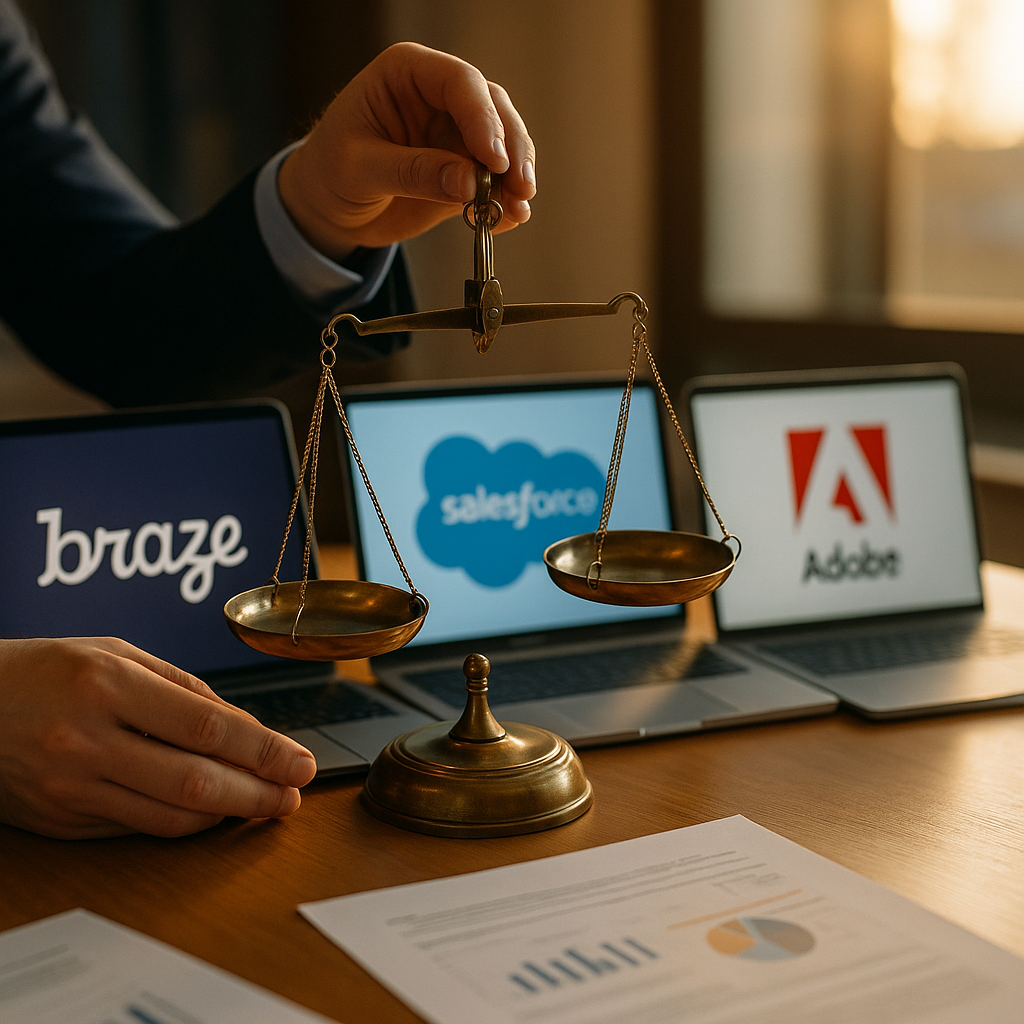
Gartner predicts that by the end of this year, over 80% of customer interactions on major brand channels will involve some form of AI mediation. That number should make every CMO pause. The question is no longer whether to deploy a conversational AI agent for journey automation, it is which platform architecture fits your risk tolerance, your data stack, and your compliance posture. Braze, Salesforce, and Adobe all claim “one to one” personalization at scale. The mechanics underneath differ enough to change your vendor shortlist entirely.
Why One to One Journey Automation Is the New Battleground
Segmented campaigns are dying a slow death. Marketers who spent the last decade building audience tiers (high value, lapsed, churn risk) are now expected to generate a distinct message, timing, and channel decision for every individual customer, in real time. That is not a copywriting problem. It is an orchestration problem, and it requires an AI agent that can read behavioral signals, decide next-best-action, and execute without a human clicking “send” on every journey step.
This shift is why Braze, Salesforce, and Adobe have all rushed conversational AI agents into their journey builders over the past eighteen months. Each vendor is betting that agentic decisioning, not just generative content, is where the next contract renewal gets won or lost.
The real differentiator isn’t which platform generates the smartest message. It’s which one gives your compliance and brand teams a clear audit trail when the AI gets it wrong.
Braze: Speed First, Governance Bolted On
Braze’s AI Agent (built on its Sage AI layer) is arguably the most aggressive of the three when it comes to autonomous decisioning. It can select channel, timing, content variant, and frequency cap adjustments inside a single canvas, often without a human review step unless you explicitly configure one. For brands running high-velocity lifecycle programs, like subscription apps or retail flash promotions, that speed is a genuine competitive advantage.
But speed has a cost. Our own reporting has flagged that Braze’s real-time decisioning forces marketing ops teams to rethink governance after the fact rather than before launch. We’ve also covered how Braze AI approvals can skip human review entirely, and how auto-approve settings in Braze Operator have missed subtle disclosure issues in regulated verticals like financial services and healthcare adjacent brands. If you’re in a space where the FTC or a state regulator could ask “who approved this message,” Braze’s default settings need deliberate tightening before launch, not after a complaint lands.
The upside: Braze’s agent is genuinely good at micro-timing decisions (send window, channel fallback, frequency throttling) that used to require a data science team to model manually. If your use case is retention and lifecycle messaging at high volume, this is hard to beat on raw throughput.
Where Braze Fits Best
- Mobile-first brands with high daily active user counts
- Teams that already have a strong internal QA or legal review cadence to layer on top
- Use cases where latency matters more than nuance (cart abandonment, streak reminders, renewal nudges)
Salesforce: CRM Depth, Slower But Steadier
Salesforce’s Agentforce for Marketing Cloud leans on something Braze and Adobe can’t fully replicate: a native, deeply structured CRM record for every contact. When Salesforce’s agent decides the next journey step, it’s pulling from service case history, purchase data, and sales rep notes in the same data model, not a stitched-together customer profile assembled from multiple systems.
That depth is powerful, but it is also why Salesforce’s agent tends to run more conservatively than Braze’s. Decisions route through more validation layers by default, which slows time-to-send but reduces the odds of a journey firing off a message that contradicts something a service agent just told the customer on a call. For B2B and considered-purchase B2C brands (insurance, automotive, SaaS renewals) that’s the right tradeoff.
We’ve written about how fusing CRM and creator data introduces its own governance gaps, and Salesforce’s architecture is a direct answer to that problem, even if it hasn’t fully closed the gap. Marketers evaluating Salesforce should also look at how the platform’s attribution model compares to rivals, since clashing AI attribution models across vendors can force a costly rebuild if you switch platforms mid-contract.
Where Salesforce Fits Best
- Enterprises with existing Sales Cloud or Service Cloud investment
- Regulated industries needing a defensible audit trail tied to a single customer record
- Long sales cycles where the “next best action” depends on cross-departmental context, not just campaign engagement
Adobe: Creative Precision, Steeper Setup Cost
Adobe’s AI Agent orchestration inside Journey Optimizer (built on its Experience Platform and Firefly generative layer) takes a different bet entirely. Rather than optimizing primarily for send timing or channel selection, Adobe’s agent puts heavy weight on creative variant generation, matching tone, imagery, and offer structure to a granular customer segment, sometimes a segment of one.
This is Adobe’s home turf. If your brand lives or dies by visual and tonal consistency (luxury retail, media, travel) Adobe’s creative-first agent logic produces output that feels less templated than what Braze or Salesforce typically ship by default. The tradeoff is setup complexity. Adobe’s data model requires more upfront schema work in Experience Platform before the agent has enough structured signal to make good decisions. Teams without a dedicated Adobe admin often underuse the agent for months after go-live.
There’s also a quality control wrinkle worth naming directly: generative creative at scale still needs a human check. Our coverage of AI models that speed up creative production while skipping human QA applies just as much to Adobe’s agent as to any standalone generative tool. Fast creative variants are only an asset if someone is still checking them for brand voice, legal claims, and disclosure compliance before they hit a live journey.
Adobe’s agent can generate a hundred creative variants before lunch. The bottleneck isn’t generation anymore, it’s who signs off on them.
Where Adobe Fits Best
- Brands with heavy creative asset libraries and strict visual brand guidelines
- Enterprises already standardized on Adobe Experience Cloud
- Marketing orgs with the headcount to maintain a structured data schema and a dedicated review loop
The Governance Question Nobody’s Vendor Deck Answers
Every vendor pitch leads with speed and personalization lift. None of them lead with “here’s exactly how you’ll prove to a regulator what our AI decided and why.” That’s on you to build, regardless of platform. A useful starting point is the kind of framework we outlined in our piece on how splitting marketing tasks into risk-based buckets cuts AI exposure, which gives teams a way to decide which journey decisions can run fully autonomous and which need a human checkpoint before launch.
It’s also worth building in approval thresholds rather than blanket auto-approve or blanket manual review. Our analysis of approval thresholds for auto-published content applies directly to journey automation: set a confidence or risk score, and route anything below it to a human, regardless of which platform you’re on.
According to eMarketer, brands that implemented structured AI governance layers before scaling agentic marketing tools reported fewer compliance escalations than those who bolted governance on after launch. That ordering matters more than the platform choice itself.
And regulators aren’t waiting for marketing teams to catch up. The FTC has been explicit that automated decisioning doesn’t exempt a brand from disclosure and truth-in-advertising obligations, and the ICO has flagged automated profiling as a specific area of scrutiny under UK data protection rules. If your AI agent is making a one to one offer decision based on inferred financial or health status, that’s a conversation your legal team needs to have before go-live, not after an audit request.
Picking Between the Three: A Practical Filter
Skip the feature matrix for a second and ask three questions instead.
- How much CRM context does the decision actually need? If the answer is “a lot,” Salesforce wins by default.
- How fast does the journey need to react? If it’s seconds, not minutes, Braze’s architecture is built for that cadence.
- How much does creative nuance matter to the outcome? If brand voice and visual precision are the conversion lever, Adobe’s generative depth earns its setup cost.
Most enterprise stacks end up running two of these in parallel rather than picking one outright, Salesforce for service-linked journeys, Braze for lifecycle and retention sends. That’s not inefficiency, it’s a reasonable hedge against any single vendor’s AI agent making a bad call at scale. For a deeper look at how marketers are vetting these tools before committing budget, see our guide on evaluating AI models like ad inventory before you sign.
It’s also worth stress-testing vendor claims against independent benchmarks rather than taking roadmap slides at face value. HubSpot’s state of marketing research and Sprout Social’s annual index are both useful cross-checks on where AI-driven personalization is actually moving engagement, versus where it’s just a demo feature.
FAQs
What is a conversational AI agent in journey automation?
It’s a system that reads individual customer signals, such as behavior, purchase history, and engagement patterns, and autonomously decides the next message, channel, and timing for that specific person, rather than relying on pre-set segment rules.
Is Braze, Salesforce, or Adobe better for one to one personalization?
It depends on your priority. Braze excels at real-time lifecycle speed, Salesforce excels at CRM-depth decisioning for considered purchases, and Adobe excels at creative-precision personalization for visually driven brands.
Do these AI agents require human review before sending messages?
Not by default in every case. Braze and Adobe can both be configured to auto-approve decisions, which creates compliance risk if not deliberately tightened. Salesforce tends to route through more validation steps natively, but no platform replaces a dedicated human review process for regulated use cases.
How do brands measure ROI from AI journey automation?
Most teams track lift in conversion rate per journey step, reduction in time-to-send, and decrease in manual campaign-building hours, then weigh that against the cost of added governance and review headcount needed to manage the AI safely.
What’s the biggest risk of deploying these AI agents without a governance framework?
Undisclosed or non-compliant messaging reaching customers at scale before a human catches the error, which creates both regulatory exposure and brand trust damage that’s hard to walk back.
Next step: before you sign with any vendor, run a 30-day pilot on a single journey, Braze, Salesforce, or Adobe, with a human-in-the-loop checkpoint at every decision node, then measure how often the AI’s call actually needed that human override.
Top Influencer Marketing Agencies
The leading agencies shaping influencer marketing in 2026
Agencies ranked by campaign performance, client diversity, platform expertise, proven ROI, industry recognition, and client satisfaction. Assessed through verified case studies, reviews, and industry consultations.
Moburst

-
2

The Shelf
Boutique Beauty & Lifestyle Influencer AgencyA data-driven boutique agency specializing exclusively in beauty, wellness, and lifestyle influencer campaigns on Instagram and TikTok. Best for brands already focused on the beauty/personal care space that need curated, aesthetic-driven content.Clients: Pepsi, The Honest Company, Hims, Elf Cosmetics, Pure LeafVisit The Shelf → -
3

Audiencly
Niche Gaming & Esports Influencer AgencyA specialized agency focused exclusively on gaming and esports creators on YouTube, Twitch, and TikTok. Ideal if your campaign is 100% gaming-focused — from game launches to hardware and esports events.Clients: Epic Games, NordVPN, Ubisoft, Wargaming, Tencent GamesVisit Audiencly → -
4

Viral Nation
Global Influencer Marketing & Talent AgencyA dual talent management and marketing agency with proprietary brand safety tools and a global creator network spanning nano-influencers to celebrities across all major platforms.Clients: Meta, Activision Blizzard, Energizer, Aston Martin, WalmartVisit Viral Nation → -
5

The Influencer Marketing Factory
TikTok, Instagram & YouTube CampaignsA full-service agency with strong TikTok expertise, offering end-to-end campaign management from influencer discovery through performance reporting with a focus on platform-native content.Clients: Google, Snapchat, Universal Music, Bumble, YelpVisit TIMF → -
6

NeoReach
Enterprise Analytics & Influencer CampaignsAn enterprise-focused agency combining managed campaigns with a powerful self-service data platform for influencer search, audience analytics, and attribution modeling.Clients: Amazon, Airbnb, Netflix, Honda, The New York TimesVisit NeoReach → -
7

Ubiquitous
Creator-First Marketing PlatformA tech-driven platform combining self-service tools with managed campaign options, emphasizing speed and scalability for brands managing multiple influencer relationships.Clients: Lyft, Disney, Target, American Eagle, NetflixVisit Ubiquitous → -
8

Obviously
Scalable Enterprise Influencer CampaignsA tech-enabled agency built for high-volume campaigns, coordinating hundreds of creators simultaneously with end-to-end logistics, content rights management, and product seeding.Clients: Google, Ulta Beauty, Converse, AmazonVisit Obviously →