


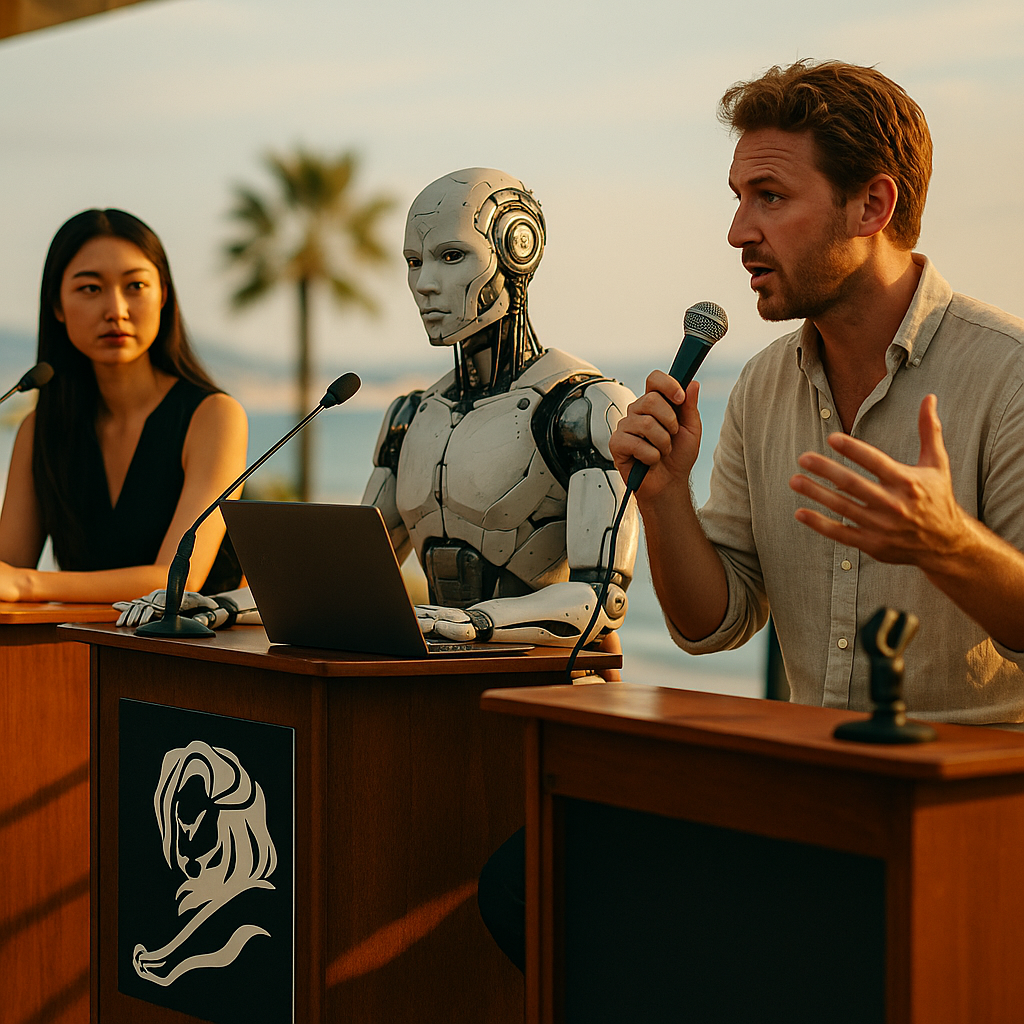
If your brand team is handing AI the keys to campaign production, you should be asking one question first: what exactly are you keeping for humans? The Cannes Lions AI debate has crystallized an uncomfortable truth that many CMOs already sense but few have operationalized.
What Cannes Lions Is Actually Arguing About
Strip away the awards show pageantry and the Cannes Lions conversation in its current cycle is fundamentally a governance debate. Not “can AI make good creative?” — it clearly can, at volume and speed no human team can match. The real argument is about accountability, brand coherence, and the irreducible human judgments that sit beneath every campaign worth remembering.
The festival’s emerging consensus, shaped by jurors, brand leaders, and agency heads across multiple Lions categories, points in one direction: AI earns its seat at the production table, but not at the strategy table. That distinction matters enormously for how campaign teams structure their workflows, protect their budgets, and define roles going into the next planning cycle.
The brands winning Lions in AI-adjacent categories are not the ones who automated the most. They are the ones who drew the clearest lines between what the machine owns and what the human owns — and then held those lines under production pressure.
The Volume Trap
Here is where most brand teams are getting it wrong. They adopt generative AI for variant production — hundreds of ad executions, personalized copy, localized creative — and within two quarters, the human creative brief has quietly shrunk. Strategy becomes a template. The brand voice becomes a style guide that the LLM interprets. And suddenly the “human minimum” is just approval clicks.
Tools like Adobe Firefly, Midjourney, and Runway have genuinely collapsed the cost of production. Market data consistently shows that generative AI adoption in marketing functions is accelerating, with creative asset generation among the top three use cases for brand teams globally. That efficiency gain is real. Surrendering brand authorship to capture it is not a trade worth making.
The Cannes conversation names this explicitly. Several Grand Prix discussions this cycle have centered on campaigns where the brief, the cultural insight, and the ethical guardrails were demonstrably human-authored — and where AI served as a production accelerant, not a strategic author. That is the model the festival is rewarding, and more importantly, it is the model that holds up under client scrutiny and regulatory examination.
What AI Cannot Do for Brands (The Cannes Working List)
This is not abstract philosophy. Based on the jury deliberations and panel frameworks coming out of the Palais, the creative community has converged on a practical set of things that remain genuinely outside AI’s current competence for brand work.
- Cultural risk assessment: AI can scan for surface-level sensitivities, but it cannot weigh the reputational cost of a creative choice against a specific brand’s existing equity and audience trust. That calculus is human.
- Brand point of view: A brand’s perspective on a contested cultural moment — whether to engage, how to frame it, what to refuse — requires judgment that no prompt can fully encode. The brief can guide. The machine cannot decide.
- Creative intention: The difference between an ad that provokes thought and one that provokes backlash is often a millimeter of intentionality. AI optimizes for pattern match. Creative intention is about deliberate divergence from pattern.
- Stakeholder trust and accountability: When a campaign goes wrong, someone has to own it. AI-generated creative with no identifiable human author creates accountability vacuums that legal, compliance, and comms teams are increasingly unwilling to accept.
- Long-term brand equity decisions: Choosing what a brand will not say, which audience it will not chase, which trend it will deliberately ignore — these are strategic refusals that define brand identity over time. They are not optimizable outputs.
For a deeper operational view on where human judgment is getting squeezed out of creator programs more broadly, the analysis on competency gaps killing campaign performance is directly relevant here.
Defining the Human Creative Minimums Your Team Must Protect
The Cannes framework gives brand teams a language, but you still have to translate it into workflow decisions. What does “human minimum” actually mean when your team is running a 500-variant DTC campaign on Meta with AI-generated copy and creative?
Start with the brief. The creative brief is not an AI input. It is a human document that encodes strategic intent, brand voice, competitive context, and cultural judgment. If your brief is being auto-generated or templated by AI tools before a human strategist has authored the core insight, you have already crossed the line.
Next, protect the gate at cultural intersections. Any campaign touching a social issue, a news moment, a community identity, or a contested brand positioning requires human review that is explicitly documented. This is not just a brand safety protocol — it is evidence of human authorship that matters for FTC compliance as FTC guidance on AI-generated content continues to evolve.
Finally, keep creative direction human at the concept level. Use AI for refinement, variation, and localization. The original creative concept — the idea, the tension, the cultural hook — should have a human name attached to it. This matters for awards, for accountability, and for the long-term coherence of your brand’s creative body of work.
Teams navigating the structural shift in how AI is changing creative roles should also look at how the CMO role is being reshaped by these pressures — the organizational implications go well beyond any single campaign.
The Influencer and Creator Program Parallel
This same tension plays out in creator marketing. AI can identify creators, model performance, draft briefs, and generate reporting. What it cannot do is understand why a specific creator’s relationship with their audience makes them the right or wrong fit for a specific brand moment. That judgment is relational and contextual in ways that training data does not capture.
The brands that are scaling creator programs without losing authenticity are applying exactly the same logic the Cannes jury is articulating: use AI for efficiency at the execution layer, keep humans accountable for the relationship and positioning layer. The distinction between AI and manual creator programs is not just operational — it is a brand identity choice.
Authenticity in creator marketing and brand voice in AI-generated campaigns are the same problem framed differently. Both come down to whether a human being made a deliberate, accountable choice — or whether the machine optimized toward a mean.
Building the Governance Layer Your Agency Probably Hasn’t Built
Most holding company agencies and challenger shops are still figuring this out in real time. The Cannes debate is moving faster than most agency AI governance frameworks. That creates a specific risk for brand teams: you may be buying AI-assisted creative services where the human minimums are undefined and undocumented.
Ask your agency three questions before the next campaign cycle. First, who is the named human creative director on this brief? Second, what review process exists for cultural and reputational risk that is not AI-mediated? Third, how is human authorship documented across the campaign for compliance and accountability purposes?
If those answers are vague, you have a governance gap. The IP and AI governance frameworks emerging from APAC markets are actually ahead of many Western agency structures on this — worth examining as a reference model. For teams building out their own AI competency internally, a structured 90-day AI upskilling plan gives a practical starting point for closing that gap without waiting for agency partners to catch up.
The WIPO framework on AI-generated content ownership and the EU AI Act are also introducing compliance dimensions that make human authorship documentation a legal necessity in some markets, not just a creative philosophy.
One concrete action before your next campaign review: write down the five creative decisions on your current campaign that only a human could have made, and confirm that a human actually made them. If you can’t name five, you have your answer.
FAQs
What is the core conclusion from the Cannes Lions AI debate for brand teams?
The emerging consensus is that AI should handle production volume, speed, and variant generation, while humans retain accountability for creative strategy, cultural judgment, brand positioning, and any decisions that carry reputational or ethical weight. The debate is not about whether to use AI, but about defining which decisions must remain human-owned.
What are the human creative minimums brands should protect when using generative AI?
The key minimums include: authoring the original creative brief, making cultural risk and brand voice decisions, establishing the concept-level creative idea, reviewing any content that intersects with social or contested issues, and maintaining documented human accountability for campaign outcomes. These are the decisions that define brand identity over time and cannot be safely delegated to AI.
How does this apply to influencer and creator marketing programs?
The same principle applies. AI can optimize creator discovery, brief drafting, and performance modeling. Human judgment is required for assessing creator-brand fit at a relational and cultural level, managing creator relationships, and making positioning decisions about which creators align with or risk diluting brand equity.
What governance questions should brand teams ask their agencies about AI use in creative production?
Brand teams should ask: who is the named human creative director on the brief; what non-AI-mediated process exists for cultural and reputational risk review; and how is human authorship documented across deliverables for compliance and accountability. Vague answers signal a governance gap that creates brand and legal exposure.
Is AI-generated creative a compliance risk under current FTC and EU frameworks?
It can be. FTC guidance on AI-generated content is actively evolving, and the EU AI Act introduces accountability requirements for high-impact AI use cases in commercial contexts. In both frameworks, the ability to demonstrate human oversight and documented decision-making becomes increasingly important as a compliance safeguard, particularly for campaigns with significant audience reach.
Top Influencer Marketing Agencies
The leading agencies shaping influencer marketing in 2026
Agencies ranked by campaign performance, client diversity, platform expertise, proven ROI, industry recognition, and client satisfaction. Assessed through verified case studies, reviews, and industry consultations.
Moburst

-
2

The Shelf
Boutique Beauty & Lifestyle Influencer AgencyA data-driven boutique agency specializing exclusively in beauty, wellness, and lifestyle influencer campaigns on Instagram and TikTok. Best for brands already focused on the beauty/personal care space that need curated, aesthetic-driven content.Clients: Pepsi, The Honest Company, Hims, Elf Cosmetics, Pure LeafVisit The Shelf → -
3

Audiencly
Niche Gaming & Esports Influencer AgencyA specialized agency focused exclusively on gaming and esports creators on YouTube, Twitch, and TikTok. Ideal if your campaign is 100% gaming-focused — from game launches to hardware and esports events.Clients: Epic Games, NordVPN, Ubisoft, Wargaming, Tencent GamesVisit Audiencly → -
4

Viral Nation
Global Influencer Marketing & Talent AgencyA dual talent management and marketing agency with proprietary brand safety tools and a global creator network spanning nano-influencers to celebrities across all major platforms.Clients: Meta, Activision Blizzard, Energizer, Aston Martin, WalmartVisit Viral Nation → -
5

The Influencer Marketing Factory
TikTok, Instagram & YouTube CampaignsA full-service agency with strong TikTok expertise, offering end-to-end campaign management from influencer discovery through performance reporting with a focus on platform-native content.Clients: Google, Snapchat, Universal Music, Bumble, YelpVisit TIMF → -
6

NeoReach
Enterprise Analytics & Influencer CampaignsAn enterprise-focused agency combining managed campaigns with a powerful self-service data platform for influencer search, audience analytics, and attribution modeling.Clients: Amazon, Airbnb, Netflix, Honda, The New York TimesVisit NeoReach → -
7

Ubiquitous
Creator-First Marketing PlatformA tech-driven platform combining self-service tools with managed campaign options, emphasizing speed and scalability for brands managing multiple influencer relationships.Clients: Lyft, Disney, Target, American Eagle, NetflixVisit Ubiquitous → -
8

Obviously
Scalable Enterprise Influencer CampaignsA tech-enabled agency built for high-volume campaigns, coordinating hundreds of creators simultaneously with end-to-end logistics, content rights management, and product seeding.Clients: Google, Ulta Beauty, Converse, AmazonVisit Obviously →