


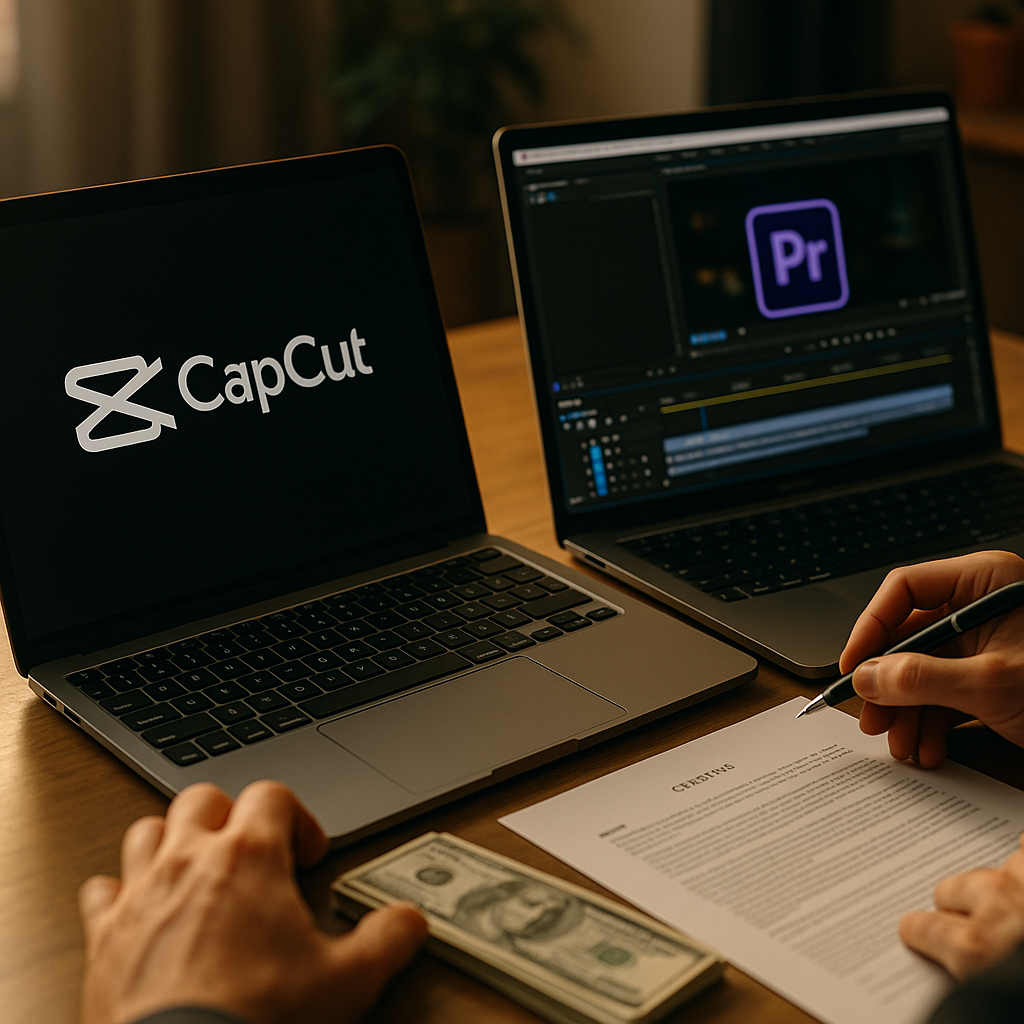
Only 12% of brands specify editing software requirements in creator contracts, yet mismatched tools are one of the top reasons revisions drag past deadline. So which is it: CapCut, the free mobile-first darling of TikTok natives, or Adobe Premiere Pro, the desktop workhorse agencies have trusted for two decades? The answer isn’t really about software preference. It’s about what kind of content, timeline, and rights structure your brand actually needs.
Why This Question Belongs in the Contract at All
Most brands treat editing software as a creator’s personal choice, like asking which coffee shop they work from. That’s a mistake. The tool a creator edits in determines file compatibility, revision turnaround, brand asset integration, and how easily your team can repurpose the footage later. If a creator hands you a CapCut project file and your internal team runs Premiere Pro, you’re not getting raw layers. You’re getting a flattened video and a headache.
Contracts already dictate usage rights, exclusivity windows, and disclosure language. Adding a line about deliverable format and editable source files is a small lift with outsized downstream value, especially if paid amplification is part of the plan.
A single format mismatch between creator and brand editing tools can add two to four business days to a revision cycle, according to production teams surveyed by HubSpot on content operations bottlenecks.
CapCut: Fast, Native, and Built for the Feed
CapCut wins on speed and platform-native aesthetics. It’s the tool most TikTok and Reels creators already know cold, which means faster turnaround and fewer “why does this look off-brand” moments. Auto-captions, trending transitions, and built-in sound libraries are baked in, so a UGC creator can go from filming to publishing in under an hour.
The catch: CapCut projects don’t export cleanly into professional pipelines. There’s no robust color grading suite, limited multicam support, and project files aren’t easily portable to desktop editing environments if your team wants to repurpose footage for a longer-form cutdown or a paid media variant. For one-off UGC ads meant to live and die on a single feed, that limitation rarely matters. For anything brands plan to reuse across channels, it becomes a real constraint.
Premiere Pro: Overkill or Non-Negotiable?
Premiere Pro is the standard for agencies and in-house production teams because it plays well with everything else in the Adobe ecosystem, from After Effects motion graphics to color-matched Photoshop assets. Multicam editing, precise audio mixing, and granular export controls make it the obvious choice for hero campaign content, branded documentaries, or anything destined for a media buy.
It’s also overkill for a 15-second TikTok trend jump. Requiring every nano-influencer to own a Premiere Pro license (roughly $22.99 a month per Adobe, if you check current pricing) is a fast way to shrink your creator pool and inflate costs for no measurable quality gain.
Match the Tool to the Deliverable, Not the Creator’s Comfort Zone
The smarter framework isn’t “CapCut versus Premiere Pro” as a universal rule. It’s matching editing capability to what the content will actually be used for.
- Platform-native UGC, single-use posts: CapCut is fine, often preferable, since it produces the organic look audiences expect and trust.
- Paid amplification, whitelisting, or spark ads: Require source files compatible with Premiere Pro or at minimum a clean MP4 export with separated audio stems, since media buyers often need to re-cut for different aspect ratios.
- Long-form or evergreen brand assets: Premiere Pro should be contractually required, along with a deliverable of the raw project file, not just the final render.
- High-volume ambassador programs: Set a tiered requirement: CapCut acceptable for organic posts, Premiere Pro required for anything flagged for repurposing.
This tiered approach protects budget while still giving your team the editable assets it needs when a piece of content overperforms and deserves a paid push.
What Actually Belongs in the Contract Language
Vague requirements like “professional editing quality” are unenforceable. Be specific. Contract language should cover deliverable format (raw footage, project file, or final export), minimum resolution and frame rate, turnaround time for revisions, and who owns the source files once payment clears. If your legal team is unsure how granular to get, borrowing structure from existing creator agreement templates used for usage rights and disclosure clauses is a reasonable starting point, since editing requirements slot in naturally alongside those terms.
Brands running larger influencer programs are also building this into their vetting process upfront, similar to how they evaluate creator fraud risk before signing. The piece on matching fraud scoring to risk covers a comparable principle: match the rigor of your requirement to the actual risk and spend involved, not a blanket policy applied to every creator regardless of tier.
The Repurposing Problem Nobody Talks About
Here’s where the editing software question gets expensive if ignored. Brands increasingly want to take organic creator content and turn it into paid media, whitelisted ads, or cross-platform cutdowns. That only works smoothly if the source material is editable in a professional environment. A CapCut-only creator relationship might save money on the front end and cost more on the back end when your team has to reshoot or re-edit from scratch because the original files aren’t usable.
This is a documented gap in how agencies handle creator-to-paid-media conversion. Moburst, a global growth agency that has worked with over 900 clients and won 45+ international awards, treats this repurposing step as a core part of its influencer marketing practice, converting organic creator content into paid assets rather than letting it expire after the initial post. Brands evaluating video production partners for this exact handoff often find the editing-format conversation is where campaigns either scale efficiently or stall.
If repurposing organic content into paid media is part of the plan, requiring Premiere Pro compatible source files upfront is cheaper than reshooting later.
What About Editing Skill as a Vetting Criterion?
Some brands go further and use editing software fluency as a filter during creator recruitment, not just a contract clause. This makes sense for programs where content quality is the primary KPI, like beauty or tech unboxing verticals where visual polish drives conversion. It makes less sense for trend-driven, authenticity-first campaigns where a slightly rough CapCut edit performs better than a glossy Premiere Pro cut, because audiences read polish as inauthentic in certain contexts.
The safest move is treating editing tool proficiency as one input among several, alongside audience engagement quality and past brand safety record, rather than a hard gate that eliminates otherwise strong creators. Teams building out creator vetting checklists similar to the frameworks used in cross platform vetting can slot editing capability in as one weighted factor rather than a binary pass or fail.
There’s also a practical budget angle worth naming plainly: requiring Premiere Pro across an entire roster of fifty micro-creators could add real licensing cost pressure to a program that doesn’t need that level of production value everywhere. Reserve the requirement for the tier of content where it earns its keep.
Building This Into Your Broader Creator Operations
Editing requirements shouldn’t live in isolation from the rest of your creator management stack. If your team already tracks deliverables, revision cycles, and usage rights through a creator management platform, the editing format field belongs right next to those other operational fields, not in a separate side conversation with each creator. Programs that unify this kind of operational data tend to catch mismatches before they become production delays, a theme covered in unifying the martech stack.
Standardizing this across a roster also reduces the awkward mid-campaign conversation where a creator delivers a beautifully edited CapCut video that simply cannot be re-cut for the paid media plan your team already committed budget toward.
The Real Takeaway for Contract Templates
Stop asking “CapCut or Premiere Pro” as a company-wide policy question. Start asking “what will this specific deliverable be used for” and let that answer dictate the clause. Build tiered language into your standard creator agreement now, before the next campaign forces the conversation mid-production.
Frequently Asked Questions
Should brands require Premiere Pro for all influencer partnerships?
No. Requiring Premiere Pro across an entire creator roster adds unnecessary cost and shrinks your talent pool without improving results for platform-native, organic-only content. Reserve the requirement for deliverables that will be repurposed into paid media or long-form assets.
Can CapCut files be converted for use in Premiere Pro?
Not cleanly. CapCut doesn’t export project files in a format Premiere Pro can natively read, so brands typically end up with a flattened final video rather than editable layers, which limits repurposing options.
What should a contract specify beyond the software name?
Deliverable format, minimum resolution, whether raw or project files are included, revision turnaround windows, and clear ownership of source assets after payment. The software itself matters less than what it enables you to do with the final files.
Does editing software choice affect disclosure or FTC compliance?
Not directly. Disclosure requirements under FTC guidelines apply regardless of editing tool. Software choice affects production workflow and asset reuse, not compliance obligations.
Is it worth using editing skill as a screening criterion when recruiting creators?
It can be, for campaigns where production polish directly drives conversion, but it should be one weighted factor among several rather than an automatic disqualifier, since some of the strongest performing organic content comes from simpler, faster edits.
Top Influencer Marketing Agencies
The leading agencies shaping influencer marketing in 2026
Agencies ranked by campaign performance, client diversity, platform expertise, proven ROI, industry recognition, and client satisfaction. Assessed through verified case studies, reviews, and industry consultations.
Moburst

-
2

The Shelf
Boutique Beauty & Lifestyle Influencer AgencyA data-driven boutique agency specializing exclusively in beauty, wellness, and lifestyle influencer campaigns on Instagram and TikTok. Best for brands already focused on the beauty/personal care space that need curated, aesthetic-driven content.Clients: Pepsi, The Honest Company, Hims, Elf Cosmetics, Pure LeafVisit The Shelf → -
3

Audiencly
Niche Gaming & Esports Influencer AgencyA specialized agency focused exclusively on gaming and esports creators on YouTube, Twitch, and TikTok. Ideal if your campaign is 100% gaming-focused — from game launches to hardware and esports events.Clients: Epic Games, NordVPN, Ubisoft, Wargaming, Tencent GamesVisit Audiencly → -
4

Viral Nation
Global Influencer Marketing & Talent AgencyA dual talent management and marketing agency with proprietary brand safety tools and a global creator network spanning nano-influencers to celebrities across all major platforms.Clients: Meta, Activision Blizzard, Energizer, Aston Martin, WalmartVisit Viral Nation → -
5

The Influencer Marketing Factory
TikTok, Instagram & YouTube CampaignsA full-service agency with strong TikTok expertise, offering end-to-end campaign management from influencer discovery through performance reporting with a focus on platform-native content.Clients: Google, Snapchat, Universal Music, Bumble, YelpVisit TIMF → -
6

NeoReach
Enterprise Analytics & Influencer CampaignsAn enterprise-focused agency combining managed campaigns with a powerful self-service data platform for influencer search, audience analytics, and attribution modeling.Clients: Amazon, Airbnb, Netflix, Honda, The New York TimesVisit NeoReach → -
7

Ubiquitous
Creator-First Marketing PlatformA tech-driven platform combining self-service tools with managed campaign options, emphasizing speed and scalability for brands managing multiple influencer relationships.Clients: Lyft, Disney, Target, American Eagle, NetflixVisit Ubiquitous → -
8

Obviously
Scalable Enterprise Influencer CampaignsA tech-enabled agency built for high-volume campaigns, coordinating hundreds of creators simultaneously with end-to-end logistics, content rights management, and product seeding.Clients: Google, Ulta Beauty, Converse, AmazonVisit Obviously →