


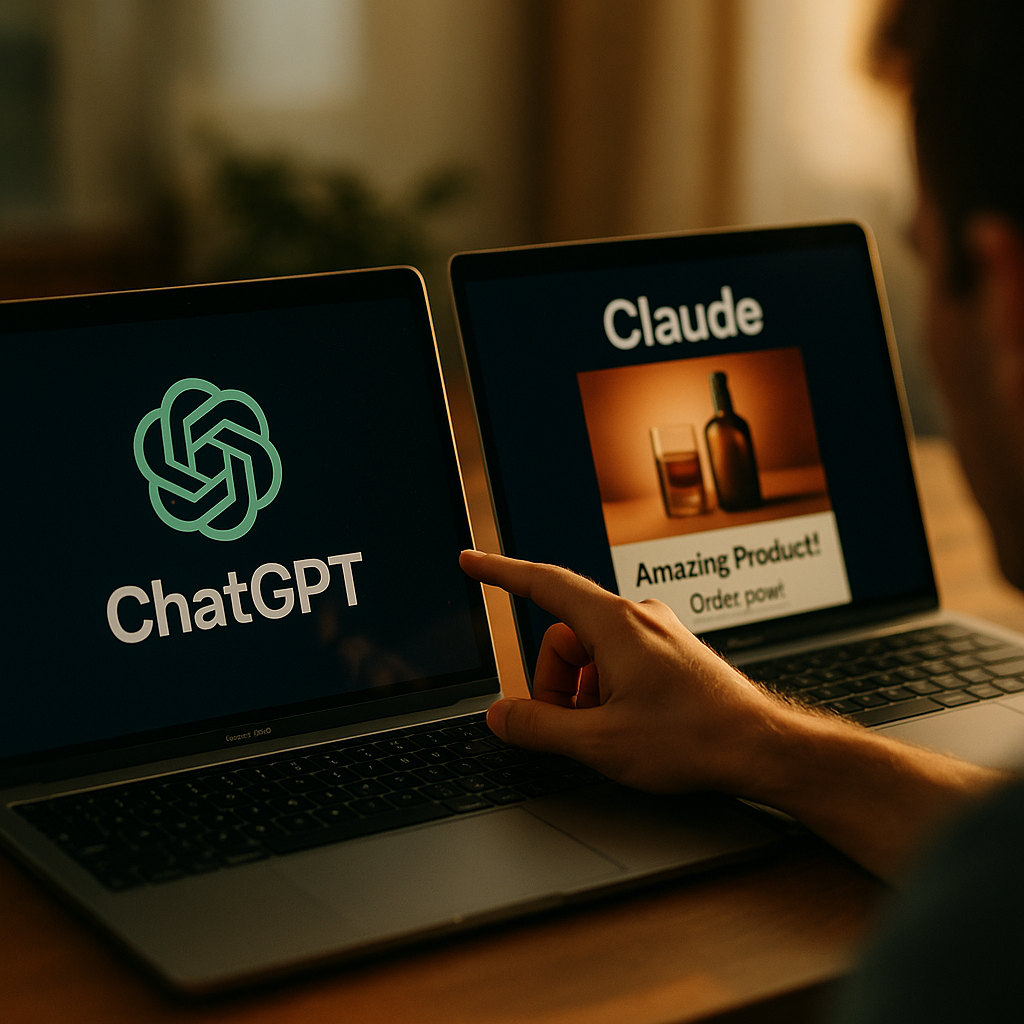
Two AI models built the same lemonade stand ad campaign. One leaned punchy and visual. The other went long on copy and safety disclaimers nobody asked for. Genspark’s multi-agent showdown pitting ChatGPT against Claude wasn’t just a novelty demo — it’s a preview of how agentic ad production will actually get evaluated inside brand marketing teams. The real story isn’t which model “won.” It’s what the gap between them tells you about deploying multi-agent systems at scale.
What Actually Happened in the Lemonade Stand-Off
Genspark, the AI agent platform that’s been racing OpenAI and Anthropic-backed tools for enterprise attention, ran a public experiment: give two leading LLMs an identical creative brief — build marketing assets for a fictional lemonade stand — and let their respective agent orchestration layers handle everything from concept to finished ad copy, visuals, and channel formatting. No human touched the output until the reveal.
The results diverged fast. ChatGPT’s agent chain produced tighter, more conversion-oriented copy with a clear CTA hierarchy. Claude’s output leaned more narrative, more brand-voice-consistent, but slower to get to the point. Neither was “wrong.” That’s precisely why this matters to brand strategists: agentic creative production doesn’t converge on one right answer the way a media-buying algorithm converges on lowest CPA. It reflects the underlying model’s training priorities, and those priorities are invisible until you stress-test them.
The lemonade stand test wasn’t about which AI writes better ads. It was a controlled demonstration of how differently two agent architectures interpret the same brief with zero human correction in the loop.
Why a Toy Example Actually Matters for Real Budgets
Skeptics will say a lemonade stand brief is too simple to generalize from. Fair criticism, partially. But simplicity is the point. Strip away the complexity of a real client brief — legal review, brand guidelines, regional compliance — and you isolate the model’s default creative instincts. That’s exactly what a procurement team should want to see before greenlighting an agentic workflow for actual campaigns.
Consider how this plays out at scale. A mid-market DTC brand running twelve SKUs across five markets doesn’t have time to manually audit every agent-generated asset before publishing. According to eMarketer, marketers are accelerating AI adoption for content production faster than they’re building governance to check it. That gap is the actual risk, not the AI’s creative competence.
Genspark’s demo essentially forces a question every CMO should be asking their vendor right now: which model architecture is running under the hood of our agentic tools, and have we tested its default behavior against our brand voice before it touches a live campaign?
The Multi-Agent Difference: Orchestration, Not Just Generation
Here’s where the showdown gets genuinely useful for people building ad production pipelines. This wasn’t a single-prompt comparison. Genspark used multi-agent orchestration — separate agents for research, copywriting, visual direction, and formatting, chained together and handing off work sequentially. That’s a materially different test than asking ChatGPT and Claude to “write an ad” in a chat window.
Multi-agent chains introduce compounding variance. If the research agent slightly misreads the target audience, that error propagates through every downstream agent. This is the same dynamic that’s been surfacing in agentic AI marketing frameworks more broadly: the more autonomous steps you chain together, the more critical your checkpoints between them become.
Brand teams evaluating agentic ad tools should ask vendors a blunt question: where are the human-in-the-loop gates in this chain, and what happens when an upstream agent gets the brief wrong? Recent research on AI agent error rates in adjacent use cases like media buying shows autonomy failures cluster exactly where handoffs between agents lack verification steps. Creative production isn’t immune to the same pattern.
Model Personality Is a Brand Risk Variable Now
Marketers have spent years obsessing over creator brand fit. Genspark’s experiment suggests it’s time to apply the same scrutiny to model fit. ChatGPT and Claude have measurably different “personalities” baked into their outputs — one more direct and sales-forward, the other more cautious and conversational. Neither is universally better. But if your brand voice is playful and irreverent, and your agentic stack defaults to Claude’s more hedged tone, you’ll spend more time correcting outputs than you saved by automating them.
This is a governance issue as much as a creative one. Teams that have built governance-first AI marketing stacks are already treating model selection as a brand-safety decision, not just a technical one. That’s the right instinct. Expect procurement checklists to start including “which foundation model powers this agent” as a standard line item within the next few budget cycles.
Where the ROI Case Gets Murky
Let’s talk numbers, because that’s ultimately what gets an agentic ad pipeline funded or killed. Genspark and similar platforms pitch dramatic time savings — full campaign concepts in minutes instead of days. That’s true at the surface level. What’s less discussed is the revision cost.
If ChatGPT’s version needs three rounds of legal review because its CTAs are too aggressive for a regulated category, and Claude’s version needs two rounds of copy tightening because it’s too verbose, the “minutes to produce” number is misleading. The real KPI is minutes-to-approved-asset, not minutes-to-first-draft. Brands still don’t have great tooling to measure that end-to-end, which is why work like the approval risk gap analysis on AI collaborators inside workflow platforms like Workfront matters. The bottleneck has moved from creation to verification.
Speed to first draft is a vanity metric in agentic ad production. Speed to legally cleared, brand-approved, publish-ready asset is the number that actually determines ROI.
There’s also the attribution question nobody’s fully solved. If an agent-generated ad underperforms, is that a creative failure, a targeting failure, or a model failure? Teams already wrestling with probabilistic attribution for delayed conversions now have to layer model provenance on top of channel and creator attribution. It’s not impossible to untangle, but it does mean your reporting stack needs another dimension it probably doesn’t have yet.
Practical Guardrails Before You Deploy a Multi-Agent Pipeline
None of this means agentic ad production isn’t worth pursuing. Genspark’s showdown, and comparable demos from competitors, are accelerating a real shift. HubSpot’s own research on marketing AI adoption has repeatedly shown production speed as the number one driver of tool investment (see HubSpot’s marketing research hub for ongoing benchmarks). The opportunity is real. The execution needs discipline most teams haven’t built yet.
A few operational guardrails worth putting in place before scaling a multi-agent creative pipeline:
- Run your own bake-off before committing. Don’t take a public demo’s word for it. Feed your actual brand brief, tone guidelines, and a recent underperforming campaign into both model architectures and compare against known outcomes.
- Map every agent handoff point. Know exactly where research becomes copy, where copy becomes visual direction, and insert a checkpoint at each transition, not just at the final output.
- Build a model-switching contingency. Treat foundation model choice like a media vendor contract. If Claude’s next update shifts tone defaults, or OpenAI changes ChatGPT’s ad-copy guardrails, you need a fallback plan, not a scramble.
- Score outputs against a rubric, not a vibe check. Use the same evaluation framework you’d apply to a vendor evaluation for hook-structure generators: consistency, compliance, brand-voice match, and revision cost, scored numerically, not just “this one felt better.”
- Keep a human accountable for final sign-off. Legally and reputationally, someone needs to own the published asset. Multi-agent orchestration doesn’t remove that requirement, it just changes what that person is reviewing.
Regulatory scrutiny on AI-generated advertising is also tightening. The FTC has flagged AI-generated marketing claims as an enforcement priority, and disclosure expectations aren’t static. Any pipeline producing ad copy at machine speed needs a compliance checkpoint that moves at least as fast as the generation step, or you’re just manufacturing risk faster.
The Bigger Signal Behind the Stunt
Genspark didn’t run this experiment purely for engagement (though it got plenty). It’s positioning itself in a crowded field of agent orchestration platforms trying to prove they can manage model diversity, not just plug into one LLM. That’s a legitimate differentiator. Brands locked into a single-model vendor relationship are making a bet on that model’s roadmap, its safety tuning, its pricing changes. A platform that can route creative tasks across multiple models based on task fit is solving a real procurement problem, not just a marketing one.
Whether Genspark specifically becomes the winner in that category is beside the point. The lemonade stand-off is a signal that agentic ad production is maturing past “can AI write an ad” toward “which combination of agents, models, and checkpoints produces the best-performing, lowest-risk asset for this specific brand.” That’s a much harder, much more useful question. And it’s the one brand teams should be asking their AI vendors this quarter.
Next Step
Before you greenlight a multi-agent creative pipeline, run your own three-brief bake-off across at least two model architectures and score the outputs on revision cost, not speed. That single test will tell you more about real ROI than any vendor demo.
FAQs
What is Genspark’s ChatGPT vs Claude lemonade stand-off?
It’s a public multi-agent experiment where Genspark tasked ChatGPT and Claude with independently producing a full ad campaign for a fictional lemonade stand, using chained agents for research, copywriting, and creative direction, to compare how differently each model handles the same creative brief.
Does this test prove one AI model is better for ad production?
No. It shows the two models have different creative defaults — one more direct and CTA-driven, the other more narrative and cautious. Which is “better” depends entirely on your brand voice, category compliance needs, and revision tolerance.
What is agentic ad production?
Agentic ad production refers to using chained AI agents, rather than a single prompt, to handle sequential creative tasks like research, copywriting, visual direction, and formatting, with minimal human intervention until final review.
What’s the biggest risk in multi-agent creative pipelines?
Compounding error across agent handoffs. If an early-stage agent misreads the audience or brief, that mistake propagates through every downstream step, often surfacing only at final review when it’s most expensive to fix.
How should brands evaluate which AI model to use for creative work?
Run your own bake-off using an actual brand brief and past campaign data, then score outputs against a consistent rubric covering brand-voice match, compliance risk, and revision cost, rather than relying on a public demo or subjective preference.
Is speed-to-first-draft the right metric for ROI on agentic tools?
No. Speed to a legally cleared, brand-approved, publish-ready asset is the metric that actually reflects ROI, since faster drafts that require more revision cycles can erase the time savings entirely.
FAQs
What is Genspark’s ChatGPT vs Claude lemonade stand-off?
It’s a public multi-agent experiment where Genspark tasked ChatGPT and Claude with independently producing a full ad campaign for a fictional lemonade stand, using chained agents for research, copywriting, and creative direction, to compare how differently each model handles the same creative brief.
Does this test prove one AI model is better for ad production?
No. It shows the two models have different creative defaults — one more direct and CTA-driven, the other more narrative and cautious. Which is “better” depends entirely on your brand voice, category compliance needs, and revision tolerance.
What is agentic ad production?
Agentic ad production refers to using chained AI agents, rather than a single prompt, to handle sequential creative tasks like research, copywriting, visual direction, and formatting, with minimal human intervention until final review.
What’s the biggest risk in multi-agent creative pipelines?
Compounding error across agent handoffs. If an early-stage agent misreads the audience or brief, that mistake propagates through every downstream step, often surfacing only at final review when it’s most expensive to fix.
How should brands evaluate which AI model to use for creative work?
Run your own bake-off using an actual brand brief and past campaign data, then score outputs against a consistent rubric covering brand-voice match, compliance risk, and revision cost, rather than relying on a public demo or subjective preference.
Is speed-to-first-draft the right metric for ROI on agentic tools?
No. Speed to a legally cleared, brand-approved, publish-ready asset is the metric that actually reflects ROI, since faster drafts that require more revision cycles can erase the time savings entirely.
Top Influencer Marketing Agencies
The leading agencies shaping influencer marketing in 2026
Agencies ranked by campaign performance, client diversity, platform expertise, proven ROI, industry recognition, and client satisfaction. Assessed through verified case studies, reviews, and industry consultations.
Moburst

-
2

The Shelf
Boutique Beauty & Lifestyle Influencer AgencyA data-driven boutique agency specializing exclusively in beauty, wellness, and lifestyle influencer campaigns on Instagram and TikTok. Best for brands already focused on the beauty/personal care space that need curated, aesthetic-driven content.Clients: Pepsi, The Honest Company, Hims, Elf Cosmetics, Pure LeafVisit The Shelf → -
3

Audiencly
Niche Gaming & Esports Influencer AgencyA specialized agency focused exclusively on gaming and esports creators on YouTube, Twitch, and TikTok. Ideal if your campaign is 100% gaming-focused — from game launches to hardware and esports events.Clients: Epic Games, NordVPN, Ubisoft, Wargaming, Tencent GamesVisit Audiencly → -
4

Viral Nation
Global Influencer Marketing & Talent AgencyA dual talent management and marketing agency with proprietary brand safety tools and a global creator network spanning nano-influencers to celebrities across all major platforms.Clients: Meta, Activision Blizzard, Energizer, Aston Martin, WalmartVisit Viral Nation → -
5

The Influencer Marketing Factory
TikTok, Instagram & YouTube CampaignsA full-service agency with strong TikTok expertise, offering end-to-end campaign management from influencer discovery through performance reporting with a focus on platform-native content.Clients: Google, Snapchat, Universal Music, Bumble, YelpVisit TIMF → -
6

NeoReach
Enterprise Analytics & Influencer CampaignsAn enterprise-focused agency combining managed campaigns with a powerful self-service data platform for influencer search, audience analytics, and attribution modeling.Clients: Amazon, Airbnb, Netflix, Honda, The New York TimesVisit NeoReach → -
7

Ubiquitous
Creator-First Marketing PlatformA tech-driven platform combining self-service tools with managed campaign options, emphasizing speed and scalability for brands managing multiple influencer relationships.Clients: Lyft, Disney, Target, American Eagle, NetflixVisit Ubiquitous → -
8

Obviously
Scalable Enterprise Influencer CampaignsA tech-enabled agency built for high-volume campaigns, coordinating hundreds of creators simultaneously with end-to-end logistics, content rights management, and product seeding.Clients: Google, Ulta Beauty, Converse, AmazonVisit Obviously →